
Accessory Dwelling Units (ADUs) have transformed from a niche housing solution into a mainstream strategy for homeowners across California and Arizona. Whether you're in Monterey County or Maricopa County, adding an ADU can unlock significant value. Homeowners use them to create rental income, house family members, or establish a private home office.
The success of your project hinges on choosing the right design. Making a well-informed decision from the start prevents costly revisions and ensures the final structure meets your functional, aesthetic, and financial goals. This guide moves beyond generic advice to provide a comprehensive look at actionable ADU design ideas.
What You'll Learn
We will explore a curated collection of innovative concepts, from cost-effective garage conversions popular in Santa Cruz County to modern detached cottages suited for spacious lots in San Benito County. Each idea is presented with practical implementation details, layout considerations, and real-world applications to help you visualize the possibilities for your own property.
By understanding these distinct ADU design ideas, you will be better equipped to select a path that aligns with your property, budget, and long-term objectives. This resource is designed to empower you with the knowledge needed to start your ADU journey with confidence.
1. Detached Backyard Cottage
The detached backyard cottage is one of the most classic and sought-after ADU design ideas. This standalone structure, built in the backyard of an existing single-family home, operates as a completely separate, smaller dwelling. It offers the highest degree of privacy for both the main house occupants and the cottage residents.
This makes it an ideal solution for rental income, multi-generational living, or a dedicated guesthouse. These units, often called Detached Accessory Dwelling Units (DADUs), provide a true sense of independence. For homeowners in Monterey, Santa Cruz, or San Benito Counties, a backyard cottage can maximize property value while preserving the tranquility of the main residence.
Key Considerations for a Detached Cottage
Building a detached ADU requires careful planning, especially regarding local regulations. Early in the process, it's crucial to verify your property's specific setback requirements, which dictate how far the structure must be from property lines.
You should also consider the orientation of the cottage to maximize natural light with strategic window and door placement. Using materials like energy-efficient Milgard windows can make a smaller footprint feel spacious and bright.
Expert Insight: A well-designed detached cottage not only adds functional living space but also enhances your property's overall appeal. Integrating outdoor living areas, like a small patio or deck, can significantly expand the usable space and improve the quality of life for its occupants.
At a Glance: Detached Backyard Cottage
For homeowners considering this popular ADU design, this quick reference summarizes the essential data points.
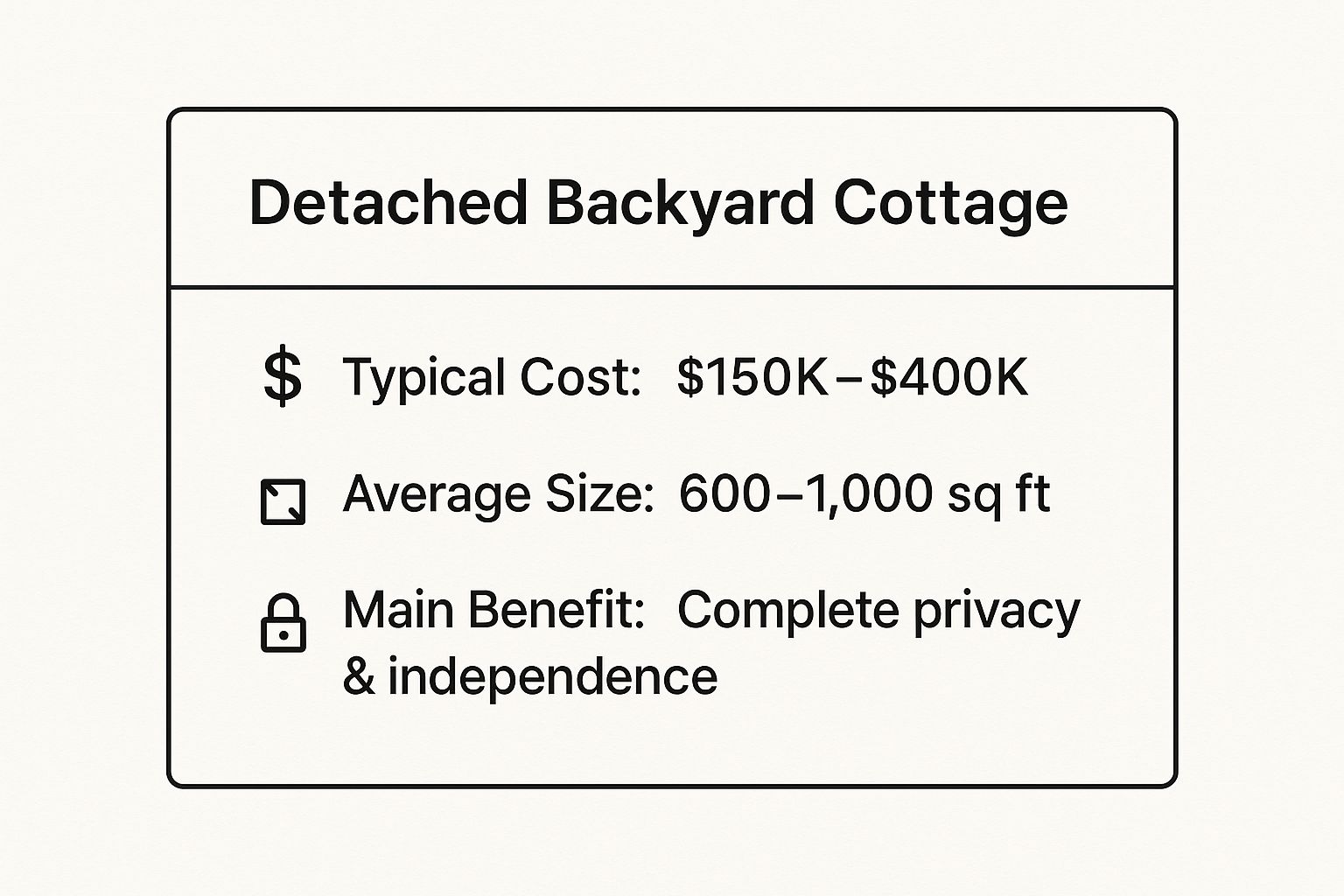
The data clearly shows that while the investment is significant, the primary benefit is total independence—a feature that is invaluable for long-term rental success. To further enhance this, incorporating features like solar panels can offset utility costs and appeal to eco-conscious renters or family members.
2. Garage Conversion ADU
A garage conversion ADU is one of the most cost-effective and practical ADU design ideas available. This approach repurposes an existing attached or detached garage into a fully functional, independent living unit.
By leveraging the pre-existing foundation, walls, and roof, homeowners can significantly reduce construction timelines and costs compared to building a new structure. It’s an ideal way to add value and utility without sacrificing precious yard space.
For homeowners in Monterey County or Maricopa County, AZ, converting a garage is a smart strategy to create a rental unit or an in-law suite. The process transforms an underutilized space into a valuable, habitable asset.
Key Considerations for a Garage Conversion
Successfully converting a garage into a livable space requires addressing several critical structural needs. The primary task is upgrading the structure to meet residential building codes, which involves adding insulation, installing drywall, and ensuring proper electrical and plumbing systems are in place.
You must also consider how to replace the large garage door with a new wall that incorporates windows and a standard entry door to create a welcoming, well-lit interior.
Expert Insight: When planning a garage conversion, focus on maximizing natural light to combat the typically dark, enclosed nature of a garage. Integrating skylights or large glass doors can dramatically transform the feel of the space, making it feel open, airy, and much larger than its actual footprint.
At a Glance: Garage Conversion ADU
For homeowners interested in this pragmatic ADU design, this quick reference summarizes the essential data points.
The data underscores that the main advantage of a garage conversion is its affordability and speed. To ensure a comfortable living environment, it's crucial to invest in high-quality insulation for walls and ceilings to manage temperature fluctuations. Additionally, you must verify that all construction plans meet local mandates, as navigating these regulations is a key step. You can learn more about construction permit requirements on aldridgeconstruction.biz to prepare for your project.
3. Basement ADU
A basement ADU is an excellent way to add a complete, independent living unit by converting existing below-grade space. This ADU design idea is particularly effective for homes with walk-out or daylight basements.
By transforming an underutilized cellar into a code-compliant apartment, homeowners can create a valuable asset without expanding their home’s footprint. For homeowners in Monterey County or even those with sloped properties in Maricopa County, Arizona, a basement ADU offers a discreet and cost-effective path to generating rental income or housing family.
Key Considerations for a Basement ADU
Converting a basement into a legal, habitable dwelling requires a sharp focus on technical details. The top priority is ensuring the space is safe, dry, and comfortable. This begins with comprehensive waterproofing and drainage systems to prevent moisture intrusion.
You must also meet specific residential building code requirements for ceiling height (typically at least 7 feet) and egress, which often involves adding or enlarging windows or creating a separate, direct entrance.
Expert Insight: Proper ventilation is non-negotiable in a basement ADU. Installing a high-quality HVAC system with a dehumidifier is crucial for maintaining healthy air quality and preventing mold growth. This investment protects both the structure and the well-being of its occupants.
At a Glance: Basement ADU
For homeowners exploring ADU design ideas, a basement conversion offers a unique set of benefits and challenges. This summary highlights the key points.
- Average Size: 400 – 1,000 sq. ft.
- Typical Occupants: Single renters, young couples, aging parents
- Primary Benefit: Cost-Effectiveness. Utilizes existing foundation and structure, which can significantly lower construction costs.
- Primary Challenge: Code Compliance. Meeting requirements for light, ventilation, ceiling height, and egress in a below-grade space can be complex.
The data underscores that while upfront technical investment is necessary, the primary advantage is leveraging your home's existing square footage. By focusing on smart design choices like light-colored paints, reflective surfaces like polished concrete floors, and strategic LED lighting, you can transform a dark basement into a bright, welcoming home.
4. Tiny House ADU
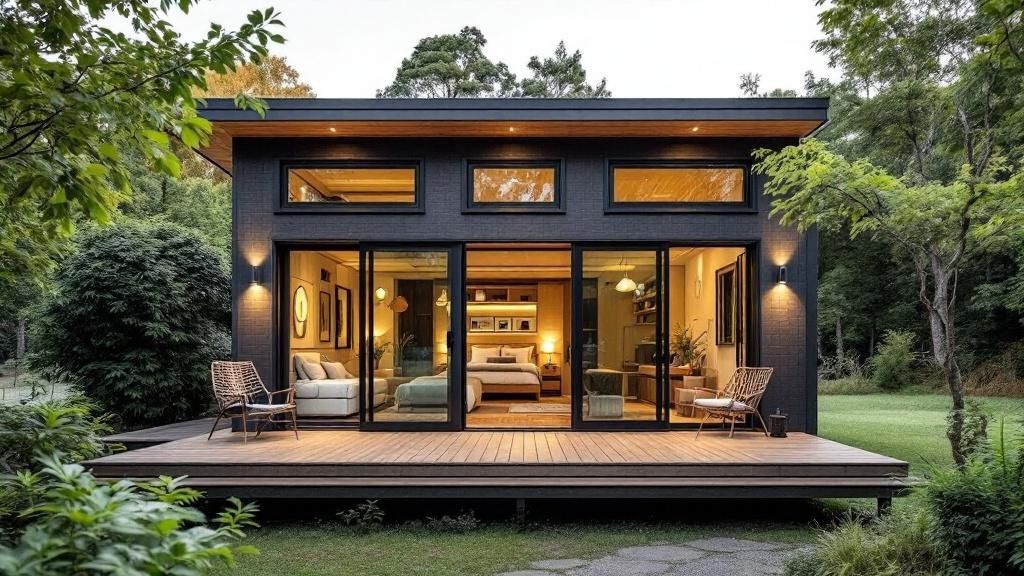
The tiny house ADU embodies the principle of "less is more," offering one of the most resource-efficient ADU design ideas available. These compact dwellings, typically ranging from 200 to 500 square feet, are masterclasses in spatial efficiency.
They leverage intelligent design to provide full-scale living in a minimal footprint. For property owners in Monterey or Santa Cruz County, where lot sizes can be constrained, a tiny house ADU built on a permanent foundation offers a smart, stylish, and cost-effective way to add a rental unit or guesthouse.
Key Considerations for a Tiny House ADU
Success with a tiny house ADU hinges on clever design that maximizes every square inch. Your primary focus should be on creating a sense of openness. This involves strategic use of vertical space, such as incorporating a sleeping loft, which frees up the main floor.
It is also crucial to ensure the unit is built on a permanent foundation to comply with most local ADU regulations, distinguishing it from a recreational vehicle. Before breaking ground, verify that the design complies with California's building codes and any local ordinances in Monterey, Santa Cruz, or San Benito Counties.
Expert Insight: In a tiny house ADU, built-in and multi-functional furniture are necessities. Investing in a quality Murphy bed, a fold-down dining table, or custom cabinetry that doubles as seating can transform the space from cramped to comfortable and highly functional.
At a Glance: Tiny House ADU
The defining benefit of a tiny house ADU is its ability to fit onto properties where other ADU types might not be feasible. To enhance livability, prioritize high-quality windows to flood the interior with natural light and create a visual connection to the outdoors. Thoughtful material choices, like light-colored paints and reflective surfaces, will further amplify the sense of openness.
5. Prefabricated/Modular ADU
The Prefabricated/Modular ADU offers one of the most streamlined and predictable paths to adding a new dwelling unit. These structures are built in a controlled factory setting and then transported to your property for final assembly.
This off-site construction method minimizes on-site disruption, shortens the project timeline, and often ensures a high level of quality control. For homeowners in areas with high construction costs like Monterey and Santa Cruz Counties, prefab ADUs can offer a more cost-certain solution.
Key Considerations for a Prefabricated/Modular ADU
Opting for a prefab ADU requires different planning compared to a site-built unit. Your first step should be to confirm site accessibility; a crane and large truck will need clear access to your backyard to deliver and set the unit.
You must also prepare the foundation and utility connections (sewer, water, electricity) in advance. This process requires precise coordination with the manufacturer's specifications.
Expert Insight: The biggest advantage of a prefab ADU is timeline predictability. While site work happens, your unit is being built simultaneously in a factory, significantly compressing the schedule. However, it's crucial to factor in all "soft costs," including site prep, foundation, utility hookups, and crane rental, to understand the true total investment.
At a Glance: Prefabricated/Modular ADU
For homeowners intrigued by the efficiency of factory-built ADU design ideas, this summary outlines the key factors.
- Primary Benefit: Speed and Cost Predictability
- Average Cost (Unit Only): $150,000 – $350,000+
- Total Project Cost: $200,000 – $500,000+ (including site work, delivery, installation)
- Best For: Homeowners on a tight timeline and properties with straightforward crane access.
- Potential Challenges: Site access limitations, coordinating foundation and utility work.
Success hinges on meticulous site planning and choosing a reputable manufacturer. Working with an experienced general contractor can help bridge the gap between the factory and your property, ensuring a seamless installation.
6. Upper Floor Addition ADU
When yard space is at a premium, building up instead of out presents one of the most innovative ADU design ideas. An upper floor addition ADU involves constructing a new story on top of an existing single-story home or garage.
This vertical approach is a game-changer for homeowners in dense urban areas or on smaller lots. For property owners in Monterey, Santa Cruz, or even tightly packed neighborhoods in Maricopa County, AZ, building vertically allows for the creation of a high-value rental unit while preserving precious outdoor amenities.
Key Considerations for an Upper Floor Addition ADU
The primary consideration for this type of project is structural. Before any design work begins, a structural engineer must assess the existing home's foundation and framing to confirm it can support the weight of an additional story.
Access is another critical factor. You will need to decide between an internal staircase, which saves exterior space but reduces privacy, or an external staircase, which provides complete separation for the new unit.
Expert Insight: Proper sound insulation is paramount in an upper floor ADU. Investing in high-quality soundproofing materials between the floors, such as acoustic insulation, resilient channels, and double layers of drywall, will prevent noise transfer and ensure a peaceful living environment for occupants in both units.
At a Glance: Upper Floor Addition ADU
For those considering building upward, this quick reference summarizes the key data points associated with this space-saving ADU design.
- Footprint Impact: Minimal to none, as it utilizes the existing building footprint.
- Privacy Level: High, especially with a separate external entrance.
- Cost Factor: High, due to significant structural engineering, reinforcement, and roofing work.
- Best For: Small lots, preserving yard space, and maximizing property value in dense areas.
- Key Challenge: Ensuring the existing structure can support the additional load.
The data confirms that while an upper floor addition is a complex endeavor, its primary benefit is adding a full-sized living unit without consuming valuable land. This makes it an unparalleled choice for maximizing a property's potential.
7. Container-Based ADU
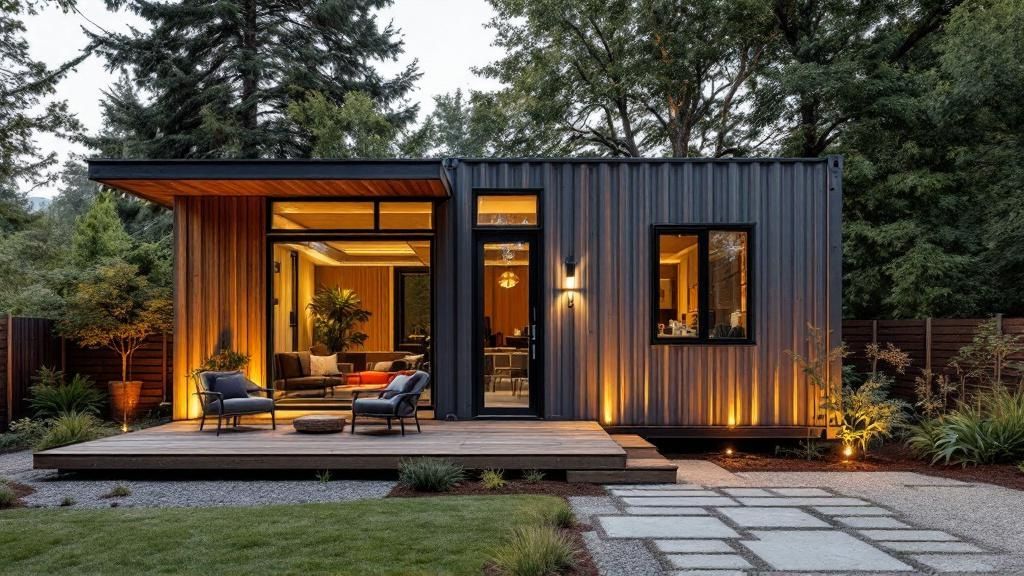
A container-based ADU is an innovative housing solution that repurposes shipping containers to create stylish, modern living spaces. This approach to ADU design ideas leverages an industrial aesthetic to produce a unique dwelling.
This method offers a distinct and sustainable alternative to traditional construction. For homeowners in Monterey County or Maricopa County, AZ, a container-based unit can be a fast, cost-effective way to add a rental property or home office with a bold, contemporary look.
Key Considerations for a Container-Based ADU
Executing a container-based ADU requires addressing several unique challenges. First, check with your local planning department, as some municipalities in Santa Cruz or San Benito Counties may have specific regulations.
Proper insulation is also non-negotiable. Spray foam is often recommended to manage interior temperatures and prevent condensation. Planning for utilities is another critical step, as the steel structure requires careful cutting for windows, doors, and utility lines.
Expert Insight: The industrial nature of a container ADU can be softened by integrating natural materials. A wooden rainscreen, a large sliding glass door, or a rooftop deck can transform the container from a simple steel box into a warm and inviting modern home.
At a Glance: Container-Based ADU
This quick reference summarizes the key data points for homeowners considering this unique ADU design.
- Cost: $1,800 – $6,500 per container (raw), plus significant modification, delivery, and installation costs.
- Timeline: 3-6 months. Faster than traditional construction due to off-site fabrication.
- Pros: Fast construction, sustainable repurposing, unique modern aesthetic, high durability.
- Cons: Potential zoning hurdles, requires specialized contractors, significant insulation needed.
- Best For: Homeowners seeking a modern or industrial look, projects with tight timelines.
To maximize livability, focus on an open floor plan and large windows to counteract the narrow footprint and create a bright, airy interior. This forward-thinking approach delivers a functional living space and a powerful design statement.
Comparing Your Top ADU Design Ideas
| ADU Type | Complexity 🔄 | Best For 💡 | Key Advantage ⭐ |
|---|---|---|---|
| Detached Cottage | High | Larger lots, total privacy | Maximum design flexibility |
| Garage Conversion | Medium | Budget-conscious projects | Lower cost, faster build time |
| Basement ADU | Medium | Homes with existing basements | Efficient use of space, preserves yard |
| Tiny House ADU | Low-Medium | Small lots, minimalism | Low cost, eco-friendly |
| Prefab/Modular ADU | Medium | Tight timelines | Speed and quality control |
| Upper Floor Addition | High | Small lots, dense areas | Maximizes lot use, no yard loss |
| Container-Based ADU | Medium | Modern aesthetic, sustainability | Fast installation, unique look |
Ready to Build Your ADU?
Embarking on an Accessory Dwelling Unit project is an exciting and impactful investment. As we've explored, the world of ADU design ideas offers a solution for nearly every vision, budget, and lot size.
From the classic appeal of a detached backyard cottage in Monterey County to the ingenious space-saving of a garage conversion in Maricopa County, AZ, the right design is a strategic blend of form, function, and financial foresight. A well-designed ADU can offer a significant return on investment, with a recent report from Porch.com noting they can increase property value by up to 35%.
Your Next Steps to a Finished ADU
Feeling inspired? It's time to translate that inspiration into action. A successful ADU project hinges on careful planning and expert execution. Here’s how you can move forward confidently:
- Conduct a Self-Assessment: Review the ADU types. Which one aligns best with your property, budget, and goals?
- Verify Local Regulations: A preliminary check of your local planning department’s regulations in Monterey, Santa Cruz, or Maricopa County is crucial.
- Outline Your Financial Plan: Develop a realistic budget that includes construction, design, permits, and utility hookup fees.
- Consult with a Professional: This is the most critical step. An experienced design-build contractor like Aldridge Construction can evaluate your property, refine your ADU design ideas, and create a feasible project roadmap.
Frequently Asked Questions (FAQs)
1. What is the most cost-effective ADU to build?
A garage conversion is typically the most cost-effective ADU design idea. It leverages your existing foundation, structure, and roof, which significantly reduces material and labor costs compared to building a new detached unit from the ground up.
2. How long does it take to build an ADU in California?
The timeline varies, but a typical ADU project can take anywhere from 6 to 18 months. This includes design, permitting (2-6 months), and construction (4-12 months). Prefabricated ADUs can often shorten the construction phase.
3. Can I build an ADU on my property in Santa Cruz or Monterey County?
Most single-family properties in California, including those in Santa Cruz and Monterey Counties, are eligible for at least one ADU. Aldridge Construction can help you confirm your property’s specific eligibility based on local zoning and state laws.
4. What size ADU can I build?
California state law allows for ADUs up to 1,200 square feet, but local ordinances can vary. For example, a detached ADU must be at least 800 square feet to accommodate more than one bedroom. We can help you determine the maximum size allowed for your specific lot.
5. How much value does an ADU add to my home?
According to industry data, an ADU can increase a property's value by 20-35% and generate significant rental income. This makes it one of the best home improvement investments a homeowner in California or Arizona can make.
Ready to take the next step and discuss your project in detail? The team at Aldridge Construction specializes in bringing custom ADU design ideas to life across Monterey, Santa Cruz, San Benito, and Maricopa Counties. Let our expertise guide you through every phase, from initial concept and permitting to final construction.