
Waterproofing your basement walls isn't just about patching a few leaks. It's a fundamental defense for your home's foundation and your family's health. The process creates a tough, impenetrable barrier that stops water in its tracks, either by managing it from the inside or blocking it completely from the outside.
Why Waterproofing Your Basement Is a Critical Investment
That damp, musty smell in the basement? It’s easy to get used to, but you shouldn’t. It’s a major red flag.
Ignoring persistent moisture can kick off a chain reaction of expensive, hazardous problems that undermine your home from the ground up. The consequences go beyond a soggy carpet, affecting everything from your property value to the air you breathe.
A wet basement is incredibly common. In fact, a staggering 98% of basements will deal with water damage at some point [American Society of Home Inspectors]. This widespread issue has driven the U.S. basement waterproofing market to an estimated $3.93 billion in 2024 [Market Research Future], demonstrating how seriously homeowners are taking foundation protection.
The True Cost of a Wet Basement
Water is a silent destroyer. Once it starts seeping through porous concrete, it can unleash a host of serious issues.
- Foundation Damage: Constant water pressure weakens concrete, creates deep cracks, and can even cause foundation walls to bow inward, putting your home’s entire structure at risk.
- Hazardous Mold Growth: A damp, dark basement is the perfect environment for mold and mildew. These fungi can trigger allergies, asthma, and other respiratory problems.
- Decreased Property Value: Signs of a wet basement can alarm potential buyers, significantly lowering your home's market value and appeal.
- Damaged Belongings: Any items stored downstairs—furniture, family photos, holiday decorations—are vulnerable to moisture, rot, and mold.
Local Climate Challenges in California and Arizona
Your home's location dramatically impacts the type of water-related stress its foundation endures.
In coastal areas like Monterey and Santa Cruz Counties, the persistent marine layer and heavy winter rains keep the ground saturated. This creates constant hydrostatic pressure pushing against foundation walls.
In dry regions like Maricopa County, Arizona, the problem is the intense monsoon season. Hard, sun-baked soil can't absorb a sudden downpour, so water pools around the foundation almost instantly. Both climates demand a robust strategy for waterproofing basement walls.
Think of professional waterproofing not as a simple repair, but as a permanent upgrade to your home’s core infrastructure. It’s a vital part of any long-term home renovation and remodeling strategy that protects your single biggest asset.
Tackling water intrusion is an essential investment in the health, safety, and future of your home. You have two main routes to a dry basement: managing water from the inside or stopping it from the outside.
Quick Look: Interior vs. Exterior Waterproofing
To get a clearer picture, it helps to see the two main strategies side-by-side. The best choice often depends on your specific situation, from the severity of the water issue to your budget.
| Aspect | Interior Waterproofing | Exterior Waterproofing |
|---|---|---|
| Approach | Manages water that has already entered the foundation. | Prevents water from ever reaching the foundation walls. |
| Method | Drains, sealants like cementitious coatings, sump pumps, and vapor barriers. | Excavation, waterproof membranes like liquid-applied polymers, and drainage systems. |
| Cost | Less expensive and less disruptive upfront. | More expensive due to significant labor and excavation. |
| Best For | Minor leaks, managing high water tables, budget constraints. | Severe water intrusion, fixing foundation cracks from the outside. |
| Disruption | Minimal; work is contained inside the basement. | High; involves digging around the entire foundation perimeter. |
| Effectiveness | Highly effective for managing water, but doesn't stop it. | The most comprehensive and permanent solution for stopping water. |
While interior systems are a great solution for many, exterior waterproofing offers the most complete protection available.
Diagnosing Your Basement Moisture Problem
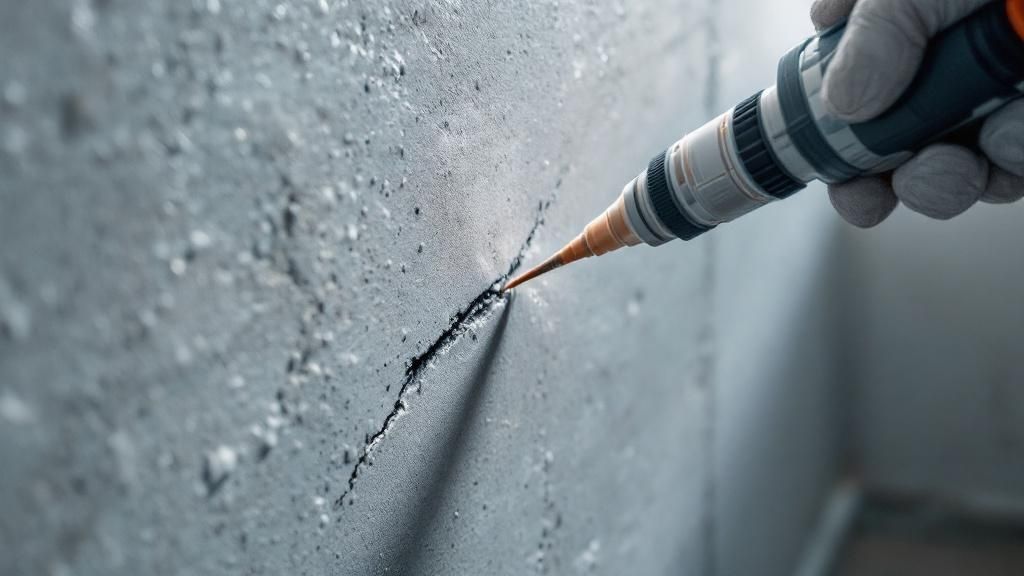
Before you can think about waterproofing basement walls, you need to play detective. Figuring out how and why water is getting into your basement is the most important step. A wrong diagnosis leads to the wrong solution, wasting time and money on fixes that don't solve the real issue.
Your first move is a thorough inspection. A systematic once-over helps you collect the right information before calling in a professional from Aldridge Construction.
Your Initial Inspection Checklist
Keep an eye out for these common red flags, as they each point to different kinds of water intrusion:
- Musty Odors: That persistent damp, earthy smell is a dead giveaway that mold or mildew is present, even if you can't see it yet.
- Visible Mold or Mildew: Look for splotches of black, green, or white growing on walls, stored items, or wood joists.
- Efflorescence: A chalky, white powder on concrete walls is definitive proof that water is migrating through your foundation. It's caused by salt deposits left behind after water evaporates.
- Spalling or Flaking Concrete: When water inside concrete freezes and expands, it can cause the surface to peel or crumble. This is a serious indicator of moisture-related structural decay.
- Water Stains and Drips: Dark streaks running down the walls are telltale signs of leaks. Note their location—are they near windows, around pipes, or at the base of the wall?
The Plastic Sheet Test: A Simple Diagnostic Tool
Not sure if dampness is seeping through the walls or condensing from humid air? This simple test can give you a clear answer, especially for homeowners in humid coastal areas like Santa Cruz or Monterey.
Tape a one-foot by one-foot square of plastic sheeting to a dry spot on your basement wall, sealing all four edges tightly with duct tape. Leave it for 24 to 48 hours.
If you see moisture beads on the outside of the plastic, your problem is likely high humidity. But if moisture is trapped on the inside of the plastic (against the wall), that confirms water is seeping through the concrete from the outside.
Understanding the Forces at Play
The "why" behind your wet basement usually comes down to two culprits: condensation or hydrostatic pressure.
Condensation is humid air hitting cool basement walls. A good dehumidifier can often keep this under control.
Hydrostatic pressure, on the other hand, is a powerful force. It’s what happens when soil around your foundation gets saturated with water. This saturated soil exerts immense pressure, forcing water through any crack, joint, or porous spot it can find in your concrete.
This pressure is why a simple coat of waterproof paint almost always fails. To successfully waterproof basement walls against hydrostatic pressure, you need a robust system. For more insights on smart home improvements, check out our collection of home renovation tips.
Understanding Interior Waterproofing Systems
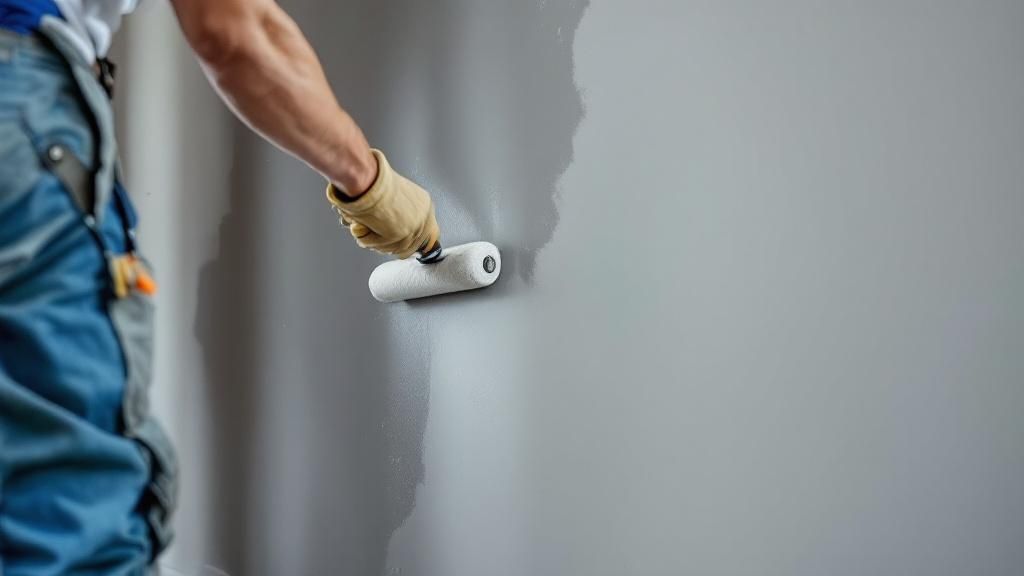
When exterior excavation isn't feasible, managing water from the inside is a common and effective approach. Interior waterproofing aims to collect and channel away any moisture that enters your foundation walls before it can cause damage. This usually involves a combination of specialized coatings and a drainage system.
Coatings and Sealants: Your First Barrier
Many homeowners head to the big-box store for "waterproof paint," but this is only a surface-level solution. It cannot fight the hydrostatic pressure that actively pushes water through concrete.
For real waterproofing basement walls, you need professional-grade materials. Aldridge Construction uses:
- Cementitious Sealants: A heavy-duty, cement-based coating applied like thick paint. It soaks into the pores of the concrete, creating a dense, rock-solid barrier that becomes part of the wall itself.
- Epoxy or Polyurethane Injections: A surgical solution for active cracks. We inject a two-part epoxy or polyurethane foam directly into the crack, where it expands to fill every void and create a bond stronger than the surrounding concrete.
Interior Drainage: A Smarter Way to Manage Water
While sealants block moisture, a truly bulletproof interior system actively manages water. An interior drainage system—or interior French drain—is the gold standard for basements with persistent water issues. This system intercepts water at the cove joint, where the wall meets the floor.
The installation involves cutting a small channel into the concrete slab along the basement's perimeter. A perforated drainpipe is laid in this trench and surrounded by gravel to facilitate water flow.
An interior drainage system doesn't try to stop water from entering; it intelligently controls it. By capturing moisture at the perimeter and directing it away, it protects your finished walls, flooring, and belongings from damage.
All that captured water needs a place to go. That's where the heart of the system comes in: the sump pump.
The Make-or-Break Role of the Sump Pump
Your sump pump is the engine that makes the whole system work. Water collected by the drain flows into a basin, or sump pit, set into the floor. When the water reaches a certain level, a float switch activates the pump, which expels the water away from your home.
This is not the place to cut corners. A flimsy pump is a flood waiting to happen. For homeowners in Monterey County facing heavy winter rains or those in Maricopa County dealing with monsoons, power outages are a real threat.
That’s why a battery backup system is an absolute must-have. If the power cuts out, the backup system kicks on automatically, keeping your basement dry when it’s most vulnerable. This principle of reliability is crucial in all our work, including our bathroom renovation services.
Exterior Waterproofing for Ultimate Protection
While interior systems manage water, the definitive solution is to stop it from the outside. Exterior waterproofing creates an impenetrable shield around your foundation, preventing water from ever touching the concrete. It is an intensive process, but it provides the highest level of long-term protection.
This method tackles the problem at its source: the saturated soil pressing against your foundation. The importance of these advanced solutions is reflected in the global market, which was valued at around $6.3 billion in 2024 and is projected to hit $9.1 billion by 2033 [Allied Market Research]. Preventing water infiltration is far better than dealing with the costly structural damage it causes. You can learn more from detailed market analysis reports.
The Excavation and Preparation Phase
Exterior waterproofing requires excavation. This means carefully digging a trench around your home’s perimeter to expose the foundation walls down to the footing.
Once exposed, the walls must be meticulously cleaned to remove dirt and old materials. We then address any cracks, sealing them with high-strength epoxy or polyurethane to restore the wall's integrity.
Applying a High-Performance Waterproof Membrane
With a clean surface, it's time to apply the waterproof membrane. This is a thick, flexible barrier designed to withstand constant hydrostatic pressure. Professionals at Aldridge Construction typically use:
- Liquid-Applied Membranes: These are polymer-modified asphalt or rubberized compounds that are sprayed or rolled on. They cure to form a seamless, monolithic layer that bonds tightly to the concrete.
- Sheet Membranes: These are durable, rubberized asphalt sheets applied to the foundation walls with sealed, overlapping seams to create a continuous, tear-resistant barrier.
The best choice often depends on site conditions and regional soil types, like the expansive clay found in parts of California.
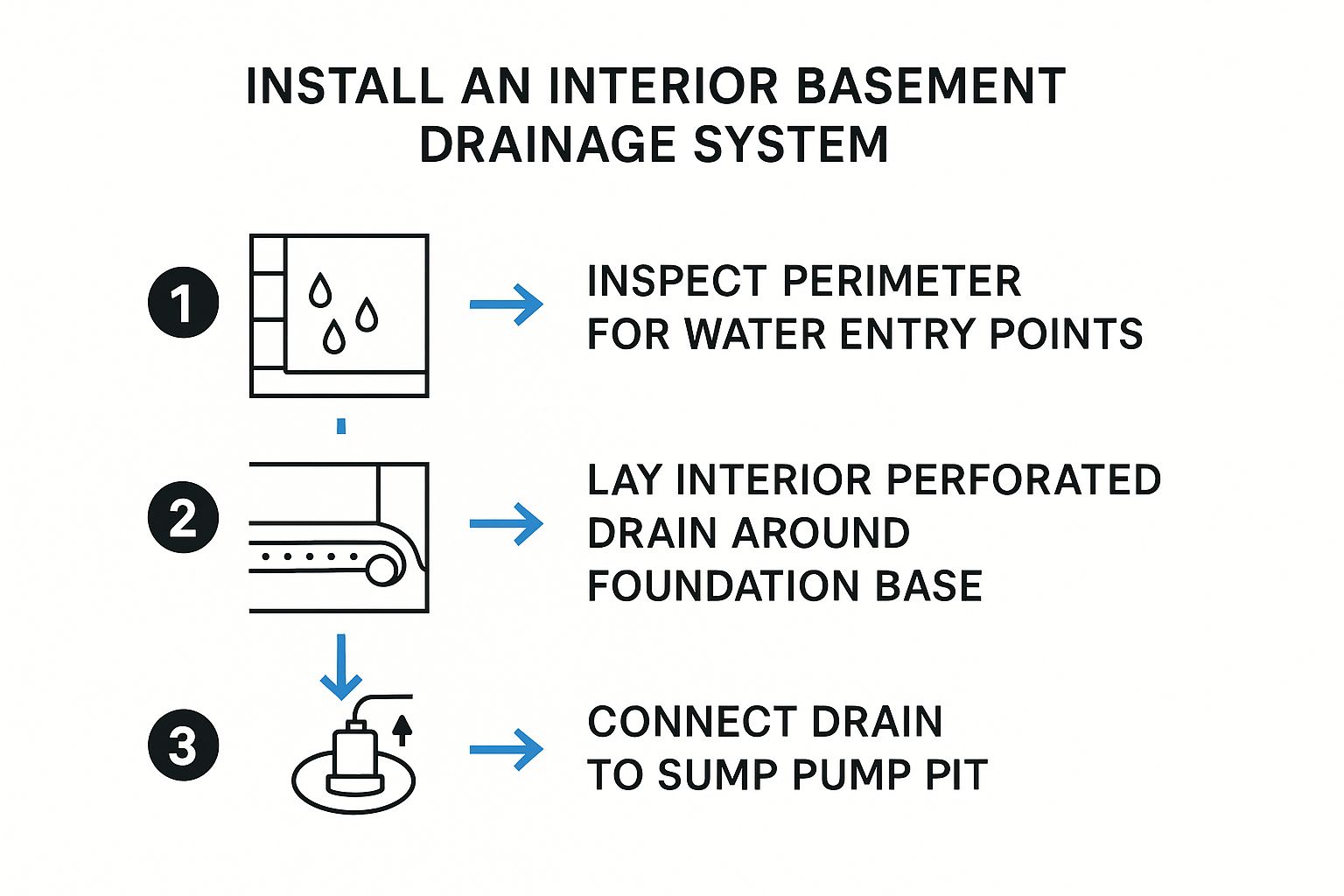
This visual shows how a well-designed interior drainage system captures and redirects water, forming a crucial part of a comprehensive waterproofing strategy.
Installing a New Exterior Drain System
Applying a membrane is only half the battle. To relieve hydrostatic pressure, we install an exterior drain tile system (French drain) at the base of the foundation footing.
A perforated pipe is laid in a bed of free-draining gravel. This system collects groundwater and channels it away from your newly waterproofed walls to a sump pump or a safe discharge point.
Expert Insight: The backfilling process is just as important as the waterproofing. We always backfill with gravel first, creating a porous buffer that lets water drain freely to the new tile system, completely relieving pressure from the foundation walls.
Due to the heavy excavation and technical skill involved, exterior waterproofing basement walls is not a DIY project. It requires a licensed contractor like Aldridge Construction to ensure it’s done safely and effectively.
Essential Support Systems for a Dry Home
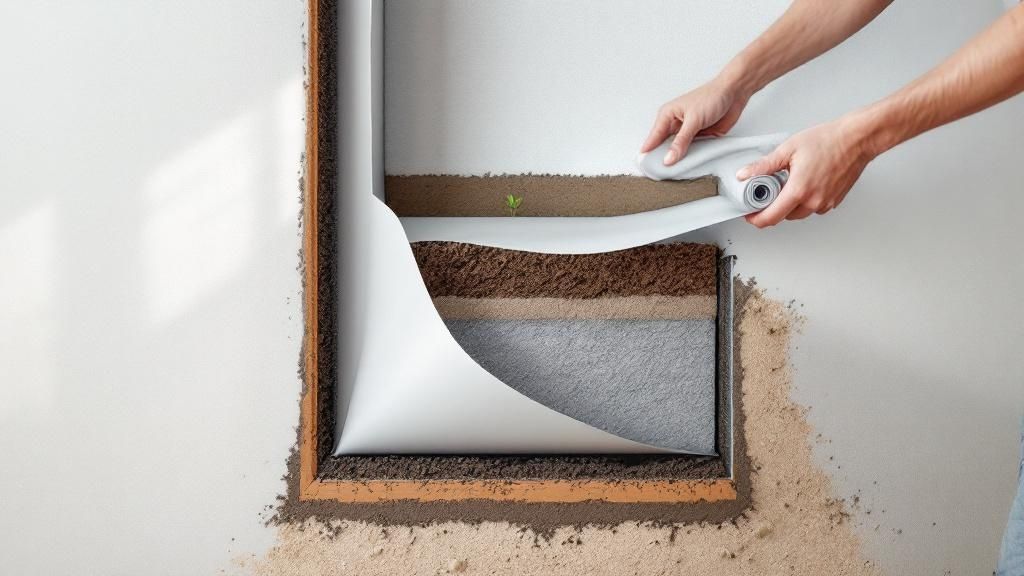
A truly dry home relies on more than just waterproofing your basement walls. The real secret is a complete defensive system that manages water at the source, taking pressure off your primary waterproofing.
Master Your Landscape Grading
The single most common mistake is a yard that slopes towards the house. Your landscape should guide water away from your foundation.
The ground next to your home needs a clear slope away from the foundation—a drop of at least six inches over the first ten feet is a good rule of thumb. This simple fix can solve a surprising number of minor water issues.
The Critical Role of Gutters and Downspouts
Your gutters and downspouts are the unsung heroes of a dry basement. They must be clean and set up correctly to work.
Clogged gutters will overflow, dumping a sheet of water right against your foundation. This is especially damaging during heavy rains in Santa Cruz County or the monsoon season in Maricopa County.
An overflowing gutter system can dump hundreds of gallons of water next to your foundation in a single storm. This leading cause of basement leaks is entirely preventable with regular maintenance.
Follow these best practices:
- Clean Gutters Regularly: Clear them of debris at least twice a year.
- Install Downspout Extenders: Discharge water at least six to ten feet from your foundation.
- Check the Discharge Point: Ensure water flows away and doesn't create a new puddle.
Reinforce Your Defenses
A few more targeted upgrades add another layer of protection.
Install Window Well Covers
A sturdy window well cover stops rain and debris from collecting against your basement window. Clear polycarbonate covers keep water out without blocking sunlight.
Use a Dehumidifier
Even with perfect drainage, you can still get dampness from airborne moisture, especially in the foggy coastal climate of Monterey. Running a quality dehumidifier will keep humidity below 50%, preventing musty smells and mold.
Integrating these proactive measures is a core part of any smart home improvement in Monterey.
Partner with Aldridge Construction for a Permanent Solution
Understanding the theory behind waterproofing basement walls is one thing; getting the job done right is another. This is where professional experience makes all the difference.
At Aldridge Construction, we deliver complete, permanent solutions built on trust and top-tier craftsmanship. Our work starts with a meticulous assessment to find the true source of your water problem.
We then build a custom plan tailored to your home. Whether you're in Monterey, Santa Cruz, or San Benito counties dealing with damp soil, or in Maricopa County facing monsoons, we use our local knowledge to select the right methods and materials, like high-performance elastomeric membranes and heavy-duty Zoeller sump pumps.
Our Commitment to a Lasting Fix
Our value lies in our methodical approach and commitment to quality. We go after the source of the water, not just the symptoms it leaves behind.
This means we focus on:
- Expert Diagnosis: We pinpoint if the problem is hydrostatic pressure, poor drainage, or foundation vulnerabilities.
- Industry-Leading Materials: We use high-performance waterproof membranes, professional-grade epoxies, and heavy-duty drainage systems engineered for long-term performance.
- Skilled Installation: Our seasoned crew ensures every component is installed perfectly to meet local California or Arizona building codes.
A permanently dry basement is a carefully managed construction project. Choosing an experienced general contractor ensures every part of the job is handled correctly.
As a leading home renovation and ADU contractor in Salinas, we have the field-tested experience to handle even the most daunting waterproofing projects.
Frequently Asked Questions About Basement Waterproofing
To help homeowners in Monterey, Santa Cruz, and Maricopa counties feel confident about protecting their homes, here are answers to common questions about waterproofing basement walls.
1. How much does waterproofing basement walls cost?
The cost depends on the method. Interior solutions, including drainage and a sump pump, typically range from $3,000 to $7,000 for an average basement. Exterior waterproofing is more intensive due to excavation and usually starts between $10,000 and $15,000, varying with home size and site complexity. Aldridge Construction provides a precise quote after an on-site assessment.
2. Is waterproof paint a good enough solution?
No. Waterproof paint is a temporary, surface-level fix for minor dampness, not active leaks or hydrostatic pressure. True waterproofing involves robust systems like membranes and drains that address the root cause of water intrusion. When water pressure builds, paint will bubble, peel, and fail.
3. How long will professional waterproofing last?
When installed correctly by a skilled team from Aldridge Construction, a high-quality exterior membrane system is designed to last for the life of the foundation. Modern interior drainage systems are also highly durable and often come with long-term or lifetime manufacturer warranties, ensuring a permanent solution.
4. What is the difference between damp proofing and waterproofing?
Damp proofing is a thin, moisture-resistant coating (often asphalt-based) applied during new construction. It can block moisture from damp soil but cannot stop liquid water under pressure. Waterproofing creates a thick, seamless barrier engineered to block liquid water even under significant hydrostatic pressure, offering a much higher level of protection.
5. Why is waterproofing important for homes in Monterey or Maricopa County?
Both regions have unique climate challenges. In Monterey and Santa Cruz, heavy winter rains and saturated soil create constant hydrostatic pressure. In Maricopa County, intense monsoon storms cause rapid water pooling around foundations. Professional waterproofing is essential in both areas to prevent structural damage, mold, and decreased property value.
A dry, secure basement is the bedrock of a healthy home. At Aldridge Construction, we provide permanent solutions, not temporary patches. If you're ready to protect your home's foundation and value, contact us for a professional assessment.