
Try our new ADU Cost Estimate Calculator Here
Direct Answer: A detached ADU on the Central Coast typically costs $200,000–$450,000+ depending on size, finish level, and site conditions. Garage conversions start lower, around $80,000–$150,000.
If you’ve looked into building an ADU anywhere in Monterey County, Santa Cruz County, or San Benito County, you’ve probably gotten one of two things from contractors: a vague non-answer or a quote that made no sense compared to the last one you got. That gap isn’t contractor dishonesty — it’s that ADU costs are genuinely variable, and most of the things that move the number are specific to your property.
Brian Aldridge gets this question at nearly every consultation: What’s this actually going to cost me? This article gives you a real breakdown — by ADU type, by county, and by the cost drivers that homeowners most often underestimate. There’s also a free adu cost estimator built specifically for Central Coast homeowners that lets you run your own numbers before you ever pick up the phone.
The goal here isn’t a one-size-fits-all number. It’s to give you enough information to walk into a consultation knowing what questions to ask and what to watch for.
Why Two ADUs on the Same Street Can Cost $50,000 Apart
Homeowners often compare ADU quotes side by side expecting them to line up. They rarely do, and that’s not a red flag — it usually means the contractors are pricing different things.
ADU type is the biggest variable. A detached new-construction unit built from the ground up is priced very differently than an attached addition or a garage conversion. These aren’t variations on the same project — they’re fundamentally different scopes.
- Detached ADU (new construction): $200,000–$450,000+ for most Central Coast projects
- Attached ADU or addition: $150,000–$300,000 depending on square footage and integration complexity
- Garage conversion: $80,000–$150,000, but can climb fast if the garage needs significant structural work or utility upgrades
Finish level swings the total by 40% or more. An economy-finish ADU and a premium-finish ADU with the same floor plan can differ by $80,000–$120,000. Flooring, cabinetry, countertops, fixtures, and appliances add up quickly when you’re doing a complete living unit.
Site-specific conditions are where homeowners get surprised most often. Grading on a sloped lot, long utility trenching runs, poor soil bearing capacity — any one of these can add $15,000–$50,000 to a project that looked straightforward on paper. Two identical ADU floor plans on different lots in Salinas can land at very different final numbers for exactly this reason. If you want to understand how to read what contractors are actually pricing, How to Read a Home Remodeling Estimate Before You Sign Anything breaks that process down clearly.
What the Numbers Look Like County by County
Permit fees, utility connection costs, and local demand all vary across the three-county area. Here’s what homeowners in each market are actually dealing with.
Monterey County has a well-established ADU permitting process, and rental demand in Salinas, Marina, Seaside, and Carmel Valley is strong. Plan check fees through Monterey County vary by project value — a $300,000 ADU project typically generates $8,000–$15,000 in permit and plan check fees, not counting design and engineering costs. Properties in the Coastal Zone face an additional layer: coastal administrative permits that add time and sometimes design constraints. That’s not a dealbreaker, but it does affect your timeline and budget planning. For a deeper look at how that process works, The Advanced Guide to ADU Permits in California covers the county-by-county specifics in detail.
Santa Cruz County carries higher land values — median home prices around $1.12M mean rental income ROI on an ADU is often stronger here than anywhere else in the three-county area. Cities like Scotts Valley, Capitola, and the city of Santa Cruz itself are active ADU markets. Permit fees in the City of Santa Cruz and unincorporated county areas differ, so the jurisdiction of your specific parcel matters.
San Benito County — particularly Hollister and San Juan Bautista — is growing fast, and lower land costs create favorable project economics. Total project costs can come in slightly lower here than in coastal Monterey County, and permit fees through San Benito County’s Building & Safety division tend to be more modest. For homeowners looking at ADU construction as a rental income strategy, Hollister’s rental demand is increasing steadily as the region absorbs overflow from the Bay Area.
ADU Cost Ranges by Type — Central Coast Baseline
These ranges reflect typical Central Coast projects with standard finishes and average site conditions. Actual costs vary based on lot specifics, finish selections, and permit jurisdiction.
| ADU Type | Typical Cost Range | Key Variables |
|---|---|---|
| Detached New Construction | $200,000 – $450,000+ | Lot grading, utility distance, size, finish level |
| Attached Addition | $150,000 – $300,000 | Structural integration, square footage, finish level |
| Garage Conversion | $80,000 – $150,000 | Structural upgrades needed, utility work, insulation |
| Junior ADU (JADU) | $40,000 – $80,000 | Scope of interior conversion, kitchen/bath additions |
| Permit & Design Fees | $12,000 – $30,000 | County jurisdiction, project value, engineering complexity |
| Site Prep & Utilities | $10,000 – $50,000 | Trench length, grading needs, soil conditions |
The Cost Components Homeowners Most Often Underestimate
When contractors talk about ADU costs, they usually lead with construction — framing, roofing, finishes, labor. Those numbers are real, but they’re not the full picture.
Solar and battery storage are not optional. California’s Title 24 energy code has required solar on all new residential construction since 2020, and the 2025 California Building Standards Code (effective January 1, 2026) tightens those requirements further. Budget $12,000–$20,000 for a code-compliant solar and battery package on a new detached ADU. This surprises homeowners who only got a construction bid without energy code compliance factored in.
Site prep and utility trenching are consistently underestimated. Running new electrical service, water supply, and sewer laterals from the main house or street to an ADU involves trenching — and on a typical Salinas or Hollister lot, that trench run can be 50 to 150 feet. At current labor and material rates, trenching alone can add $15,000–$35,000 to a project. If there are mature trees, hardscape, or concrete flatwork in the path, costs climb further.
Here’s a full breakdown of the major cost buckets on a typical detached ADU:
- Shell construction (framing, roofing, windows, exterior): largest single cost bucket
- Interior finishes (flooring, cabinetry, counters, paint): varies most by finish level
- Mechanical, electrical, plumbing (MEP): typically $30,000–$60,000 on a new unit
- Solar and battery: required for new construction, $12,000–$20,000
- Permit, design, and engineering fees: $12,000–$30,000 depending on county and project complexity
- Site prep and utilities: $10,000–$50,000 based on lot conditions
- Landscaping and private entrance: improves rentability; budget $5,000–$15,000 for a functional setup
Understanding what is value engineering in construction can help you find areas to trim without compromising quality — especially relevant when a project starts pushing budget limits.
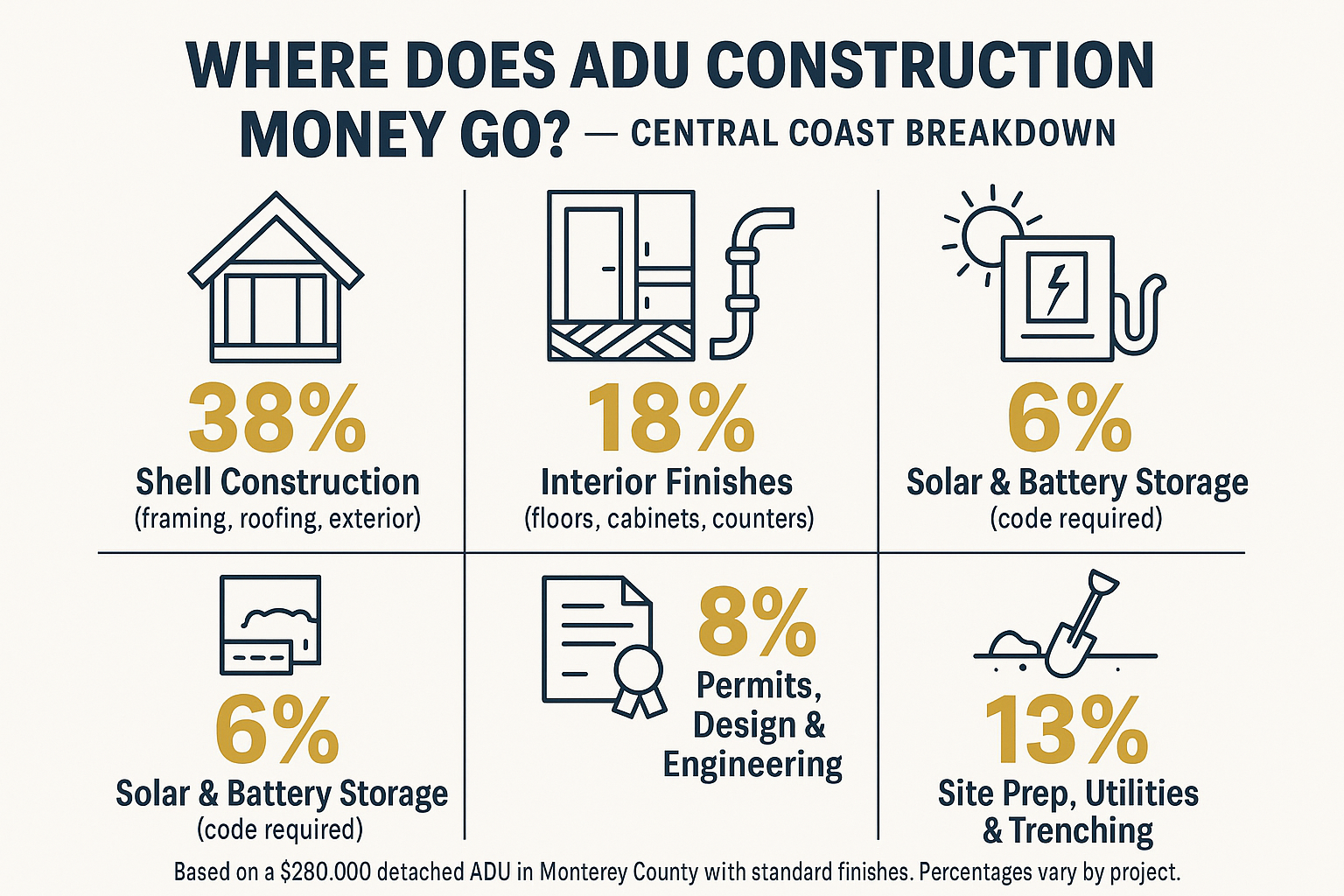
ADU Cost Breakdown: Where the Money Actually Goes
This breakdown shows the typical cost distribution on a $280,000 detached ADU build in Monterey County — useful for understanding which buckets to prioritize when comparing bids.
The Rental Income Math — and When an ADU Pays for Itself
For most Central Coast homeowners, the decision to build an ADU isn’t just about adding space — it’s about what that space earns.
A well-built ADU in Monterey County typically rents for $1,800–$3,500 per month, depending on size, location, and finish level. A 600-square-foot unit near downtown Salinas will land differently than a 900-square-foot unit in Carmel Valley — but both produce meaningful income. In Santa Cruz County, where rents run higher, a comparable unit in Scotts Valley or Capitola can push toward the upper end of that range or beyond.
At $2,200/month gross rent on a $280,000 project, you’re looking at a payoff window of roughly 10–12 years before the unit is generating pure cash flow. Reduce that project cost through a garage conversion or JADU, or land in a higher-rent submarket, and that window can shrink to 7–8 years.
The free adu cost estimator built for Central Coast homeowners includes a payoff calculator — you can plug in your specific ADU type, square footage, estimated rent, and project cost to see how the numbers work for your property. It’s a starting point, not a final number, but it gives you a real framework before you sit down with a contractor.
For homeowners navigating the full decision, Future-Proof Your Property: 5 Smart Moves for Custom ADU Design-Build in 2026 covers the design decisions that most affect long-term rental value and livability.
Frequently Asked Questions About ADU Costs on the Central Coast
What’s the cheapest type of ADU I can build in Monterey County?
A garage conversion or JADU (Junior ADU) will almost always be the most cost-effective starting point. Garage conversions in the $80,000–$150,000 range are realistic if the structure is sound and utilities don’t require a major run. A JADU carved out of existing living space can come in even lower. The tradeoff is livability — smaller spaces and shared-wall units typically rent for less than a fully detached unit.
Do permit fees really differ that much between counties?
Yes, and it’s not just the permit fee itself — it’s the number of agencies involved and the sequencing required. Monterey County projects in the Coastal Zone require an additional coastal administrative permit through the County Planning Department. Santa Cruz County has its own plan check process with different timelines. San Benito County’s Building & Safety division tends to move faster on ADU applications than some larger jurisdictions. These differences can affect your project start date by 3–6 months, which matters if you’re planning around rental income.
Is solar really required on a new ADU in California?
Yes. All new residential construction in California, including ADUs, has required solar since January 1, 2020 under Title 24. The 2025 California Building Standards Code, effective January 1, 2026, adds battery storage requirements for new construction. There’s no way to permit a new detached ADU without meeting these standards — budget $12,000–$20,000 for a compliant system.
Why did one contractor quote me $180,000 and another quoted $320,000 for the same ADU?
This is one of the most common things Brian hears. The most likely causes: one bid is missing line items (solar, utility trenching, permit fees, or engineering), one is using lower-grade subcontractors or materials, or they’re scoping the project differently. A $180,000 bid that grows to $280,000 through change orders is not a better deal than a $280,000 bid that comes in on budget. Before signing anything, read the estimate line by line and ask each contractor what’s explicitly excluded.
How long does an ADU project take from permit application to move-in?
For a detached new construction ADU in Monterey County, budget 12–18 months from initial design through final inspection. That includes design and engineering (6–10 weeks), permit plan check (8–16 weeks depending on county backlog), and construction (4–7 months). Garage conversions move faster — sometimes 8–12 months total. Coastal Zone projects in Monterey County can add 4–8 weeks to the permitting phase. For a more detailed look at how to avoid timeline surprises, how to navigate ADU construction in Salinas without surprises covers the sequencing in plain terms.
Can I use the rental income to qualify for financing on the ADU?
Some lenders will count projected ADU rental income as part of a debt-to-income calculation, but the rules vary by loan product. This is a question for your lender — Aldridge Construction doesn’t offer financing advice, but can connect you with local lenders who specialize in ADU projects if you ask during your consultation.
Ready to Get a Real Number for Your Property?
The free ADU cost estimator is the right place to start — it takes about five minutes and gives you a realistic cost range, per-square-foot breakdown, and payoff estimate based on your specific ADU type and finish level. When you’re ready to go deeper, Brian Aldridge offers free on-site consultations across Monterey County, Santa Cruz County, and San Benito County — no pressure, no sales pitch, just a straight conversation about what your project actually involves. Reach the team at 831-682-9788 or through the contact page at aldridgeconstruction.biz.