
Direct Answer: Starting January 1, 2027, SB 1117 lets local agencies charge ADU impact fees only on livable area above 750 square feet, for the first two ADUs on a lot.
Several people who reach out to me ask a version of the same question before anything else: how big am I allowed to build, and what are the fees going to do to my budget? For years the answer on the fee side was simple. Stay under 750 square feet and local impact fees mostly stayed off your bill.
That rule of thumb changes shape on January 1, 2027. Under SB 1117, signed September 29, 2026, a local agency can charge impact fees only on the portion of livable space above 750 square feet, for the first two ADUs on a lot.
Here is my position, and it runs against the advice I still hear at kitchen tables across Monterey County: stop shrinking your ADU to 749 square feet. The fee cliff becomes a slice, and for most households the right size is the one that actually works, not the one that squeaks under a line.
What SB 1117 actually changes on January 1, 2027
The bill was signed on September 29, 2026 and takes effect January 1, 2027. It applies to local agency impact fees statewide, which includes the City of Salinas and unincorporated Monterey County, along with Santa Cruz County, San Benito County, and the south Santa Clara County cities.
What it does, in plain terms:
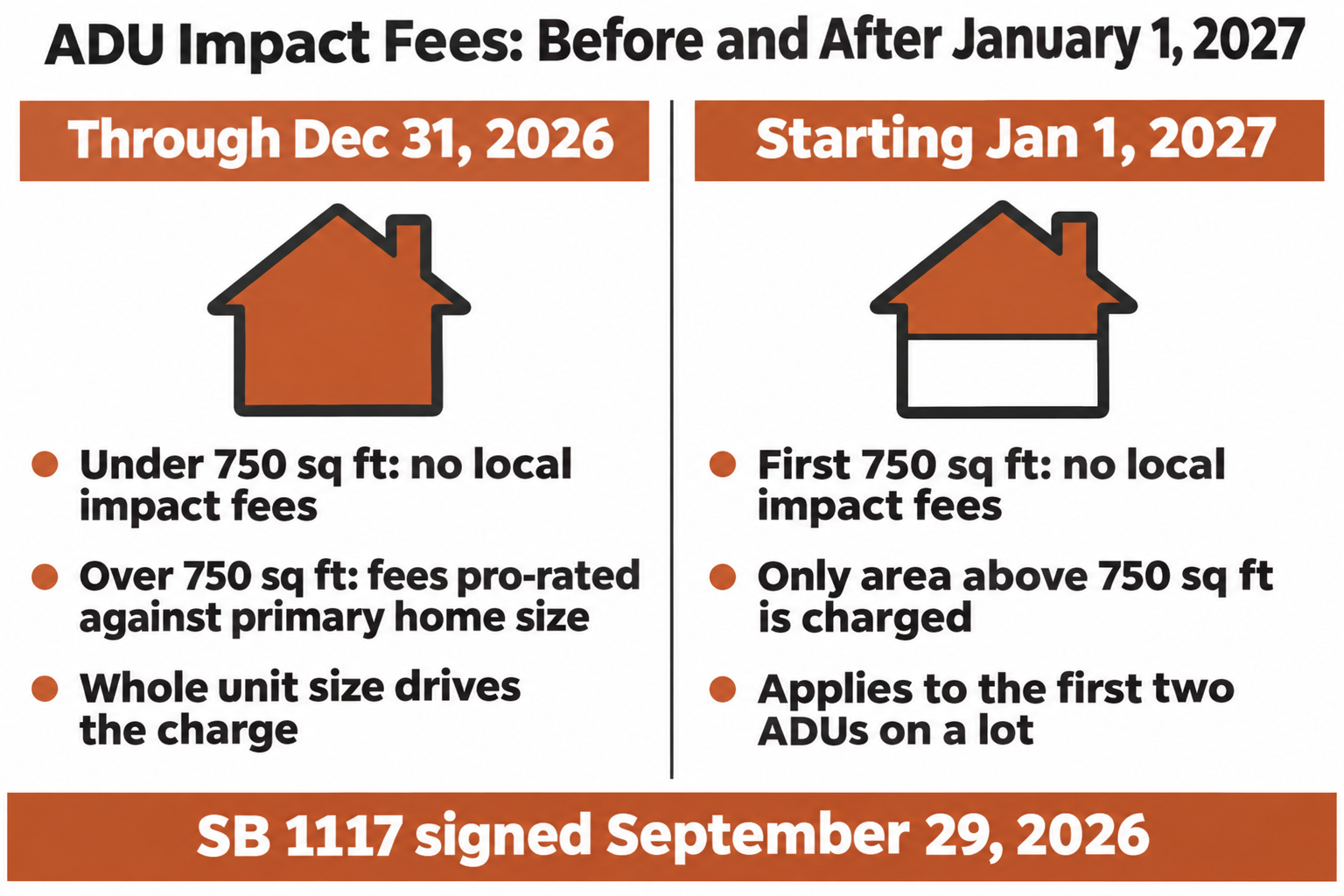
- Impact fees can be charged only on the livable area above 750 square feet
- The relief covers the first two ADUs on a lot
- Anything at or below 750 square feet stays where it has been, with no local impact fees
Before this, state law required agencies to pro-rate impact fees for ADUs larger than 750 square feet based on the size of the ADU compared to the size of the primary dwelling. So a 1,000 square foot ADU behind a 1,400 square foot house was charged on a ratio of the whole unit. Starting in 2027, that same unit is assessed on 250 square feet.
One thing to keep straight: impact fees are the charges a city or county collects toward things like water, sewer, parks, and traffic capacity. They are not the same as plan check or building permit fees, and practice varies by agency. The state’s ADU guidance from the California Department of Housing and Community Development is a good place to read the framework, and your local counter is the place to confirm what you will be charged.
Why the “keep it under 750” advice stops making sense
I have watched homeowners design backward from the fee line. They want two bedrooms for aging parents, or a unit that rents well, and then they squeeze it to 749 square feet because someone told them that was the smart move.
The result is usually a compromise they live with for twenty years. Two bedrooms, a full bath, a kitchen, and a place to sit all inside 600 to 750 square feet means tight bedrooms and almost no storage. I walked through exactly that tradeoff in what fits in a two bedroom ADU at 600 square feet.
Starting in 2027, going from 750 to 950 square feet means you are paying impact fees on 200 square feet, not on the whole unit. That can still move real money, since impact fee schedules differ a lot between Salinas, Hollister, Gilroy, and the unincorporated county, but it is a line item you can price instead of a wall you design around.
Where I would still hold the line at 750 or below:
- Small lots where setbacks and coverage already cap your footprint
- Garage conversions working inside an existing slab and walls
- Septic lots where Environmental Health ties capacity to bedroom count
- Budgets where every added square foot of construction cost, not fee cost, is the binding constraint
The fee change does not make square footage free. Construction cost per square foot is still the larger number by a wide margin.
How the fee math shifts at common ADU sizes
This compares how impact fees are assessed, not what they cost. Actual dollar amounts depend entirely on your jurisdiction’s fee schedule, so treat this as a framework and confirm figures with your agency.
| ADU size | Through December 31, 2026 | Starting January 1, 2027 |
|---|---|---|
| 600 sq ft detached | No local impact fees | No local impact fees |
| 750 sq ft detached | No local impact fees | No local impact fees |
| 900 sq ft detached | Fees pro-rated using ADU size vs. primary dwelling size | Fees assessed on 150 sq ft |
| 1,000 sq ft attached | Fees pro-rated using ADU size vs. primary dwelling size | Fees assessed on 250 sq ft |
| Second ADU on the same lot | Varies by agency | Same 750 sq ft exclusion applies to the first two ADUs |
The 750 square foot line, before and after
A side by side look at how SB 1117 changes the way local agencies calculate ADU impact fees.
Should you time your permit application around the date?
This is the question I expect to get most this winter, and my answer depends on where your project sits today.
If you are designing a unit above 750 square feet and you have not submitted yet, there is a reasonable case for landing your application so the fees get calculated under the new rule. Most agencies calculate and collect impact fees at permit issuance rather than at submittal, but that practice is not uniform, so ask your plan check counter directly how and when your fees get locked in.
If your plans are already in review and the permit is close, I would not pull the project back. Holding a set of drawings for months to chase a fee change usually costs more in schedule than it saves. Plan check rounds, utility coordination, and weather windows all move while you wait, and the PG&E connection step holds up more ADUs than framing does. One homeowner who converted a garage put it plainly in a review: the project “took a little longer than expected, but this was due to PG&E’s scheduling and availability.”
Two other 2027 changes are worth knowing while you plan:
- AB 956, signed the same day, doubles the by-right allowance to two detached ADUs on a lot with a single-family dwelling, and broadens state limits on HOA rules and private covenants that restrict ADUs
- AB 1621 limits building permit reviews to two plan check rounds, shortens appeal deadlines to 30 or 45 business days, and bars inspectors from requiring deviations from approved plans without written findings
All three take effect January 1, 2027. The summary of these bills that I have found most useful for the legal detail is the client alert published by Best Best and Krieger LLP in October 2026.
What this does not change
A fee change is not a zoning change. Everything that governs whether your lot can hold the unit still applies.
- Setbacks, height limits, and lot coverage
- Coastal zone review in Carmel, Pacific Grove, and parts of unincorporated Monterey and Santa Cruz Counties
- Environmental Health approval on septic lots
- Water permits on the Monterey Peninsula before a building permit can issue
- Historic inventory review, which I get asked about more often than people expect
Assessed value also moves when you add livable space. An ADU changes your property tax bill through a new blended assessment on the added improvement, and that is an annual number, not a one-time fee.
Before any of this gets priced, somebody has to walk the lot. The site walk that happens before anyone can price your ADU is where utility runs, grade, access, and setback reality get sorted out, and it is the step that tells you whether 900 square feet was ever on the table.
Frequently Asked Questions About ADU Impact Fees in 2027
Does SB 1117 apply in Salinas and unincorporated Monterey County?
Yes. It applies to local agency impact fees statewide, which covers the City of Salinas, unincorporated Monterey County, and the other jurisdictions in our service area. Fee schedules still differ by agency, so the savings amount will not be the same everywhere.
What if I build two ADUs on one lot?
The 750 square foot exclusion applies to the first two ADUs on a lot as the law is written. If you are planning beyond that, confirm the treatment with your local planning department before you budget.
How much money does this actually save me?
That depends on your jurisdiction’s fee schedule, and I am not going to quote a number I cannot back up. On a 1,000 square foot unit, you move from fees pro-rated against the whole unit to fees on 250 square feet, which can be a difference of thousands of dollars in some agencies. Ask your permit counter for the current schedule.
Should I delay my permit application until January to get the lower fees?
Only if your project is still in design and your unit is meaningfully above 750 square feet. Ask the agency whether fees are set at submittal or at issuance. If your plans are already in review, the schedule risk from waiting usually outweighs the fee savings.
Do impact fees include school fees and permit fees?
No. Impact fees are the capacity charges a city or county collects. Plan check fees, building permit fees, and school district fees are separate line items with their own rules, so read your fee estimate line by line.
Does this change how big an ADU I am allowed to build?
No. Size limits still come from state law and your local ordinance, along with lot size, setbacks, and bedroom count. A fee rule and a size rule are two different things.
Thinking through ADU size and timing for 2027?
If you are sketching out an ADU in Salinas, Monterey, Santa Cruz County, or Hollister and trying to decide whether the 2027 fee change should move your square footage or your submittal date, it helps to run the numbers against your actual lot. Aldridge Construction handles ADU design, permitting, and construction across the Central Coast, and Brian is available at 831-682-9788 or through the contact page at aldridgeconstruction.biz if you want a second set of eyes on the plan.