
Direct Answer: Starting January 1, 2027, SB 1117 charges qualifying impact fees only on ADU square footage above 750, on lots with no more than two ADUs. Units 750 square feet or less still pay none.
For years, the advice I gave homeowners in Salinas and across Monterey County was simple: if you can live in 750 square feet or less, stay there, because crossing that line can open the door to impact fees. That advice is about to be incomplete.
Governor Newsom signed SB 1117 on September 29, 2026, and it takes effect January 1, 2027. On lots with no more than two ADUs, qualifying impact fees for an ADU larger than 750 square feet will be charged only on the square footage above 750.
Here is my position: if your family actually needs a second bedroom, do not shrink the plan to 750 just to dodge fees anymore. The penalty for going bigger got much smaller. But the break only covers the first two ADUs on a lot, and it does not touch permit fees or utility charges, so the math still deserves a careful look.
What SB 1117 actually changes on January 1, 2027
Impact fees are the one-time charges a city or county collects on new living space to help pay for things like parks, roads, and schools. They are separate from your building permit fee.
State law already required local agencies to pro-rate impact fees for ADUs larger than 750 square feet, based on the size of the ADU compared to the size of the primary dwelling. SB 1117 narrows what gets counted in that calculation.
From January 1, 2027, on a property with no more than two ADUs:
- Qualifying impact fees apply only to interior livable space above 750 square feet
- That above-750 area is still prorated against the size of the main house
- ADUs of 750 square feet or less continue to pay no impact fees
- Junior ADUs continue to sit outside the fee picture as well
The bill was signed the same day as AB 956, which doubles the by-right allowance to two detached ADUs on a single-family lot and tightens limits on HOA rules that restrict ADUs. Reporting on both bills is available from PublicCEO, LA Construction Compliance, and Perpetual Homes ADU. I also wrote about this change while the bill was still moving.
What this looks like on a 1,000 square foot ADU
Say you want a two-bedroom unit in the 1,000 square foot range. Several homeowners who reached out to us this summer wanted exactly that, usually for a parent or an adult child.
Under the old approach, the fee calculation looked at the whole unit, prorated against your main house. Starting in 2027, the calculation looks at 250 square feet instead of 1,000.
That can cut thousands off a permit bill. I will not quote you a number as fact, because impact fees are set locally and vary a lot between Salinas, the City of Monterey, unincorporated Monterey County, Santa Cruz County, and Hollister. Two lots twenty minutes apart can land in very different places.
What drives your number:
- Which agency has jurisdiction over your parcel
- The size of your primary dwelling, since the proration compares the two
- Which fees in your jurisdiction qualify under the new rule
- Whether your lot sits inside the Coastal Zone, which adds review steps
The practical takeaway is that the jump from 750 to 1,000 square feet is no longer a cliff. Size the unit around how people will use it. Our guide on what fits at 600 square feet is still worth reading before you assume you need the extra room.
How ADU size affects impact fees before and after the change
This is a simplified side-by-side. Local rules still control which fees qualify, so verify with your permitting agency.
| ADU scenario | Through December 31, 2026 | From January 1, 2027 |
|---|---|---|
| JADU or ADU at 750 sq ft or less | No impact fees | No impact fees |
| 900 sq ft ADU, first or second on the lot | Fees prorated on full 900 sq ft against main house size | Fees prorated on 150 sq ft against main house size |
| 1,000 sq ft ADU, first or second on the lot | Fees prorated on full 1,000 sq ft | Fees prorated on 250 sq ft |
| Third ADU on the same lot | Prorated under prior rules | Falls outside the new calculation |
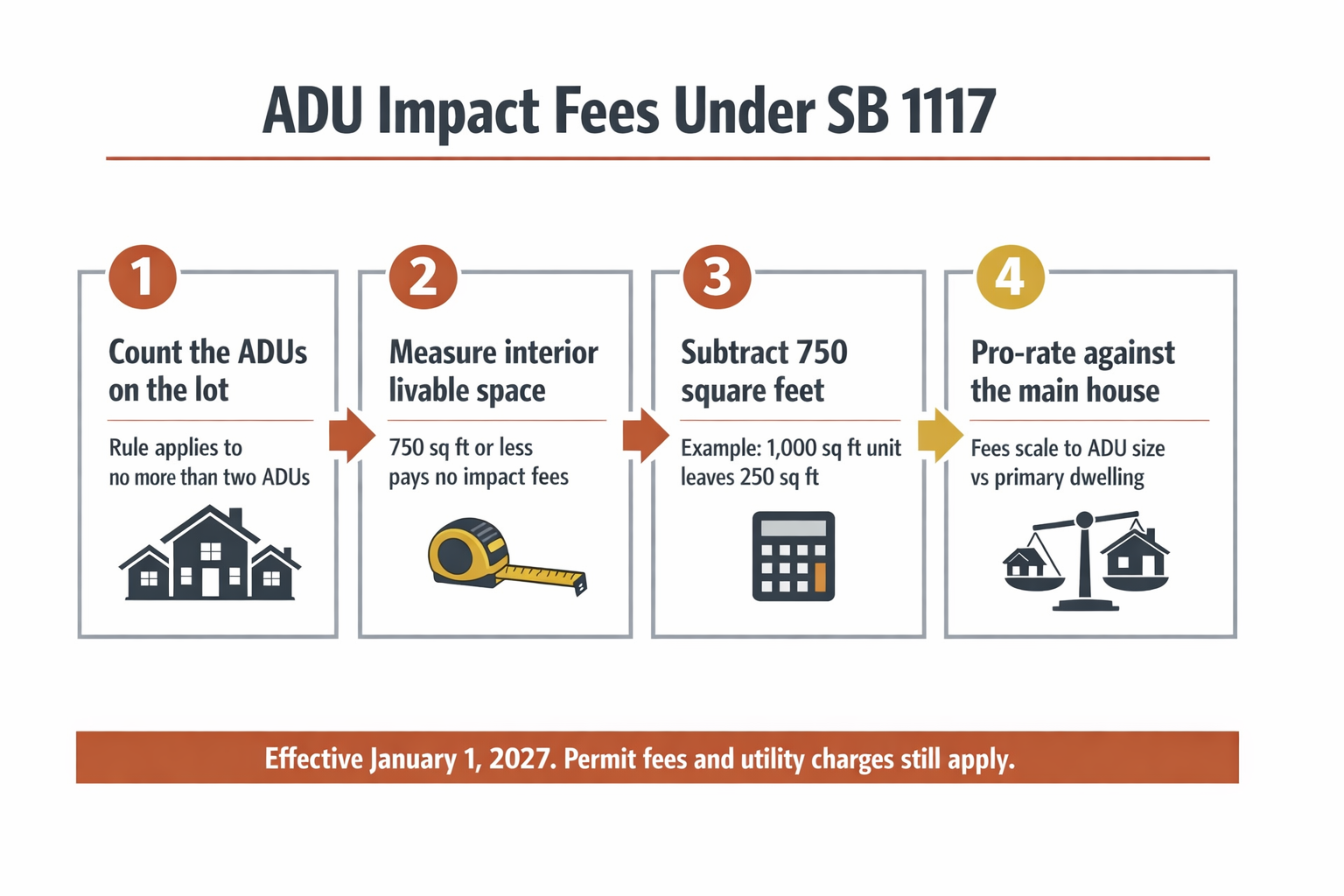
How the 2027 fee calculation works, step by step
Four steps that decide whether the new rule applies to your project and what gets counted.
The two ADU limit is where people lose the break
This is the part I expect to cause problems on Central Coast lots, and it is the part nobody mentions in the headlines.
The new calculation applies on properties with no more than two ADUs. If you already have a converted garage and a detached unit out back, adding a third unit puts you outside that window.
I see this risk most on older Salinas and Seaside properties where there is already something in the backyard. One homeowner who contacted us wanted to remove an existing studio and build a new ADU. Another wanted a two-story garage conversion on a coastal, historic-registry property.
Before you add a third unit, think through:
- What is already permitted on the parcel, not just what is standing
- Whether an unpermitted structure counts once it is legalized
- Whether a junior ADU is the better fit, since JADUs sit in their own category
- How a third unit changes septic, water, and parking review
If you are not sure which category your backyard structure falls into, start with JADU or ADU: which one fits your property and whether to convert the structure or start over.
Impact fees are not the whole permit bill
A lower impact fee is real money saved. It is also one line on a page with many lines.
Permit fees, plan check, utility charges, and other applicable costs still need to be budgeted. On the Monterey Peninsula, a water permit can come before a building permit. On septic lots in the unincorporated county, Environmental Health gets its own look.
And the slowest step on most of our ADU jobs is not framing. One client told us straight out that her garage conversion took longer than expected because of PG&E scheduling, not the build. That has been the pattern for a while now.
If you want to check the state-level rules yourself, the California Department of Housing and Community Development ADU page keeps current guidance and handbooks posted. Local requirements change, so confirm specifics with your city or county before you commit to a size.
My honest read for most Monterey County homeowners: this change makes a well-sized two-bedroom unit easier to justify than it was a year ago. It does not make permitting simple, and it does not change the utility connection timeline that decides when you actually move someone in.
Frequently Asked Questions About ADU Impact Fees in 2027
If I pull my permit in December 2026, do I get the new fee calculation?
The law takes effect January 1, 2027, so projects fee’d out before that date fall under the current rules. If your plans are close to that line, ask your permitting agency directly how they handle applications in progress. The answer can vary by jurisdiction, and it is worth a phone call before you submit.
Does this mean a 1,000 square foot ADU is now cheaper to build than a 750?
No. Construction cost still scales with square footage, and the extra 250 square feet costs what it costs. What changed is the fee penalty for crossing 750, which used to push the whole unit into the fee calculation. Now only the area above 750 counts.
Does the rule apply in the Coastal Zone in Monterey and Santa Cruz Counties?
SB 1117 is a state fee rule, but coastal properties carry extra review layers that affect timeline and cost regardless of fees. If your lot sits in the Coastal Zone, plan for a coastal administrative permit step and confirm current requirements with your local planning department.
What counts as interior livable space?
Generally the conditioned living area inside the unit, not a detached storage room or an uncovered deck. Because measurement conventions differ between agencies, I would confirm how your jurisdiction measures it before you lock the floor plan at 749 or 751 square feet.
Can I still rent out an ADU built under this rule?
ADUs can generally be rented long term, and that is why many of our clients build them. Short-term rentals often carry added local restrictions, especially in coastal communities, so check your city or county rules before you count on that income.
Thinking through ADU size before 2027?
If you are weighing a 750 square foot unit against something larger on a lot in Monterey County, the fee math is only part of the decision. Setbacks, utilities, and what is already standing in the backyard matter just as much. Brian and the team are available at 831-682-9788 or through aldridgeconstruction.biz if you want to talk through how the change lands on your property.