
Direct Answer: AB 462, signed in October 2025, gives local agencies 60 days to approve or deny a Coastal Development Permit for an ADU — ending the open-ended review timelines that used to stall coastal projects for a year or more.
If you own a home inside California’s Coastal Zone — whether in Carmel, Carmel Valley, the Monterey Peninsula, or the Santa Cruz coastline — and you shelved an ADU project because the permit process felt like a dead end, that situation has materially changed.
AB 462, signed as an urgency statute in October 2025, put a hard deadline on Coastal Development Permit reviews for ADUs. For the first time, homeowners in coastal jurisdictions have a legally enforceable timeline — not an open-ended wait that could stretch past a year.
This article breaks down exactly what changed, what the law does not change, and what it takes to actually start the 60-day clock on your Monterey County project.
Why the Old Coastal ADU Permit Process Stopped So Many Projects Cold
Before AB 462, building an ADU on a Coastal Zone parcel in Monterey County meant going through a Coastal Development Permit (CDP) process that had no required deadline. Reviews ran on the agency’s schedule — and that schedule was often six months to well over a year.
Worse, even after a local agency approved the CDP, the decision could be appealed to the California Coastal Commission, adding another unpredictable layer on top of an already slow process. For homeowners in Carmel Valley, Pacific Grove, or the west side of Santa Cruz, that uncertainty made it nearly impossible to plan a project or commit to a construction budget.
It also meant the CDP review happened sequentially — you waited for the coastal review to finish before the standard ADU building permit review could even begin. Two long queues, back to back.
The practical result: a lot of legitimate projects never made it off the drawing board. Homeowners who had a detached structure they wanted to convert, or a backyard that could realistically fit a rental unit, simply gave up when they heard how long it could take. That hesitation was completely understandable — and it’s exactly what AB 462 was designed to address.
What AB 462 Actually Changed — The 60-Day Clock
AB 462 does two things that matter for coastal ADU projects in Monterey County.
First, it sets a 60-day decision deadline for local agencies with a certified Local Coastal Program (LCP). Once a homeowner submits a complete application for a CDP covering an ADU, the agency must approve or deny it within 60 days. The open-ended wait is gone.
Second, the CDP review now runs concurrently with the standard ADU permit review — not sequentially. That concurrent track alone can shave months off a project timeline, since both processes move at the same time instead of one waiting on the other.
For homeowners in areas like Carmel, Seaside, or the coastal edges of Santa Cruz County, that’s a meaningful shift. A project that might have taken 14 to 18 months just to clear the permit stage could now move through in a fraction of that time — assuming the application is complete and the parcel meets underlying requirements.
It’s also worth noting that Monterey County’s Local Coastal Program is certified, which means the 60-day clock should apply to projects in the unincorporated coastal areas of the county. But rules vary by jurisdiction — homeowners in incorporated coastal cities should verify the status of their local agency’s LCP directly. For a broader look at how ADU permits work county by county in this region, the advanced guide to ADU permits in California is a useful reference.

What AB 462 Does Not Change — This Part Matters
Some homeowners have heard that coastal ADU permitting got easier and assumed that means the CDP is now optional or that coastal design rules were relaxed. That is not what happened.
AB 462 is a timing and process law. It gives homeowners a faster answer — it does not change what that answer is based on. Every coastal ADU project in Monterey County still needs to:
- Meet all underlying ADU size, height, and setback standards under state and local law
- Comply with the applicable Local Coastal Program design and resource protection policies
- Clear the Coastal Development Permit requirement — the permit itself was not eliminated
- Satisfy any additional environmental health or agency-specific reviews that apply to the parcel
If your proposed ADU didn’t comply with coastal setback rules before October 2025, it still doesn’t comply now. What changed is that you’ll get a clear answer in 60 days instead of waiting indefinitely.
The distinction is important because projects that go in with unrealistic expectations — assuming the new law removed barriers it didn’t actually touch — will still hit the same walls. Understanding what separates a renovation that goes smoothly from one that doesn’t often comes down to how well the contractor and homeowner understand the regulatory environment before the first drawing gets submitted.
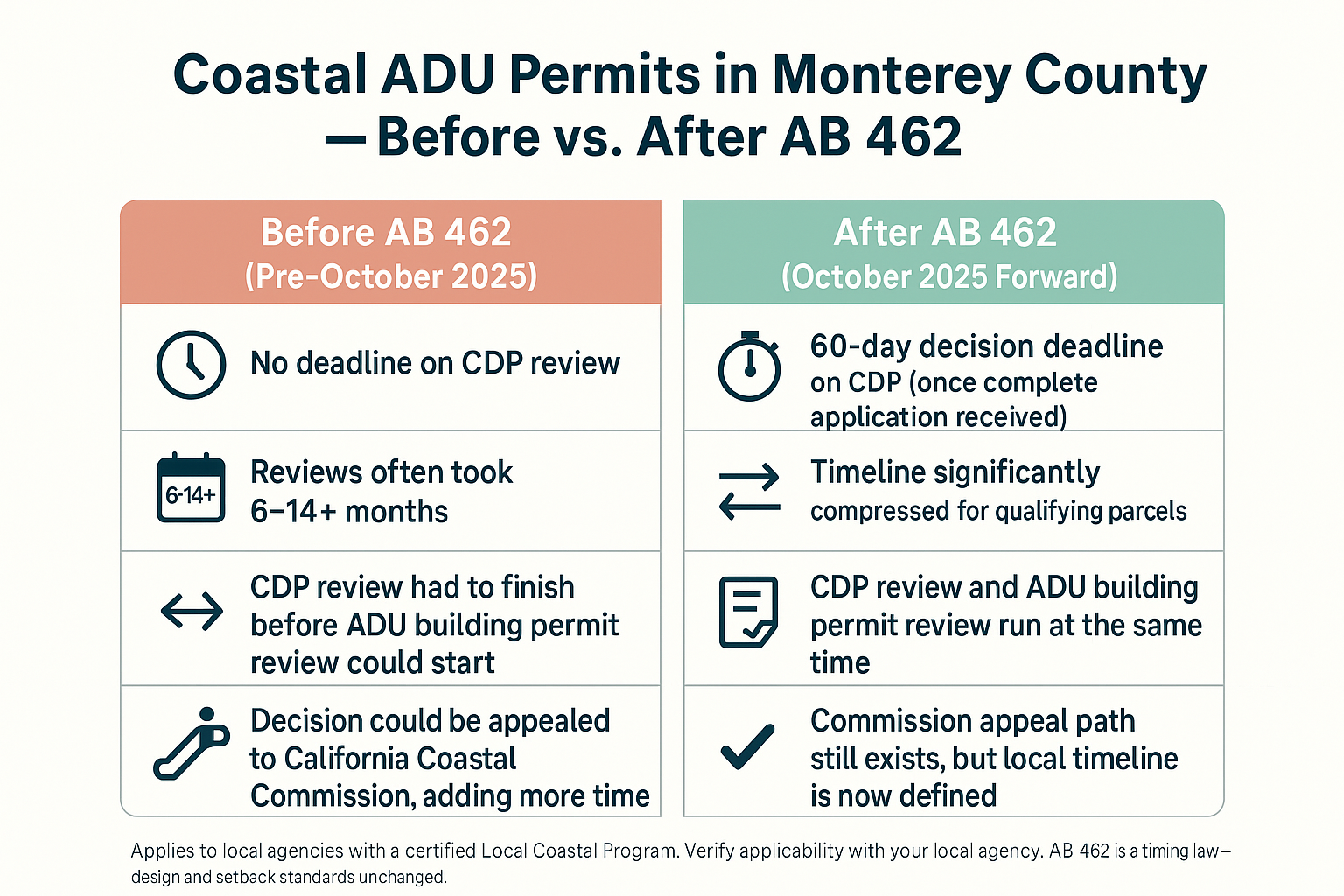
Before and After AB 462: Coastal ADU Permit Timeline in Monterey County
This comparison shows how the coastal ADU permit process changed under AB 462 — from a sequential, open-ended review to a concurrent, deadline-driven track.
The ‘Complete Application’ Problem — Why This Is the New Critical Step
The 60-day clock does not start until the agency receives a complete application. That single condition is where a lot of coastal ADU projects will still get stuck.
An incomplete submission gets sent back. The clock resets. You resubmit. And in the meantime, weeks or months pass while you chase down missing documents.
In Monterey County, a complete coastal ADU application typically requires:
- Site plan showing parcel boundaries, existing structures, proposed ADU footprint, and setbacks to property lines and coastal resources
- Floor plans and elevations for the proposed unit, dimensioned and to scale
- Coastal resource analysis — documentation addressing visual impacts, proximity to wetlands or ESHA (Environmentally Sensitive Habitat Areas), and how the project meets LCP policies
- Proof of legal lot status and current parcel zoning designation
- Completed CDP application form with all required signatures and fees
- Any required environmental health department pre-clearance documentation, particularly for septic systems on parcels not served by municipal sewer
That list is not exhaustive, and requirements can vary by parcel and project type. But the pattern is consistent: projects that get submitted with professional-grade drawings and complete documentation move to the 60-day clock immediately. Projects that go in with rough sketches and missing items cycle back before the clock ever starts.
One homeowner in Carmel Valley reached out asking whether a detached structure on their property could become a rentable ADU and what drawings would be needed to even apply — that question is exactly the right starting point. Confirming Coastal Zone status, verifying LCP certification, and understanding the documentation threshold before investing in design work is the move that separates a fast project from a slow one.
For a full picture of what ADU construction costs look like in this region once permitting is underway, the cost guide for Monterey, Santa Cruz, and San Benito Counties breaks down the major variables.
Coastal ADU Permit: What Changed and What Stayed the Same Under AB 462
This table is a quick reference for homeowners comparing the pre- and post-AB 462 regulatory environment for ADU projects in Monterey County’s Coastal Zone.
| Factor | Before AB 462 | After AB 462 |
|---|---|---|
| CDP review deadline | None — open-ended | 60 days from complete application |
| Review sequencing | CDP first, then ADU building permit | CDP and ADU permit run concurrently |
| CDP requirement | Required | Still required — not eliminated |
| ADU size/height/setback rules | Set by state law and local LCP | Unchanged — same rules apply |
| Commission appeal path | Available | Still available |
| Applies to | N/A | Local agencies with certified LCPs only |
What This Means If You Had a Coastal ADU Project on Hold
If you shelved a coastal ADU plan because the old permit timeline felt like a gamble you couldn’t afford to take, the situation is genuinely different now. The regulatory environment changed — and for the first time, you can plan around a real deadline instead of an open-ended process.
That said, the preparation work matters more now, not less. Because the 60-day clock only starts on a complete submission, the quality of the upfront package — drawings, site documentation, coastal resource analysis — is what determines whether your project moves on the new fast track or gets recycled back into the queue.
A few practical steps worth taking before submitting anything:
- Confirm your parcel’s Coastal Zone status using Monterey County’s GIS mapping tools or by contacting the county planning department directly. Not every parcel near the coast is inside the Coastal Zone boundary.
- Verify your local agency’s LCP certification status — the 60-day rule only applies where the LCP is certified. Unincorporated Monterey County is covered; some incorporated cities may differ.
- Have professional drawings prepared that meet the county’s submission standards before you apply — not after the first rejection.
- Check septic and utility conditions early, since environmental health review and PG&E coordination can run parallel to the permit process but have their own timelines.
For anyone navigating the Salinas-area ADU process specifically, the guide on how to navigate ADU construction in Salinas without surprises covers the local permitting sequence in plain terms.
Frequently Asked Questions About Coastal ADU Permits in Monterey County
Does AB 462 apply to my property in Carmel or Carmel Valley?
It depends on two things: whether your parcel falls inside the Coastal Zone boundary, and whether the local agency has a certified Local Coastal Program. Much of unincorporated Monterey County — including parts of Carmel Valley — falls under the county’s certified LCP, so AB 462 should apply. But Coastal Zone boundaries are parcel-specific, and incorporated cities may operate under different conditions. Verify with Monterey County Planning before assuming the 60-day clock covers your project.
Does the CDP requirement go away under AB 462?
No. The Coastal Development Permit is still required for ADU projects inside the Coastal Zone. AB 462 only changed the timing — agencies must now decide within 60 days of a complete application. The permit itself, and all the design standards that go with it, remain in place.
What happens if my application isn’t complete when I submit it?
The 60-day clock does not start until the agency formally accepts your application as complete. An incomplete submission gets returned — and the timeline resets when you resubmit. Getting the documentation package right on the first try is the single biggest factor in how fast your project moves under the new rules.
Can a Coastal Development Permit decision still be appealed to the California Coastal Commission?
Yes. AB 462 did not eliminate the Commission appeal pathway. A local agency decision can still be appealed, which could extend the overall project timeline beyond the 60-day local review. The law improved the local process — it didn’t remove the state’s oversight role.
How much does a coastal ADU permit cost in Monterey County?
Permit fees in Monterey County vary depending on project type, square footage, and which agencies are involved — county planning, environmental health, and building all charge separately. Based on general market context for California coastal jurisdictions, total permit-related fees for a standard ADU often run somewhere in the range of $5,000 to $15,000 or more, but that range shifts significantly based on site conditions and project complexity. Aldridge Construction can walk through expected fee categories for your specific parcel during an initial consultation.
Is a garage conversion treated the same as a new detached ADU under coastal rules?
Not necessarily. Conversions of existing structures and new detached construction can be evaluated differently under a Local Coastal Program, particularly around issues like impervious surface coverage, visual impact, and proximity to sensitive resources. The underlying analysis depends on what the LCP says about your parcel type. This is one of the reasons a contractor with specific Monterey County coastal experience matters — the regulatory details vary by project type, not just by location.
Ready to Find Out If Your Coastal Property Qualifies?
Aldridge Construction works with homeowners across Monterey County — including Carmel, Carmel Valley, Seaside, and the Salinas area — on ADU projects that involve exactly this kind of regulatory groundwork. If you have a property inside or near the Coastal Zone and want a straight answer about what the process actually looks like for your parcel, Brian Aldridge can walk through it with you. Reach the team at 831-682-9788 or through the contact page at aldridgeconstruction.biz.