
Embarking on a home renovation, custom build, or ADU project is a significant investment of time, money, and trust. The ultimate success of your project, whether in Monterey County, CA, or Maricopa County, AZ, hinges on choosing the right construction partner.
The most effective way to vet a potential builder is by asking insightful, specific questions that go far beyond a simple price quote. The answers you receive will reveal their professionalism, experience, and commitment to quality. This guide provides the essential questions to ask general contractors, ensuring you find a trustworthy expert like Aldridge Construction to bring your vision to life.
1. Are You Properly Licensed and Insured?
This is the absolute first question you must ask any potential contractor. It’s a non-negotiable starting point that separates legitimate professionals from unqualified and risky operators.
A proper license demonstrates that the contractor has met state-mandated requirements for experience and knowledge. Adequate insurance protects you from financial ruin if an accident occurs on your property.
Why This Question Is Critical
Hiring an unlicensed contractor can lead to disastrous consequences. For example, in California, if an unlicensed contractor’s work fails inspection, the homeowner is often left responsible for paying for the necessary corrections and may even face fines under California Business and Professions Code.
This initial query acts as a powerful filter. A legitimate contractor will readily provide their license number and insurance certificates. Any hesitation is a major red flag.
Actionable Steps for Verification
Don't just take their word for it. Proactive verification is simple and essential.
- Check the License Online: For projects in Monterey, Santa Cruz, or San Benito counties, use the California Contractors State License Board (CSLB) website. For work in Maricopa County, consult the Arizona Registrar of Contractors (ROC) portal.
- Request Insurance Certificates: Ask for a Certificate of Insurance (COI) for both General Liability and Workers' Compensation. General liability covers property damage, while workers' comp covers injuries to the contractor's employees.
- Confirm Coverage Directly: Call the insurance agency listed on the certificate to confirm the policy is active and the coverage amounts are sufficient for your project's scope.
- Investigate Their History: Use the state licensing board websites to check for any public complaints or disciplinary actions associated with the contractor’s license number.
2. Can You Provide References and Examples of Past Projects?
After verifying credentials, the next step is to evaluate their actual work. Reviewing a portfolio and speaking with past clients provides unfiltered insight into their workmanship, reliability, and communication style.
A reputable contractor will have a portfolio showcasing a range of work, from custom homes to specific remodels featuring high-quality materials like energy-efficient Milgard windows or durable Trex decking.

Why This Question Is Critical
This question separates contractors with a proven history of client satisfaction from those who may only look good on paper. A confident, experienced contractor will be proud to share their work and connect you with happy customers.
Hesitation to provide recent, relevant references is a significant warning sign. It suggests they may have something to hide or lack the specific experience your project requires.
Actionable Steps for Verification
Diligence here will pay dividends, ensuring you find a good contractor who aligns with your expectations.
- Request Relevant References: Ask for at least three recent references for projects similar in scope and style to yours. If you're planning a kitchen remodel in Santa Cruz, a reference for a commercial build in Arizona is less helpful.
- Visit a Completed Site: If possible, ask to visit a completed project in person. This allows you to assess the quality of finishes, joinery, and overall craftsmanship up close.
- Ask Specific Questions: When speaking with references, go beyond "Were you happy?" Ask pointed questions like:
- "How did the contractor handle unexpected issues or change orders?"
- "Was the project completed on schedule and on budget?"
- "How was the communication with the project manager?"
- "Were you satisfied with the cleanliness and professionalism of the worksite?"
- Review Their Full Portfolio: Look for consistency in quality across a range of projects, not just one or two showcase examples.
3. What Is Your Project Timeline and Key Milestones?
After confirming a contractor is licensed, the next critical area is the project schedule. Asking for a detailed timeline is one of the most important questions to ask general contractors, as it establishes clear expectations from day one.
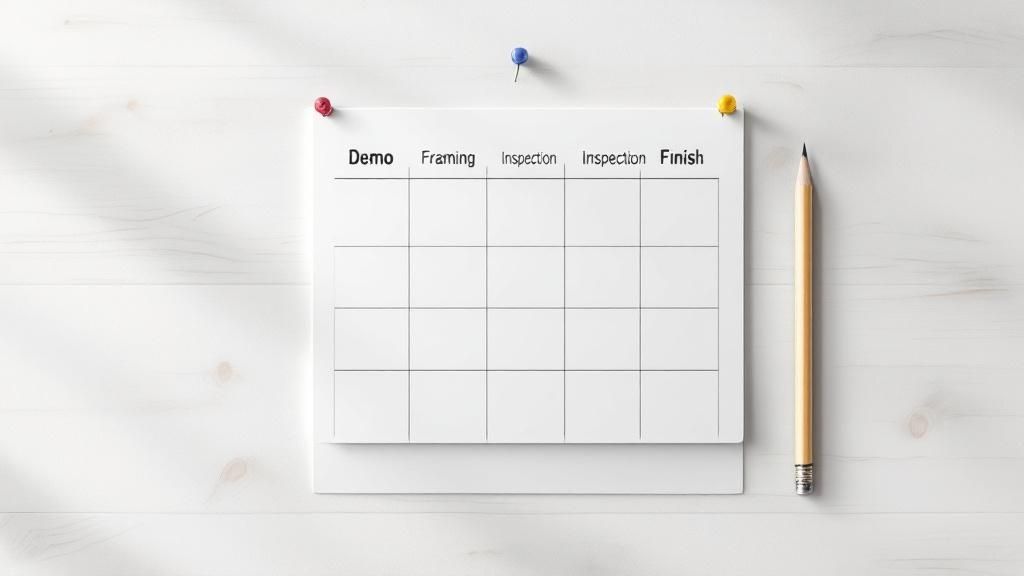
This schedule is a roadmap that dictates material orders, subcontractor coordination, and permit inspections. A professional timeline will account for local factors, such as scheduling exterior work around the rainy season in Monterey or extreme summer heat in Maricopa County.
Why This Question Is Critical
A vague answer like "it should take a few months" is a major red flag. A professional contractor will have a system for mapping out projects, which becomes the backbone of your contract and the primary tool for measuring progress.
This accountability prevents the project from dragging on indefinitely. It also helps you coordinate your own life around the work.
Actionable Steps for Verification
A verbal promise isn't enough. Ensure the timeline is a concrete, documented part of your agreement.
- Require a Written Schedule: Insist that the detailed timeline, including key milestones like demolition, framing, and final inspections, is included in the contract.
- Discuss Delay Protocols: Ask pointedly: "How do you handle unexpected delays, and how will you communicate them?" A good contractor has a clear process for issuing change orders and updating the schedule.
- Build in a Contingency: For any major renovation, it’s wise to mutually agree on a time contingency of 10-15% to account for weather or supply chain issues.
- Define "Completion": Clarify what "substantial completion" means. Does it include passing the final inspection from the city or county, or just finishing the punch list?
4. How Do You Handle Change Orders and Unexpected Costs?
Even with meticulous planning, surprises are a natural part of construction. Hidden issues like termite damage or outdated wiring can emerge once walls come down.
A professional contractor anticipates this with a clear, documented process for managing changes, known as a change order. This is one of the most important questions to ask general contractors to avoid budget shock and disputes.
Why This Question Is Critical
This question reveals how a contractor handles adversity and maintains financial transparency. An ambiguous or verbal-only approach to changes is a massive red flag that can lead to significant budget overruns.
A well-defined system ensures both parties are on the same page about any adjustments to the scope, timeline, and cost. It turns unexpected problems into manageable, agreed-upon solutions.
Actionable Steps for Verification
Before signing a contract, ensure their change-order process is clearly defined.
- Request a Sample Change-Order Form: Ask to see the document they use. It should have clear fields for a description, a line-item cost breakdown, and the impact on the project schedule.
- Discuss the Approval Process: Agree on a response window (e.g., 24–48 hours) for you to review and approve change orders to keep the project moving.
- Clarify Mark-up Policies: Ask what percentage, if any, they add to subcontractor invoices or materials for change-order work.
- Confirm "No Work Without Approval": Get explicit confirmation that no additional work incurring extra costs will be performed without your signed approval on a formal change order.
5. What Is Your Payment Schedule?
A transparent payment schedule is the financial backbone of a successful project. This schedule details the initial deposit, progress payments tied to specific milestones, and the final payment.
For instance, a draw might be due after framing is complete and passed inspection, or once all cabinetry is installed. This structure ensures you only pay for work that has been verifiably completed to your satisfaction.
Why This Question Is Critical
Asking about the payment schedule sets clear financial expectations. It prevents situations where a contractor asks for large sums of money upfront with no work to show for it—a major red flag for potential scams.
A milestone-based schedule protects your investment by ensuring the contractor remains motivated to move the project forward efficiently to trigger their next payment.
Actionable Steps for Verification
Before signing any contract, carefully review the proposed payment schedule.
- Scrutinize the Deposit: Never pay a huge deposit. In California, a contractor cannot legally ask for a down payment of more than 10% of the total contract price or $1,000, whichever is less.
- Tie Payments to Milestones: Insist that every payment is linked to a clear, verifiable milestone. Examples include "foundation poured," "rough-in electrical passed inspection," or "drywall installed."
- Require Lien Waivers: Before releasing a progress payment, require the contractor to provide signed lien waivers from themselves and all major subcontractors. This document proves they have been paid and prevents them from placing a mechanic's lien on your property.
- Hold Back Final Payment: The contract should specify that a final payment (typically 5-10%) is held back until the "punch list" of all remaining minor fixes is complete. You can explore how project size affects these milestones using a room addition cost calculator.
6. Who Will Be Onsite Daily and Who Manages Subcontractors?
Understanding the chain of command is crucial for smooth communication. You need to know exactly who is responsible for day-to-day progress and who to contact with questions.
A well-defined team structure prevents confusion and minimizes delays. For a complex kitchen remodel in Maricopa County, for instance, knowing the dedicated project manager is the go-to for all queries streamlines the entire process.
Why This Question Is Critical
This question reveals how a contractor organizes their team. A clear answer indicates a well-oiled machine, while a vague response could signal potential chaos.
Knowing who manages subcontractors (the plumber, electrician, painter) and who supervises the job site daily lets you know who is ultimately accountable for quality and schedule.
Actionable Steps for Verification
Establish clear communication protocols before the first hammer swings.
- Request an Org Chart: Ask the contractor to include a simple organizational chart in your contract. This should name the Project Manager (main contact for scheduling/budget) and the Site Supervisor (contact for daily onsite activities).
- Schedule Weekly Meetings: Insist on a standing weekly on-site meeting at a fixed time to review progress and make decisions.
- Confirm Subcontractor Insurance: Verify that the general contractor requires all subcontractors to carry their own liability and workers' compensation insurance. Ask for proof, as this protects you from liability.
- Discuss Communication Methods: Define the preferred method for updates and questions, whether it's a daily text, a weekly email summary, or calls at specific times.
7. How Do You Ensure Quality Control and Code Compliance?
A beautifully designed project means nothing if the execution is flawed. A robust quality control (QC) process ensures every task meets industry standards and your personal expectations.
It also guarantees that all work adheres strictly to local building codes, such as California's Title 24 energy standards, preventing failed inspections and costly rework.
Why This Question Is Critical
Asking about quality control and code compliance reveals a contractor's internal processes. A confident contractor will welcome this question and can clearly articulate their system.
They should be able to explain how they manage subcontractors, conduct internal inspections, and prepare for municipal inspections. This isn't just about avoiding defects; it's about building your project right the first time.
Actionable Steps for Verification
Don't settle for a vague answer like "we keep an eye on things." Dig deeper to understand their specific procedures.
- Request a QC Checklist: Ask to see a blank copy of a quality control checklist or punch list they use. This document provides a window into their process.
- Discuss the Inspection Process: Inquire about their schedule for internal and municipal inspections. How do they prepare for city or county inspectors in places like Salinas or Santa Cruz?
- Clarify the Final Walkthrough: Confirm who will be present at the final walkthrough. Ideally, the general contractor and key trade foremen should attend to address any final punch list items.
- Understand Permit Compliance: Ask how they ensure every phase of work aligns with the approved plans and permit requirements.
8. How Will We Communicate and Share Project Updates?
A successful project runs on clear, consistent communication. Establishing a protocol before work begins is essential for preventing misunderstandings and managing expectations.
A contractor who prioritizes a transparent communication plan demonstrates organization and respect for your investment. Without a system, crucial details can get lost in a sea of texts, missed calls, and unread emails.
Why This Question Is Critical
This question reveals how a contractor manages information and client relationships. A professional will have a system ready, whether it's a dedicated project management app or scheduled weekly meetings.
Vague responses like "we'll just call you" are a red flag, indicating potential for chaos. A clear plan ensures homeowners in areas like Monterey or Maricopa County remain informed and in control.
Actionable Steps for Verification
Lock in your communication strategy before signing the contract.
- Establish a Primary Channel: Agree on one main method for non-urgent updates, such as email or a project management tool. This creates a single, searchable record.
- Schedule Recurring Meetings: Set up a standing weekly meeting, either on-site or virtual, to review progress and address concerns.
- Request Visual Updates: Ask for photo or video documentation at key project stages. This is invaluable for tracking progress, especially for out-of-town property owners.
- Define Emergency Contact Procedures: Clarify the best way to get in touch for urgent matters and define what constitutes an emergency.
Frequently Asked Questions (FAQs)
1. What is the difference between an estimate, a bid, and a contract?
An estimate is a rough approximation of cost. A bid is a more detailed, fixed-price offer to complete the project for a specific amount. A contract is the final, legally binding document that details the full scope of work, timeline, payment schedule, and materials. Aldridge Construction provides comprehensive bids that form the basis of a transparent contract.
2. How much should I budget for unforeseen issues?
It's standard practice to set aside a contingency fund of 10-20% of the total project cost. This covers unexpected issues like hidden structural damage or asbestos that aren't visible until demolition begins. A professional contractor will discuss this with you during the planning phase.
3. What happens if I want to change something mid-project?
This is handled through a "change order." It's a written document that details the change, the additional cost for materials and labor, and any adjustment to the project timeline. You must sign this document before the new work begins, ensuring full transparency.
4. How long does the permitting process take in Monterey or Santa Cruz County?
Permit timelines vary significantly by jurisdiction and project complexity. A simple remodel might take a few weeks, while a new custom home or major addition can take several months. Aldridge Construction has extensive experience navigating the permitting departments in Monterey, Santa Cruz, and San Benito counties and can provide a realistic timeline estimate for your specific project.
5. Does the general contractor handle all permits and inspections?
Yes, a full-service general contractor like Aldridge Construction is responsible for pulling all necessary permits, scheduling all required inspections with local officials, and ensuring the project passes at every stage. This is a key part of their project management role.
Ready to Build with Confidence in California or Arizona?
Choosing the right general contractor is the single most important decision for your project. A low bid can often hide future costs from surprise change orders, subpar materials, or project delays. The most reliable contractors welcome detailed inquiries as an opportunity to demonstrate their commitment to quality and integrity.
Arming yourself with these questions to ask general contractors is the first step. Now, it’s time to put them into action. Pay close attention not just to what they say, but how they say it. A true professional understands that an informed client is an empowered one, and an empowered client is the best partner for a successful build.
Ready to work with a team that has clear, confident answers to every one of these questions? At Aldridge Construction, we believe transparency and expertise are the foundation of every successful project we undertake in Monterey, Santa Cruz, San Benito, and Maricopa Counties.
Contact Aldridge Construction for a consultation where your questions are always welcome.