
Direct Answer: Most Salinas homeowners underestimate bathroom renovation timelines by 2–4 weeks. Permits, material lead times, and trade scheduling — not demo and tile — are what actually slow projects down.
Most Salinas homeowners who plan a bathroom renovation budget their time the way they budget their money — they guess low and figure they’ll adjust later. The problem is that adjusting later in a bathroom renovation means showering at the gym for an extra three weeks.
Bathroom projects in Monterey County have real timing layers that most homeowners never see coming. Permits, inspector availability, material backlogs, and trade sequencing all stack on top of each other — and none of them care about your schedule.
This article breaks down what actually controls a bathroom renovation timeline, where projects most commonly stall, and what you can do to keep things moving from the planning phase forward.
The Timeline Most Homeowners Expect — vs. What Actually Happens
Walk into any home improvement store in Salinas or Seaside and you’ll hear the same assumption: a bathroom remodel takes two to three weeks. That’s based on visible work — demo, tile, fixtures, paint. And sure, the hands-on construction portion of a straightforward bathroom might hit that window.
But the visible work is only part of the project. Here’s what the full timeline actually looks like for a standard bathroom renovation in Monterey County:
- Permit application and approval: 2–4 weeks for standard residential permits through the City of Salinas Building Division
- Material lead times: 2–6 weeks depending on tile, vanities, and specialty fixtures
- Trade scheduling: Plumbers, electricians, and tile setters each need their own scheduling window
- Inspections: Each phase — rough plumbing, rough electrical, waterproofing — requires a separate inspection and inspector availability can add days
- Punch list and final walkthrough: 3–5 days at the end for corrections and closeout
Add that up and a 6–10 week total timeline is realistic for most bathroom renovations in this area. Projects that touch the electrical panel, move drain lines, or involve older homes from the 1950s and 60s — which are common in central Salinas neighborhoods — can push past 12 weeks.
The homeowners who feel burned by contractors are usually the ones who were quoted the construction time, not the total project time. Those are two very different numbers.
Why Permits Add More Time Than People Expect in Monterey County
A lot of homeowners ask whether they really need a permit for a bathroom remodel. The answer in California is: it depends on what you’re changing, but most meaningful renovations do require one. Do you really need a permit for that remodel? covers this in detail, but here’s the short version for bathrooms.
If you’re moving a toilet, relocating a sink drain, adding a circuit for a heated floor, or touching any structural wall, you need a permit. In the City of Salinas, permit applications for residential work are submitted through the Building Division on Lincoln Avenue, and review times vary based on department workload.
In unincorporated Monterey County — which covers a lot of the Salinas Valley, Gonzales, and rural areas east of Highway 101 — you’re working with the County’s Building Services department instead, and the sequencing can be slightly different.
A few things that routinely slow down the permit phase:
- Incomplete applications or missing contractor license information
- Projects that trigger environmental health review (septic connections in rural areas)
- Plan check comments that require revised drawings before approval
- High-volume periods — spring and early summer are peak season
Building in a 3-week permit buffer before any construction starts is a reasonable baseline. Some projects clear faster; some don’t. But assuming permits are a quick errand is the single most common scheduling mistake homeowners make.
Material Lead Times Are the Hidden Schedule Killer
Even after permits are in hand, projects stall waiting on materials. This is especially true for bathrooms because so many finishes are ordered custom or semi-custom — specific tile patterns, vanities in non-standard sizes, walk-in shower systems, and specialty faucet finishes.
The supply chain for these products has improved since 2021–2022, but lead times are still real. Here’s what to expect in the current market:
- Standard ceramic or porcelain tile (in-stock): 3–7 days
- Special order tile (imported or large format): 3–6 weeks
- Vanities from big box stores: 1–2 weeks
- Semi-custom vanities from specialty vendors: 4–8 weeks
- Walk-in shower systems (prefab): 2–4 weeks
- Custom shower glass enclosures: 4–6 weeks after measurements (which can only be taken after tile and curb work is done)
That last point about shower glass is one people miss. Glass enclosures are measured after the tile is complete — not before — because field dimensions never match plan dimensions exactly. So even if the glass is ordered early, it can’t be installed until the tile work is done and cured.
For homeowners planning a double sink bathroom layout or anything with a custom vanity run, front-loading the material decisions by 4–6 weeks before demolition is the single best thing you can do to keep construction moving without gaps.
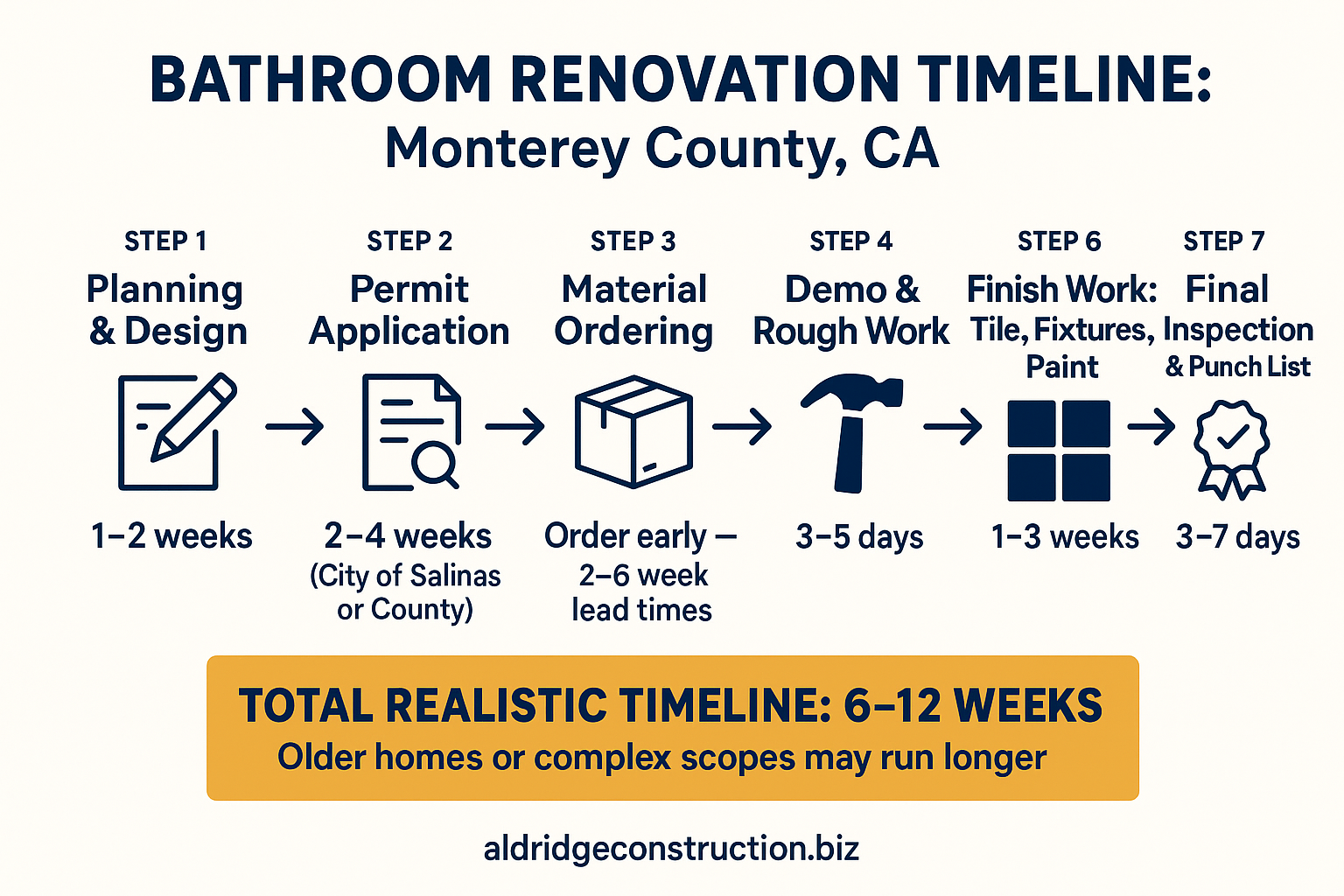
Bathroom Renovation Timeline: Phase by Phase
This breakdown shows the typical phases of a Monterey County bathroom renovation and how they stack against each other in real time.
Trade Sequencing: Why You Can’t Rush the Order of Operations
Here’s something that surprises a lot of homeowners: construction trades can’t all work at the same time. There’s a strict sequence, and skipping steps or overlapping phases creates defect risk, failed inspections, and rework.
A standard bathroom renovation follows this general order:
1. Demo — remove existing fixtures, tile, drywall
2. Rough plumbing — move or modify drain and supply lines
3. Rough electrical — new circuits, GFCI placement, exhaust fan wiring
4. Inspections — rough plumbing and electrical must pass before walls close
5. Waterproofing — shower pan, wet wall membranes
6. Backer board and tile substrate
7. Tile installation — floor first, then walls
8. Fixtures and vanity installation
9. Finish electrical — outlets, switches, fan
10. Paint, trim, accessories
11. Glass enclosure — measured and installed after tile cure
12. Final inspection
Each trade needs to finish their phase before the next begins. A plumber who shows up late for rough-in doesn’t just delay their own work — they push back every trade behind them.
This is why scheduling coordination matters as much as the work itself. A contractor who manages the sequencing tightly keeps a project on a 6-week track. One who lets trades drift adds 2–4 weeks without adding a single extra task.
Bathroom Renovation Timeline by Project Type — Monterey County
These are realistic total timelines from planning to final inspection, not just construction days. Actual times vary based on permit load, material selection, and home age.
| Project Type | Typical Total Timeline | Biggest Delay Risk |
|---|---|---|
| Cosmetic refresh (no permit needed) | 2–3 weeks | Material lead times |
| Full gut remodel, same layout | 6–8 weeks | Permit review + inspections |
| Layout change (move plumbing) | 8–10 weeks | Permit + rough plumbing inspection |
| Primary bath addition to existing home | 10–14 weeks | Structural review, multiple inspections |
| Older home (pre-1960s) full remodel | 10–16 weeks | Hidden conditions, asbestos/lead testing |
| Small bathroom, tight access | 7–9 weeks | Trade access, waterproofing complexity |
Older Homes Add Timeline Risk That’s Hard to Predict
A large share of homes in central Salinas, Gonzales, and older Monterey neighborhoods were built between 1940 and 1975. These homes carry hidden conditions that can stop a renovation cold once walls open up.
Common surprises in older Salinas-area homes:
- Asbestos-containing materials in floor tile, drywall compound, or pipe insulation — requires certified abatement before demo continues
- Knob-and-tube or aluminum wiring that needs replacement before a new bathroom circuit can connect
- Cast iron drain lines that are corroded or undersized for current code
- No subfloor waterproofing beneath existing tile — moisture damage that’s much worse than it looked from outside
- Out-of-plumb walls that make tile layout and shower enclosure fitting significantly harder
None of these are a contractor’s fault — they’re conditions that exist behind the walls before anyone touches them. But they add real time. Asbestos abatement alone can add 5–10 business days once a sample comes back positive, and the project is legally stopped until clearance is issued.
If your home was built before 1978, build in a contingency buffer of at least 2 extra weeks and $2,000–$5,000 before you start. That’s not pessimism — that’s just what the numbers look like in this market.
What You Can Actually Do to Keep Your Project on Track
Timeline overruns aren’t inevitable. Homeowners who do a few things right in the planning phase consistently have smoother projects.
Here’s what actually helps:
- Make all material selections before demo starts. Every undecided finish is a future delay.
- Ask your contractor for a written project schedule — not a ballpark, but a phase-by-phase plan with inspection milestones. Knowing what questions to ask before hiring a contractor starts with exactly this.
- Understand what a punch list is and when it happens. A punch list at the end of your project is normal — it’s not a sign things went wrong. It’s the documented final check.
- Don’t change your mind mid-project. Scope changes after demo is done are the fastest way to extend a timeline and increase cost.
- Have a temporary bathroom plan. In a one-bathroom home, know exactly what you’re doing for 6–8 weeks before the project starts.
And ask your contractor directly: What will stop this project, and how will we handle it? A contractor who gives you a real answer — not just reassurance — is the one worth hiring.
For Santa Cruz County homeowners dealing with similar questions, the bathroom renovation guide for Santa Cruz covers some of the same ground with county-specific context.
Frequently Asked Questions About Bathroom Renovation Timelines
How long does a bathroom renovation actually take in Salinas?
A full bathroom renovation in Salinas realistically takes 6–10 weeks from permit application to final inspection. Cosmetic-only projects with no permit work can finish in 2–3 weeks. Older homes or projects that move plumbing can push to 12 weeks or more.
Do I need a permit for a bathroom remodel in Monterey County?
Yes, in most cases. If you’re moving plumbing, adding electrical circuits, or making structural changes, a permit is required. The City of Salinas Building Division handles permits for city properties; unincorporated Monterey County goes through the County Building Services department. Check with your local agency before assuming no permit is needed.
What causes most bathroom renovation delays?
Permit review times and material lead times are the two biggest culprits — neither one has anything to do with how fast a crew works. Undecided material selections and hidden conditions in older homes are close behind. Coordinating trade schedules is where good project management pays off.
Can I live in my house during a bathroom renovation?
Yes, but plan ahead. If you have a second bathroom, you’re in good shape. If it’s a one-bathroom home, you’ll need a temporary arrangement for potentially 6–8 weeks. Some homeowners stay with family; others rent a nearby unit short-term. Don’t leave this unplanned — it adds stress fast.
What’s the biggest mistake homeowners make when planning a bathroom remodel timeline?
Quoting construction time as total project time. The visible work — demo, tile, fixtures — might take 2–3 weeks. But permits, inspections, material ordering, and trade scheduling can add 4–6 weeks before and after. Build your calendar around the full project duration, not just the hammer time.
Ready to Plan Your Bathroom Renovation with Real Numbers?
If you’re a homeowner in Salinas, Monterey, Gonzales, or anywhere else in Monterey County thinking about a bathroom remodel, Aldridge Construction is available to walk through the timeline and scope with you before you commit to anything. Brian Aldridge and his team can be reached directly at 831-682-9788 or through the contact page at aldridgeconstruction.biz — no pressure, just a straight conversation about what your project actually involves.