
Thinking about a room addition is exciting, but the first question is always about cost. While a quick search for a room addition cost calculator might give you a number, the final price can swing wildly from around $21,000 to over $100,000. The final total depends entirely on your project's scope, your location, and the finishes you select.
Nailing down a realistic budget from the start is the most critical step. This guide will walk you through the key factors that shape the cost, helping you plan effectively.
Your Guide to Estimating Room Addition Costs
An online room addition cost calculator provides a ballpark figure, but it’s often too simple to be accurate. These tools use national averages and can't account for local realities that drive the final bill. For homeowners in places like Monterey County, CA, or Maricopa County, AZ, local labor rates and material costs make a massive difference.
To get a number you can trust, you need to dig deeper than a single online estimate and understand the moving parts of a construction budget.
Quick Look at Room Addition Cost Factors
To get a clear picture of where your money goes, it helps to break down the main cost drivers. Each of these elements can significantly shift your budget, so understanding them is key to making smart decisions.
| Cost Factor | Low-End Impact | High-End Impact |
|---|---|---|
| Project Scope & Size | A small 120 sq. ft. bump-out. | A 400+ sq. ft. multi-room extension. |
| Room Type | Basic living space like a den or office. | A kitchen or bathroom requiring complex plumbing & electrical. |
| Level of Finishes | Builder-grade materials and standard fixtures. | Custom cabinetry, quartz countertops, and premium windows. |
| Structural Changes | A simple addition on a slab foundation. | A second-story addition requiring structural reinforcement. |
These four areas are where you have the most control. A small change in one, like opting for premium flooring instead of standard, can have a ripple effect on the total cost.
Key Factors Influencing Your Budget
Let’s break down those core components further. Each one plays a huge role in the final number, and tweaking any of them will move the needle on your budget.
-
Project Scope & Size: This is the most straightforward factor. A simple 10×12 foot bedroom is obviously less expensive to build than a sprawling 400-square-foot great room that opens to the backyard.
-
Room Type & Complexity: What you're building inside the new walls is a massive cost driver. A bathroom or kitchen addition, with all the necessary plumbing, electrical, and ventilation work, will always have a higher per-square-foot cost than a simple bedroom or home office.
-
Level of Finishes: Here’s where personal taste meets the budget. Your choice of materials creates a huge cost spectrum. You can keep things affordable with standard, builder-grade materials or go high-end with custom cabinetry, exotic hardwood floors, or premium Milgard windows, which will naturally push the budget higher.
-
Structural Changes: The complexity of the build itself heavily influences labor costs. Extending your home "out" with a new foundation is a different ballgame than building "up" with a second-story addition. The latter requires significant work to reinforce the existing structure to carry the new load.
A common mistake is getting fixated on the cost per square foot while forgetting fixed costs. Architectural plans, site preparation, and permits come with significant price tags, whether you’re adding 100 or 500 square feet.
Understanding Average Costs
To ground your expectations, it helps to look at industry data. According to Remodeling Magazine's 2024 Cost vs. Value Report, a midrange primary suite addition of 24×16 feet averages around $157,000 and recoups about 32.7% at resale.
A more useful metric is often the price per square foot, which typically sits between $80 and $200. But even that can be misleading because the room's function causes wild swings. For example, a small bedroom addition might cost between $9,600 and $24,000. In contrast, a new bathroom can run anywhere from $20,000 to over $90,000 due to the intensive plumbing and expensive fixtures involved.
This is also why it’s critical to understand the difference between a standard addition and an Accessory Dwelling Unit (ADU). ADUs come with their own set of rules, regulations, and cost structures. You can explore our detailed guide on the cost to build an ADU to see how different the budgeting process can be.
Deconstructing The Costs Per Square Foot
When you start planning a room addition, one of the first terms you'll hear is "cost per square foot." It’s the construction industry’s go-to metric, but it’s a number that can be wildly misleading if you don't know what's behind it.
Think of the cost-per-square-foot figure as a blended average. It’s a convenient shorthand that bundles the core construction elements into one number, giving you a starting point for your budget.
What Is Included in the Base Square Foot Price
When a contractor gives you a baseline cost per square foot, they’re usually talking about the essentials needed to build a weatherproof, structurally sound "shell." It's the bare bones of your new space.
This foundational price typically covers:
- Foundation Work: Pouring a standard concrete slab or building a crawl space.
- Framing: All the lumber and labor to erect the walls, floor system, and roof.
- Exterior Finishes: Basic siding, standard roofing, and simple trim work.
- Insulation and Drywall: Insulating the walls and ceiling, then hanging and finishing the drywall.
- Basic Electrical: Running wires for standard outlets and a central light fixture.
- Standard Windows and Doors: Builder-grade units that are functional and meet code.
Essentially, you get a finished, enclosed room. But it’s what isn't included that often catches homeowners by surprise and can dramatically inflate the final cost. Assuming the initial square-foot estimate is all-inclusive is a critical mistake.
Why This Number Varies So Dramatically
The cost per square foot is never a fixed price because no two projects are the same. Several key factors make this number swing, sometimes by a huge margin. For example, national data suggests room additions can average between $125 and $250 per square foot.
So, a 400-square-foot family room could run anywhere from $50,000 to $100,000. A smaller 100-square-foot bump-out might fall between $12,500 and $25,000. The range is massive.
The project's scale also plays a huge part. A larger addition, like a 500-square-foot great room, often has a lower cost per square foot than a small 200-square-foot primary suite. Why? Because big-ticket fixed costs—like architectural plans, permits, and excavation—get spread out over more square footage, creating better economies of scale.
How Local Conditions Affect Your Costs
Beyond the build itself, local factors in places like Santa Cruz or San Benito County will have a huge impact on your final price. These are the details a generic online calculator will never capture.
- Soil Conditions: The expansive clay soil common in many parts of California often requires a more robust—and expensive—engineered foundation.
- Zoning and Setbacks: Local rules in Monterey or Santa Cruz determine how close you can build to your property lines. Tight lots might demand complex engineering or retaining walls, adding to the budget.
- California Building Codes: We work with some of the strictest regulations in the country, like California’s Title 24. It mandates high-performance insulation, energy-efficient Milgard windows, and specific HVAC systems that all increase material costs.
- Labor and Material Availability: Labor rates and supply chain pressures differ dramatically. A project in a booming area like Maricopa County, AZ, will face different cost factors than one on the Central Coast.
Understanding these variables is what turns a vague estimate into a rock-solid budget. As you put the financial pieces together, it's smart to look at all your funding avenues; our guide on home renovation loans is a great place to start.
How Room Type Shapes Your Final Budget
When you're trying to nail down the cost of a room addition, one of the biggest factors isn't just the size—it's what you plan to do with that new space. Not all square footage is created equal. The function of a room completely changes the materials, the specialized labor needed, and ultimately, the final price tag.

Adding a simple bedroom is a world away from building out a full kitchen. A home office is mostly about the shell, but once you start talking about rooms with complex systems, the costs escalate quickly. Getting a handle on these differences is key to creating a realistic budget.
Why Kitchen and Bathroom Additions Cost More
Kitchens and bathrooms are, without a doubt, the most expensive rooms to add on a per-square-foot basis. This isn't just an opinion; it's a construction reality based on what it takes to make these spaces safe, functional, and up to code—especially in places like Monterey County, CA, or Maricopa County, AZ.
The main culprits driving up the costs for these "wet rooms" are:
- Extensive Plumbing: This means running new supply lines for hot and cold water and installing complex drain-waste-vent (DWV) systems. If you're on a slab foundation, this often involves cutting into concrete, a messy and labor-intensive job.
- Specialized Electrical Work: A modern kitchen is a power-hungry space, requiring dedicated circuits for appliances like ovens and refrigerators. Bathrooms need ground-fault circuit interrupter (GFCI) outlets near any water source for safety.
- Ventilation and HVAC: Proper ventilation is required by code. This means a powerful exhaust fan for a bathroom and a ducted range hood for a kitchen to handle cooking fumes and moisture.
- High-End Fixtures and Finishes: This is where budgets can really escalate. Think about the cost of quartz or granite countertops, custom tile for backsplashes, waterproof flooring, and custom cabinetry.
Even a modest bathroom addition can run anywhere from $20,000 to $75,000 or more. A huge chunk of that can be just the plumbing and fixtures before you even get to the framing and drywall.
Comparing Simpler Room Additions
On the flip side, adding a primary bedroom, home office, or family room is a much more straightforward construction project. The costs are generally lower and far more predictable because you don't have the layered complexity of a kitchen or bath.
For these "dry" spaces, your budget is mainly going toward:
- The Structure: Foundation, framing, roofing, and siding.
- The Interior Shell: Insulation and drywall.
- Basic Electrical: Standard outlets and a couple of light fixtures.
- The Finishes: Flooring (like carpet or laminate), paint, and trim.
A primary bedroom suite is a great example of a project that falls in the middle. While the bedroom part is relatively simple, adding an ensuite bathroom blends the lower cost of a “dry” space with the higher expenses of a “wet” one. A typical primary suite addition can range from $37,500 to over $117,000, depending on the size and luxury of the bathroom.
A Real-World Scenario in Monterey County
Let's put this into perspective. Imagine a homeowner in Salinas wants to add a 250-square-foot space to their house.
- As a Home Office: The project is clear-cut. You'd focus on good insulation, plenty of outlets, and maybe a large, energy-efficient window to meet California’s Title 24 standards.
- As a Bathroom: That same 250-square-foot addition becomes a completely different animal. You’d need to tie into the home's main sewer line, run extensive plumbing for a toilet, dual vanity, and custom-tiled walk-in shower, plus specialized electrical and heavy-duty ventilation.
The cost difference between those two projects—for the exact same square footage—could easily be $50,000 or more. This is precisely why a detailed plan is non-negotiable. Working with experienced home improvement contractors ensures your budget reflects the reality of your vision from day one.
Uncovering The Hidden Costs In A Room Addition
A classic mistake is getting fixated on the price per square foot while ignoring the "soft costs" and prep work that happens long before construction.
This is exactly where a generic room addition cost calculator can lead you astray. It can't account for the nitty-gritty details specific to your property and local laws. Failing to budget for these items is the fastest way to blow past your budget and introduce stress.
Architectural And Engineering Fees
Before you can pull a permit, you need a professional set of plans. These blueprints are the non-negotiable roadmap for your project, ensuring it is safe, functional, and meets all building codes.
- Architectural Fees: An architect or skilled designer will turn your ideas into detailed drawings. Expect to pay anywhere from $150 to $250 per hour, or a set percentage of the total project cost.
- Structural Engineering: If you’re adding a second story or altering load-bearing walls, a structural engineer must review the plans. Their job is to ensure your home's existing frame can safely handle the new weight.
Think of these services as an investment. Paying for expertise upfront saves you from structural failures or expensive code violations down the road.
Navigating Permits In California And Arizona
The permitting process is almost always more complicated and costly than homeowners expect. In places like Monterey County, CA, or Maricopa County, AZ, getting the right permits is a journey with fees at every checkpoint.
You'll likely encounter a few different types of reviews:
- Planning Review: Your local planning department ensures your project fits zoning laws, property line setbacks, and any specific neighborhood design rules.
- Building Permits: This is the main one, covering the actual construction—framing, electrical, plumbing, and HVAC systems.
- Specialty Permits: Depending on where you live, you might need more. Projects in coastal zones like Santa Cruz or Monterey often require a Coastal Development Permit, which adds another layer of review and expense.
Permit fees are not a flat rate. They are typically calculated based on the project's valuation, meaning a more expensive addition will have higher permit costs.
Site Preparation And Unforeseen Issues
Your land itself can hide some of the biggest potential budget-busters. The ground has to be properly prepared before any foundation work can start, and you never know what you'll find until you start digging.
Here are a few potential costs to keep in mind:
- Demolition and Debris Removal: If your addition is replacing an old patio or deck, you have to pay to tear it down and haul it all away.
- Excavation and Grading: The site needs to be dug out for the new foundation and graded correctly to ensure rainwater flows away from your home.
- Soil Reports: In many areas of California, a soil report is mandatory. This report identifies issues like expansive clay or poor drainage, which will dictate the foundation design.
The average cost for a room addition in the United States often lands around $48,000, but that number frequently glosses over these crucial hidden expenses. A detailed, professional estimate for a home renovation and addition in Salinas or Monterey is much more reliable than any generic online calculator.
Why A Professional Estimate Beats Any Online Calculator
Let’s be honest. When you first get the idea for a room addition, one of the first things you do is search for an “online room addition cost calculator.” It’s tempting to get a quick number, but those tools have serious limitations.
They are built on national averages and simple formulas, giving you a figure that’s too generic for real financial planning. They can’t see your property, understand local building codes, or factor in the unique quirks every project has. For homeowners in places like Monterey, CA, or Maricopa, AZ, those local details aren't just minor—they're everything.
The Shortcomings Of Generic Calculators
Online estimators are designed for simplicity. What this completely misses are the on-the-ground variables a professional contractor from Aldridge Construction assesses during an in-person visit.
A professional estimate digs much deeper, looking at things like:
- Site-Specific Conditions: Is your property on a slope? Is the soil the expansive clay type that demands a special foundation? Is backyard access for machinery tight?
- Existing Home Structure: An experienced contractor needs to see exactly how the new addition will tie into your current home. This means evaluating the existing foundation, framing, and roofline.
- Local Labor & Material Rates: The cost for a skilled framing crew in Santa Cruz County can be dramatically different from rates in Maricopa County. A professional estimate uses current, localized pricing.
This chart gives you a ballpark idea of starting costs for different rooms, but a real quote will dial these numbers in for your specific project and location.
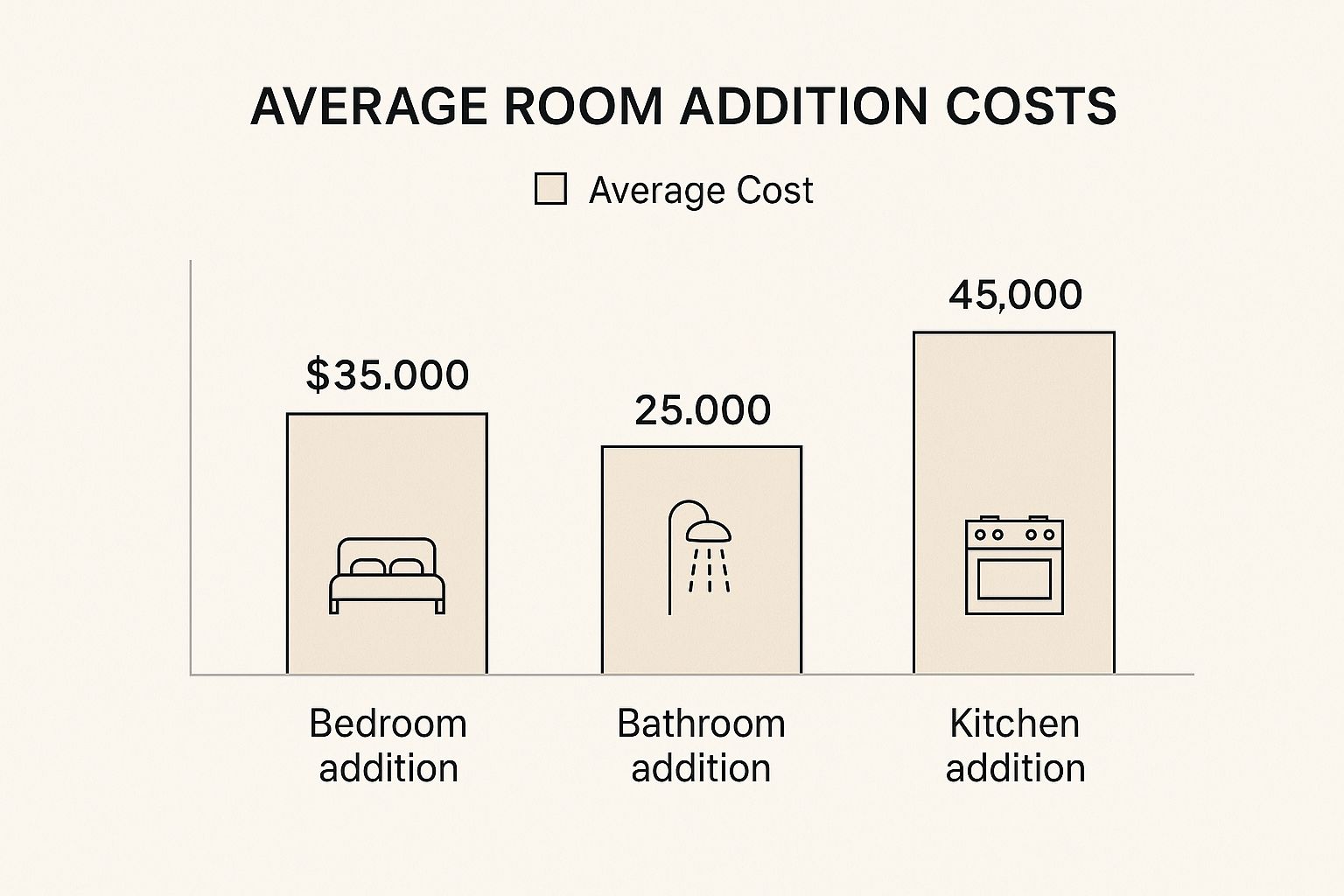
As you can see, what the room is for changes the cost significantly. Kitchens and bathrooms always involve more complex plumbing and electrical work, which drives up the price.
Online calculators are a great starting point for dreaming, but they fall short when it's time to build a real budget. Here’s a quick comparison of what you get from a generic online tool versus a detailed, professional bid from our team at Aldridge Construction.
Online Calculator vs. Professional Estimate
| Feature | Online Calculator | Aldridge Construction Professional Estimate |
|---|---|---|
| Pricing Basis | National or regional averages | Current, localized material and labor costs |
| Site Conditions | Not included | Detailed assessment of slope, soil, access |
| Structural Tie-In | Not considered | In-depth analysis of existing foundation & framing |
| Permits & Fees | Rough guess, if included at all | Specific costs based on local jurisdiction |
| Level of Detail | A single, lump-sum number | A multi-page, line-item bid for every phase |
| Financial Utility | Unsuitable for bank loans or contracts | Required for financing and forms the basis of the contract |
| Project Planning | Too vague for decision-making | Empowers you to make informed choices on materials & scope |
This table highlights the difference. One is a guess; the other is a roadmap.
The Power Of A Detailed, Line-Item Bid
A professional estimate from Aldridge Construction isn't just a single number. It’s a comprehensive, line-item document breaking down every single phase of your project. This detailed bid is the most powerful tool you have for financial planning.
A detailed estimate is the foundation of trust between a homeowner and a contractor. It eliminates guesswork, prevents misunderstandings, and ensures everyone is aligned on the scope of work and costs before the project begins.
This level of detail is absolutely critical. It empowers you to make informed decisions and is often required by lenders to approve financing. Most importantly, this document protects you by becoming a core part of your contract.
Working with an experienced home addition contractor who provides this level of detail is the first step toward a successful build. It’s how you protect your investment and ensure your vision is executed exactly as planned.
Frequently Asked Questions About Room Addition Costs

When you’re thinking about adding on to your home, a lot of questions come up—especially around the budget. Here are some of the most common ones we hear from homeowners, along with our straightforward, experience-based answers.
How accurate is a room addition cost calculator?
An online room addition cost calculator is a decent starting point for a very rough, ballpark idea. However, it cannot account for specific labor rates in Monterey, your chosen materials, or the unique conditions of your property. For a budget you can actually build on, you need a detailed, professional estimate.
What's the best way to save money on a room addition?
Smart ways to keep costs in check include opting for a simple "bump-out" instead of a full-scale addition and choosing standard-sized windows and doors. You can also save by selecting quality mid-range finishes over high-end luxury options. Never cut corners on licensed professional labor for structural, plumbing, or electrical work.
How long does a typical room addition project take?
A typical room addition can take anywhere from 3 to 6 months from start to finish, but that timeline can vary. The project's complexity, permit approval times in jurisdictions like Santa Cruz County, weather delays, and material availability all have a major impact. The initial design and permitting phase can take several weeks or months before construction begins.
Does adding a room increase property taxes?
Yes, almost certainly. Adding square footage increases your home's assessed value, which will trigger a reassessment by your local municipality. This will likely lead to an increase in your annual property taxes. The exact amount depends on local tax rates and the final value assigned to your new addition.
What is the cheapest type of room addition?
Generally, the most affordable room additions are "bump-outs" or simple "dry" rooms like a home office or den built on a slab foundation. These projects have minimal plumbing and electrical work and often use standard, builder-grade materials. Keeping the design simple and the size modest are key to controlling costs.
Ready to move past online calculators and get a real, detailed estimate for your project? The team at Aldridge Construction provides comprehensive, line-item bids that give you a clear and accurate financial picture. Contact us today to start planning your home addition in Monterey, Santa Cruz, San Benito, or Maricopa County.