
Think of a master chef tasting a sauce as it simmers, adjusting the seasoning along the way, rather than waiting until the final dish is plated. That’s the very essence of quality control in construction projects. It’s not a one-time test at the end of a project.
Instead, it's a continuous process woven into every stage, ensuring everything from the materials to the installation meets unwavering standards for safety, longevity, and performance. This guide explains how Aldridge Construction implements this crucial process in Monterey, Santa Cruz, San Benito, and Maricopa Counties.
Understanding Quality and Its True Impact
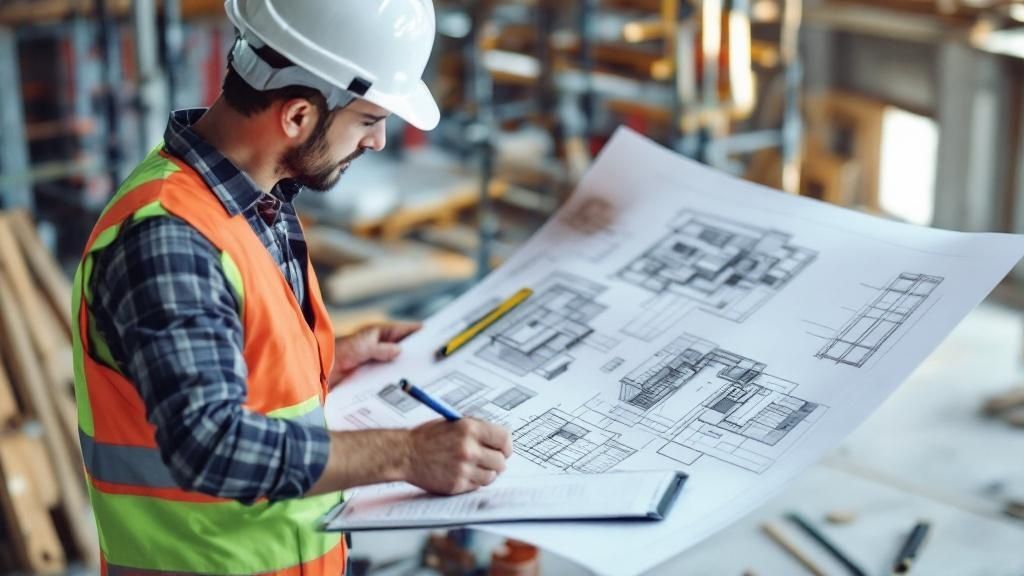
At its heart, quality control is the boots-on-the-ground job of inspecting, testing, and correcting defects as they happen. It’s the practical activity that confirms the work being done perfectly matches the blueprints and specifications. This is different from Quality Assurance (QA), which creates the high-level systems to prevent defects in the first place.
Let's say we're building a custom home in Monterey County. Quality control is the site manager physically measuring rebar spacing in the foundation before concrete is poured. It’s pressure-testing plumbing lines to find tiny leaks long before the drywall goes up. These actions ensure the high standards we promised become a physical reality.
The importance of this meticulous oversight can't be overstated. Without it, tiny mistakes can snowball into major structural flaws and safety hazards. Industry analysis shows that rework can eat up as much as 5% to 10% of a project's total cost—a staggering figure that proves the wisdom of getting things right the first time.
The Growing Demand for Excellence
This commitment to quality isn’t just a nice-to-have; it's a rapidly growing global expectation. The worldwide market for construction quality control services was recently pegged at around $150 billion and is on track to soar past $250 billion in the next few years [Data Insights Market, 2024]. This surge is driven by increasing urbanization and stricter building codes. You can read more about the construction quality market growth to see these trends for yourself.
For homeowners in Santa Cruz, San Benito, or Maricopa County, this dedication delivers real value. A project managed with rigorous QC by a firm like Aldridge Construction means:
- Enhanced Safety and Durability: The home is built to last, designed to withstand everything from the salty coastal air in California to the intense sun in Arizona.
- Reduced Long-Term Costs: Catching issues early means fewer expensive repairs and lower maintenance bills.
- Increased Property Value: A well-built, high-quality home is a better long-term investment.
- Peace of Mind: Knowing every detail has been inspected and perfected provides unmatched confidence.
In essence, quality control acts as the project’s immune system, constantly monitoring for issues and addressing them before they can compromise the integrity of the entire structure. It’s the practical application of a promise to deliver excellence.
The Three Pillars of an Effective Quality Control Plan
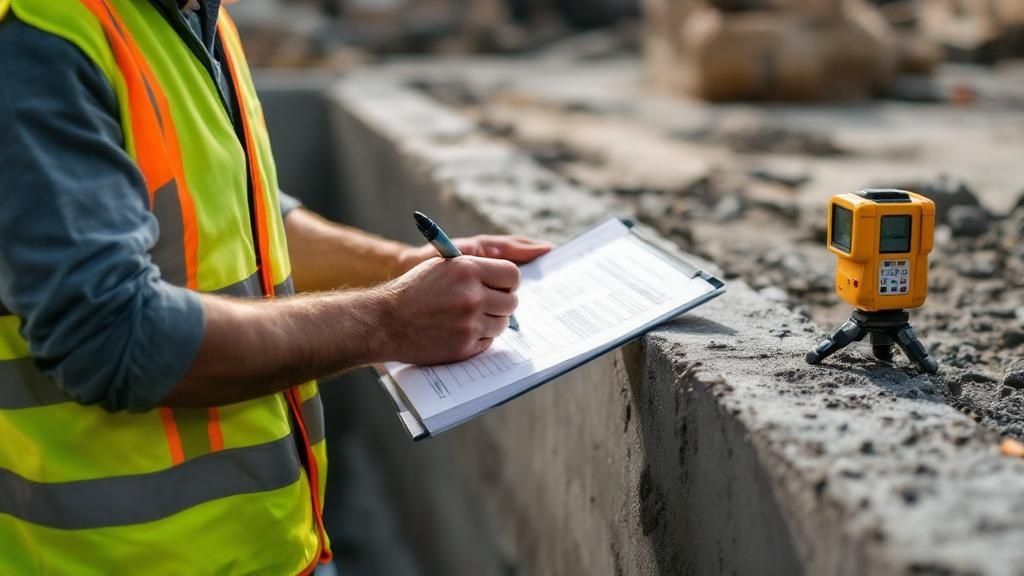
An effective system for quality control in construction projects doesn’t happen by accident. It's a deliberate framework built on three interconnected pillars. When these elements work together, they create a powerful system that prevents mistakes rather than just fixing them.
Think of it like building the project itself: you need a solid plan, the right execution, and a clear record. Each pillar supports the others, forming a complete cycle of accountability that Aldridge Construction brings to every job site, from the coastal hills of Santa Cruz to the sunny landscapes of Maricopa County.
Pillar 1: Proactive Planning and Standards
The first pillar is proactive planning, which happens long before the first shovel hits the dirt. This is the blueprint for quality itself. It involves defining exactly what "high quality" means for every part of the project, leaving zero room for interpretation.
During this stage, we establish clear benchmarks and create detailed checklists. For instance, before pouring a new foundation in Santa Cruz, a pre-pour checklist verifies everything from soil compaction to rebar placement.
Key activities in this phase include:
- Defining Material Standards: Specifying exact materials, like corrosion-resistant fasteners for coastal homes in Monterey County to fight salt air.
- Establishing Workmanship Criteria: Setting clear expectations for finishes, such as the required steps for waterproofing a new shower with Schluter-KERDI membrane.
- Creating Inspection Checklists: Developing comprehensive lists that guide our teams through every critical inspection point.
This meticulous planning ensures everyone—from our project managers to our trusted subcontractors—is working toward the same definition of excellence.
Pillar 2: Diligent On-Site Implementation
With a solid plan locked in, the second pillar is diligent implementation. This is the active, hands-on process of turning the quality plan into reality. It’s where our team translates standards into tangible results through constant monitoring and testing.
This isn't a final check; it's a continuous loop of observation. For a home in Maricopa County, Arizona, this might mean our team conducts moisture tests on drywall before painting to prevent issues caused by the dry climate. It’s about being present and paying attention at every milestone.
Effective implementation is the bridge between the project’s design and its physical reality. It ensures the standards defined on paper are precisely executed with real-world materials and craftsmanship.
This pillar is where a contractor's experience truly shines. Knowing which questions to ask is crucial. For more on this, our guide on how to find a good contractor for your project offers valuable questions every homeowner should consider.
Pillar 3: Meticulous Documentation and Reporting
The third and final pillar is meticulous documentation. In construction, if an action isn't recorded, it's as if it never happened. This pillar ensures there is a clear, traceable record of every quality control activity.
This involves keeping precise records of every inspection, test result, and corrective action. For example, we log all material certifications to prove that the specified Milgard windows or high-performance insulation were installed. If an issue is found, the documentation includes a record of the problem, the solution, and a follow-up verification.
This transparent record-keeping provides irrefutable proof that quality standards were met. It gives clients ultimate peace of mind and creates a valuable historical record for the home.
Key Project Stages for Quality Control Checks
Great quality control on a construction project isn’t a one-time event. It's a series of crucial health checkups for your home as it's being built, ensuring the structure is strong, safe, and performing exactly as it should. At Aldridge Construction, we consider these stages non-negotiable checkpoints.
This process map shows how we weave quality control through every part of the project lifecycle.
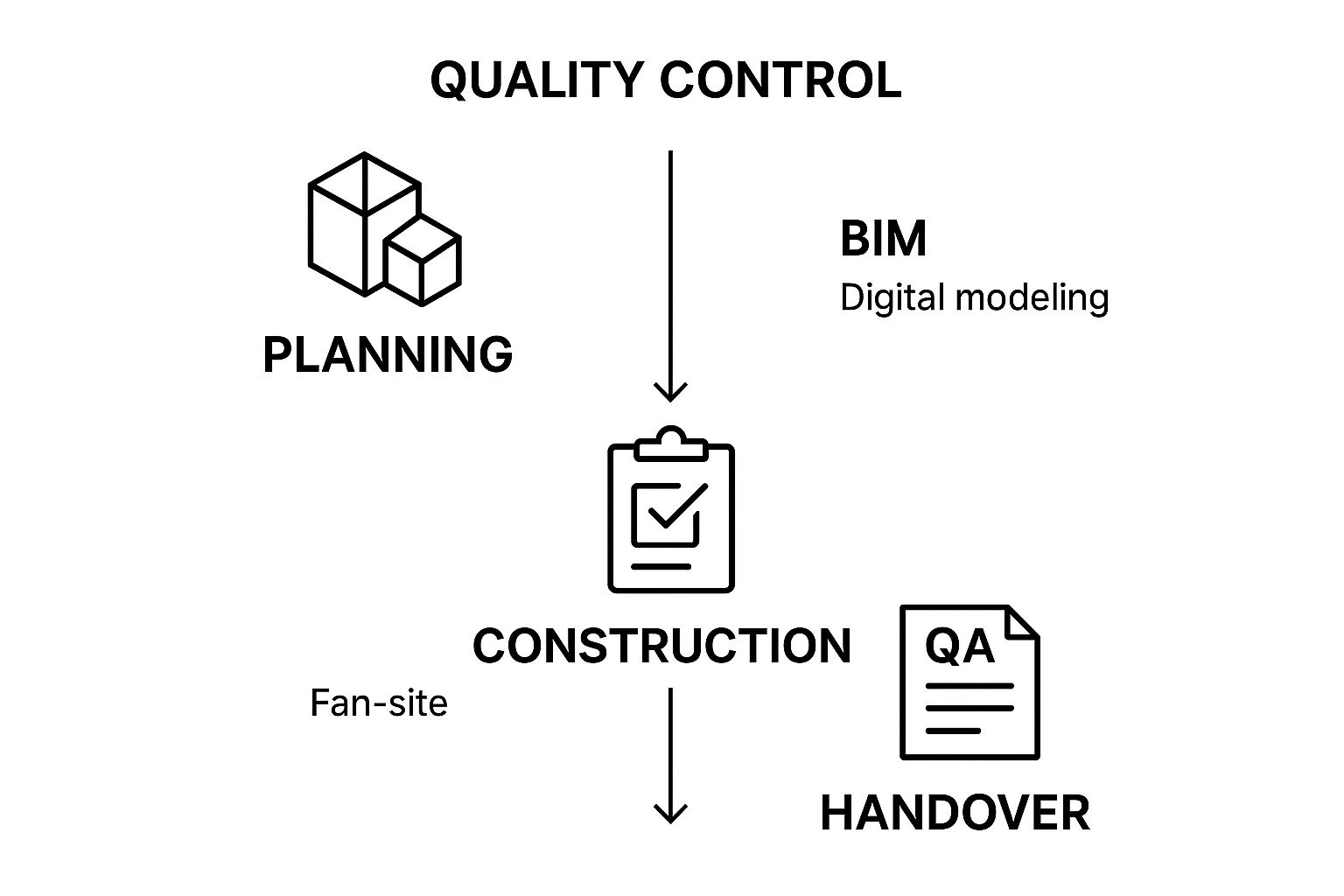
As you can see, a solid quality process starts long before a single shovel hits the dirt and doesn't stop until you have the keys in your hand. We use different tools and techniques at each phase to make sure the final result is a success.
Pre-Construction and Site Preparation
Before we break ground, the work of quality control has already begun. This first phase is all about verification and planning—catching potential problems on paper. We meticulously review architectural plans against engineering documents to spot any discrepancies.
We also do a complete site analysis, checking soil conditions and drainage patterns. This is when we verify every single material delivered to the job site, from the lumber to the windows, making sure it matches project specifications. It’s also when we align all plans with local requirements; for more on this complex process, check out our guide to navigating construction permit requirements.
Foundation and Structural Framing
With a rock-solid plan, the next checks focus on the home's skeleton. A building is only as strong as its foundation, so this stage gets an incredible amount of our attention.
Here are a few of the critical foundation checks we perform:
- Soil Compaction Tests: We confirm the ground is properly compacted to prevent the house from settling or shifting.
- Rebar and Formwork Inspections: Before pouring concrete, we inspect the steel reinforcement grid to ensure size, spacing, and placement are perfect.
- Concrete Slump Tests: We test the concrete mix right before the pour to guarantee it has the exact strength and workability required.
Once the foundation is cured, our focus shifts to framing. We look for plumb walls, square corners, and secure connections. For homes in coastal areas like Monterey, we also double-check that every fastener is corrosion-resistant and structural bracing is ready for seismic activity.
Systems Installation (MEP)
Next up are the home's vital organs: the Mechanical, Electrical, and Plumbing (MEP) systems. Quality control here is all about safety, performance, and comfort. Each system goes through its own rigorous series of inspections.
For projects in California, this is where compliance with Title 24 energy codes is paramount. Meticulous QC ensures every duct is sealed, insulation is installed without gaps, and windows meet energy performance standards. This directly translates to lower utility bills and a more comfortable home.
Our typical system checks include:
- Plumbing Pressure Tests: We pressurize the entire water supply system with air to find even the tiniest leaks before any drywall goes up.
- HVAC Duct Sealing Tests: In a climate like Maricopa County's, a leaky duct wastes tremendous energy. We test the entire system for air tightness.
- Electrical Circuit Verification: Every wire, outlet, and switch gets inspected to ensure it’s installed safely and meets the National Electrical Code.
Finishes and Final Handover
The final stage of quality control is where we zoom in on the details that transform a structure into a beautiful, functional home. These checks might seem cosmetic, but they’re also about durability and craftsmanship. We inspect everything, from the smoothness of the drywall to the evenness of the paint.
This all leads to the punch list walkthrough. We walk the entire project with you, the client, to identify any final items needing adjustment. It’s a collaborative process that ensures every last detail meets your expectations before we hand over the keys.
How Technology Enhances Construction Quality Control
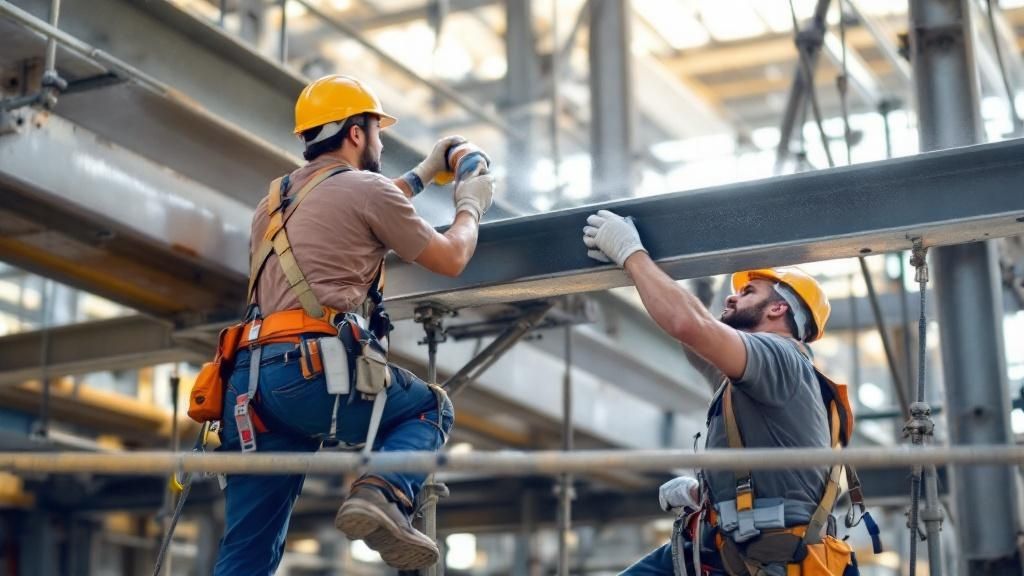
Modern quality control in construction projects is now driven by sophisticated tools that bring new precision, speed, and transparency to the job site. At Aldridge Construction, we integrate these advancements to elevate our standards and deliver superior results.
Instead of just reacting to issues, technology allows us to anticipate them. A complete digital model of your home can lay out every pipe and wire in 3D before a single wall is framed. This proactive approach identifies potential system clashes early, saving time and money.
This shift toward digital tools is a major move in our industry. According to industry reports, approximately 70% of construction firms in developed markets now use Building Information Modeling (BIM) to integrate design and quality processes from day one.
From Clipboards to Cloud-Based Reporting
One of the most significant changes is the move from manual paperwork to real-time, cloud-based software. Project management apps like Procore or Buildertrend allow our team to instantly upload inspection photos, notes, and test results from the field. This information is immediately accessible to everyone involved.
This instant communication speeds up decision-making. If an inspector on-site in Santa Cruz spots a minor issue, they can document it with a photo and assign a corrective task in minutes. This ensures problems are resolved swiftly and creates a permanent digital record.
A digital-first approach to quality control means greater accountability and unparalleled transparency. It transforms the process from a series of isolated checks into a continuous, collaborative conversation about excellence.
This meticulous, tech-driven process is a core part of how we manage every build. To see how this fits into the bigger picture, you can learn more about your custom home building process explained in our detailed guide.
Advanced Tools for Deeper Insights
Specialized hardware gives us entirely new ways to see and measure quality. These tools provide data that the human eye could never capture, ensuring every component performs exactly as designed.
Here are a few key examples of advanced tools we use:
- Drones and Aerial Imaging: For large sites or complex roof inspections, drones provide a safe and efficient bird's-eye view to assess conditions and monitor progress.
- Infrared (Thermal) Cameras: In both the desert heat of Maricopa County and the cooler climate of Monterey, proper insulation is key. Thermal cameras reveal invisible air leaks or gaps in insulation.
- Laser Scanners and 3D Modeling: These tools create hyper-accurate 3D models of existing spaces, ensuring new additions line up perfectly with millimeter precision.
It's fascinating to see how far quality control has come. What used to be a manual, reactive process has become a proactive, data-driven one.
Technology in Modern Quality Control
| QC Task | Traditional Method | Modern Technology Solution |
|---|---|---|
| Defect Tracking | Handwritten punch lists, physical photos | Real-time photo/video uploads via mobile apps, digital task assignment |
| Blueprint Management | Rolled paper blueprints, manual markups | Cloud-based BIM models, digital plans accessible on tablets |
| Site Inspections | Manual measurements, visual checks, climbing ladders | Drone flyovers for aerial views, thermal cameras for insulation checks |
| Progress Reporting | Daily logs written by hand, delayed email updates | Automated daily reports with photos, instant cloud synchronization |
| Dimensional Accuracy | Tape measures, plumb bobs, manual string lines | 3D laser scanners for hyper-accurate as-built models |
By pairing traditional craftsmanship with these modern solutions, we ensure that every Aldridge Construction project isn't just built to code—it's built to a higher standard of performance, durability, and lasting value.
The Connection Between Quality Control and Sustainable Building
Exceptional quality control is inherently green. The same obsessive attention to detail that keeps a home standing strong for decades is also the bedrock of sustainable, high-performance building. The two ideas aren’t just related—they’re deeply intertwined.
This connection has a massive impact. Globally, the construction sector is a huge energy user, responsible for roughly 34% of all energy-related CO₂ emissions. As detailed in the 2024 Global Status Report for Buildings and Construction, effective quality control in construction projects is one of our best tools to fight this. It ensures materials are used with precision and buildings perform as designed.
From Standards to Savings
Think about something as fundamental as sealing a home’s building envelope. A quality control plan doesn't just say, "seal the envelope." It defines how, verifying every gap is filled, every joint is airtight, and every inch of the weather-resistant barrier is installed perfectly.
When our team performs these checks on a home in Monterey or Santa Cruz, we're doing more than just stopping leaks. We are creating an airtight structure that needs less energy for heating and cooling, which means lower utility bills for the homeowner.
A well-sealed home built with rigorous quality control doesn't just meet a code requirement; it delivers a tangible improvement in comfort and a measurable reduction in energy consumption.
This logic applies to every sustainable feature. You can choose the best high-performance materials, but their benefits are only unlocked when they’re installed correctly—a job that falls squarely on the shoulders of quality control.
Ensuring Green Materials Perform as Promised
Specifying sustainable materials is a fantastic first step, but it’s only half the battle. Without rock-solid QC, their environmental and financial perks can evaporate on the job site.
Just look at these common scenarios:
- Energy-Efficient Windows: A top-of-the-line Milgard window won't stop a draft if it’s installed even slightly out of plumb or isn't sealed exactly to the manufacturer's specs.
- Recycled-Content Insulation: If insulation gets compressed or has gaps around outlets, its promised R-value plummets. QC checks ensure a continuous thermal blanket.
- Low-VOC Paints: The cleaner indoor air you expect from low-VOC (volatile organic compound) paints is compromised if the drywall underneath wasn’t prepped correctly.
For anyone serious about building with sustainability in mind, getting familiar with material choices is a must. We put together a complete overview in our guide to green construction materials that serves as a great starting point.
Ultimately, quality control is the engine that turns the sustainable vision on the blueprints into a high-performing reality. It’s how we make sure demanding standards like California’s Title 24 go from being a line item on a permit to a true benchmark for an efficient home.
Partnering for Unmatched Quality on Your Project
As this guide has shown, true quality is built into a project from the ground up. Achieving a superior result comes down to partnering with a team that has an unwavering commitment to getting every detail right. This meticulous approach to quality control in construction projects is what separates an adequate job from an exceptional one.
Choosing a general contractor is one of the most critical decisions you'll make. You aren't just hiring someone to build; you're entrusting them with your vision and investment. That's why it's so important to dig into their processes. To help, we created a list of 8 essential questions to ask general contractors before hiring.
A Commitment That Exceeds the Standards
At Aldridge Construction, our philosophy is simple: we build every home as if it were our own. This belief is the driving force behind our rigorous quality control system. Our deep experience navigating the unique demands across Monterey, Santa Cruz, San Benito, and Maricopa counties gives us a distinct advantage.
We understand the specific challenges each region presents and tailor our QC process accordingly.
- In the coastal climates of Monterey and Santa Cruz, our focus is on superior weatherproofing, using corrosion-resistant materials and techniques that stand up to salt air and moisture.
- For the harsh desert environment of Maricopa County, our process prioritizes heat-resistant materials, high-efficiency HVAC installations, and foundations engineered for local soil conditions.
Choosing Aldridge Construction means choosing peace of mind. It’s the assurance that your project is engineered with precision, built with superior materials, and managed by a team that values integrity above all else. The final product isn’t just beautiful—it’s built to last.
We invite you to experience the difference a true commitment to quality makes. Contact our team to schedule a consultation for your upcoming project, and let us show you how we build trust, one detail at a time.
5 Common Questions About Construction Quality Control
It’s normal for homeowners to have questions about what quality control looks like on a real job site. That's why we've put together answers to the questions we hear most often from our clients across Monterey, Santa Cruz, San Benito, and Maricopa Counties. At Aldridge Construction, transparency is the foundation of a great project.
1. What is the difference between Quality Assurance and Quality Control?
This is the most common point of confusion. The easiest way to think about it is planning a menu versus cooking a specific dish.
- Quality Assurance (QA) is the proactive planning done before and during the project to prevent mistakes. It’s the master plan—our systems, choice of materials, and subcontractor vetting process.
- Quality Control (QC) is the hands-on work of inspecting and testing as we build to catch and correct issues. It’s corrective, like pressure testing plumbing lines before walls are closed up.
So, QA is the strategy to prevent defects, while QC is the boots-on-the-ground work of finding and fixing them.
2. Who is responsible for quality control on my project?
While everyone on our job site has a role, the ultimate responsibility lands on the general contractor. As your builder, Aldridge Construction owns the entire quality process from start to finish. This is a core part of our job.
Our responsibility includes:
- Running our own internal inspections at every critical milestone.
- Coordinating with all third-party city and county inspectors.
- Holding every subcontractor accountable for meeting our high standards.
Think of us as the central hub for quality, ensuring every component comes together exactly as it should.
3. How can I be sure quality control is actually being done?
The only way to be sure is through complete transparency and solid documentation. A trustworthy contractor will never tell you to "just trust them." At Aldridge Construction, we believe you have a right to see the proof.
Transparency is the cornerstone of trust. We believe clients have a right to see the evidence of the quality being built into their homes every single day.
We make key documents like daily logs, inspection reports, and material certifications available to you. On many projects, we use management software that gives you a direct window into the job site, with progress photos and QC checklists in near real-time.
4. Does good quality control increase my project cost?
This is a fair concern, but the answer is no. A robust QC plan is one of the most effective cost-saving measures in construction. While it requires an upfront investment of time, it pays for itself many times over.
Industry studies show that rework—fixing mistakes—can eat up as much as 10% of a total project budget. Catching a small framing error before the drywall goes up is a simple, inexpensive fix. Finding it after everything is finished means a costly, messy repair. Good quality control is an investment that protects your budget.
5. How does quality control adapt to local conditions?
Adapting to the local climate and geology is absolutely essential for building a home that lasts. A one-size-fits-all approach is a recipe for failure, especially in the diverse environments we build in.
This is where local expertise shines:
- For a coastal home in Monterey or Santa Cruz, our QC plan is obsessed with preventing water intrusion. We are meticulous about inspecting flashing, window seals, and house wrap and use corrosion-resistant hardware.
- For a project in Maricopa County, Arizona, our focus shifts to materials that handle brutal UV radiation and extreme heat. We ensure HVAC systems are installed for peak efficiency and use foundation techniques designed for the region’s unique soil.
Proper quality control isn't a generic checklist. It's a dynamic plan that accounts for the specific environmental pressures your home will face for decades.
Your home is your most significant investment, and ensuring its quality is our most important job. At Aldridge Construction, we build every project with integrity and a meticulous eye for detail. Contact us today to discuss how our commitment to quality can bring your vision to life.
"""