
Direct Answer: Building an ADU in Gilroy or Morgan Hill means working with different permit agencies, fee structures, and often septic systems, not the coastal overlay rules that apply in Monterey County.
Most of the ADU content online is written for one place, and that place is not Gilroy. Homeowners in south Santa Clara County search the same questions as everyone else, but the answers they find were built for Salinas, the Peninsula, or the Bay Area. The regulatory environment, the lot conditions, and the permit agencies are genuinely different down here.
I’ve seen this play out firsthand. When we work on ADU projects in Gilroy and Morgan Hill, the questions homeowners are wrestling with, septic capacity, which department handles their permit, whether a pre-approved plan saves them money, have different answers than they would on a Salinas lot three miles from downtown. Getting those answers wrong at the start is what causes delays and budget surprises six months in.
This article covers the three things that actually change when you’re building an ADU in south county. I’m not going to run through every regulation or fee, those change, and you should verify them directly with your local agency before any project starts. What I can do is help you understand the categories of difference so you know what questions to ask.
Which Agency Is Actually Reviewing Your Permit
This is where south county homeowners get confused first, and it matters more than most people realize.
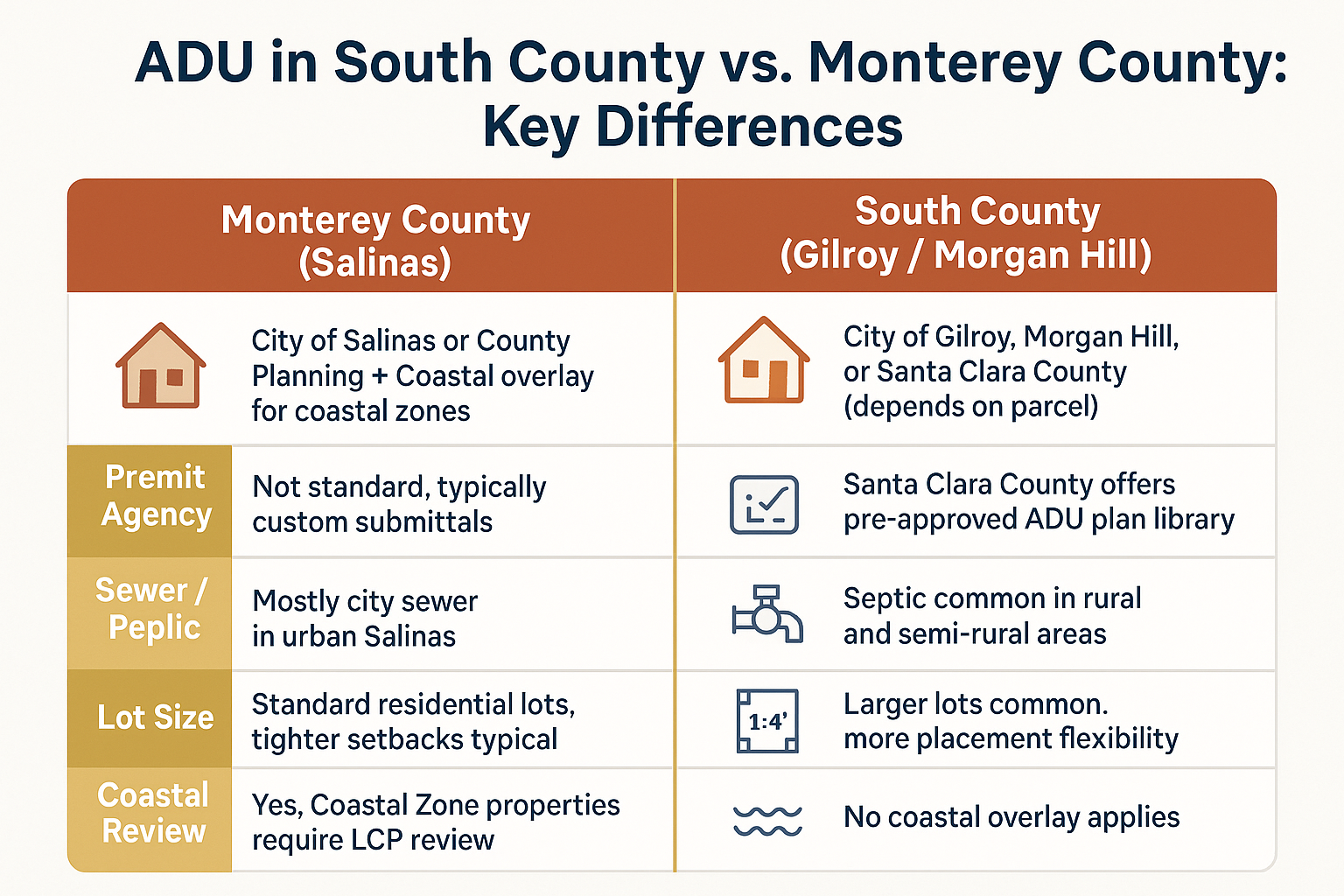
If your property is within Gilroy city limits, your ADU permit goes through the City of Gilroy’s Building Division. If you’re on unincorporated land in the surrounding area, you’re working with Santa Clara County Planning. Morgan Hill has its own building department and handles its own permits independently. These are three separate agencies with their own staff, their own timelines, and their own submittal checklists.
Compare that to what I deal with in Monterey County, where coastal properties involve an additional overlay of coastal permit review under the Local Coastal Program, and multi-agency sequencing through planning, environmental health, and building is common. South county doesn’t have that coastal layer, but the trade-off is that you need to be very clear up front about which jurisdiction your parcel falls under before you design anything.
One practical difference worth knowing: Santa Clara County maintains a pre-approved ADU plan library that homeowners can draw from. Using a pre-approved plan can shorten the design and plan-check portion of the process because the structural engineering is already reviewed. Whether those plans fit your lot, your finish preferences, and your local utility situation is a separate question, but it’s worth asking your contractor about before commissioning a full custom design.
For a broader look at how permit agency structure shapes the ADU process, the California Department of Housing and Community Development maintains updated guidance on ADU law statewide.
Septic Is the Constraint Nobody Talks About Until It’s a Problem
Urban Salinas is largely on city sewer. A lot of south county is not.
In rural and semi-rural areas around Gilroy, and certainly in the San Benito County corridor near San Juan Bautista, properties run on septic systems. And septic capacity is a hard constraint on ADU feasibility. You can’t add a full bathroom and kitchen to your property without demonstrating that the existing system can handle the additional load, or that you can upgrade it.
We’ve heard from homeowners in this exact situation. One inquiry from a property outside San Juan Bautista made it clear right away: the ADU project would also need septic work. That’s a realistic scenario for south county and San Benito County homeowners, and it needs to go into the project budget and timeline from day one, not after permits are pulled.
Here’s what the septic question affects in practice:
- Feasibility: A failing or undersized system may need full replacement before the county approves your ADU
- Cost: Septic upgrades can add a meaningful amount to overall project cost depending on system size, soil conditions, and access, a contractor can give you a realistic range once your site is assessed
- Timeline: Environmental health departments review septic capacity separately from the building department, which adds a sequencing step to your permit process
- ADU type: A studio or one-bathroom unit puts less load on a system than a two-bedroom with a full kitchen and laundry
If your property is on septic, get a system assessment early. It’s the kind of thing that changes your ADU design decisions entirely. For more on how site conditions like this interact with ADU choices, this breakdown on garage conversions versus detached ADUs covers some of the same trade-off thinking, even though it’s written for Monterey County context.
How South County ADU Projects Differ from Monterey County
This comparison covers the key structural differences a homeowner in Gilroy or Morgan Hill will encounter versus what’s typical in the Salinas and Monterey County market.
Larger Lots Help, Until They Don’t
One genuine advantage south county homeowners often have is lot size. A half-acre or larger parcel in Gilroy gives you more placement options for a detached ADU than a standard Salinas residential lot. You have room to position the unit away from the main structure, closer to a street for separate access, or in a corner of the property that doesn’t affect how the main house lives.
But larger lots come with their own complications. Longer utility runs, water, electrical, sometimes gas, add cost when you’re placing a detached unit far from the main service point. And as I mentioned above, rural lots are far more likely to be on septic, which changes the equation entirely.
The lot size question also ties into setback requirements. California state law sets a minimum of four-foot rear and side setbacks for most ADUs, but local agencies can apply additional requirements depending on fire zones, easements, and zoning overlays. Verifying your specific parcel’s setbacks before you commit to a placement is a step we always take before any design work begins.
If you’re still working through whether a detached ADU is the right move for your property versus other options, this article on room additions, ADUs, and floor plan reconfiguration walks through how to think about that decision.
The New Permit Timeline Law and Why Your Submittal Quality Determines Whether It Helps You
Starting in 2026, California’s SB 543 sets a 15-business-day completeness review requirement and a 60-day approval clock for ADU permits. This applies statewide, Gilroy, Morgan Hill, and every other California jurisdiction. On paper, that means homeowners now have statutory protection against the permit delays that have historically added months to ADU timelines.
In practice, those protections only kick in when your application is complete and correct at the time of submittal. An incomplete application restarts the clock. And most incomplete submittals come down to the same categories of missing information:
- Site plan doesn’t reflect actual lot dimensions or property lines
- Structural drawings missing required details for the 2025 California Building Standards Code (effective January 1, 2026)
- Energy compliance documentation incomplete or absent
- Utility connection details not addressed
- For septic properties, environmental health sign-off not coordinated
This is where the quality of your initial submittal matters more than anything else. A contractor who regularly submits ADU applications in a given jurisdiction knows what that specific plan checker wants to see. That familiarity is built through repetition, and it’s one reason why hiring someone who is already active in south county, rather than a contractor treating it as a one-off, makes a concrete difference in how your project actually runs.
For more on how permit timelines and code changes affect renovation and ADU projects, this piece on what the 2025 Building Standards Code changes mean for permits is worth reading before you sit down with a contractor.
And if you’re comparing contractors and not sure what to look for, this guide on what to actually check before hiring walks through the specifics in plain language.
South County ADU Project Variables at a Glance
These are the variables I look at first on any south county ADU inquiry. Each one affects design, timeline, or budget, and some affect all three.
| Variable | Why It Matters | Who to Verify With |
|---|---|---|
| Parcel jurisdiction (city vs. county) | Determines which agency reviews your permit and which fee schedule applies | City or county planning department |
| Sewer vs. septic | Septic capacity limits ADU size and adds environmental health review | County Environmental Health |
| Lot size and setbacks | Affects placement options and may trigger additional review | Local planning or building department |
| Pre-approved plan eligibility | May reduce plan-check time and design cost in Santa Clara County | Santa Clara County Planning |
| Fire hazard zone designation | Can affect construction materials, sprinkler requirements, and setbacks | Local fire department or building department |
| Utility run distance | Longer runs for water and electrical add to project cost on large lots | Utility provider and contractor estimate |
Frequently Asked Questions About Building an ADU in South County
Does California’s new 60-day permit approval rule apply in Gilroy and Morgan Hill?
Yes. SB 543’s 15-business-day completeness review and 60-day approval clock apply statewide as of 2026. But those timelines only start running once the city or county considers your application complete. An incomplete submittal can reset the clock, which is why the quality of your initial application package matters so much.
My south county property is on a septic system. Can I still build an ADU?
Often yes, but it depends on your system’s current capacity and condition. The county environmental health department will need to review whether the existing system can handle the added load from an ADU. If it can’t, you may need to upgrade or replace the system as part of the project. Get a septic assessment early, it’s the kind of finding that changes your budget and timeline if it comes up late.
What’s the advantage of using a Santa Clara County pre-approved ADU plan?
Pre-approved plans have already passed structural engineering review at the county level, which can shorten the plan-check portion of your permit timeline. The trade-off is that you’re working within a fixed design. If your lot conditions, utility locations, or finish preferences don’t match well with what’s in the plan library, a custom design may still make more sense.
How much does an ADU in Gilroy or Morgan Hill typically cost?
Cost varies based on ADU type, size, finish level, site conditions, and whether septic or extended utility runs are involved. In our experience across the Central Coast and south county, detached ADUs on the smaller end, 450 to 600 square feet, typically fall in a range that reflects both construction costs and local permit fees, which differ from Monterey County’s fee structure. For a project-specific number, an on-site consultation is the only reliable way to get there. See our ADU cost breakdown for the broader tri-county region for context on what drives those numbers.
Does it matter whether my contractor has worked in Gilroy before?
It matters more than most homeowners expect. A contractor who regularly submits to the City of Gilroy or Santa Clara County Planning knows what those plan checkers flag, how inspection scheduling actually works, and which sub-trades are reliably available in the area. That familiarity shortens your timeline and reduces the back-and-forth that adds weeks to a project. A contractor who treats south county as a one-off job is starting that learning curve on your project.
Planning an ADU in Gilroy, Morgan Hill, or the Surrounding Area?
We work with homeowners across south Santa Clara County and the broader Central Coast, including Monterey and San Benito Counties. If you’re trying to sort out which agency handles your permit, whether your lot and septic situation makes a detached ADU realistic, or what a project like this actually costs, a conversation with our team is the right first step. Reach Brian Aldridge directly at 831-682-9788 or through the contact page at aldridgeconstruction.biz.