
Direct Answer: Any permit application submitted on or after January 1, 2026 is governed by the 2025 California Building Standards Code, which changes electrical, energy, and wildfire construction requirements for residential projects.
If you got a bid in late 2025 and your project is just now getting underway, there is one question worth asking your contractor right away: which code cycle governs your permit? It is not a technical formality. The answer determines what your electrical system needs to handle, what exterior materials may be required, and what your inspector will be checking at every stage.
The 2025 California Building Standards Code was published in July 2025 and became effective January 1, 2026 for all new permit applications. Projects submitted before that date may still be reviewed under the 2022 code, depending on when they entered plan check and how your local agency handled the transition. But anything submitted on or after January 1, 2026 is being designed and inspected against a different set of standards.
For homeowners across Monterey County planning a kitchen remodel, bathroom renovation, room addition, or ADU, the practical impact of this code change is real. I want to explain the parts that actually matter and skip the regulatory noise.
What the Code Transition Actually Means for Your Project
The first thing to understand is that this is not just an update to one document. The 2025 code touches the California Residential Code, the Energy Code, and the Green Building Standards Code all at once. When one of those changes, your contractor’s design decisions change with it.
The question of which code applies to your project is not always obvious. If your permit was submitted before January 1, 2026 and was already in plan check, some local agencies allowed it to continue under the 2022 code. Others did not. Monterey County’s Building Services department is the right place to verify which rulebook applies to your specific permit, and your contractor should know to ask.
What I tell homeowners is this: if your project has been sitting in permitting for a few months and you are not sure which code cycle governs your inspections, find out before framing starts. That is the point where code-driven decisions become expensive to change. You can read more about how the permit and design process typically sequences in our article on what one contractor handling everything actually changes.
Electrification Requirements Just Got More Specific
This is the change I see affecting the most projects right now, particularly kitchens and ADUs.
The 2025 code expands the electrical scope of residential remodels in meaningful ways. The updates involve:
- Updated load calculation requirements that affect how your electrical panel is sized for the project
- Increased service sizing expectations on remodels that add significant appliance load
- EV-ready infrastructure mandates that require rough-in conduit for electric vehicle charging on applicable projects
For a homeowner planning a kitchen remodel with induction cooking, this matters at the framing stage, not the finish stage. If your panel needs to be upsized to handle the added load, that work gets done before the walls close. Discovering it later means opening them back up.
A customer who completed a full kitchen remodel with us noted that the induction cooktop and built-in appliances required careful coordination on the electrical side. That kind of coordination is exactly where the new load calculation requirements make a difference. If your contractor is not reviewing the energy provisions as part of the initial design, ask why.
For ADU projects, the electrical scope is even more significant because you are building a complete system from scratch. The panel sizing, EV conduit, and energy compliance all get specified at the design stage. Getting those right upfront is much less expensive than correcting them at inspection. For context on what an ADU project involves end to end, what an ADU actually costs in Monterey County in 2026 walks through the full picture.
Three Code Areas That Change the Most for 2026 Permits
This infographic shows which parts of the 2025 California Building Standards Code have the most practical impact on residential remodel and ADU permits submitted after January 1, 2026.
The Wildland-Urban Interface Code Is Now Its Own Document
Before the 2025 code cycle, wildfire-resistant construction standards were scattered across multiple chapters of the residential code. The 2025 update consolidates all of that into a standalone Wildland-Urban Interface code under Title 24, Part 7.
For most homeowners in central Salinas or a flat lot in Seaside, this may not change much. But for homeowners in the Santa Cruz Mountains, the hills above Carmel Valley, or the rural edges of San Benito County near Hollister, it can affect what exterior materials are acceptable on an addition or a new detached ADU.
The consolidated code makes the requirements more defined, which is actually useful. Instead of digging through multiple chapters, an experienced contractor can now go directly to Part 7 and determine what assembly and material requirements apply to a specific property and structure type. The problem is that a contractor who is not current on this code may not flag the issue until the building department does, which is a much worse time to find out.
If your property is in a fire-adjacent area, ask your contractor at the design meeting whether WUI requirements apply. That is the right time for the conversation, not after plans are drawn. Our article on five things that separate a reliable contractor from a risky one covers what that kind of proactive regulatory awareness looks like in practice.
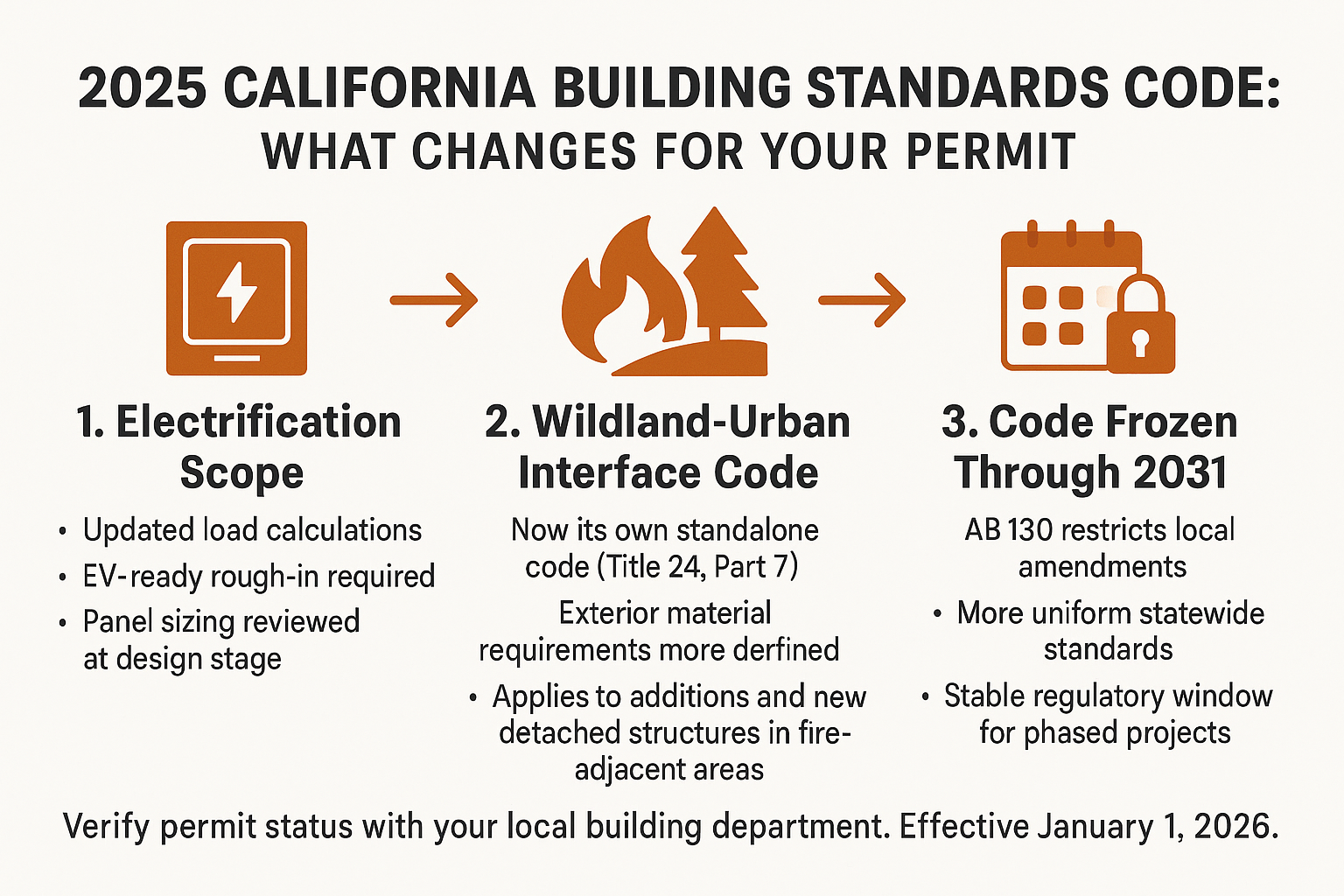
One Thing That Actually Helps: This Code Is Stable Through 2031
California building codes typically update on a three-year cycle. The 2025 code is different. Because of AB 130, local jurisdictions have significantly less room to layer in their own amendments during this cycle, and the standards apply with greater uniformity statewide through at least 2031.
For homeowners planning a phased renovation, that is genuinely useful information. It means the regulatory landscape you are designing to today is the same one that will govern your next permit application two or three years from now. You can plan a kitchen remodel now and a bathroom remodel in 2028 and not worry that the rules will shift between phases.
According to Hanson Bridgett’s 2026 construction law summary, AB 130’s restriction on local amendments is what makes this cycle unusually stable. That is not a guarantee that no local rules apply to your project, and you should always verify with your local building department. But for long-range planning purposes, the window is more predictable than usual.
If you are thinking through a phased approach, the right order to renovate when you are staying in the house is a good starting point for sequencing decisions.
2022 Code vs. 2025 Code: Key Differences for Residential Projects
This comparison covers the areas most likely to affect a kitchen, bathroom, addition, or ADU permit submitted in 2026.
| Area | Under the 2022 Code | Under the 2025 Code |
|---|---|---|
| Electrification scope | Load calculations and panel sizing addressed per standard residential code | Expanded load calculation requirements; EV-ready rough-in mandated on applicable projects |
| Wildfire standards | Scattered across multiple residential code chapters | Consolidated into standalone Title 24, Part 7 WUI code with more defined material/assembly requirements |
| Local amendments | Jurisdictions could layer in local modifications | AB 130 restricts local amendments; greater uniformity statewide through 2031 |
| Effective date | Governed projects permitted before January 1, 2026 | Governs all permit applications submitted on or after January 1, 2026 |
| Plan check transition | Projects already in plan check before Jan 1, 2026 may have remained under 2022 code | Verify with your local building department which cycle governs your permit |
Frequently Asked Questions About the 2025 Building Code and Your Remodel
My permit was submitted in November 2025. Which code applies to my project?
It depends on your local agency’s policy at the time of submittal. Projects that were already in plan check before January 1, 2026 may have been allowed to continue under the 2022 code, but not all agencies handled the transition the same way. The only reliable answer comes from your local building department. Ask them directly which code cycle governs your permit, and make sure your contractor knows the answer before inspections begin.
Does the new electrification scope affect a basic bathroom remodel?
Probably not in a major way if the bathroom scope is limited to fixtures, tile, and vanity work. The electrical provisions have the most impact when you are adding significant load, such as a heated floor system, or when the remodel triggers a panel evaluation. A contractor who is reviewing your project properly will flag any electrical scope that the new code touches.
I live near Carmel Valley. Do I need to worry about the new wildfire code?
If you are adding onto your home or building a detached ADU and your property is in or adjacent to a State Responsibility Area or local high fire hazard zone, then yes, the new Title 24, Part 7 WUI code could affect your exterior material selections and assembly requirements. Your contractor should identify this at the design stage and factor it into the plans before they go to the building department.
Does the code freeze through 2031 mean I don’t need to worry about changes for several years?
It means the statewide code is more stable than usual during this cycle, and local jurisdictions have less room to add their own amendments because of AB 130. But local rules, zoning requirements, and agency-specific conditions still apply to your property. Always verify current requirements with your local building department before finalizing plans.
Will the new EV-ready requirement add much cost to a kitchen remodel or ADU?
For a kitchen remodel, the EV-ready provision is more relevant if the project also triggers broader electrical work. For a new ADU, it is typically a conduit rough-in at the framing stage, which costs far less than retrofitting it after the walls are finished. The actual cost varies based on panel location, conduit run length, and site conditions, so the best way to understand the impact on your specific project is to get it itemized in your contractor’s estimate.
Have a Project Starting in 2026? Get the Code Questions Answered Early.
If you are planning a kitchen remodel, bathroom renovation, addition, or ADU anywhere in Monterey County and are not sure which code cycle applies to your project, or what the new electrical and wildfire provisions mean for your specific plans, that is exactly the kind of question worth sorting out in a first conversation. Aldridge Construction works with homeowners across Salinas, Carmel Valley, Seaside, Hollister, and the broader Central Coast, and regulatory fluency is a core part of how we approach every project from the start. You can reach Brian Aldridge directly at 831-682-9788 or through the contact page at aldridgeconstruction.biz.