
Direct Answer: When one licensed contractor manages every trade, permit, and inspection from start to finish, the homeowner stops being the project manager, and the project moves more predictably.
The question I hear most often before a project starts is not about tile or cabinet brands. It’s some version of: who is going to coordinate all of this? One homeowner in Santa Cruz sent in a project scope that covered a kitchen remodel, a bathroom addition, new flooring, and a detached ADU, and the first thing they asked was whether we could handle all of it under a single agreement, phased if needed. That is not a luxury request. That is a reasonable question from someone who has tried to manage multiple bids across multiple trades and figured out how badly that can go.
The coordination problem is real, and it does not get enough plain-language attention. What actually changes when one contractor holds the license and runs every phase is not just convenience. It is sequencing, accountability, and regulatory fluency, three things that are hard to replicate when you are managing four separate contractors yourself.
This article focuses on two things that matter most: what happens inside a well-run project that you probably do not see, and what you actually absorb as risk when you split a project across multiple contractors instead of one.
The Trade Sequencing Problem Homeowners Don’t See Until It’s Too Late
Every renovation has a sequence that cannot be shortcut. In a kitchen remodel, framing has to be done before rough electrical, rough electrical before insulation, insulation before drywall, drywall before finish work. That is not a preference, it is how inspections work. The Monterey County Building Department requires inspections at specific phases, and if a trade gets ahead of the inspection it is supposed to follow, work gets stopped or torn out.
When one contractor is running the project, that sequencing is managed internally. We know when to call for the rough electrical inspection before the insulation crew shows up. We know how long the county typically takes to schedule an inspector, and we build that into the timeline rather than discovering it mid-project.
When a homeowner is managing separate plumbers, electricians, and finish carpenters on their own, a delay from any one of them cascades into the next. The electrician finishes late, so the insulation sub cannot start, so the drywall crew that was scheduled for Tuesday has to reschedule, and their next availability might be three weeks out. I have seen this pattern add six to eight weeks to projects that were originally quoted at half that. It is not a contractor quality problem. It is a coordination problem, and it only gets solved at the GC level, not by hoping individual trades stay in sync.
For multi-scope projects, a kitchen and an ADU running simultaneously, or a full home renovation alongside a garage conversion, the sequencing complexity compounds. If you want to understand how permits from different agencies get layered on top of each other, this breakdown of ADU project realities in Monterey County is worth reading before you start planning.

What You Actually Take On When You Split the Project Yourself
There is a version of the multi-contractor approach that sounds reasonable on paper: get a plumber, get an electrician, get a tile setter, coordinate between them, and save whatever markup a GC would charge. I understand why homeowners consider it. But here is what that actually looks like in practice.
When you are managing your own subcontractors, you become the de facto project manager. That means:
- Scheduling each trade and adjusting when one runs late
- Resolving conflicts when work from two separate contractors does not meet the same standard
- Calling the city or county to schedule permit inspections yourself
- Absorbing the liability when there is a dispute about whose work caused a problem
In Monterey County, where coastal zone projects in areas like Carmel and Pacific Grove already require coordination across planning, environmental health, and building departments, adding contractor fragmentation on top of that is a real risk. A single missed inspection or a sequencing conflict between two independent subs can pause a project for weeks while the county sorts out who is responsible for what.
The GC markup that feels like a cost line is actually covering the project management, the scheduling buffer, and the single point of accountability when something needs to be fixed. Before signing any contract, split or single, this checklist for evaluating contractors in Salinas walks through what to actually verify before you commit.
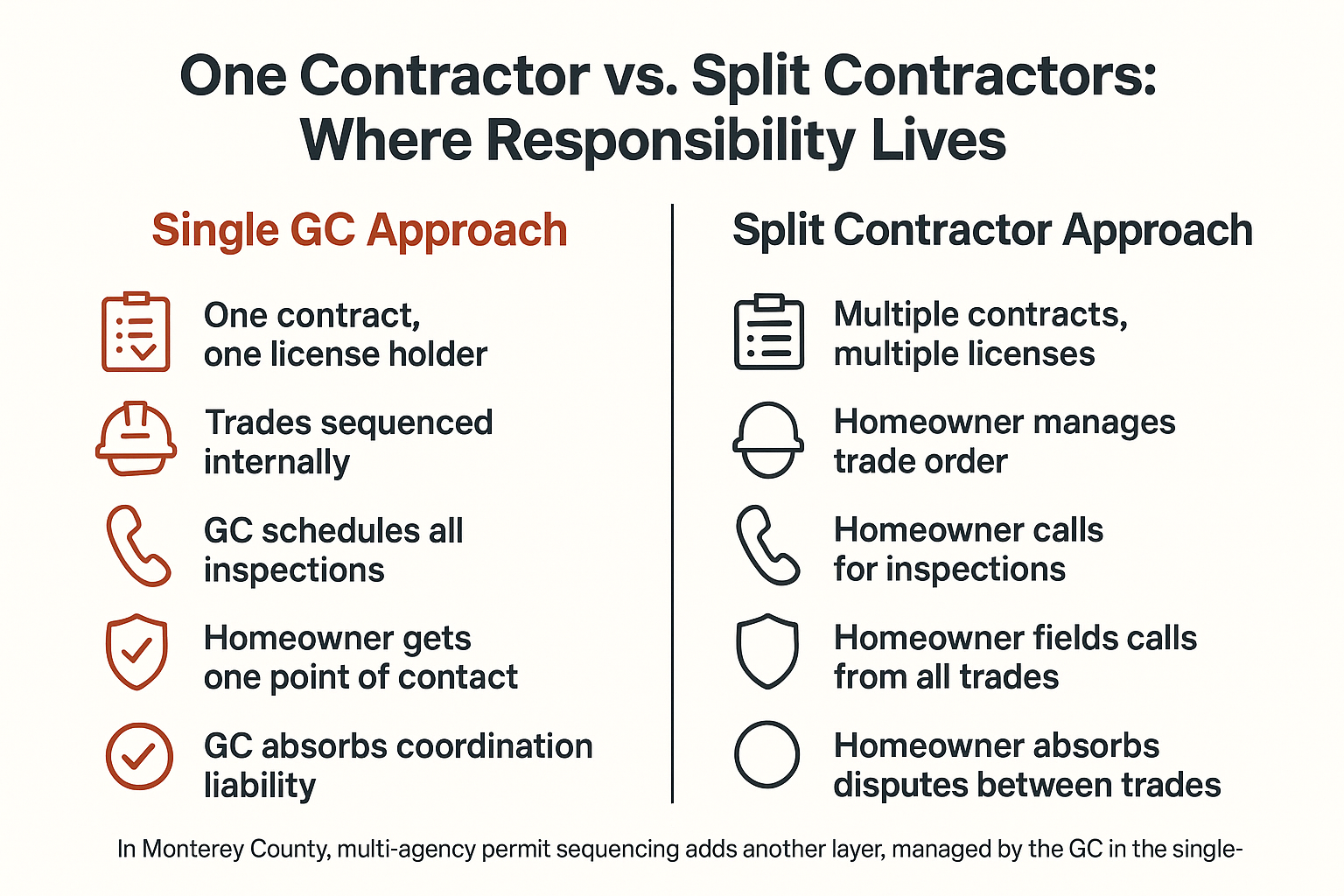
How a Single-Contractor Project Flows vs. a Split-Contractor Approach
This comparison shows how responsibility and communication flow differently depending on whether one contractor or multiple separate contractors are managing a renovation project.
What Good Communication Actually Looks Like During an Active Renovation
One thing that does not show up in bids but shows up immediately once work starts is communication cadence. Who do you call when you have a question? How often do you hear from the team without having to chase them? What decisions come back to you, and which ones stay with the contractor?
A review from one of our multi-room remodel clients captures this plainly: “From Luis, Brianna, Alvin, and Rene, they would inform me on any issue along the way and keep to the schedule.” Another client who lived in their home throughout a full kitchen, family room, bathroom, and office renovation wrote that the team was “experienced, courteous, and respectful of our home, which was especially important since we lived in it during the renovations.”
Those are not small things. When you are living through an active remodel in Salinas or Seaside or Hollister, the quality of daily communication determines whether the experience is manageable or miserable. Good communication in practice looks like:
- Progress updates before you think to ask, not just when problems arise
- Clear answers about which decisions need your input versus which the team handles
- Honest reporting when a subcontractor ran long or a material was delayed, and what that means for your timeline
- A direct line to the person overseeing the work, not a rotating cast of crew members
Brian Harrington, who had a deck project completed with us, put it simply: “Communication? Top-notch. I got updates before I even thought to ask. If Brian didn’t answer my calls he called back very quick.” That kind of consistency is easier to maintain when the person who signed the contract is also the person on site overseeing the work.
For homeowners wondering what separates a renovation that stays on track from one that spirals, this article on what makes renovations go smoothly covers the factors that actually matter, most of which have nothing to do with materials.
What Stays With the Contractor vs. What Comes Back to You
One of the clearest ways to understand the single-contractor structure is to map out which decisions and tasks belong to whom throughout the project.
| Project Task | Single GC Model | Split Contractor Model |
|---|---|---|
| Permit applications and filing | GC handles | Homeowner coordinates |
| Scheduling trade sequencing | GC manages internally | Homeowner manages between subs |
| Calling for inspections | GC schedules with county | Homeowner schedules directly |
| Resolving trade conflicts | GC resolves internally | Homeowner mediates |
| Budget tracking across scopes | GC tracks under one agreement | Homeowner tracks per contractor |
| Single point of accountability | Yes, one license holder | No, responsibility is fragmented |
Owner-Operator Accountability: What That Phrase Actually Means
The phrase “owner-operated” gets used a lot in contractor marketing, but it has a specific structural meaning that matters for homeowners. When the business owner is also the license holder and the person overseeing field work, the person who sold you the project is the same person responsible for delivering it. There is no handoff from a sales rep to a separate project management team after you sign.
Elizabeth G., a repeat client, described it this way: “He stays in communication and explains everything.” That is not a personality quirk, it is what happens when the owner has direct skin in the outcome of every project.
For larger or multi-scope projects, this matters even more. When one homeowner in Salinas came to us wanting an ADU alongside a full remodel of the main house and garage, the permitting alone involved coordination across building, planning, and environmental health. Having a single contractor who knows how ADU costs and timelines actually stack up in Monterey County, and who is personally accountable for keeping all of it moving, is a fundamentally different experience than managing that complexity yourself.
The California Contractors State License Board requires licensed GCs to carry liability insurance and maintain an active license in good standing, which creates a baseline of accountability. But the practical accountability, the person who answers when something needs to be corrected, comes from the structure of the business itself, not just the license. That is the part worth asking about before you hire anyone.
Frequently Asked Questions About Working With a Single General Contractor
Can one contractor really handle both a kitchen remodel and an ADU at the same time?
Yes, but it depends on the contractor’s capacity and how the phases are structured. In our experience, overlapping scopes work best when permits are sequenced carefully, you do not want an ADU permit held up because a building department question about the main house renovation is unresolved. A phased approach, where one permit track is substantially underway before the second opens, tends to keep things moving. We have handled combined kitchen remodel and ADU projects in Salinas, and the key is front-loading the planning so both tracks are not waiting on the same agency at the same time.
What happens if something goes wrong with work from one of the subcontractors?
When a GC holds the prime contract, the GC is responsible for the work, including work performed by subcontractors. You do not negotiate directly with the sub or argue over whose scope caused the problem. One license holder, one point of accountability. That is a meaningful difference from the split-contractor model, where disputes between independent trades often land back on the homeowner to resolve.
How do permit inspections work when a GC is managing the project?
The GC schedules inspections with the relevant agency, city building department, county building department, or both depending on jurisdiction, and stages the work so the inspection happens at the right phase. In Monterey County, that typically means a rough framing inspection, a rough electrical and plumbing inspection, an insulation inspection, and then a final. The homeowner does not need to track any of that. The GC knows the sequence and handles the calls.
Does living in the home during the remodel affect how the project is managed?
It does require more attention to sequencing and dust containment, but it is very common, especially for kitchen and bathroom remodels. Most homeowners in Salinas and across Monterey County stay in their homes during these projects. A good contractor will walk you through which phases are loudest or most disruptive and plan accordingly. For tips on making that experience manageable, this article on living through a kitchen remodel is worth reading before you start.
What should I do if I have a project that spans multiple service categories, like a bathroom remodel plus an ADU?
Bring the full scope to the initial consultation, even if you are planning to phase it. A contractor who understands how room additions, ADUs, and floor plan changes compare can help you sequence the work so one phase does not create complications for the next. Getting the full picture early also helps with permit planning, since some combinations of work require coordinated filings rather than separate applications.
Ready to Stop Managing the Coordination Yourself?
If you have a renovation project in Monterey County, Santa Cruz County, or anywhere across the Central Coast, whether it is a single bathroom remodel or a combined ADU and whole-home renovation, we are glad to walk through the scope with you in a straightforward consultation. Call Aldridge Construction at 831-682-9788 or reach out through the contact page at aldridgeconstruction.biz to start the conversation with Brian directly.