
When homeowners in Monterey and Santa Cruz consider building an ADU, one question always comes up first: "Won't my property taxes skyrocket?" It's a valid concern that a major construction project will trigger a huge, unaffordable jump in their annual tax bill.
The good news is that this is the biggest myth out there. It's based on a common misunderstanding of how California's tax laws actually work for Accessory Dwelling Units. This guide on adus & property taxes: what homeowners get wrong will clear things up.
The Biggest ADU Property Tax Myth Debunked
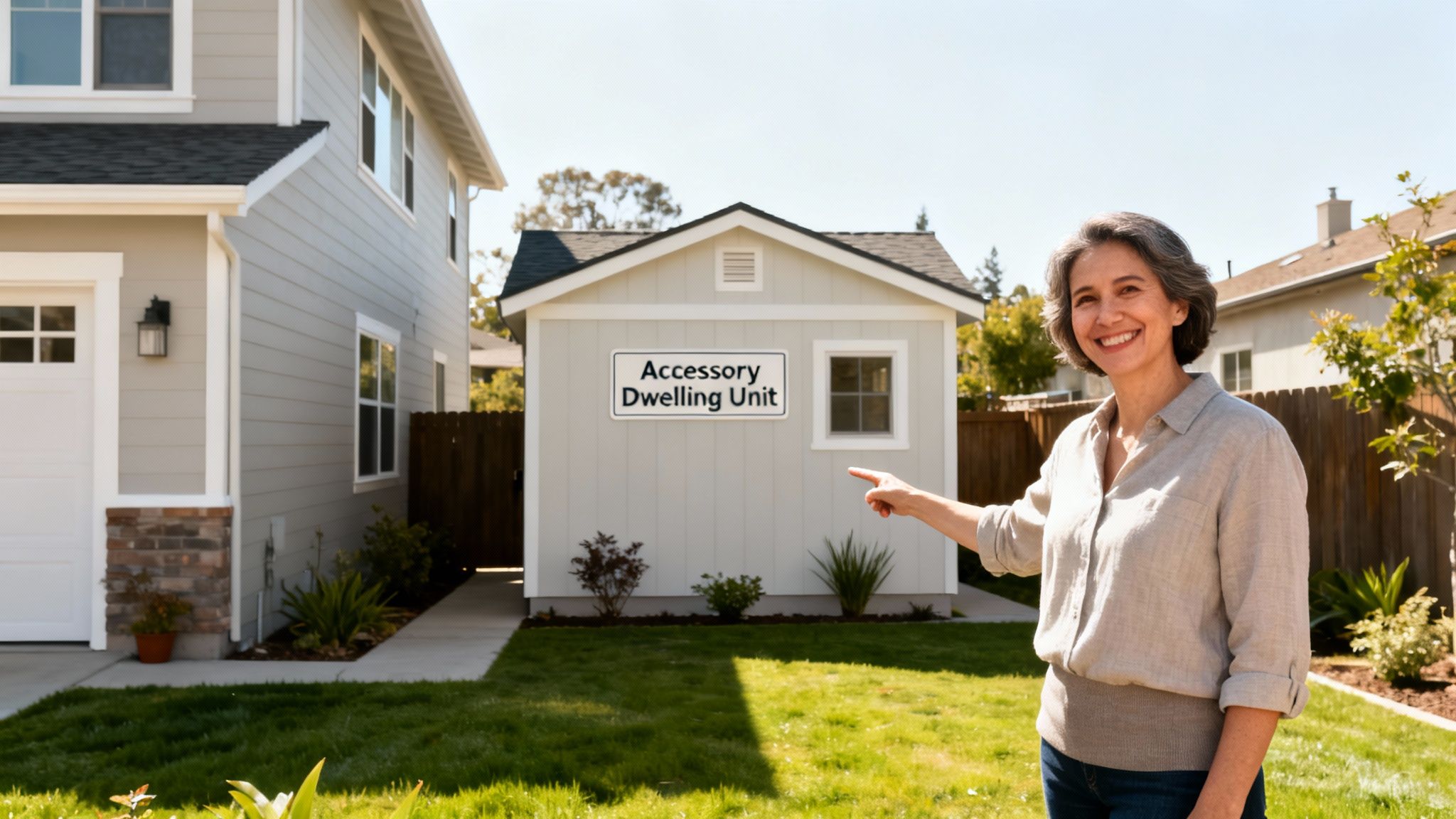
Let’s get straight to the point. A common question we hear is, “Won’t my property taxes skyrocket if I build an ADU?” However, recent insights show that ADUs are assessed separately under California law. The main home’s property tax base remains unchanged.
What this actually means for you is that building an ADU won’t trigger a full reassessment of your home’s value. Only the added value of the ADU is evaluated, which keeps your tax increase manageable and often minimal.
Why Your Entire Property Won't Be Reassessed
Thanks to Proposition 13, the assessed value of your main home is protected. Your original home's tax base is locked in.
The county assessor simply adds a supplemental assessment for the new value created by the ADU. This keeps your tax increase predictable and much smaller than most people fear.
ADU Property Tax Myth vs. Reality
To make it even clearer, let's break down the common fears versus what actually happens when you build an ADU.
| What Homeowners Fear | How It Really Works |
|---|---|
| My entire property will be reassessed at its current, much higher market value. | Only the newly constructed ADU gets a supplemental assessment. Your primary home's tax base is safe. |
| My property tax bill is going to double or even triple overnight. | The tax increase is calculated only on the ADU's value, not the whole property. It's a blended rate. |
| The new tax payment will make the whole ADU project unaffordable in the long run. | The tax impact is predictable. You can (and should) factor this modest, manageable increase into your project budget from day one. |
This distinction is crucial. Thinking about building a granny flat or backyard cottage brings up a lot of questions. Before you get too deep into the numbers, it helps to understand the basics. Our complete guide on what an ADU means in construction is a great place to start building a solid foundation for your project plan.
How Tax Assessors Actually Value Your New ADU
So, how does the assessment really work? It’s a lot less scary than most homeowners think. In places like California and Arizona, assessors use a straightforward method called a supplemental assessment. This is what keeps your tax increase manageable.
The whole point of this process is to make sure your existing home's value stays locked in, especially under the powerful protections of Proposition 13 here in California. The tax bump comes only from the new value the ADU adds.
Understanding the Blended Assessment Method
Think of it like adding a deck to your house. The county doesn’t re-evaluate your entire home just because you built a new deck. They simply figure out the value of the new addition and add that to your existing tax base.
This "blended" approach is exactly what prevents that dreaded tax skyrocket everyone worries about. The assessor's job is to pin down the market value of the new construction itself. To get a better feel for how they land on a number, it's helpful to understand a few common real estate property valuation methods.
Here’s a simple breakdown of how it works in counties like Monterey, Santa Cruz, and Maricopa:
- Your Existing Home: Your primary house keeps its original assessed value, which only goes up by the small, legally capped amount each year.
- The New ADU: An assessor calculates the value of the ADU. They look at its square footage, features like a full kitchen with quartz countertops, and the overall quality of the build.
- The Supplemental Tax Bill: You'll get a one-time bill for this new value, adjusted for the remainder of the tax year. After that, this new amount just gets rolled into your regular annual property tax bill.
A Real-World Example
Let's walk through a quick scenario. Imagine you own a home in Santa Cruz with a current assessed value of $400,000. You decide to build a 500-square-foot ADU in the backyard.
Once the project is finished, the county assessor determines the new ADU adds $150,000 in value.
Your new total assessed value isn't the current market price of your home plus the ADU. Instead, it’s simply your old assessed value plus the ADU’s value: $400,000 + $150,000 = $550,000. Your tax increase is based only on that extra $150,000.
By understanding the true cost to build an ADU and how its value will be assessed, you can plan your budget with confidence.
Estimating Your Potential Property Tax Increase
Alright, let's turn that idea of a "blended assessment" into something you can actually use. For homeowners in Monterey, Santa Cruz, and Maricopa County, this is a straightforward formula that can give you a really solid estimate.
You are not taxed on what you spent to build the ADU. You're taxed on the assessed value it adds to your property—and that number is often less than your actual construction cost.
A Step-by-Step Example in Santa Cruz County
Let's walk through a real-world scenario. Imagine you're a homeowner in Santa Cruz County, and you're adding a new 600-square-foot ADU.
-
Determine the Added Assessed Value: The county assessor determines your new ADU adds $180,000 in value to your property. This is the only part that gets taxed at the new rate.
-
Apply the Base Tax Rate: California’s base property tax rate under Prop 13 is 1% of the assessed value. So, the base tax increase is: $180,000 x 0.01 = $1,800 per year.
-
Factor in Local Assessments: Most communities have small, voter-approved local bonds for things like schools or water districts. Let's say these add an extra 0.15% in Santa Cruz.
-
Calculate the Total Annual Increase: Now you just add them together. Your total tax rate is 1.15% (1% + 0.15%). Your estimated annual tax increase comes out to: $180,000 x 0.0115 = $2,070, which is about $172.50 per month.
This process visually breaks down how a new ADU is valued separately from your existing home.
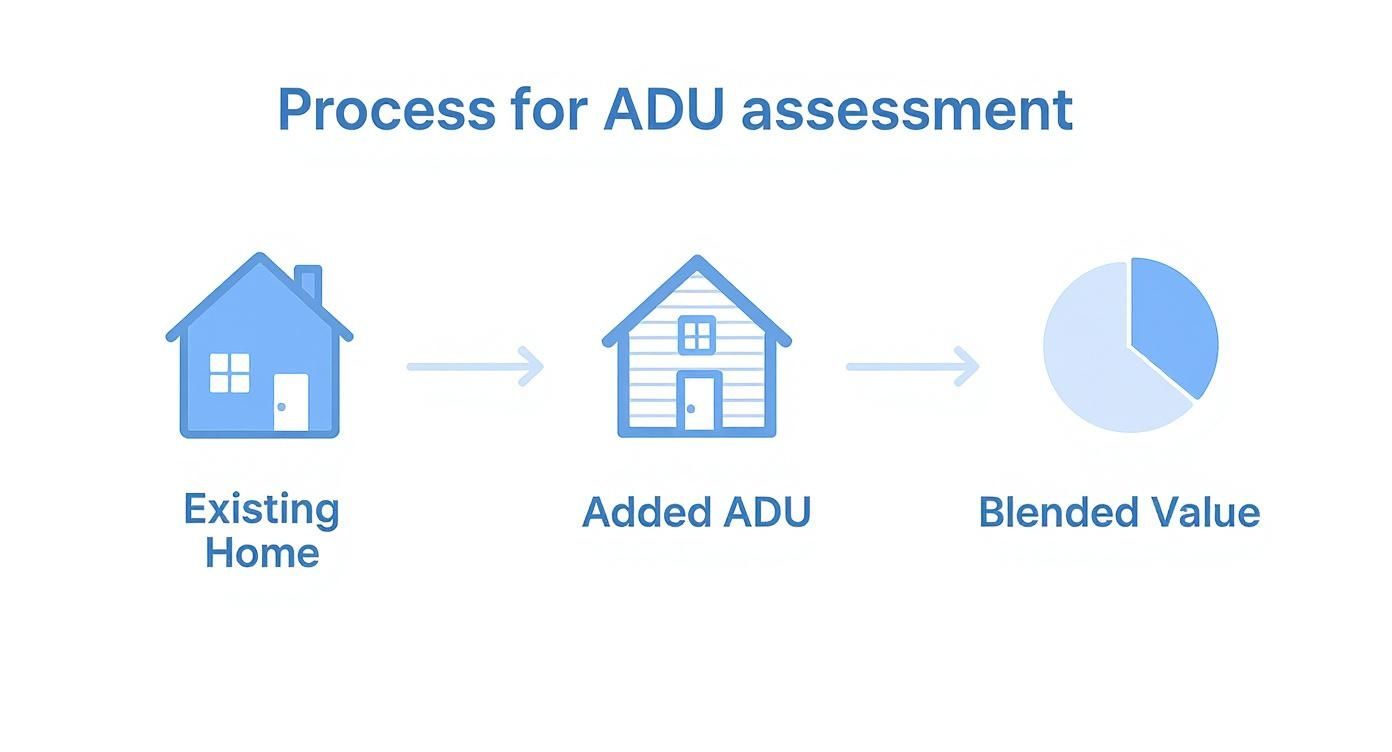
As the diagram shows, your original home’s value is protected. Only the value of the new ADU is tacked on to create that new, blended total for tax purposes.
Suddenly, that modest increase feels a lot more manageable. If you want to get a better feel for how different project scopes might affect your overall budget, you can play around with our home addition costs calculator. The single most important actionable step is to talk to your local assessor’s office about how ADUs are evaluated and estimate the tax impact before starting.
Navigating Local Tax Rules in California and Arizona
Property tax rules change from state to state and even between counties. Understanding the local landscape—in Monterey, Santa Cruz, and San Benito Counties in California, and Maricopa County in Arizona—is key to planning your ADU project without surprises.
For our clients in California, everything starts with Proposition 13. This law is the bedrock of our property tax system. It guarantees that your main home's assessed value won't jump by more than 2% a year, shielding you from market swings [Source: California State Board of Equalization].
How California Counties Handle ADU Assessments
When you build an ADU in places like Monterey, Santa Cruz, or San Benito County, the assessor's office performs a supplemental assessment. This is a one-time valuation that only looks at the value added by the new ADU.
Here’s what that really means for you:
- Your Main Home is Protected: The Prop 13 tax base for your existing house is left alone.
- Only New Value is Taxed: The tax increase is calculated only on the assessed value of the ADU itself.
- A Supplemental Bill is Issued: You’ll get a separate tax bill just for this new value. In the following years, it gets rolled into your regular property tax bill.
Knowing the specific permit process is crucial. To get a head start on the statewide rules, check out our guide to California ADU requirements.
The Assessment Process in Maricopa County, Arizona
Over in Arizona, the system for assessing property value is a little different. Maricopa County assesses property at its Full Cash Value (FCV), which is its market value.
When you add a new structure like an ADU, the county assessor's office will re-evaluate your property to account for the value of the new construction. The increase in your property's total assessed value will directly reflect the value of the new unit. The local county assessor’s office is always the final authority, and Aldridge Construction can guide you on what questions to ask.
Does ADU Rental Income Affect Property Taxes?
This is one of the most common questions homeowners have. Let's clear it up right away.
Your property tax bill is based purely on the assessed value of your property—not on any income you might earn from it. This is a critical distinction for anyone considering building an ADU as a rental investment.
Income Tax vs. Property Tax
It's easy to get these two mixed up, but they are completely separate. They are paid to different government agencies for different reasons.
- Property Tax: This is a local tax paid to your county (like Santa Cruz or Maricopa) based on the assessed value of your real estate. This money funds local services like schools and fire departments.
- Income Tax: This tax is paid to the state and federal government (IRS) on earnings you receive. That includes rental income.
The money you collect from a tenant is absolutely considered income, and you'll need to report it on your tax return. But that rental income has zero impact on how much property tax you owe.
Managing Your Rental Income and Expenses
Once your ADU is built and you have a tenant, you’ll need to handle the financial side of being a landlord properly. To get a handle on the specifics of managing the income your ADU generates, you might find this landlord's guide to taxes on rental income to be a helpful resource.
And remember, keeping your investment in great shape is key. If you need help with ongoing maintenance or repairs for your new rental unit, Aldridge Construction also offers expert property management remodeling and repair services to protect your investment.
How We Help You Plan for Every ADU Cost
At Aldridge Construction, we believe a successful project means no surprises—especially when it comes to your budget. We’re more than just builders; we’re your partner in seeing the full financial picture. That includes helping you understand ADUs & property taxes: what homeowners get wrong.
While we aren't tax advisors, our years of experience building in Monterey, Santa Cruz, and Maricopa counties give us a practical understanding of how things work. We know the right questions to ask your local assessor.
Your Partner in Financial Clarity
Our role is to support your project’s financial health with clear, detailed documentation. A proactive approach here prevents a lot of headaches and ensures the assessed value truly reflects the work done.
Here’s how we help:
- Detailed Project Scopes: We provide exhaustive breakdowns of all work, from the foundation to the final coat of paint.
- Transparent Cost Breakdowns: You get an itemized list of material and labor costs, creating a clean paper trail for the assessor.
- Guidance on Local Procedures: We can help you find your way through the specific administrative hoops in your county.
This commitment to transparency isn’t just about building trust; it’s about setting you up for long-term financial success. Understanding all your financial tools is a huge part of planning, which is why we always suggest exploring the different ADU financing options early in the process.
Frequently Asked Questions
1. Will my main house be reassessed when I build an ADU?
No. This is the most common myth. Under California's Proposition 13, your main home’s assessed value is protected. Only the new ADU itself gets a "supplemental assessment," meaning the county only adds the value of the new construction to your existing tax base.
2. Is the property tax increase based on my construction cost?
Not directly. The county assessor determines the "assessed value," which is how much market value the ADU adds to your property. While your construction costs are a factor, the assessor's final number might be higher or lower based on their valuation models, not just your receipts.
3. How soon will I see the tax increase on my bill?
Typically, a few months after your ADU passes final inspection, you will receive a one-time "supplemental tax bill." This covers the prorated tax increase for the rest of the fiscal year. After that, the new amount is rolled into your regular annual property tax bill.
4. Can I appeal the county's assessment if it seems too high?
Yes. Every homeowner has the right to appeal a new assessment. If the county's valuation of your ADU seems much higher than the actual value it added, you can file an appeal with your local Assessment Appeals Board. You will need evidence to support your case.
5. Does converting my garage into an ADU get taxed the same as a new build?
It's usually assessed differently, often resulting in a smaller tax increase. Since you are converting an existing structure, the county is only assessing the value of the improvements (like adding a kitchen and bathroom), not the value of a whole new structure. This typically leads to a lower assessed value.
Want to explore how much value an ADU could add without hurting your tax bill? The team at Aldridge Construction provides expert guidance for projects in Monterey, Santa Cruz, San Benito, and Maricopa Counties. Contact us for a free consultation today.