
Building an ADU in California is a great way to add value to your property. It can also create rental income and give you more flexible living space. New state laws make it easier for homeowners in places like Monterey and Santa Cruz Counties to add these units. The process involves planning, design, getting permits, and construction, but it creates a valuable asset for the future.
Why Building an ADU in California Is a Smart Investment

Adding an Accessory Dwelling Unit (ADU) is more than just a building project. It is a smart financial choice. In California, there is high demand for housing. An ADU makes your property more useful and attractive right away.
The trend of building an ADU in California has grown quickly. In 2023, the state permitted 26,924 new ADUs. This shows that homeowners see the value these units add. [California Department of Housing and Community Development, 2024]
Financial and Lifestyle Benefits
For many homeowners in Monterey and San Benito Counties, an ADU solves modern living problems. It can provide rental income to help pay your mortgage. This makes owning a home more affordable.
An ADU also offers great flexibility. Homeowners use them in many ways:
- A Home for Family: You can create a private, comfortable home for older parents or adult children. This keeps family close while letting everyone have their own space.
- A Home Office: You can design a quiet office or studio separate from your main house. This helps create a good work-life balance.
- A Place for Guests: You can offer a nice space for friends and family to stay. This gives them privacy without using your own space.
A Real Return on Your Investment
An ADU is an asset that can greatly increase your property's sale price. Buyers see it as a ready-to-go rental or a flexible space for their own needs. This makes your home stand out in the market.
Understanding basic real estate numbers can help you see the long-term financial benefits. To learn more, read about the key metrics for real estate investors. Aldridge Construction can help you through this whole process. We make sure your project is a good investment from the start.
Understanding California ADU Laws and Local Rules
Before you start building your ADU, you need to understand the rules. In California, there are two sets of rules. The state has basic rules to make building an ADU in California easier. But local areas like Monterey, Santa Cruz, and San Benito Counties can add their own requirements.
State laws have made it much easier to build ADUs. That’s why California has seen so many new ones. Between 2013 and 2023, 88,885 ADUs were permitted in California. That’s far more than any other state on the West Coast.
Knowing both state and local rules is the first step to a smooth project. It helps you avoid expensive delays and design changes. A local builder with experience is the best person to guide you through these rules.
Statewide California ADU Rules
California's state laws are the main rules that every city and county must follow. These rules were made to remove common problems and encourage homeowners to build more housing.
Here is a quick look at the key statewide rules that apply everywhere in California.
Key California Statewide ADU Rules at a Glance
| Regulation Type | Statewide Rule Summary | Important Note |
|---|---|---|
| Setbacks | A maximum of 4-foot side and rear yard setbacks is required. | This stops local rules from requiring large, empty spaces around your ADU. |
| Size Limits | A detached ADU can be up to 1,200 square feet. | Local areas can set their own limits, but they must allow a unit of at least 800 square feet. |
| Parking | No extra parking is needed if the property is within a half-mile of public transit. | You also don't need extra parking for garage conversions or in historic districts. |
These statewide laws provide a clear path forward. They ensure that every homeowner in California can build a reasonably sized ADU. This is an important part of figuring out your budget. You can learn more in our guide on the cost to build an ADU.
Local City and County Rules
While state laws set the foundation, your local city or county has the final say on many details. This is where things can get tricky. Areas in Monterey, Santa Cruz, and San Benito often have their own unique rules. This is why having an expert local builder is so important.
For example, a property in the coastal zone of Santa Cruz might need extra design reviews or have stricter height limits. In a high-fire-risk area of San Benito County, you might need to use special fire-resistant materials, like non-combustible siding and dual-pane tempered glass windows. These local rules can make a big difference.
Different ADU Types and Their Rules
The rules can also change based on the kind of ADU you want to build. Each type has its own rules that will affect your design, permits, and construction.
Here are the main types:
- Detached ADU: This is a separate, standalone structure like a backyard cottage. It offers the most privacy but usually costs the most to build.
- Attached ADU: This is built as an addition connected to the main house. It can be cheaper since you might share a wall and utilities.
- Conversion ADU: This is made by changing an existing space, like a garage or basement, into a living unit. These projects are often the fastest and cheapest.
- Junior ADU (JADU): This is a small unit, no more than 500 square feet, created inside the main house. For a JADU, the property owner must live in either the JADU or the main home.
Each type of ADU meets a different need and has its own set of rules. Working with a professional helps make sure your project follows the rules from the start.
Planning and Designing Your Perfect ADU
Now that you understand the rules, it's time for the fun part. You can start turning your idea for a backyard cottage or garage apartment into a real plan. This is when you decide on layouts, finishes, and what you will use the space for.
Getting this planning phase right is very important. A good plan helps prevent expensive changes and delays later on. It's like creating a clear map that connects your goals, budget, and design.
Define Your ADU Goals
Before you look at floor plans, ask yourself a simple question: Why am I building this ADU? Your answer will guide every decision you make, from the size to the type of flooring.
Here in Monterey and Santa Cruz Counties, homeowners build for a few common reasons:
- Rental Income: If you want to make money, the design should be durable and appeal to many people. A one-bedroom layout often works best for rentals.
- Family Living: If you're building for a parent, you need to think about accessibility. This means a single-story design, wide doorways, and a walk-in shower with non-slip floors.
- Home Office: If you need a quiet workspace, your design should have lots of natural light and plenty of electrical outlets.
- Guest Space: For visitors, you'll want a layout that feels open and welcoming. A comfortable living area and a small kitchen are key.
Being clear about your main goal ensures the finished ADU works perfectly for its purpose.
Create a Realistic Budget
A budget is more than just a guess about construction costs. A good financial plan for an ADU includes everything. This includes "soft costs" that come up before building starts.
A complete budget should cover:
- Design and Engineering: Fees for architectural plans and structural calculations.
- Permits: City fees that are required for every project.
- Construction: The "hard costs" of labor and materials, from the foundation to the roof.
- Utility Connections: Fees for connecting to water, sewer, and electricity.
- Finishes and Appliances: Costs for flooring, countertops, and appliances like a refrigerator.
- Landscaping: Money for any work needed around the ADU.
- Contingency Fund: Set aside 10-15% of your total budget for unexpected problems.
Working with a builder like Aldridge Construction helps you create an accurate budget from the start.
Choose the Right ADU Type and Layout
With your goals and budget set, you can pick the best ADU type for your property. Detached ADUs are great for privacy. Attached ADUs or garage conversions can be cheaper because they use the main home's structure and utilities.
The layout is also important. Open-concept plans make small units feel bigger. If you're building a rental, a separate bedroom is a big plus for tenants. To get more ideas, you can explore some smart ADU design ideas that show how to make the most of your space.
Select Materials for the Central Coast Climate
The materials you choose will affect how your ADU looks and lasts. Here on the Central Coast, we deal with sun, fog, and salty air. It's smart to pick materials that can handle these conditions.
We often suggest materials like:
- Durable Siding: Fiber cement siding from brands like James Hardie holds up well against moisture and fire.
- Energy-Efficient Windows: Good dual-pane windows from brands like Milgard keep the inside comfortable and lower energy bills.
- Composite Decking: If you add a deck, composite materials last longer in the coastal weather than wood.
- Cool Roofing: Lighter-colored roofing reflects sunlight. This helps keep the ADU cooler and meets California’s Title 24 energy standards.
Talking to a builder early in the design process is a great idea. At Aldridge Construction, we can help you choose materials that give you the best mix of looks, performance, and cost.
4. Navigating California ADU Requirements
Before you get too far into your design, you need to understand the local and state rules. This part can feel confusing, but breaking it down makes it easier.
California has passed state laws to make building ADUs easier. But your local city or county still has its own rules. Your project must follow both.
State-Level Rules: The Big Picture
The state has set important rules that apply everywhere. For example, if your ADU meets certain rules, your local city must approve it. This has been a big help for homeowners.
Key state rules include:
- Size Limitations: You can generally build an ADU of at least 800 square feet, and up to 1,200 square feet in many cases.
- Setbacks: Side and rear setbacks have been reduced to just four feet. This helps homeowners with smaller lots.
- Parking: You don't need to add a new parking space if your property is within a half-mile of public transit.
- Owner Occupancy: Cities can no longer require the owner to live in either the main house or the ADU.
For more details, our guide on California ADU requirements is a great resource.
Local Ordinances: The On-the-Ground Reality
Now it's time to look at your specific address. This is where a good contractor's local knowledge is very helpful, because every city has different rules.
You will need to check your city or county’s planning department website. Look for their "ADU ordinance." This is where you will find local rules on things like:
- Maximum Height: How tall your ADU can be.
- Architectural Style: Some cities have design rules to make sure new ADUs fit the neighborhood.
- Lot Coverage: How much of your lot can be covered by buildings.
You can also call the planning department. They can confirm your zoning and tell you what documents you need. It is better to ask questions now than to make a costly mistake later.
Zoning and Feasibility: Will an ADU Fit?
Zoning is the first step. Most residential zones now allow at least one ADU. The key is to figure out if it will physically fit on your property.
Get a tape measure and a copy of your property’s site plan. You need to map out the area where you can build after accounting for setbacks from property lines.
Remember to think about utility lines and any large trees you want to keep. A feasibility check now can save you a lot of time and money.
Your ADU Construction Timeline from Start to Finish
Once your permits are approved, the real fun begins. The vision you spent months planning on paper starts to become real in your backyard. Seeing your ADU get built is an amazing process. Understanding the steps will help you know what to expect.
A well-run construction project follows a clear order. Inspections happen at key points to make sure every part of the build is safe and meets California's standards.
This image shows the whole journey, from design and permits to the final build.
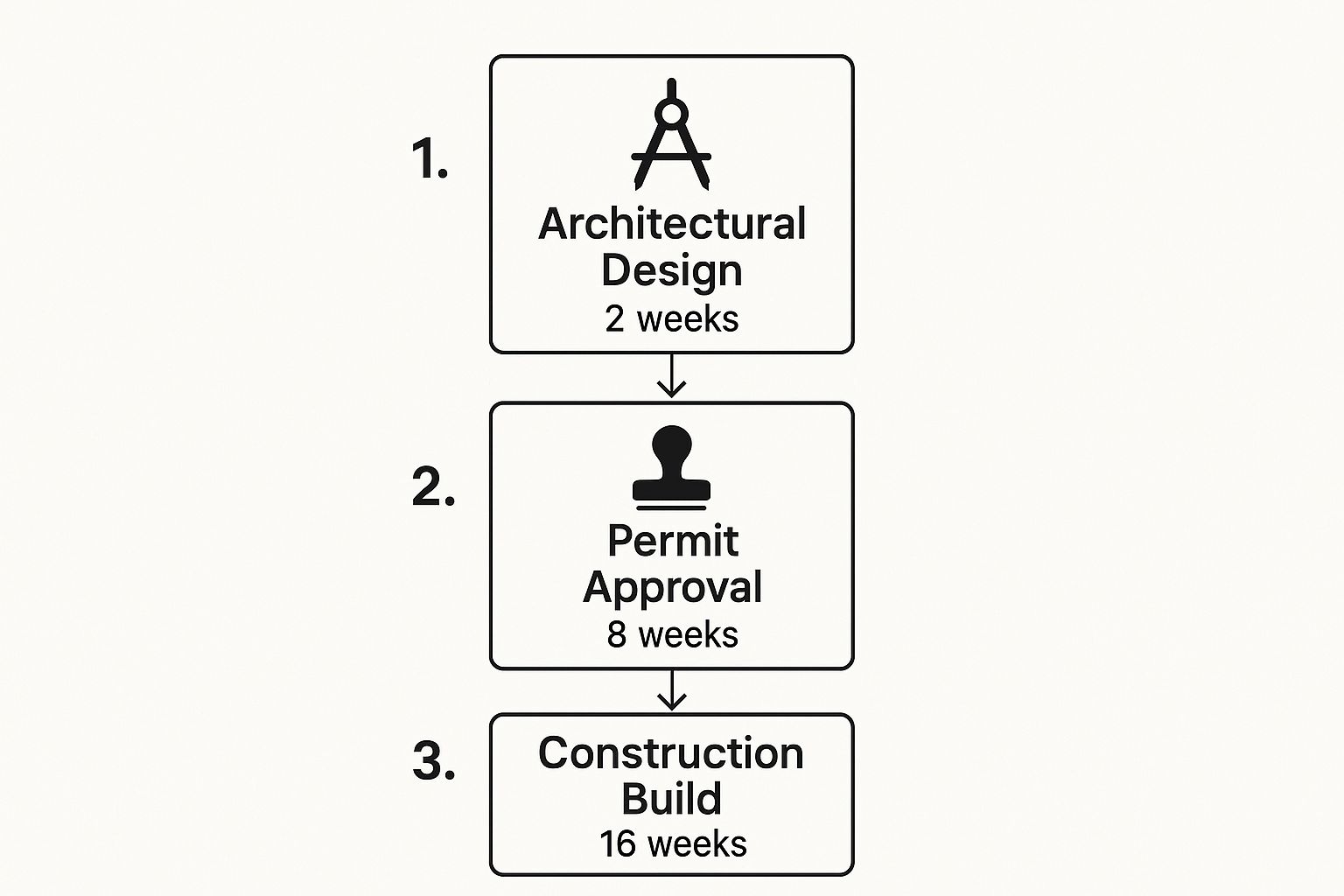
As you can see, the construction is the longest part of the process. This shows why it is so important to work with a reliable builder who can keep the project moving.
Site Preparation and Foundation Work
On the first day, the crew will prepare the site. This means clearing the area where the ADU will be built. Next, the ground is leveled to create a stable base for the building.
Once the site is ready, we dig trenches for utilities like water, sewer, and electrical lines. We then build wooden forms for the foundation and place steel rebar inside for strength. Finally, a concrete truck arrives to pour the foundation. The concrete needs time to harden before we can start framing. This is when we usually have our first big inspection.
Framing and Rough Mechanical Systems
This is a fun phase because your ADU starts to look like a house. The crew builds the walls, floor, and roof. In just a few days, you'll see the full structure of your ADU, with openings for windows and doors.
With the frame up, it's time for the "rough-ins." This is when licensed workers install the systems behind the walls:
- Rough Plumbing: Water supply and drain pipes are put in.
- Rough Electrical: Wires are run to every outlet, switch, and light.
- HVAC Systems: Ducts for heating and air conditioning are installed.
Each of these systems must be inspected by a city official to make sure it meets all building codes. A typical ADU project can have 8 to 12 different inspections.
Exterior Finishes and Interior Work
After the inspections pass, we focus on making the structure weather-proof. We install the roof, windows, and exterior doors. Then, we add siding or stucco to the outside walls.
At the same time, work moves quickly inside. We install insulation in the walls and ceilings to meet California's Title 24 energy rules. After another inspection, the drywall crew hangs and finishes the walls.
From here, it's all about the finishes that give your ADU its personality:
- Flooring is installed.
- Kitchen and bathroom cabinets are put in.
- Countertops, like quartz or granite, are set.
- Interior doors and trim are fitted.
- The inside gets a fresh coat of paint.
As your ADU gets closer to being finished, you should think about security. Using comprehensive construction site security can protect your investment from theft.
To finish up, plumbers and electricians return to install fixtures like sinks, toilets, and lights. Once everything is done, we schedule the final inspections. After the last approval, you get a Certificate of Occupancy, and your new ADU is ready to use!
Typical ADU Construction Phases and Timeline
| Construction Phase | Key Activities | Estimated Duration |
|---|---|---|
| Site Prep & Foundation | Clearing, grading, trenching for utilities, forming, rebar, pouring concrete slab. | 2-3 weeks |
| Framing | Erecting walls, floors, and roof structure. Sheathing the exterior. | 1-2 weeks |
| Rough-Ins & Inspections | Installing plumbing, electrical wiring, and HVAC systems. City inspections for each. | 2-4 weeks |
| Exterior Finishes | Installing roofing, windows, exterior doors, and siding/stucco. | 2-3 weeks |
| Interior Rough & Finishes | Insulation, drywall, painting, flooring, and cabinetry installation. | 4-6 weeks |
| Final Finishes & Punch List | Installing countertops, fixtures, appliances. Final touch-ups and clean-up. | 2-3 weeks |
| Final Inspections | Final building, plumbing, and electrical inspections for Certificate of Occupancy. | 1 week |
These timelines are just estimates. They can change based on weather, inspection schedules, and how complex your project is.
Ready to Start Your California ADU Project?
Building an ADU is a big project, but with the right team, it is a great investment. You now have a clear guide, from understanding local laws in places like Monterey and Santa Cruz to managing the final construction. An ADU adds real value, whether it's for extra income, keeping family close, or increasing your property's worth.
For many homeowners, the first step is figuring out the budget. Learning how to finance rental property, including different loan options, helps you start with a strong financial plan.
Your dream of a backyard cottage or rental unit is closer than you think. The journey starts with a good plan and an expert team to help you.
If you are a homeowner in Monterey, Santa Cruz, or San Benito County, your next step is to talk to us. At Aldridge Construction, we offer free consultations to discuss your property's potential. Let us help you start your project the right way and turn your vision into a valuable addition to your home.
FAQs About Building an ADU in California
If you are thinking about building an ADU in California, you probably have some questions. Getting clear answers is the key to moving forward with confidence. Here are some of the most common questions we hear.
1. How much does an ADU cost in Monterey or Santa Cruz County?
The final cost of an ADU can change based on its size, design, and the finishes you pick. In general, a finished, detached ADU on the Central Coast costs between $250,000 and $450,000. This price includes everything from design and permits to construction and standard finishes.
A few things that affect the final price are:
- Site Access: A steep hill or a hard-to-reach property can add to the budget.
- Utility Upgrades: The distance to your main utility lines matters. You may also need to upgrade your main electrical panel.
- Finishes: High-end choices like quartz countertops or custom tile will increase the cost.
2. What is the total timeline from design to move-in?
From the first drawing to getting the keys, a typical ADU project takes 9 to 14 months. We can break it down into three main stages:
- Design & Planning (1-2 months): This includes site analysis and creating the architectural plans needed for permits.
- Permitting (2-4 months): We submit the plans to your local building department. State law says they should review them in 60 days, but it can sometimes take longer.
- Construction (6-8 months): This is when we build the ADU, from the foundation to the final touches.
3. Can I convert my garage into an ADU?
Yes, you can! Garage conversions are a popular and often cheaper way to build an ADU. California law supports these projects. You can often convert a garage without having to add new parking spaces. A garage conversion is often the fastest way to get a finished ADU because the basic structure is already there.
4. What are the biggest mistakes homeowners make?
One of the biggest mistakes is not budgeting for all the costs. People often forget about "soft costs" like design fees, city permits, and utility fees. These can add up quickly. Another mistake is not hiring a contractor with specific ADU experience. Building an ADU involves a unique mix of state and local rules that require special knowledge. It helps to understand what an ADU means in construction to see why this expertise is so important.
5. Do I have to pay new property taxes on my ADU?
Yes, your property taxes will go up after you build an ADU. However, it's not as much as you might think. Your property will be reassessed, but only the value of the new ADU is added to your tax bill. The tax on your main house will not change. The small increase in taxes is usually easy to cover with the new rental income or property value the ADU adds.