
Building a home that saves energy is not just a trend. It has become the new standard for smart homeowners in California and Arizona. This way of building offers real benefits like lower utility bills, comfortable indoor temperatures, and cleaner air. At Aldridge Construction, we believe that planning for energy efficiency from the start is a key investment in your home's future.
The New Standard for Homes in California and Arizona
An energy-efficient home does more than just save you money. It creates a better living space for you and your family.
For homeowners in Monterey, Santa Cruz, or Maricopa County, the benefits are clear. Our local climates, from coastal fog to desert heat, make energy efficiency a must-have, not a luxury. A well-built home of this type maintains a steady, comfortable temperature year-round.
This means your heating and cooling system doesn't have to work so hard, which leads to big savings. It also makes for a quieter home without the drafts or hot spots found in older houses.
Why Efficiency Is a Smart Investment
The value of energy efficient home building goes beyond your monthly power bill. These homes are built better, which means they are more durable and often have a higher resale value. As building codes get stricter, efficiency has become a major selling point.
Consider these benefits:
- Healthier Indoor Air: Airtight construction paired with a good ventilation system filters out dust and allergens. This creates a healthier living space.
- Increased Property Value: Homes with certified efficiency ratings are popular in today's real estate market. They often sell faster and for a higher price.
- A Future-Ready Home: Building to today’s tough energy codes, like California’s Title 24, means your home is ready for future standards.
This is not just a guess. According to the Residential Energy Services Network (RESNET), more than 355,000 homes received a Home Energy Rating System (HERS) score in 2022. This was a 13% increase from the year before, showing that buyers expect energy efficiency.
At Aldridge Construction, we build custom homes that are both beautiful and smart. We choose high-performance materials like spray foam insulation and Milgard windows suited for the climates of Central California and Arizona. You can learn more in our guide on green construction materials.
Laying the Groundwork with Smart Site Planning
True energy efficiency starts long before construction begins. It starts with smart site planning and passive design. These early choices form the foundation of an efficient home and can lower your energy needs from day one.
This first step is about using your property's natural features. We look at the sun's path and local wind patterns. Getting this right can dramatically reduce how much energy your home uses.
Harnessing the Power of the Sun
One of the best strategies in energy efficient home building is orienting the house correctly. The goal is to maximize the sun's free heat in the winter while blocking it in the summer.
This approach changes based on your location. For a home in Monterey or Santa Cruz County, we would place the main living areas and largest windows to face south. This lets the low winter sun warm the home naturally.
In the strong heat of Maricopa County, Arizona, our strategy is different. Here, the priority is to shield the home from the summer sun. This might mean placing the garage or smaller windows on the west side, where the afternoon sun is harshest.
Strategic Window and Overhang Placement
Once the home is oriented, placing windows is the next key step. This is about more than just the view; it's about controlling light and heat all year.
- South-Facing Windows: In both California and Arizona, these windows are great for catching winter sun. We pair them with roof overhangs that block the high summer sun but let the low winter sun in.
- East and West Windows: These windows can cause overheating in the summer. We either use fewer of them or protect them with landscaping or high-performance coatings.
- North-Facing Windows: These windows provide great natural light without adding extra heat. They are perfect for home offices or kitchens.
Proper window placement can also help with natural ventilation. By placing windows to catch breezes, we can cool the home without using the air conditioner. This works well in the mild coastal climates of Santa Cruz and San Benito Counties.
Using Landscaping as a Natural Shield
Landscaping is not just for looks; it is a key part of passive design. It acts as your home's first defense against the weather.
For example, planting leafy trees on the south and west sides provides shade in the summer. In the winter, these trees lose their leaves, letting sunlight through to warm the house.
Other landscaping strategies include:
- Windbreaks: Planting evergreen trees can shield your home from cold winter winds.
- Ground Cover: Using plants instead of concrete helps keep the area around your home cooler.
- Shading Patios and Walls: Pergolas with vines can prevent walls from absorbing heat.
These early planning steps are vital for your home's comfort and performance. To see how Aldridge Construction includes these steps in our projects, learn more about your custom home building process.
Mastering the Building Envelope for Ultimate Comfort
Your home’s building envelope is its protective shell. This system includes the foundation, walls, roof, windows, and doors. It is the most important barrier between you and the outdoors. A good building envelope is the key to energy efficient home building, and it comes down to two things: great insulation and careful air sealing.
A home that leaks air is a home that wastes money. Every small crack lets drafts, moisture, and allergens inside. This makes your HVAC system work harder and drives up your energy bills. At Aldridge Construction, we treat the building envelope as one complete system to make sure it is well-insulated and airtight.
Choosing the Right Insulation for Your Climate
Insulation's ability to resist heat flow is measured by its R-value. A higher R-value means better insulation. The best choice depends on your local climate and where it is installed in the house.
For example, a home in the mild climate of Santa Cruz County needs different insulation than a house in the hot sun of Maricopa County. We help homeowners choose materials that meet or exceed local energy codes for the best performance.
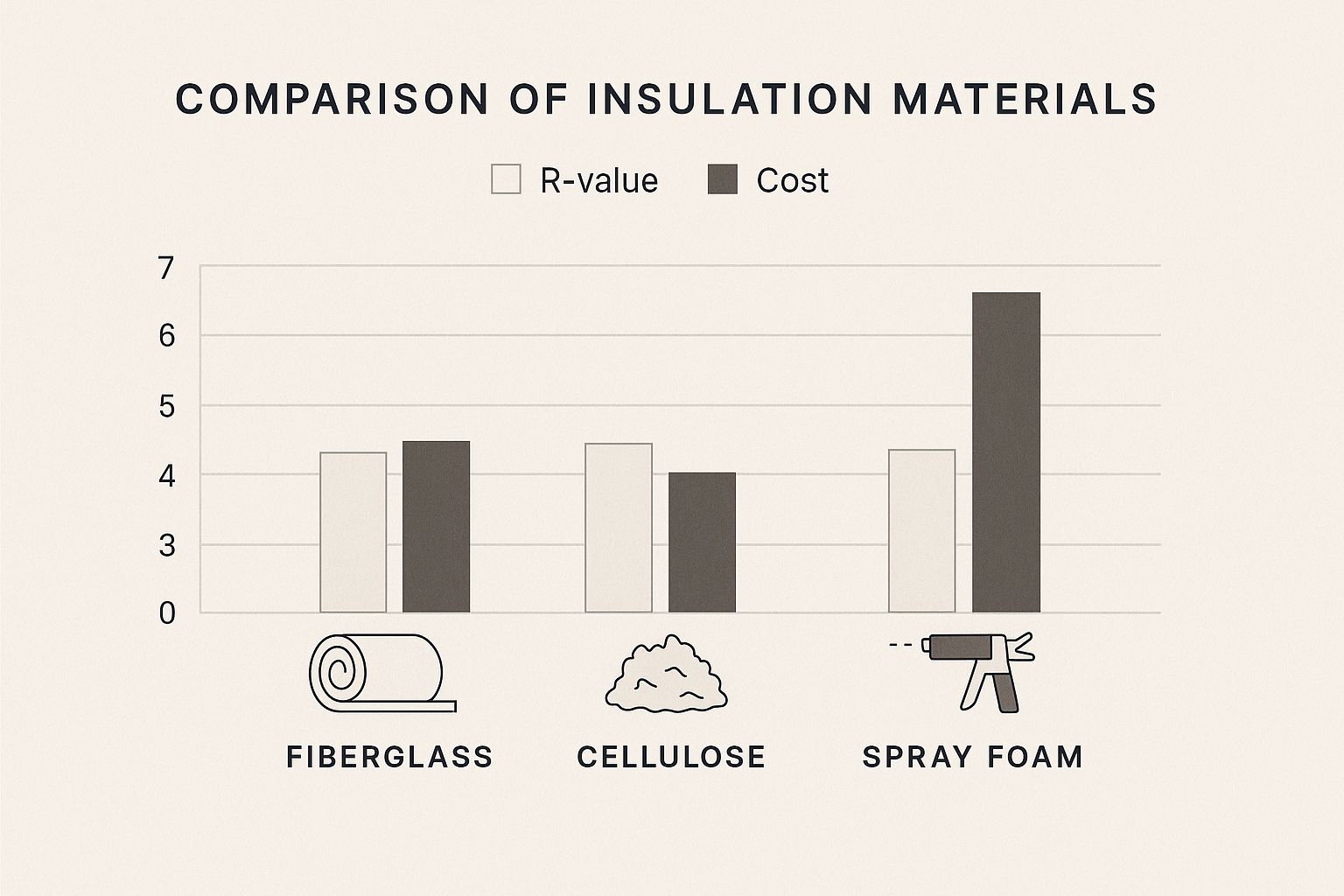
The table below shows some common insulation materials we use in California and Arizona.
Comparing Common Insulation Materials for Your Home
This table compares popular insulation options by R-value, benefits, and best uses in our local areas.
| Insulation Type | Average R-Value/Inch | Pros | Cons | Best For |
|---|---|---|---|---|
| Fiberglass Batts | 3.1 – 4.3 | Affordable, widely available. | Can lose R-value if compressed, can be damaged by moisture. | Standard walls and attics in mild climates like coastal California. |
| Cellulose (Blown-in) | 3.2 – 3.8 | Fills odd spaces well, made from recycled materials, good sound barrier. | Can settle over time, needs professional installation. | Attics and enclosed existing walls to fill every gap. |
| Spray Foam (Open-Cell) | 3.5 – 3.8 | Creates an air seal, expands to fill gaps, great sound barrier. | Lower R-value than closed-cell, lets moisture vapor pass through. | Interior walls and roof decks where moisture is less of a concern. |
| Spray Foam (Closed-Cell) | 6.0 – 7.0 | Highest R-value, acts as an air and vapor barrier, adds strength. | Higher cost, needs professional installation with safety gear. | Roofs and walls in hot climates like Arizona, where maximum insulation is needed. |
While some materials like closed-cell spray foam cost more at first, they often save a lot on energy bills over time.
Beyond Insulation: The Critical Role of Air Sealing
You can have the best insulation, but it won’t work well if your house has air leaks. Air sealing is the process of finding and closing every gap in the building envelope. It stops your conditioned air from getting out and outside air from getting in.
Most air leaks happen in common places:
- Around Windows and Doors: Gaps in the framing can cause major energy loss.
- Plumbing and Electrical Openings: Every hole for pipes or wires must be sealed.
- Recessed Lighting Fixtures: Older "can" lights can let air pour into the attic.
- Attic Hatches: These access points need to be sealed just like an exterior door.
Verifying Performance With a Blower Door Test
How do you know if a home is truly airtight? You test it. A blower door test is a tool we use to measure a home's airtightness. We place a powerful fan in an outside doorway to lower the pressure inside the house. This pulls outside air in through any leaks.
This test gives us the data we need to:
- Measure the home’s total air leakage.
- Find the exact location of leaks.
- Confirm that our air-sealing work meets performance goals.
A blower door test is our promise to you. It proves that the building envelope is performing as designed. This ensures comfort, healthy air, and lower energy bills. For more ideas, check out our home renovation tips.
Choosing High-Performance Windows and Doors
In energy-efficient home building, windows and doors are major spots where heat can be lost or gained. Choosing high-performance products is not just about looks. It directly affects your home's comfort and your monthly utility bills.
When you get this part right, your home stays warmer in the winter and cooler in the summer. Your HVAC system won't have to work as hard.
At Aldridge Construction, we help homeowners understand the technical details. The needs of a home in coastal Monterey County are very different from a desert home in Maricopa County, AZ. The windows should match the climate.
Decoding Window Performance Labels
A modern window's performance is listed on its label. To make a smart choice, you need to understand two key ratings: the U-factor and the Solar Heat Gain Coefficient (SHGC).
- U-factor: This number shows how well the window stops heat from escaping. The scale is usually 0.20 to 1.20. A lower U-factor is always better.
- Solar Heat Gain Coefficient (SHGC): This measures how much solar heat the window blocks. The SHGC scale is 0 to 1. A lower number means less solar heat gets inside.
The right combination depends on your climate. For cool areas like Santa Cruz, you want a low U-factor to keep heat inside. In a hot climate like Arizona, a low SHGC is needed to keep the sun out and lower cooling costs.
Key Features of High-Performance Windows
Several features work together to make a window efficient. We recommend specific combinations to get the best results for our clients.
- Multiple Panes: Single-pane windows are a thing of the past. Double-pane windows are the standard now. They trap a layer of gas like argon between the panes for insulation.
- Low-E Coatings: A low-emissivity (Low-E) coating is a very thin, clear metal layer on the glass. It reflects heat, keeping warmth inside in the winter and outside in the summer.
- Quality Frames: The frame material matters. Vinyl, wood, and fiberglass frames insulate much better than old aluminum frames, which transfer heat easily.
For our projects in California, we often recommend brands like Milgard. They offer great double-pane windows with Low-E coatings that meet California’s strict Title 24 energy code. According to the U.S. Department of Energy, heat gain and loss through windows account for 25%–30% of home heating and cooling energy use.
Don't Forget Doors and Roofing
Your front door can also be a big source of energy loss. We recommend insulated exterior doors made of fiberglass or steel with a foam core. They provide a better thermal barrier than a solid wood door.
The roof is your home’s first defense against the sun. In a place like Arizona, a cool roof is a must. These roofs use materials that reflect sunlight and heat away from your home.
Also, think about products like sun block window screens. They can greatly reduce heat gain and lower cooling costs, especially for west-facing windows.
Dialing in Your HVAC, Water Heating, and Lighting
Once your home has a high-performance building envelope, its energy needs are much lower. Now it's time to choose the mechanical systems that will run your home efficiently for years.
The right choices here ensure comfort and low energy bills. The wrong ones can undo all the hard work put into insulation and air sealing.
High-Efficiency HVAC for CA and AZ Climates
In most homes, the heating, ventilation, and air conditioning (HVAC) system uses the most energy. Modern systems are designed to provide great comfort while using much less energy than older units.
For the mild coastal climates in Monterey and Santa Cruz Counties, high-efficiency heat pumps are a great choice. They don't burn fuel to create heat; they just move it. In winter, a heat pump pulls warmth from the outside air and moves it inside. In summer, it does the reverse to cool your home.
In the hot climate of Maricopa County, Arizona, the focus is on efficient cooling. We often suggest a high-SEER (Seasonal Energy Efficiency Ratio) air conditioner and a high-efficiency furnace. For an all-electric home, ductless mini-splits are a great option. They let you cool different rooms separately, so you don't waste energy cooling empty spaces.
Smarter Water Heating Solutions
Heating water is the second biggest energy user in most homes. Old tank-style water heaters are wasteful because they keep a large tank of water hot 24/7.
We have better options today:
- Tankless Water Heaters: These units heat water instantly when you need it. This eliminates the energy lost by keeping a tank hot. They can be 24%–34% more energy-efficient.
- Heat Pump Water Heaters (HPWH): These are also called hybrid water heaters. They pull heat from the surrounding air and transfer it to the water. An HPWH can be two to three times more efficient than a standard electric water heater.
For homes using rainwater harvesting, different vertical water storage tank options can help manage water even more effectively.
Lighting and Appliances: The Final Piece of the Puzzle
Lighting and appliances may seem like small details, but their energy use adds up. Smart choices here can complete an efficient home.
An all-LED lighting plan is the new standard. LEDs use up to 90% less energy and last 25 times longer than old light bulbs. It's an easy change that lowers your electricity bill.
When choosing kitchen and laundry appliances, look for the ENERGY STAR label. This blue sticker means the product meets strict efficiency rules from the EPA. For example, an ENERGY STAR certified refrigerator uses about 9% less energy than a standard model.
Making sure these systems work together correctly is a key part of the construction process. To ensure your project follows all local rules, see our guide to navigating construction permit requirements.
FAQs: 5 Common Questions About Energy Efficient Home Building
It's normal to have questions when building an energy-efficient home. Here are answers to the most common questions we hear at Aldridge Construction from clients in Monterey, Santa Cruz, and Maricopa Counties.
1. How much more does an energy-efficient home cost?
It's a myth that building an energy-efficient home costs a lot more. The upfront investment is usually only about 2-5% higher. This cost is often offset by savings elsewhere. For example, a well-insulated home needs a smaller, less expensive HVAC system. When you add in the long-term savings on utility bills and available tax credits, an energy-efficient home is a smarter financial choice.
2. What is a HERS score and what should I aim for?
A HERS (Home Energy Rating System) score is like a miles-per-gallon rating for your house. A standard new home built to code gets a score of 100. With HERS, a lower score is better. A home with a HERS score of 60 is 40% more efficient than a standard new home. For a new custom home, we suggest aiming for a score of 60 or less. A Net Zero Energy Home, which produces as much energy as it uses, has a score of 0.
3. Are solar panels required for an efficient home?
No, solar panels are not required to start, but they are a great final step. The first goal of energy efficient home building is to lower your home's energy use with a good building envelope and efficient systems. Once your home is using less energy, adding solar panels becomes very effective. In California, new homes are often required to be 'solar-ready' or include panels, which makes it an easy addition.
4. How does my local climate affect the design?
Your local climate is the most important factor in designing an energy-efficient home. A design that works in coastal California won't work in the Arizona desert.
- Coastal Santa Cruz: Here, the design focuses on capturing winter sun and using natural ventilation from ocean breezes.
- Hot Phoenix: In Maricopa County, the goal is to reduce solar heat gain with light-colored roofs, deep overhangs, and windows with a low SHGC.
Aldridge Construction designs every home for its specific environment. To learn how these ideas apply to smaller projects, read about what an ADU means in construction.
5. What is the difference between ENERGY STAR and LEED?
These two terms are often confused, but they certify different things.
- ENERGY STAR for Homes focuses only on energy efficiency. It certifies that a home is at least 10% more efficient than one built to the current energy code.
- LEED for Homes looks at the bigger picture. It includes energy efficiency but also considers water conservation, indoor air quality, sustainable materials, and responsible site development.
Think of ENERGY STAR as a key ingredient and LEED as the whole recipe for a green home. For more help, you can look into the energy efficiency services in California that are available.
Ready to build a home that's as smart and efficient as it is beautiful? The team at Aldridge Construction has the local expertise to guide you through every step of the process, from initial design to final walkthrough. Contact us today to start planning your custom energy-efficient home in Monterey, Santa Cruz, San Benito, or Maricopa County.