
When you're trying to decide between a concrete patio and a deck, the best choice really boils down to your property and what you value most. A concrete patio is almost always more durable and cost-effective for ground-level spaces. On the other hand, a deck is the clear winner for sloped yards and gives you that classic, elevated look.
Ultimately, your budget, the local climate in places like Monterey or Maricopa County, and how much maintenance you’re willing to do will point you in the right direction.
Choosing Your Ideal Outdoor Living Space
Creating an outdoor area that truly extends your home is a rewarding project. For homeowners in Monterey, Santa Cruz, and Maricopa counties, this decision is shaped by everything from coastal moisture to intense desert sun. The first step is understanding the real differences between a patio and a deck.
A ground-level concrete patio offers a smooth flow from your home into the backyard. It creates a solid foundation perfect for heavy features like outdoor kitchens or fire pits.
A deck, however, feels more like a defined outdoor room. It's often raised, which is great for capturing views or solving the problem of an uneven yard.
Key Factors to Consider
Before getting lost in the details, it helps to know what actually matters. Your decision will likely be a balance between a few key things:
- Upfront Cost: The initial price for materials and labor.
- Long-Term Value: How the new addition impacts your home’s resale value.
- Durability & Maintenance: The expected lifespan and the upkeep required to keep it looking good.
- Aesthetics: The style that best matches your home’s look.
The concrete patio vs. deck debate isn't about which one is better overall, but which one is better for you. For a little more inspiration, check out these inspiring outdoor living space ideas.
Quick Look: Concrete Patio vs Deck
To make things simple, here’s a quick comparison. As experts providing home improvement services in Monterey, the Aldridge Construction team can help you weigh these pros and cons for your specific property.
| Feature | Concrete Patio | Deck (Wood or Composite) |
|---|---|---|
| Typical Cost | Lower initial investment, especially for basic designs. | Higher upfront cost, particularly for premium composites like Trex. |
| Best For | Flat ground, poolside areas, outdoor kitchens. | Sloped or uneven terrain, second-story access. |
| Lifespan | 30-50+ years with minimal maintenance. | 15-30+ years, depending on material and upkeep. |
| Maintenance | Low; requires occasional cleaning and sealing. | Higher; requires regular staining, sealing, or cleaning. |
| Design Options | Versatile; can be stamped, colored, and textured. | Classic look; wide range of wood types and composite colors. |
This table gives you a great starting point. The right choice depends on your home, how you plan to use the space, and your long-term goals.
Comparing Upfront Costs and Long-Term ROI
When you're weighing a concrete patio against a deck, the budget is usually the first thing to consider. While the initial investment is important, you also have to think about the long-term value and return on investment (ROI).
Let's break down the money side of things so you can see the full picture.
Typically, a standard poured concrete patio is your most budget-friendly option. Decks, especially those built with premium composite materials like Trex or high-end woods like cedar, will have a higher initial price.
Breaking Down the Initial Investment
The total price tag isn't just about materials. Labor, site preparation, and design complexity all play a major role. For instance, in areas like Monterey County, challenging soil might mean more prep work. In Maricopa County, proper drainage for monsoon rains can add to setup costs.
Here’s a general idea of what to expect:
- Poured Concrete Patios: These usually run between $8 to $18 per square foot. The price goes up for custom finishes like stamping or coloring.
- Pressure-Treated Wood Decks: This is a common entry-level choice for decks, often starting in the $20 to $35 per square foot range.
- Composite or Premium Wood Decks: High-performance materials like Trex or beautiful woods like cedar can push costs to $35 to $60+ per square foot. They're more expensive to start, but you'll save on maintenance later.
This side-by-side view gives you a clear idea of how these costs can stack up.
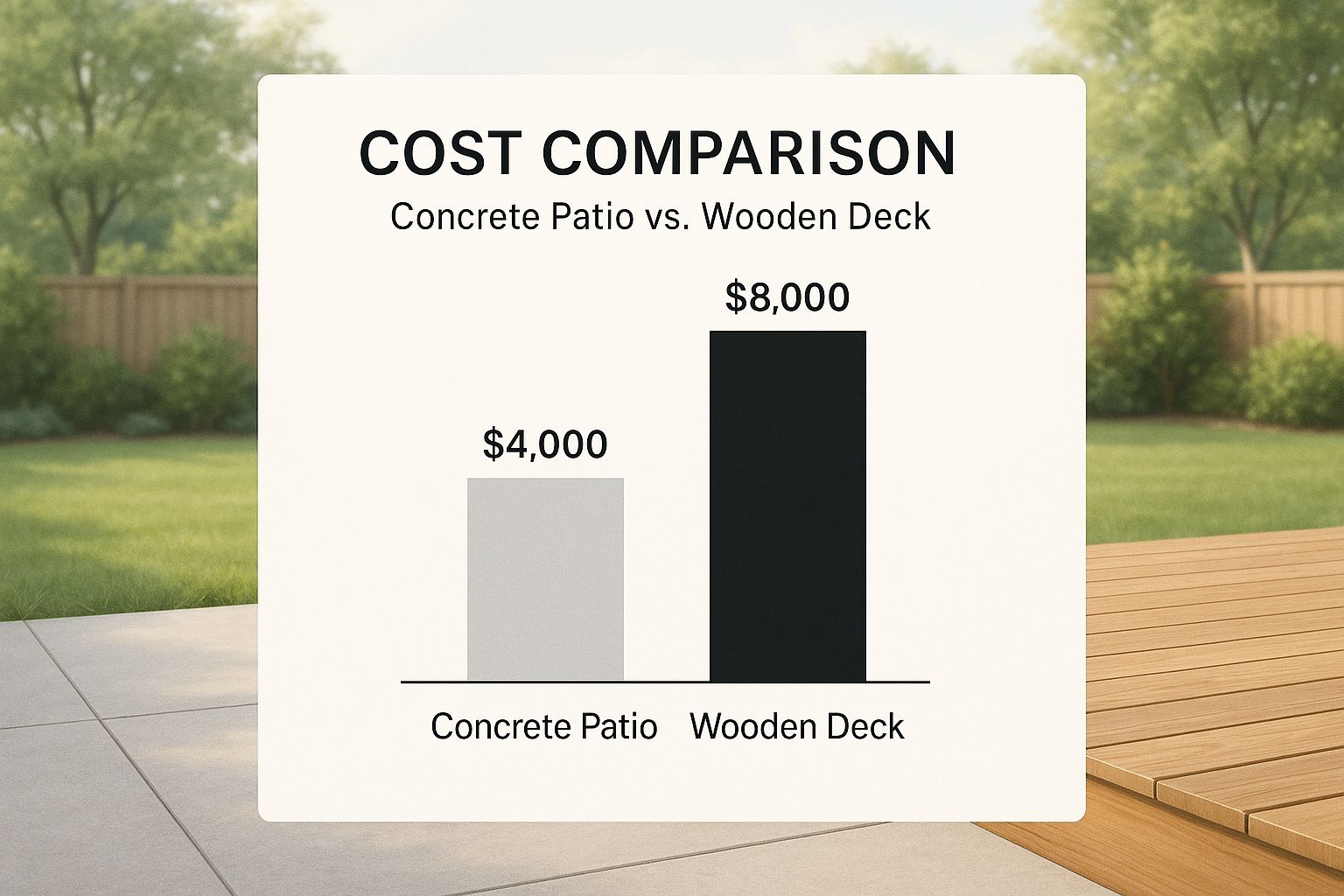
As you can see, a basic concrete patio is the most economical way to get started. A simple wood deck isn't far behind, but costs climb quickly with premium materials.
Here’s a key takeaway: The complexity of your design and the terrain of your property are massive cost drivers. An elevated deck on a sloped yard will always cost more than a simple, ground-level patio on a flat surface.
Analyzing Long-Term Return on Investment
Beyond the initial price, it's smart to look at what you get back over time. This includes both potential resale value and what you save on maintenance.
According to Remodeling Magazine's 2024 Cost vs. Value report, a wood deck addition can recoup about 59.9% of its cost at resale. A composite deck often sees a return of around 49.4%. While patios are not tracked in the same way, their lower cost and high durability offer excellent long-term value.
Many buyers see a beautiful deck as a ready-to-use outdoor room, which adds immediate lifestyle value. A patio, while incredibly durable, is sometimes seen as a more basic feature. However, a high-end stamped concrete patio can be just as impressive as any premium deck.
To get a more detailed estimate, our home addition costs calculator can help you explore different scenarios.
Analyzing Durability and Maintenance Needs
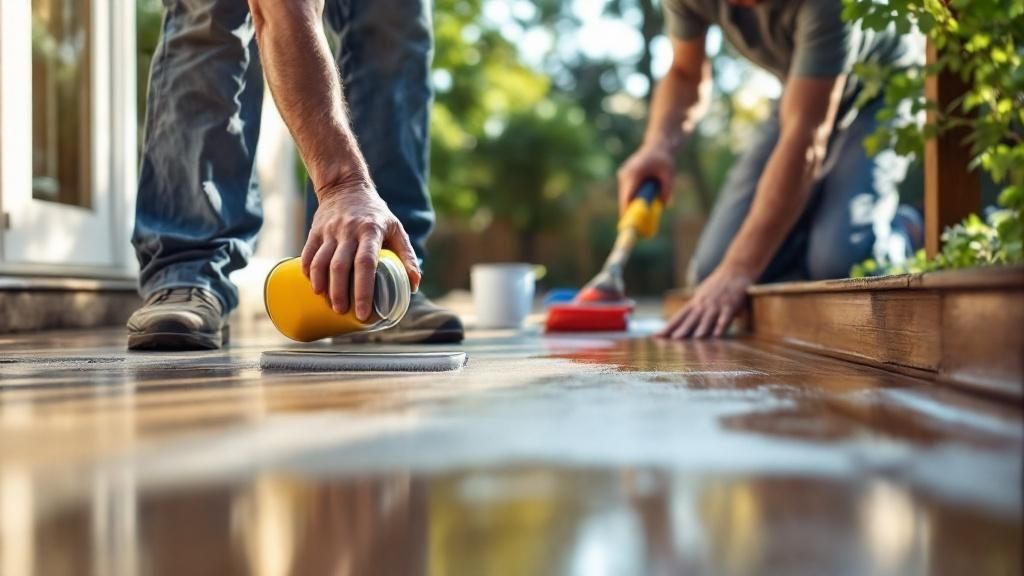
When choosing between a concrete patio and a deck, upkeep is a critical factor. How much work are you willing to put in to keep your outdoor space looking great year after year?
The right answer often depends on where you live. For homeowners in coastal spots like Santa Cruz, salty air is tough on wood decks, causing rot if not sealed properly. In the desert sun of Maricopa County, Arizona, wood can fade and splinter, while extreme heat can crack improperly installed concrete.
Understanding how each material handles your local climate is key to a smart investment.
Concrete Patio Durability and Upkeep
Concrete is known for its strength and long life. A properly installed concrete patio is a permanent part of your home that can easily last 30 to 50 years or longer. It's resistant to rot, insects, and fire, which are huge advantages in both California and Arizona.
But concrete isn't completely maintenance-free. To keep it in top shape, you'll need to:
- Clean Annually: A quick power wash once a year removes dirt and stains.
- Seal Every Few Years: Applying a sealant every 2-3 years protects the concrete from moisture, stains, and UV damage.
- Address Cracks: Seal small cracks to stop water from seeping underneath and causing bigger problems.
The real advantage of concrete is its resilience. You don't have to worry about termites or wood rot, making it a low-stress option for homeowners.
Even with its strength, the ground beneath a patio can settle. The good news is that modern solutions can often fix this without tearing everything out. Many homeowners save time and money with professional leveling services, a topic we cover in our guide to home renovation services in Salinas.
Wood and Composite Deck Durability and Upkeep
A deck's lifespan is tied to the material you choose and how well you maintain it. Traditional wood demands the most attention, while modern composites offer a more hands-off experience.
Wood Decks:
A standard pressure-treated wood deck typically lasts 15 to 20 years. Premium woods like redwood or cedar can last 20 to 30 years—but only with proper care.
You’ll need to clean it annually and re-stain or re-seal it every 1-3 years. This protects the wood from moisture (which causes rot) and the sun (which causes fading and splintering).
Composite Decks:
For homeowners who love the look of wood but hate the maintenance, composite decking is the answer. Made from wood fibers and recycled plastic, brands like Trex and TimberTech resist rot, insects, and fading. A composite deck can last 25 to 30 years or more with little effort.
Upkeep is simple: an annual cleaning with soap and water is usually all it takes.
Exploring Design Flexibility and Aesthetics
Your outdoor space should reflect your personal style. It's easy to think concrete is just a plain gray slab, but modern techniques have turned it into a versatile canvas.
A deck, on the other hand, offers a natural warmth and classic look. The choice between them comes down to the aesthetic you want and how it will blend with your home.
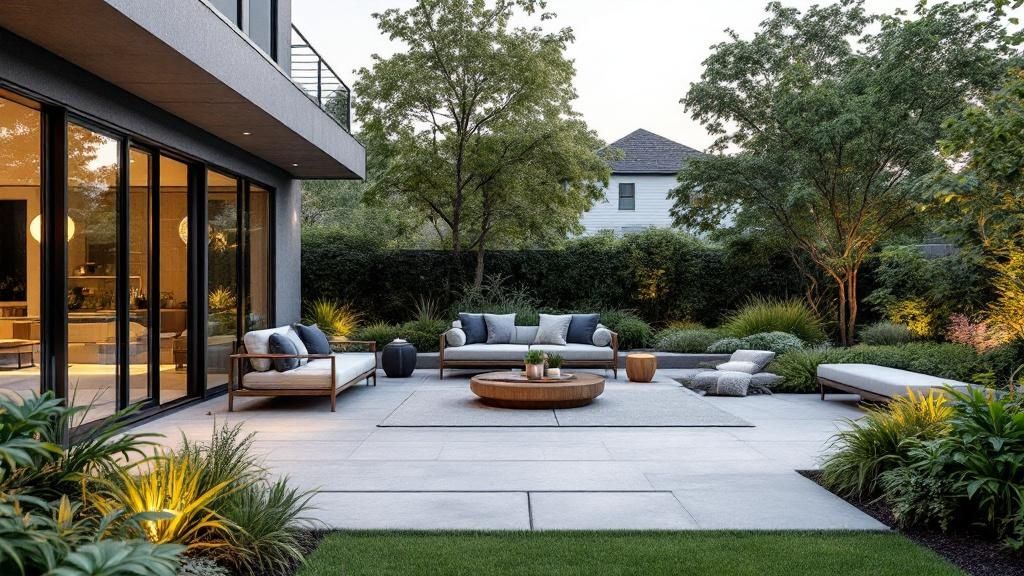
The Surprising Versatility of Concrete Patios
Today’s concrete patios can be customized to look like more expensive materials. This allows homeowners in Monterey County to get a high-end look without the high price tag.
Here are a few popular design options:
- Stamped Concrete: Using special mats, we can stamp wet concrete with patterns that look like natural stone, brick, slate, or even wood planks.
- Colored Concrete: Color can be mixed into the concrete before it’s poured for a deep, consistent hue. Stains can also be applied to the surface for more varied effects.
- Modern Finishes: A smooth or simple broom-finished surface provides a clean, minimalist look. We can also add saw cuts to create a geometric tile pattern, perfect for modern homes in Maricopa County.
A key advantage of a ground-level concrete patio is its ability to create a seamless connection between your home’s interior and the garden. It feels grounded and part of the landscape.
The Timeless Appeal of Decks
Decks bring a classic warmth that's hard to replicate. Because they are often raised, decks create a distinct "outdoor room" feel. This is also perfect for capturing scenic views or leveling out sloped terrain.
The aesthetic choice for decks usually comes down to two material categories:
- Natural Wood: Materials like redwood and cedar offer a rich, authentic beauty. The look of real wood is unmatched for creating a rustic or traditional feel.
- Composite Decking: Brands like Trex offer a huge range of colors, from earthy tones to modern grays. Many composite boards feature realistic wood-grain patterns and won't fade like real wood.
The right choice depends on your home’s style. A sleek, colored concrete patio might perfectly match a modern stucco home, while a multi-level cedar deck could be ideal for a rustic house. You can even personalize your space by growing the best vegetables for patio and balcony containers.
Understanding the Installation Process
Knowing what to expect during construction helps you choose between a concrete patio and a deck. The building process for each is completely different, affecting the timeline and disruption to your home.
A concrete patio installation requires proper site prep and some patience for curing. Building a deck is all about structural assembly. Both need a professional touch to ensure a safe, long-lasting result that meets local building codes in San Benito County.
The Concrete Patio Installation Journey
Creating a concrete patio starts with good groundwork. The first step is excavation, where our crew digs out the area to the proper depth for a stable foundation.
Next, the Aldridge Construction team builds wooden forms to create a mold for the patio's shape. We then add a base layer of compacted gravel, which is critical for drainage and preventing cracks.
The next steps are:
- Pouring the Concrete: The concrete mix is poured evenly within the forms.
- Finishing the Surface: Our crew smooths the surface and can add decorative stamps or colors.
- The Curing Period: This is the most important part. Concrete needs to cure, which is a chemical reaction. The patio should not be used for at least a week to let it gain its full strength. For more details on this process, this inground concrete installation guide offers a good look at similar techniques.
Assembling a Custom Deck
Building a deck starts with a solid foundation. This involves digging and pouring concrete footings—support piers that anchor the structure to the ground.
Once the footings have cured, the framing begins. We build a sturdy frame, usually from pressure-treated lumber, on top of the footings. After the frame is up, the decking boards—wood or composite—are installed, followed by railings and stairs.
A major advantage of deck installation is the timeline. A deck is often usable much sooner than a concrete patio because there is no extended curing period for the main surface.
Recent data from the National Association of Home Builders shows that by 2021, patios were included in 63% of new single-family homes, while decks were used in just 17.5%. This highlights the growing popularity of patios. Our guide on the custom home building process provides a broader look at what’s involved in projects like these.
Making the Right Choice for Your Property
So, how do you decide? It comes down to matching the material to your property, lifestyle, and local climate. After weighing the costs, upkeep, and design, the final choice depends on how you plan to use your outdoor space.
This decision is a key part of any major home renovation and remodeling project. Get it right, and you add both a functional living area and real value to your property.
When a Concrete Patio Is the Perfect Fit
In some situations, a concrete patio is the clear winner. Its stability and durability make it ideal for specific uses.
You should lean towards a concrete patio if:
- You Have a Pool: Concrete is the standard for poolside areas. It stands up to water without rotting and provides a safe, slip-resistant surface.
- You're Building an Outdoor Kitchen: Heavy features like a built-in grill or pizza oven need a solid, non-combustible foundation. Concrete provides strength and fire resistance that a deck can't offer.
- Low Maintenance Is Your Top Priority: For homeowners in Monterey or Maricopa County, concrete is the easy choice. A little cleaning and occasional sealing is all it takes to keep it looking sharp for decades.
When a Deck Is the Ideal Solution
A deck shines where a concrete patio isn’t practical. Its elevated structure is a great solution for tricky landscapes.
A deck is your best bet when:
- Your Yard Is Sloped or Uneven: Building a deck on posts sails right over uneven terrain, creating a level surface without expensive retaining walls.
- You Need Second-Story Access: If your back door is on the second floor, a deck creates a seamless transition from your house down to the yard.
- Maximizing Resale Value Is a Key Goal: A well-built deck often delivers a slightly higher return on investment. Its strong visual appeal as an "outdoor room" resonates with potential buyers.
The desire for quality outdoor living isn't slowing down. In fact, one market report projects the global outdoor deck and patio market to hit USD 23.0 billion by 2032, fueled by a growing interest in home improvement.
Ultimately, the concrete patio vs. deck debate is a personal one. The experts at Aldridge Construction can provide a personalized consultation for your property in Monterey, Santa Cruz, or Maricopa County to help you make the best choice.
Frequently Asked Questions (FAQs)
1. Can you build a deck over an existing concrete patio?
Yes, absolutely. Building a deck over an existing concrete patio is a common project. As long as your current patio is stable and in good shape, it can serve as a solid foundation. The process usually involves building a floating frame that rests right on top of the concrete.
2. Which is better for a sloped yard, a patio or a deck?
For a sloped or uneven yard, a deck is almost always the better and more cost-effective choice. Its post-and-beam structure easily handles changes in elevation. Installing a patio on a slope requires major excavation and expensive retaining walls, adding significant cost and complexity.
3. Do I need a permit for a patio or deck in California or Arizona?
It depends on your project's size and local rules. Most decks require a permit, especially if they are attached to the house or are more than 30 inches off the ground. A simple, ground-level concrete patio often does not require a permit. However, it's always smart to check with your local building department in Monterey, Santa Cruz, or Maricopa County first.
4. Which option adds more value to my home?
Both can add significant value. Decks, particularly those built with high-end composite materials, tend to have a slightly higher return on investment (ROI) at resale due to their strong visual appeal. However, a beautiful stamped concrete patio with its durability and low maintenance is also a huge selling point for buyers.
5. What is more expensive, a concrete patio or a wood deck?
Generally, a basic poured concrete patio is less expensive upfront than a wood deck. A pressure-treated wood deck is the next step up in price. The most expensive options are typically decks made from premium woods like cedar or high-performance composite materials like Trex.
Ready to create the perfect outdoor space for your home in Monterey, Santa Cruz, San Benito, or Maricopa County? The team at Aldridge Construction has the expertise to guide you. Whether it's a durable concrete patio or a beautiful custom deck, we can bring your vision to life.
Contact us today for a professional consultation by visiting https://aldridgeconstruction.biz.