
Direct Answer: San Benito County and the City of Hollister layer their own ADU rules on top of state minimums. The biggest difference from Salinas is septic review through Environmental Health, which adds calendar time before permits.
I get calls from Hollister and rural San Benito County that sound a lot like the Salinas calls I take every week. Same goal, same backyard, same question about what it costs and how long it takes.
But the answer is not the same. San Benito County and the City of Hollister each have their own ADU ordinance stacked on top of California’s state minimums, and the day-to-day experience of getting a permit there plays out differently than it does in Monterey County.
Below I’ll walk through the three differences that actually move your schedule and your budget: agency size and process, septic review through Environmental Health, and what a pre-approved plan really buys you.
What Changes When You Cross the County Line
State ADU law sets a floor. Every city and county in California has to allow ADUs, has to act on a complete application within a set window, and cannot impose certain lot size or parking rules. That part travels with you from Salinas to Hollister.
What does not travel is the local layer. The City of Hollister runs its own planning review, and unincorporated San Benito County runs another. A parcel off Fairview Road and a parcel five miles out toward Tres Pinos can sit under two different sets of standards.
The other real difference is scale. San Benito County’s planning and building departments are smaller shops than what you deal with in Salinas or at Monterey County’s offices in Marina. That cuts both ways:
- Pre-application meetings may be easier to get, or harder, depending on staffing that month
- Plan check turnaround can swing more than it does in a larger department
- One staff person may be the only reviewer for your discipline, so vacations and turnover show up in your schedule
- Written checklists are worth requesting early, because verbal guidance changes
I tell every homeowner the same thing: call the City of Hollister Planning Division or the San Benito County Building Department yourself and ask for their current ADU submittal checklist and average review time. Requirements change, and what was true last year may not be true when you apply.

Septic Is the Variable That Moves Your Schedule Most
In Salinas, most ADU projects tie into city sewer. You coordinate the connection, you pay the fee, you move on.
Outside Hollister city limits, a lot of parcels run on private septic systems. That changes the order of operations completely. Before a building permit gets issued, the San Benito County Environmental Health Department has to review and approve the septic situation for the added dwelling.
That review can involve:
- Soil and percolation testing on the specific parcel, often scheduled around weather and soil conditions
- Confirming whether the existing system has capacity for additional bedrooms, or needs to be expanded or replaced
- Setback distances from the leach field, replacement area, wells, and property lines
- Well and water supply review if the property is not on a public water connection
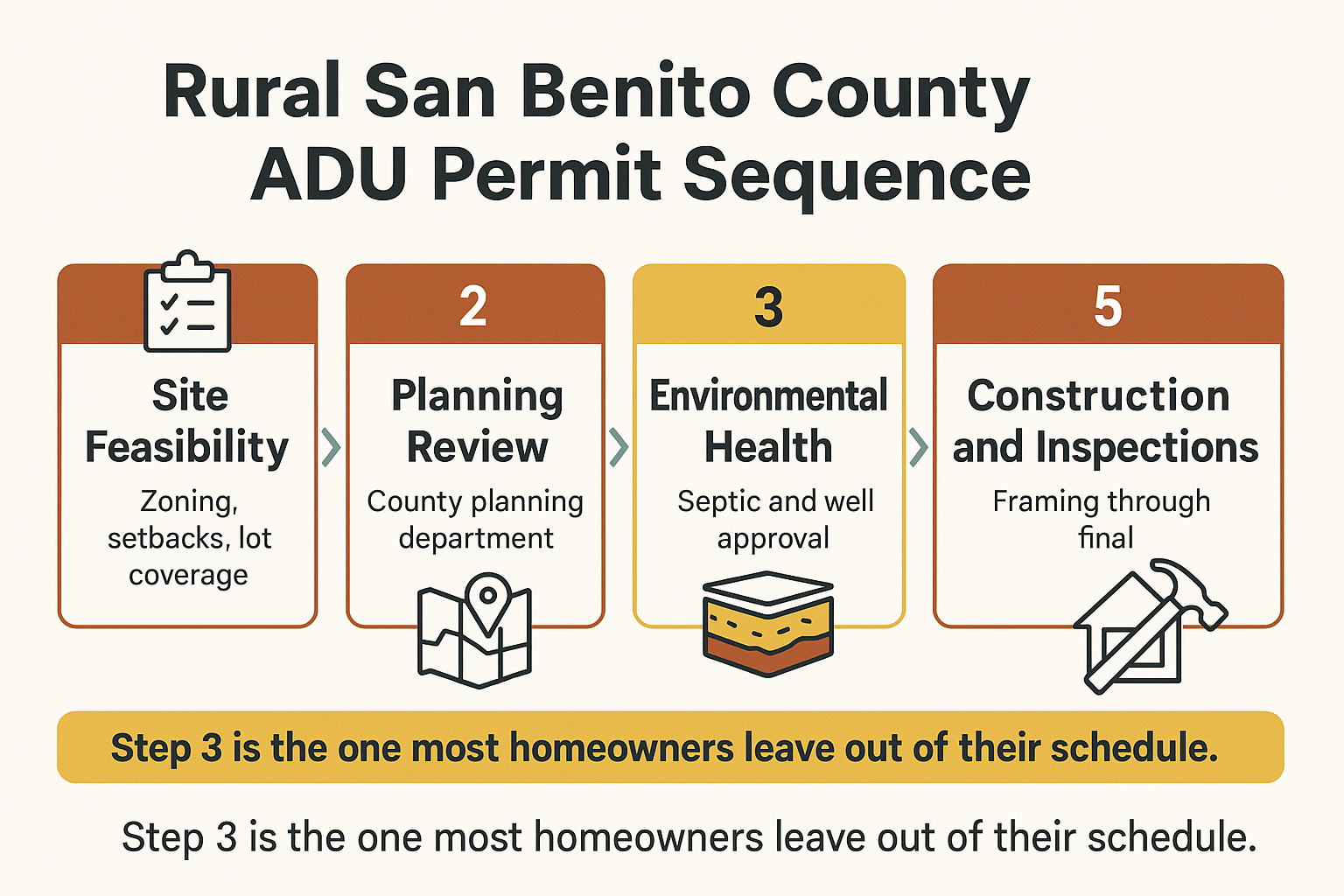
The sequence is planning first, then environmental health, then building. Each handoff is calendar time, not construction time.
I had a conversation with a ranch owner outside San Juan Bautista who had already picked a plan and had a number in his head for the build. What he had not budgeted for was the septic review window ahead of it. A homeowner who plans only for the construction schedule will watch the start date slide before anyone breaks ground.
A septic upgrade is also a real cost line. Costs vary widely with soil, slope, and system type, so I would not quote a number off a phone call. It gets scoped after testing.
Salinas vs. Hollister vs. Unincorporated San Benito County
Here is how the same 700 square foot detached ADU tends to play out differently depending on where the parcel sits. Treat this as general context and confirm specifics with the agency that has jurisdiction over your address.
| Factor | Salinas (City) | City of Hollister | Unincorporated San Benito County |
|---|---|---|---|
| Reviewing agency | City planning and building | City planning and building | County planning, environmental health, building |
| Wastewater | Usually city sewer connection | Usually city sewer connection | Often private septic, requires Environmental Health approval |
| Water | City water | City water | Often private well, may require review |
| Added review phase | Rare | Rare | Septic and well review before building permit |
| Pre-approved plans | Program available | Verify current status with the city | County has published plan sets |
| Typical schedule risk | Utility scheduling | Agency staffing levels | Soil testing, weather, multi-agency handoffs |
The Order Things Actually Happen In
This is the sequence I walk rural San Benito County homeowners through so nobody is surprised by a phase they did not know existed.
Pre-Approved ADU Plans: What They Actually Do
San Benito County has published pre-approved ADU plan sets, including a larger plan in the range of 1,190 square feet. Salinas has a similar program. This is the state’s push under AB 1332, which directs local agencies to keep pre-approved plans on the shelf as a way to shorten the path to permit.
The part homeowners misread is what “pre-approved” covers. It means the building plans themselves have already cleared plan check for code compliance. It does not mean your property is approved.
Still required for your specific parcel:
- Site plan review showing where the unit sits, setbacks, and lot coverage
- Septic and well review, if applicable, with the setbacks that come out of it
- Utility connections, including electrical service capacity and any panel upgrade
- Grading and drainage, which matters a lot on sloped rural parcels
- Fire access and defensible space conditions in some areas
I also want to flag the state’s ADU resources at the California Department of Housing and Community Development, which is a solid place to understand the statewide floor before you look at local layers.
The pre-approved route can genuinely save weeks. But it is a head start, not a fast pass. And if the published plan does not match what you need, the savings evaporate once you start modifying it.
Two Hollister Scenarios That Show Why This Matters
A church organization in Hollister reached out about building staff housing on two residentially zoned lots on their campus. They had a specific target in mind, roughly a 2 bed, 2 bath unit under 750 square feet.
That one is not a standard backyard ADU question. When the underlying parcel is part of an institutional use, the first question is what the zoning actually allows and whether the housing reads as an accessory dwelling unit or as something else entirely. That answer comes from the city, not from a contractor’s opinion.
The second scenario comes up constantly: someone shopping for five or more acres near Hollister, planning to start an ADU for family the moment escrow closes. My advice there is to make septic capacity and well output part of your due diligence before you buy, not after.
Utility coordination is its own line item too. One customer summed up a garage conversion this way: the project “took a little longer than expected, but this was due to PG&E’s scheduling and availability.” That is real, and it applies in Gonzales, Gilroy, and Hollister alike.
On budget, ADU costs across Monterey, Santa Cruz, and San Benito Counties vary with site prep, utilities, finish level, and whether septic work is in scope. I would rather walk the property than guess.
Frequently Asked Questions About San Benito County ADU Permits
How long does an ADU permit take in Hollister compared to Salinas?
State law sets a deadline for agencies to act on a complete application, and that word does most of the work. In practice, the front end of gathering site information and clearing any septic review is where San Benito County projects stretch longer than Salinas ones. Ask the City of Hollister Planning Division for their current average, because staffing changes it.
Do I need septic approval before I can even apply for a building permit?
On a parcel with a private system, yes, the Environmental Health review comes before the building permit is issued. Plan for that phase as its own block of time on your calendar, separate from design and separate from construction.
If I use the county’s pre-approved 1,190 square foot plan, is my project automatically approved?
No. The building plans are pre-cleared, but your site still gets reviewed. Setbacks, septic location, grading, drainage, and utility connections are all parcel-specific and get evaluated on your address.
Can I build an ADU on a church or school property in Hollister?
It depends entirely on the zoning of the specific lots. Residentially zoned lots on a larger institutional campus may allow it, but that determination has to come from city planning before anyone draws anything. It is worth a pre-application conversation.
Is a garage conversion easier than a detached ADU in San Benito County?
Sometimes, because you already have a foundation and walls. But on a septic property, the added bedroom still triggers wastewater review, so the conversion route does not skip that step.
Thinking About an ADU in Hollister or Rural San Benito County?
If you own a parcel outside Hollister, or you are shopping for one, the septic and site questions are worth answering before you fall in love with a floor plan. Aldridge Construction works across Monterey County, San Benito County, and the surrounding Central Coast, and we are glad to walk a property and talk through the sequence with you. You can reach us at 831-682-9788 or through the contact page at aldridgeconstruction.biz.