
Direct Answer: Most rental renovation losses in Monterey County come from process gaps, not bad craftsmanship: no written scope, wrong material choices, skipped permits, and no emergency repair plan before something breaks.
Every day a unit sits empty in Monterey County, it costs you. In a market where rents in Salinas, Seaside, and Marina stay tight all year, a two-week schedule slip on a unit turn is real money out of pocket.
Here is what I have seen over and over working with landlords and property managers on the Central Coast: the expensive problems are almost never technical. They are procedural. Somebody started demo before anybody wrote down the scope.
Below are six planning mistakes that show up again and again on rental work, and what to do differently. This is written for the person holding the keys to a duplex in Seaside or eight units in Marina, not for a homeowner remodeling their own kitchen.
1. Starting Work Before the Scope Is Written Down
This is the number one cause of blown budgets on rental work. A tenant moves out, you walk the unit with a contractor, you agree on “paint, floors, and fix up the bathroom,” and crews start Monday.
Then the bathroom turns out to have soft subfloor under the toilet. Now you are approving change orders on the fly, and every one of them adds days to a vacancy you were trying to shorten.
A written scope for a turn should name, in plain language:
- Exactly which rooms get what work
- Specific products and model numbers for flooring, fixtures, and paint
- What happens if hidden damage shows up, and who approves the cost
- A start date and a target completion date
- How and when you get updated
It takes an extra day or two upfront. On most turns, that day saves a week on the back end. Homeowners run into the same trap on their own projects, which I covered in what separates a renovation that goes smoothly from one that doesn’t.

2. Spending Big on Finishes That Do Not Move the Rent
Landlords routinely overspend on the wrong things and underspend on the things that actually protect the building. A quartz waterfall island does not raise rent proportionally in most Salinas or Gonzales submarkets. Tenants there price on bedrooms, parking, condition, and location.
What does pay back is durability. Every maintenance call you avoid over five years is money you keep.
Here is where I tell owners to put the money:
- Flooring that survives moving day and pets
- Faucets and valves with solid internals and available parts
- Bathroom waterproofing done as a system, not just tile over board
- Exhaust ventilation sized and vented outside, not into the attic
- Paint in a washable finish so turns take one coat, not three
And here is where the upgrade rarely earns anything back: decorative tile patterns, specialty cabinet hardware, statement lighting, and high-end appliance packages in a standard rental. Save those dollars for the water side of the building.
Where Spec Choice Actually Changes Your Five Year Cost
A rough way to think about material decisions on a rental unit renovation in Monterey County. Actual costs depend on unit size, condition, and access, so treat these as directional.
| Category | Spend or Save | Why It Matters Over Five Years |
|---|---|---|
| Bathroom waterproofing | Spend | A failed shower pan means demo, mold remediation, and lost rent |
| Flooring | Spend | Durable plank survives multiple tenancies; carpet often gets replaced every turn |
| Faucets and shutoff valves | Spend | Cheap cartridges drive repeat service calls and drip damage |
| Exhaust fans | Spend | Poor ventilation causes paint failure, mildew, and tenant complaints |
| Cabinet doors and hardware | Save | Refacing or repainting usually reads the same to a prospective tenant |
| Decorative tile and lighting | Save | Rarely changes what a unit rents for in Salinas or Gonzales |
| Appliance tier | Save | Mid-grade with easy parts availability beats premium in a rental |
3. Treating Permits as Optional on Small Jobs
This is the one that quietly costs the most, and it never costs anything on the day you skip it. It costs later.
Unpermitted bathroom work, panel and circuit changes done by a handyman, a garage converted to living space with no certificate of occupancy: all three surface during due diligence when you sell, refinance, or file an insurance claim. In Monterey County’s market, a clean permit record makes your exit a lot smoother.
Requirements vary by jurisdiction, and the City of Salinas, Monterey County, and Santa Cruz County do not all handle the same scope the same way. Coastal Zone properties add another layer. Verify current requirements with your local building department before you commit to a schedule.
One practical note: anyone doing work over $500 in labor and materials in California needs a license, and you can check any contractor’s status through the Contractors State License Board. If you already inherited unpermitted space, that is a solvable problem, and I walked through the process in what to do when you buy a house with an unpermitted unit.
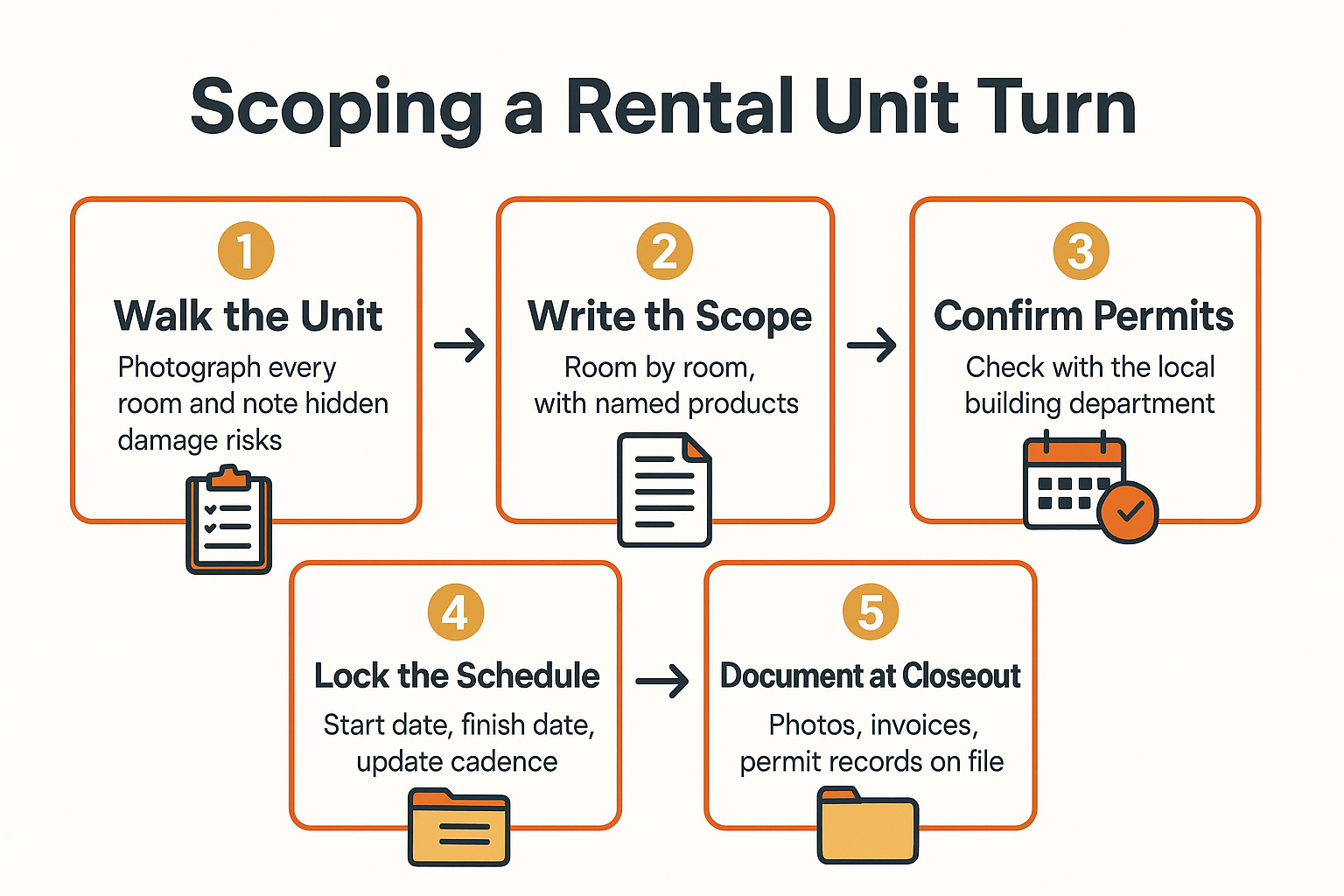
A Simple Sequence for Scoping a Unit Turn
This is the order I recommend for any rental turn, whether it is a single duplex unit in Seaside or a phased run of apartments in Marina.
4. Planning Occupied Unit Repairs Like Vacant Unit Repairs
Work in an occupied unit runs on a different clock. You have notice requirements, tenant work schedules, pets, parking, and a bathroom that cannot be out of service for six days straight.
That changes the build sequence, not just the calendar. On an occupied bathroom, staging matters more than speed:
- Order all fixtures and tile before demo starts
- Break the work into phases that restore water at the end of each day where possible
- Confirm who gives the tenant notice and how much lead time is required
- Set a daily cleanup standard in writing
Older units around Salinas and Seaside add another wrinkle. Doorways and tubs in buildings from the 1950s and 60s do not work well for aging tenants, and a turn is the natural time to widen a doorway or swap a tub for a barrier free shower. Doing it later, with someone living there, costs more and disrupts more.
If you are trying to judge how far a bathroom job will really go, this breakdown of when an update becomes a full renovation is a useful gut check.
5. Letting Exterior Deferred Maintenance Ride Until the Turn
Interior turns get all the attention because that is what the tenant sees. Meanwhile the exterior is where the building actually deteriorates, and the Central Coast climate is hard on it.
Salt air in Seaside, Marina, and Monterey chews through fasteners and finishes. Inland, the Salinas Valley fog and winter rain cycle finds every gap in caulking and siding.
The items I see neglected the longest:
- Failed caulking at windows and door trim
- Stair stringers, deck boards, and handrails on second story units
- Siding damage and dry rot at grade level
- Grading and drainage that sends water toward the foundation
None of these raise your rent. All of them protect your asset, and every one of them costs more the longer it sits. Bundling exterior repairs with a scheduled turn is usually the cheapest time to handle them, because you already have crews and access on site.
6. Waiting for an Emergency to Figure Out the Emergency Plan
If you manage multiple units, or you manage from out of the area, your emergency questions are different from your renovation questions. When a supply line lets go at 9pm in a Hollister fourplex, the only things that matter are:
- Who actually answers the phone
- How fast a licensed contractor can be on site
- What gets documented afterward
Photo updates and a written repair summary should be the baseline for any professional relationship, not an upgrade you pay extra for. Remote owners in particular need photos before, during, and after, plus a plain invoice that names what failed and what was replaced.
Sort this out while nothing is broken. Our team handles urgent repairs for property managers and landlords on a same-day basis in most cases, and having that relationship already in place is worth more than any single repair.
Frequently Asked Questions About Rental Renovation Planning in Monterey County
How long should a standard unit turn take?
It depends entirely on scope. Paint and flooring with light repairs often runs a week or two. Add a bathroom and you are looking at meaningfully longer, since bathroom remodels commonly run 2 to 5 weeks depending on tile work, plumbing changes, and inspections. Ordering materials before demo is the single biggest lever on the schedule.
What does a rental bathroom or kitchen renovation cost around Salinas?
Costs move a lot with unit size, existing condition, and how much plumbing or electrical has to change. In this market, bathroom projects commonly land somewhere in the $15,000 to $40,000 range and kitchens in the $25,000 to $75,000 range, but a rental spec job is often scoped differently than an owner-occupied remodel. An on-site walkthrough is the only way to get a number you can budget against.
Do I need a permit to replace a tub or move a sink in a rental?
Usually yes for anything that changes plumbing, electrical, or structure. A like-for-like fixture swap sometimes does not require one. Requirements vary by jurisdiction, so verify with the City of Salinas, Monterey County, or whichever agency has authority over your property before work starts.
Can you handle several units at once across a property?
Phased work across duplexes, apartment buildings, and multi-unit properties is common on the rental side. The key is sequencing so you are never carrying more vacant units than your cash flow tolerates.
What documentation should I expect after a repair?
At minimum: photos of the condition found, photos of the completed work, and an invoice that describes what was repaired or replaced. Keep permits and inspection records in the same file. That folder is what makes a future sale or refinance painless.
Thinking Through Your Next Turn or Repair Schedule?
If you own or manage rental property in Monterey, Santa Cruz, San Benito, or Santa Clara County, it helps to have a written scope and a contractor relationship in place before the unit goes vacant. Aldridge Construction works with landlords and property managers on unit turns, occupied-unit repairs, and phased multi-unit work across the Central Coast. Reach out at 831-682-9788 or through aldridgeconstruction.biz when you want to talk through a property.