
Direct Answer: AB 2533 (effective January 1, 2025) gives homeowners a formal path to legalize unpermitted ADUs built before 2020. The process involves a multi-step permit sequence, not a single form.
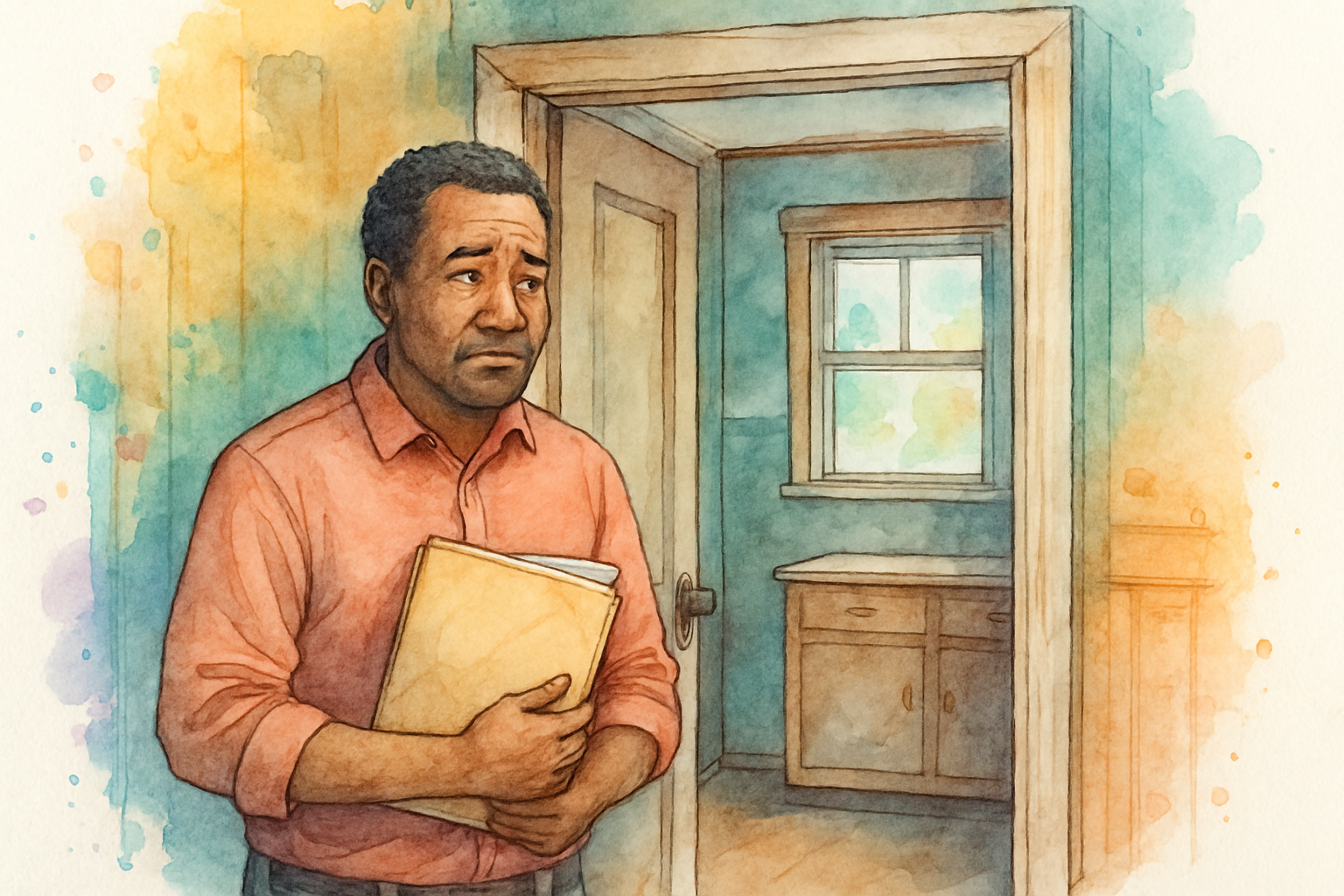
A homeowner in Carmel Valley reached out to us after discovering that the connected living space on the property they’d just purchased had never been permitted. They’d spent nearly a year trying to work through the process on their own — calling departments, getting transferred, resubmitting paperwork — and still weren’t close to a resolution. What they said stuck with me: “I didn’t build this thing. I just bought the house.”
That situation is more common on the Central Coast than most people admit. Sellers don’t always disclose unpermitted work. Buyers don’t always catch it in due diligence. And then you’re the one holding the problem.
The good news is that California now has a real pathway to fix it. If you have an unpermitted unit built before January 1, 2020, AB 2533 — which took effect in 2025 and remains in force in 2026 — gives you a legitimate legalization route. Here’s what that actually looks like in practice.
What AB 2533 Actually Changed for Homeowners With Older Unpermitted Units
Before AB 2533, homeowners with unpermitted units were in a rough spot. Local agencies had wide discretion over how to handle them, and the threat of demolition orders or major penalties made many homeowners reluctant to come forward at all.
AB 2533 changed the math. For unpermitted ADUs that were built before January 1, 2020, local agencies are now required to process legalization permits — as long as the unit meets basic health and safety standards. They cannot simply reject the application or demand demolition as a first response.
What that means practically: if you bought a home in Salinas, Seaside, Hollister, or anywhere else in Monterey or San Benito County and inherited an older unpermitted unit, you have a documented legal option to pursue. This isn’t a gray area anymore. The pathway is open, and it was still fully intact as of early 2026 — no new legislation closed or modified it.
That said, “pathway” doesn’t mean “automatic.” You still have to prove the unit predates 2020, meet current health and safety thresholds, and clear a multi-step permit process. The law removed the worst penalties; it didn’t remove the work.
JADU or ADU — The First Decision You Need to Make
Before you do anything else, you need to figure out what category your unpermitted unit falls into. That determination shapes everything that follows — the rules, the restrictions, and the rental options available to you.
Here’s how to think about it:
- JADU (Junior ADU): Under 500 square feet, located within the existing footprint of the primary home (not a detached structure). Has its own entrance and an efficiency kitchen area.
- Standard ADU: Can be attached or detached, typically up to 850 square feet (or larger in some jurisdictions), with a full kitchen and separate living space.
The distinction matters for a few reasons. First, owner-occupancy rules historically applied to JADUs — meaning someone had to live on-site. But under AB 1154, which took effect January 1, 2026, a JADU that has its own bathroom is no longer subject to that owner-occupancy requirement. For homeowners who bought the property as an investment or don’t plan to live there full-time, that’s a meaningful change.
Second, a JADU and a standard ADU go through slightly different approval tracks at the planning level — even when the underlying legalization process under AB 2533 applies to both.
If you’re not sure which category your unit falls into, a contractor or permit specialist who knows how Monterey County ADU projects actually work can help you make that call before you submit anything.
The Legalization Sequence: What You’re Actually Walking Into
This is the part most homeowners underestimate. Legalizing an unpermitted unit is not a single permit application. It’s a sequence of steps across multiple departments, and the order matters.
Here’s a realistic picture of what that typically looks like in Monterey County:
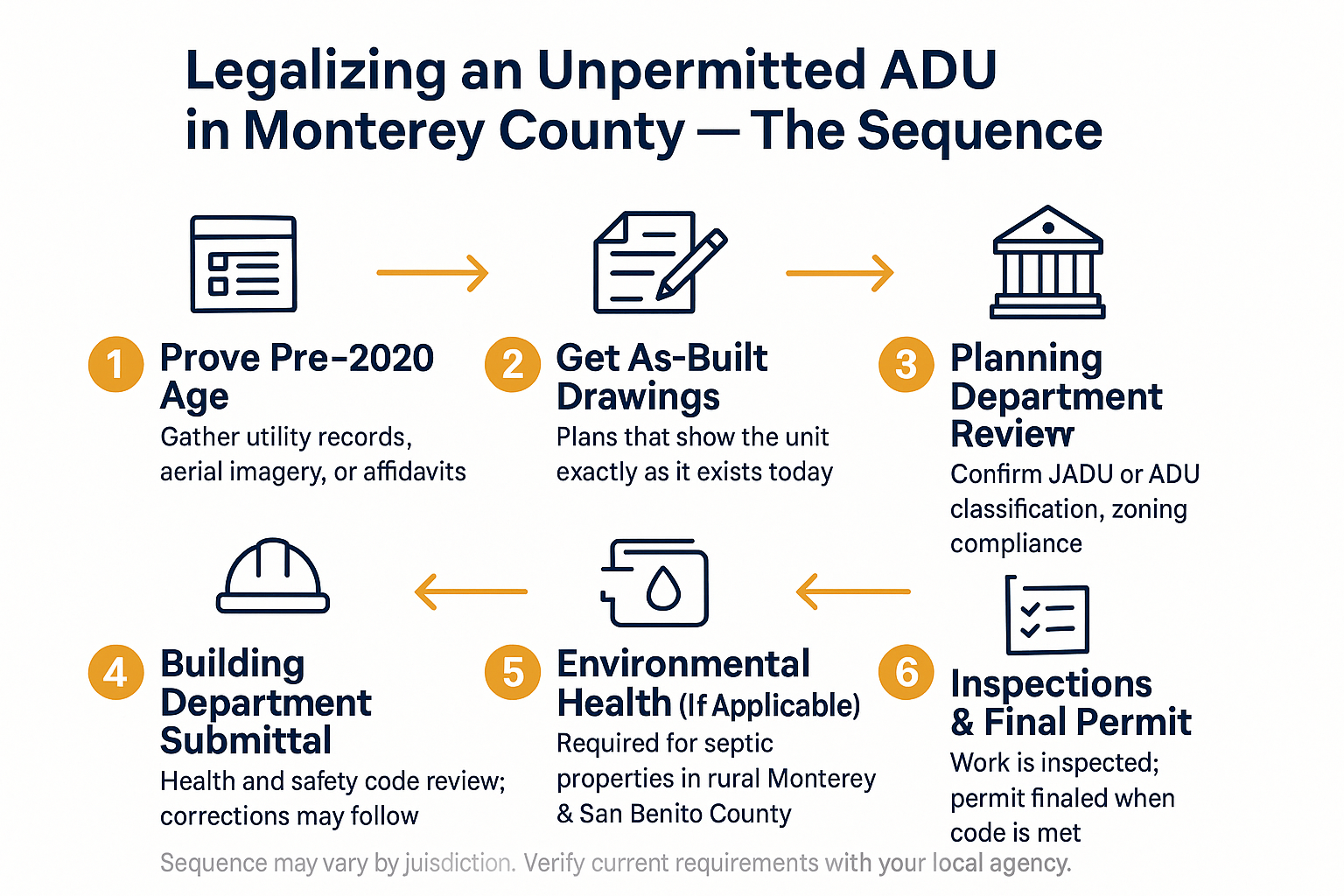
- Step 1 — Establish the unit’s age. You’ll need documentation that the structure existed before January 1, 2020. This can come from aerial imagery, utility records, prior owner affidavits, or other historical evidence.
- Step 2 — As-built drawings. A set of plans that accurately reflects the unit as it currently exists — dimensions, electrical layout, plumbing, window and door locations. These aren’t the same as design plans for new construction.
- Step 3 — Planning department review. The unit needs to conform to zoning for the parcel. This is where JADU vs. ADU classification gets formalized.
- Step 4 — Building department submittal. Plans are reviewed against current health and safety code standards. You’ll likely need to address specific items before a permit is issued.
- Step 5 — Environmental health (if applicable). Properties on septic systems in rural Monterey County or San Benito County — think Carmel Valley, Cachagua, or outside Hollister — often require environmental health sign-off to confirm the existing septic can handle the added load. This step alone can add weeks.
- Step 6 — Inspections. Once the permit is issued, work to bring the unit into compliance has to be inspected and approved. You don’t get a finaled permit without passing inspections.
If you’re on the Monterey County coast, there may also be Coastal Zone considerations. We’ve written about what coastal ADU permits in Monterey County look like in more depth if your property falls in that zone.
The Unpermitted ADU Legalization Process at a Glance
This step-by-step overview shows the typical sequence for legalizing an older unpermitted unit in Monterey County or San Benito County under AB 2533.
JADU vs. Standard ADU: Key Differences for Legalization
If you’re trying to figure out which category your unpermitted unit falls into, this comparison covers the factors that most directly affect the legalization process and what you can do with the unit afterward.
| Factor | JADU | Standard ADU |
|---|---|---|
| Max size | Under 500 sq ft | Typically up to 850–1,200 sq ft depending on jurisdiction |
| Location | Within existing home footprint only | Attached or detached; can be new construction |
| Full kitchen required? | No — efficiency kitchen area sufficient | Yes — full kitchen required |
| Owner-occupancy rule (2026) | Not required if unit has its own bathroom (AB 1154) | No owner-occupancy requirement |
| Separate utility meters | Generally not required | May be required depending on jurisdiction |
| Rental allowed? | Yes, with restrictions — cannot be short-term rental | Yes — long-term rental allowed; STR rules vary by city |
Why This Is Hard to Do on Your Own
I’m not going to tell you it’s impossible to navigate this without help — but I’ll tell you what I’ve seen happen when homeowners try.
The most common problem is missed sequencing. Someone submits to building before planning has signed off. Or they skip environmental health because they didn’t know it applied to their septic property. Each misstep adds weeks, sometimes months, to a process that’s already slow by nature.
The second problem is the as-built drawings. Many homeowners assume they can just sketch something out or use a simple app. But the drawings submitted for a legalization permit need to be accurate enough to stand up to plan-check review. If they’re wrong, the plans come back with corrections — and the clock resets.
I’ve also seen homeowners spend significant time at a planning counter only to learn their unit doesn’t clearly qualify as a JADU or a standard ADU under current definitions — and they’re back to square one figuring out what they actually have.
If you want to understand what a well-managed renovation process looks like in contrast to one that stalls, this piece on what separates smooth renovations from difficult ones covers the underlying principles pretty directly. The same logic applies to permit-heavy legalization work.
Having someone in your corner who knows the Monterey County permit workflow — who has already worked through planning, building, and environmental health on similar projects — is what turns a process that drags on indefinitely into one that resolves in a predictable timeframe. That’s not a pitch; it’s just what the data shows when you compare projects.
A Word on Costs
People ask about this early, and it’s a fair question. But the honest answer is that legalization costs vary a lot depending on what the unit needs to reach code compliance.
The permit fees alone vary by jurisdiction. In Monterey County, application and plan-check fees for an ADU legalization can range from a few hundred dollars to well over a thousand, depending on scope. As-built drawings from a qualified designer typically add to that.
The bigger variable is what the building department flags during review. If the unit has outdated electrical that doesn’t meet current safety standards, or if the ventilation doesn’t comply, or if the bathroom rough-in needs to be redone — those corrections have real costs attached. Until you have drawings reviewed and a plan-check response in hand, no one can give you an honest all-in number.
For context on how ADU project costs tend to break down across Monterey, Santa Cruz, and San Benito County more broadly, this cost breakdown is a useful starting point. Legalization is a different scope than new construction, but many of the same cost drivers apply.
Frequently Asked Questions About Unpermitted ADU Legalization in Monterey County
Does AB 2533 apply to my city, or just unincorporated Monterey County?
AB 2533 is a state law, so it applies throughout California — including incorporated cities like Salinas, Seaside, Gonzales, Hollister, and Watsonville. That said, each local agency implements it within their own process, so the specific submittal requirements and timelines vary. Always verify current requirements with the planning or building department in your jurisdiction.
What if I can’t prove the unit was built before January 1, 2020?
This is a real hurdle for some properties. Documentation options include historical aerial imagery (Google Earth’s historical layers go back quite a few years), prior utility service records, old property tax records, neighbor statements, or prior owner affidavits. A contractor or permit specialist familiar with this process can help you figure out what evidence you actually have before you commit to the legalization path.
Can I rent out the unit while the legalization is in progress?
This gets into legal territory that goes beyond what I can advise on — that’s a question for a real estate attorney familiar with California landlord-tenant law. What I can say is that renting an unpermitted unit carries real risks, including potential liability if something goes wrong. Getting the permit finaled first is the clean way to do it.
My property is in Carmel Valley and on a well and septic. Does that make this harder?
It adds a step, yes. Monterey County Environmental Health will typically need to confirm that your existing septic system has adequate capacity for the additional dwelling unit. That review is separate from planning and building, and scheduling can add several weeks to the overall timeline. It’s not a dealbreaker — but it’s a step that catches people off guard if they don’t know it’s coming.
What happens if I just do nothing and leave the unit unpermitted?
A few things can catch up with you. Homeowner’s insurance may not cover a loss involving an unpermitted structure. When you eventually sell, unpermitted units typically have to be disclosed — and buyers and their lenders often push back hard. And if a neighbor or tenant ever files a complaint, the local agency can compel you to either legalize or remove the unit on their timeline, not yours. The AB 2533 window is open now — doing nothing just means facing those risks without the favorable legalization pathway in your corner.
Ready to Find Out If Your Unit Qualifies for Legalization?
If you bought a property in Salinas, Seaside, Carmel Valley, Hollister, or anywhere else in Monterey or San Benito County and you’re sitting on an unpermitted unit, the team at Aldridge Construction can walk through what the legalization path looks like for your specific situation. We’ve worked through the Monterey County permit sequence on projects like this and know where the process tends to slow down. Reach out at 831-682-9788 or through the contact page at aldridgeconstruction.biz to start the conversation.