
Figuring out the real cost to build an ADU can feel complex, but the investment settles into predictable ranges. In areas like Monterey County, CA, or Maricopa County, AZ, construction costs for the physical structure typically run between $85,000 and $285,000.
This number doesn't include design, permits, or site preparation, but it provides a solid starting point. The final price tag will ultimately hinge on size, material choices, and local labor rates.
Your Quick Guide to ADU Construction Costs
Before diving into details, it’s helpful to have baseline numbers to frame your expectations. Think of this as the sticker price for the ADU itself, before adding custom upgrades or tackling unique property challenges. The final cost shifts based on the ADU type, square footage, and where you're building.
Foundational Cost Estimates
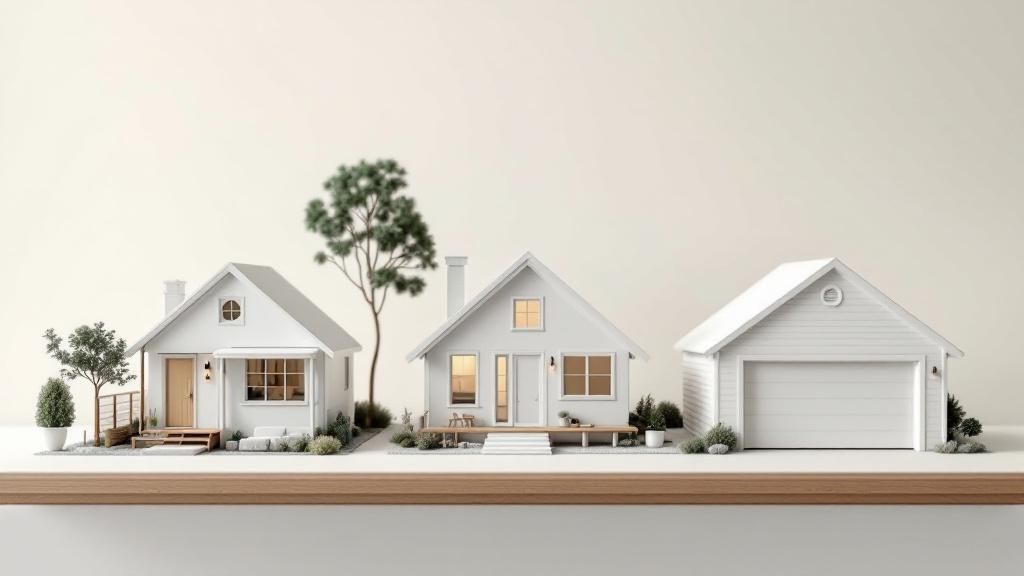
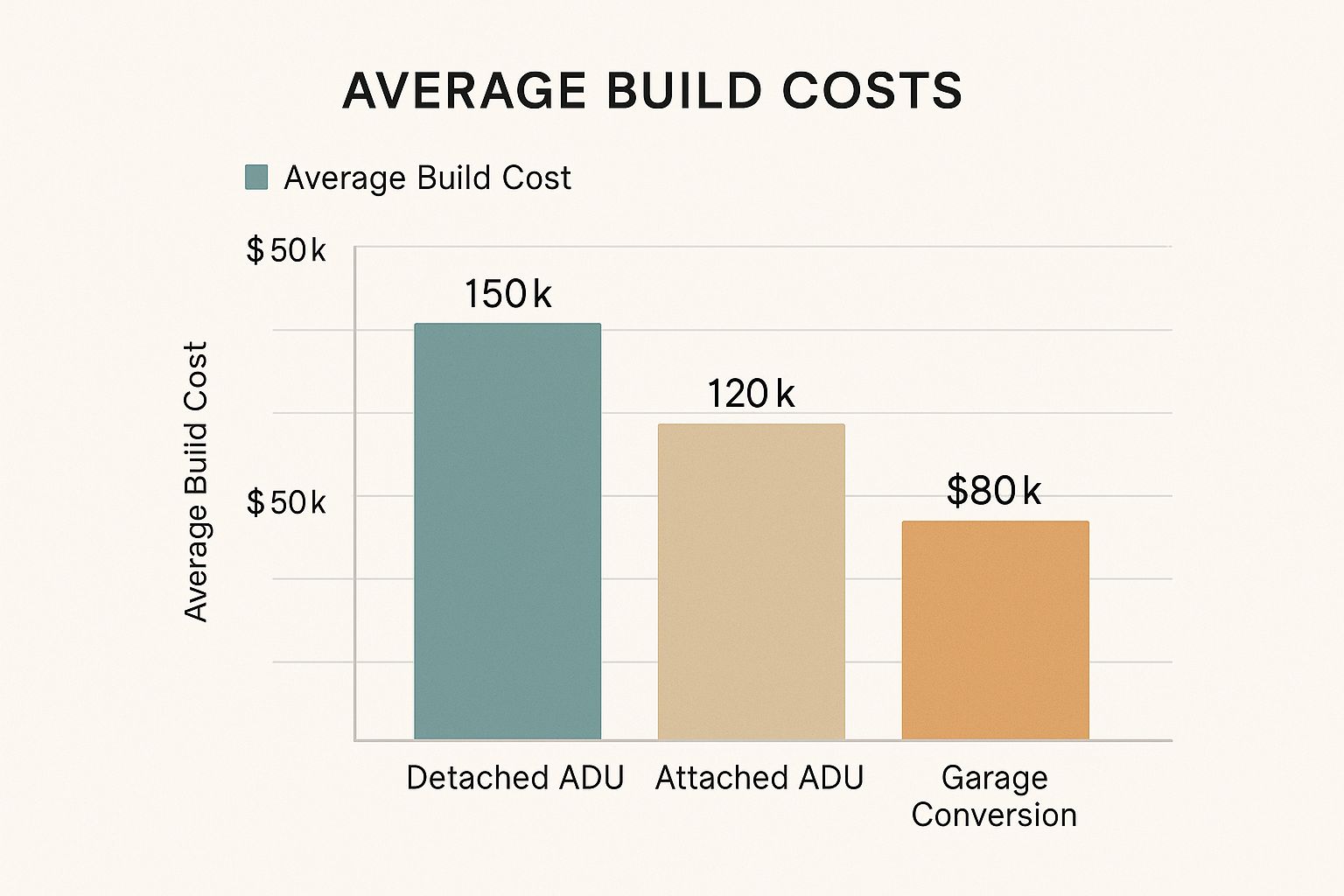
The type of ADU you choose is the biggest driver of your initial construction cost. A brand-new, standalone detached ADU usually requires the most significant investment. An attached ADU that shares a wall with your main home is often a more moderate option.
Of course, these numbers are influenced by design complexity, the quality of finishes, and local labor rates. A complete, realistic budget must also factor in design fees, city permits, and utility hookups. To see how these pieces fit together, it’s worth reviewing a typical home construction timeline.
A common misconception is that a smaller ADU is always dramatically cheaper. While size is a major factor, fixed costs like utility connections and permit fees are often similar regardless of whether you build a 400 sq. ft. studio or an 800 sq. ft. one-bedroom unit.
Estimated ADU Construction Costs by Type
To give you a clearer picture for budget planning, the table below breaks down typical construction cost ranges for the three main types of ADUs. This should help you see where your project might land.
| ADU Type | Average Size (sq. ft.) | Estimated Construction Cost Range |
|---|---|---|
| Detached New Construction | 600 – 1,200 | $150,000 – $300,000+ |
| Attached New Construction | 500 – 1,000 | $120,000 – $250,000 |
| Garage/Interior Conversion | 400 – 600 | $85,000 – $140,000 |
As you can see, converting an existing space like a garage is often the most budget-friendly path. Building a new detached unit offers the most flexibility but comes with a higher price tag.
Breaking Down the Core Construction Costs
Now that you have a ballpark idea of what an ADU might cost, let's get into the details. These "hard costs" are all about the physical structure itself, from the dirt work to the last coat of paint. Every choice you make, from the type of foundation to the style of the windows, adds up.
Foundation and Framing
The foundation is crucial for both the longevity of your ADU and your budget. It's typically either a concrete slab-on-grade or a raised foundation that creates a crawl space.
A slab is usually more wallet-friendly and common in places like Maricopa County, AZ, where the climate and soil are ideal. A raised foundation might be necessary for a sloped property—a common situation in Santa Cruz and Monterey Counties.
Next is the framing—the skeleton of your ADU. Standard wood framing is the go-to for most projects because it’s economical and efficient. However, complex designs like vaulted ceilings or intricate rooflines will increase labor and material costs.
An experienced contractor like Aldridge Construction knows that roof design complexity is a major cost driver. Extending a simple pitched roof is far less expensive than re-engineering load-bearing walls for a new gable design, a detail our team flags early to keep your budget on track.
Exterior Finishes and Openings
The exterior provides curb appeal while protecting the ADU from weather. Your material choices here are a balance of aesthetics, durability, and cost.
- Siding: Options range from stucco, a durable choice popular in Arizona and California, to mid-range vinyl. For a premium look, many homeowners opt for fiber cement siding like James Hardie.
- Roofing: Asphalt shingles are the industry standard for a reason: they’re reliable and affordable. For a modern aesthetic, a metal roof is a great option, though it comes at a higher cost.
- Windows and Doors: Windows define your ADU's character and energy efficiency. You can upgrade from standard vinyl to high-performance models like energy-efficient Milgard windows. While they cost more upfront, they can lead to lower utility bills, a critical factor for meeting California's Title 24 energy code.
Interior Systems and Finishes
Once the shell is up, the focus moves inside. The mechanical systems and finish materials make up a huge chunk of the budget, turning your ADU from a structure into a home. This phase covers plumbing, the electrical system, and the HVAC (heating, ventilation, and air conditioning) unit.
This is also where your choices directly impact the cost. Builder-grade flooring, cabinets, and countertops are most economical. If you upgrade to premium materials like quartz countertops or custom cabinetry, the budget will increase accordingly. This is where options like home renovation loans can make higher-quality finishes more achievable.
Uncovering the Hidden Costs of an ADU Project
A successful ADU budget goes beyond lumber and windows. It’s the "soft costs" and site-specific expenses that often catch homeowners by surprise. An experienced builder like Aldridge Construction identifies these from day one, which is key to keeping your project transparent and ensuring the initial cost to build an ADU doesn't creep up.
The Realities of Site Preparation
Before construction begins, your property must be ready. This phase is more than clearing grass and depends entirely on your specific lot. A flat, accessible backyard in a Phoenix suburb might need very little prep work.
In contrast, a sloped property in the Santa Cruz mountains often demands extensive grading to create a level pad. This adds machinery costs and time. In some cases, a geotechnical report to analyze soil stability may be required, adding another layer of expense.
It’s a common scenario: a homeowner has the perfect spot on a steep hillside. This automatically means a more complex and expensive foundation design, like a raised foundation with deep footings, is needed to ensure safety. This is a critical detail a seasoned contractor will identify during the initial site visit.
Navigating Permits and Municipal Fees
Every city and county has its own rulebook for construction. These fees are non-negotiable costs required to make your project legal, safe, and up to code.
You can expect to encounter a few common fees:
- Building Permits: The main permit to start construction, often tied to your project's total value.
- Plan Check Fees: The city’s planning department must review and approve your architectural drawings.
- School and Park Fees: In many areas, new residential units must contribute to local infrastructure.
- Development and Impact Fees: These offset the "impact" your new unit has on public services.
Thankfully, recent changes in California law provide relief. ADUs under 750 square feet are exempt from development and impact fees, a rule that can save you thousands of dollars. This is a huge factor when deciding on the final size of your ADU.
The Cost of Essential Utility Connections
Your new ADU needs power, water, and sewer. Getting those services connected is a significant hidden cost that can vary wildly. The price depends on whether you can tie into the main house's systems or must run new connections from the street.
Permitting and impact fees often land between $5,000 to $15,000, and separate utility connections can easily add another $5,000 to $10,000. These "extras" can swell your project's budget by 20-30%. You can get a deeper dive into these factors in this 2025 investment guide.
Running new utility lines to a backyard ADU almost always involves trenching, which can tear up existing landscaping or driveways. A pro from Aldridge Construction can help you weigh the pros and cons of separate meters versus tying into existing utilities to find the most cost-effective path.
How Location Shapes Your ADU Building Budget
The cost to build an ADU is never a one-size-fits-all number; your zip code plays a surprisingly big role. It’s a mix of local labor rates, material transport distances, and the unique rules each city and county enforces.
An ADU built in Monterey County will almost always have a different bottom line than an identical unit in Maricopa County, Arizona. At Aldridge Construction, we provide clients a real, localized budget right from the start.
California’s Central Coast vs. Arizona’s Maricopa County
Building on California's Central Coast comes with its own challenges. The cost of skilled labor is generally higher, and properties often need more site prep due to varied terrain.
On the flip side, the Phoenix metro area in Maricopa County often has more streamlined building processes and a competitive labor market. However, Arizona's intense climate demands specific design choices, like heavy-duty HVAC systems, which pushes costs up in other areas.
Regional Cost Comparison for a Mid-Range ADU
| Cost Factor | Monterey/Santa Cruz County (CA) | Maricopa County (AZ) |
|---|---|---|
| Permits & Fees | $12,000 – $25,000 (Higher due to seismic/coastal reviews) | $8,000 – $15,000 (Often more streamlined city processes) |
| Skilled Labor | $85 – $150/hour (High demand, higher cost of living) | $60 – $110/hour (Larger, more competitive labor pool) |
| Site Prep | $10,000 – $30,000+ (Sloped lots, soil issues are common) | $5,000 – $15,000 (Generally flat, uniform terrain) |
| Energy Code | High (Strict Title 24, mandatory solar) | Moderate (Robust codes for heat, but different standards) |
| Materials | Higher (Supply chain logistics to the coast) | Moderate (Proximity to major distribution hubs) |
This table highlights how universal costs like labor and permits can swing dramatically based on location. It’s a perfect example of why a generic online cost calculator can be misleading.
The Impact of Local Building Codes
Nowhere are regional cost differences more obvious than in local building and energy codes. California’s regulations are famously strict and directly impact construction methods and materials.
For instance, California’s Title 24 energy standards control everything from insulation R-values to mandatory solar panels on all new-build ADUs. These rules create energy-efficient homes but add to the upfront construction cost.
Additionally, our service areas on the Central Coast are in active seismic zones. This means every ADU must be built to handle earthquakes, often requiring beefier foundations that add to material and labor bills. You can explore our guide on California ADU requirements to learn more.
Key Takeaway: Local regulations are a primary driver of cost variation. A builder with deep local knowledge is essential for creating a budget that accurately reflects the true cost of compliance in your specific jurisdiction.
Visualizing Your Budget With Sample ADU Projects
Abstract numbers are helpful, but nothing makes budgeting clearer than seeing those numbers applied to real-world scenarios. We’ve put together three sample projects reflecting common ADU types we build across Monterey, Santa Cruz, and Maricopa Counties.
These examples show how your choices in size, finishes, and complexity directly shape the final investment.
Scenario 1: Basic Budget Garage Conversion
A homeowner in Salinas wants to turn a two-car garage into a functional studio apartment. This is often the most cost-effective path, as you’re working with an existing structure.
- Project Scope: A 400 sq. ft. studio conversion.
- Key Features: Builder-grade laminate flooring, stock cabinets, laminate countertops, and a simple bathroom layout. Minimal exterior changes beyond a new entry door and window.
- Sample Budget Breakdown:
- Design & Permits: $8,000 – $12,000
- Structural & Framing: $10,000 – $15,000 (Includes reinforcing the structure and framing new interior walls)
- Plumbing & Electrical: $15,000 – $20,000
- Interior Finishes: $25,000 – $35,000
- Exterior & Site Work: $5,000 – $10,000
- Estimated Total Cost: $63,000 – $92,000
Scenario 2: Mid-Range Detached ADU
A family in Santa Cruz is building a new, detached one-bedroom ADU for aging parents. They’re looking for a comfortable, modern space with upgraded features.
- Project Scope: A 750 sq. ft. new-build detached ADU.
- Key Features: Quartz countertops, an upgraded appliance package, Luxury Vinyl Plank (LVP) flooring, semi-custom cabinetry, and energy-efficient Milgard windows. The design includes a small patio.
- Sample Budget Breakdown:
- Design & Permits: $18,000 – $25,000
- Foundation & Site Work: $25,000 – $40,000
- Framing & Exterior: $45,000 – $60,000
- Plumbing & Electrical: $20,000 – $30,000
- Interior Finishes: $50,000 – $70,000
- HVAC & Solar: $15,000 – $20,000
- Estimated Total Cost: $173,000 – $245,000
Scenario 3: High-End Custom ADU
An investor in Maricopa County, AZ, is building a large, high-end ADU as a luxury rental. This project focuses on a premium experience with top-tier materials and custom details.
- Project Scope: A 1,200 sq. ft. custom two-bedroom detached ADU.
- Key Features: Custom cabinetry, high-end stone countertops, wide-plank hardwood flooring, a spa-like bathroom with designer tile, folding glass patio doors, and a full landscaping package. Find more inspiration in these ADU design ideas.
- Sample Budget Breakdown:
- Architectural Design & Engineering: $30,000 – $45,000
- Permits & Impact Fees: $20,000 – $30,000
- Foundation & Site Work: $40,000 – $60,000
- Framing & Exterior Finishes: $70,000 – $95,000
- Plumbing & Electrical: $35,000 – $50,000
- Luxury Interior Finishes: $90,000 – $130,000
- Landscaping & Hardscaping: $20,000 – $35,000
- Estimated Total Cost: $305,000 – $445,000+
Partner With Aldridge for a Transparent ADU Build
An accessory dwelling unit is a serious investment. Choosing the right construction partner is the single most important decision you'll make. While the cost to build an ADU is complex, the process doesn't have to be a nightmare of hidden fees.
At Aldridge Construction, we specialize in building in the communities we call home: Monterey, Santa Cruz, and San Benito Counties in California, as well as in Maricopa County, Arizona.
Your Local Building Expert
Our team lives and breathes the specific challenges each region presents. Whether it’s navigating California’s rigorous Title 24 energy codes or designing an ADU to handle the Arizona sun, we build every project to meet local demands. That firsthand experience prevents costly mistakes and keeps your budget honest.
We believe a great project is built on trust just as much as it is on concrete and lumber. Our promise is to deliver transparent pricing, top-tier craftsmanship, and expert guidance through every local regulation and inspection.
Choosing Aldridge Construction means you have a partner who manages the entire process—from the initial site check and complex permit offices to the final walkthrough. Our job is to make the journey feel as smooth and predictable as possible.
Turning Your Vision into a Home
An ADU is more than just an asset—it's a future home for a loved one or a new source of income. We give every project the care and attention to detail it deserves. If you’re ready to make your ADU vision a reality, on time and on budget, our team is here to guide you.
Ready to take the next step? Contact Aldridge Construction today for a personal consultation and a clear, detailed estimate for your project in Monterey, Santa Cruz, or Maricopa County.
Frequently Asked Questions About ADU Costs
To help you move forward with confidence, here are straightforward answers to common homeowner questions about ADU projects.
How Long Does the Entire ADU Building Process Take?
From the first design sketch to final move-in, a complete ADU project typically takes 9 to 18 months. This includes two main phases: design/permitting (3-6 months) and construction (6-12 months). The actual time depends on project complexity, weather, and local city timelines in areas like Monterey or Maricopa.
Is It Cheaper to Build a Prefab or Modular ADU?
While prefab ADUs are marketed as a bargain, the "base price" is only part of the story. You must still account for on-site work like transportation, craning the unit into place, foundation work, and utility connections, which can add $50,000 to $100,000+ to the final bill. The real-world cost difference is often much smaller than advertised.
What Is the Typical Return on Investment for an ADU?
An ADU is a powerful investment that can boost your property’s value by 20% to 35%, according to industry data. If you rent it out, the unit can generate steady cash flow, often covering loan payments and providing passive income. Learn more about the concept in our guide on what ADU means in construction.
How Can I Finance the Cost of Building My ADU?
Most homeowners finance their ADU. Common options to cover the cost to build an ADU include a cash-out refinance, a Home Equity Line of Credit (HELOC), or a dedicated construction loan. Each has its pros and cons, which Aldridge Construction can help you navigate.
Will Building an ADU Increase My Property Taxes?
Yes, your property taxes will go up, but not as much as you might fear. California law prevents your entire property from being reassessed. Instead, your tax bill is recalculated using a "blended assessment," where the county only adds the assessed value of the new ADU, keeping the tax increase manageable.