
Direct Answer: A remodeling estimate should spell out exactly what’s included, who does the work, and what happens when something changes. If it doesn’t, you’re carrying the risk.
Most homeowners in Monterey County get two or three bids on a remodel and pick the one in the middle. That’s a reasonable instinct — but it skips the most important step. Reading the estimate itself, not just the bottom-line number, is where you actually protect yourself.
A $48,000 kitchen remodel and a $61,000 kitchen remodel might be quoting completely different scopes of work. One might include permit fees, demo, and panel upgrades. The other might be materials and labor only, with permits billed separately and subcontractors not yet identified. You won’t know which is which until you read the document carefully.
This guide walks through the parts of a remodeling estimate that actually matter — what good language looks like, what vague language costs you, and which line items are most likely to blow up your budget if they’re not clearly defined upfront.
The Difference Between a Bid, a Quote, and an Estimate
These three words are used interchangeably, but they mean different things — and knowing which one you’re looking at changes how much weight you put on the number.
A bid is typically a fixed-price offer for a specific scope of work. The contractor commits to that number unless something changes. A quote is similar but often tied to current material pricing, which can expire. An estimate is a good-faith projection — it’s not a locked price, and it’s the most common format you’ll receive for a kitchen or bathroom remodel where conditions inside the walls aren’t fully known yet.
When you’re comparing documents from multiple contractors, make sure you’re comparing the same type. One fixed bid and one rough estimate sitting side by side don’t tell you much. Ask each contractor directly: is this number a firm price, or is it subject to change? And if it can change, what are the most likely reasons it would?
For anything involving plumbing, electrical, or tile work in an older Salinas or Monterey home, expect the honest answer to be: there’s a range, and we’ll know more after demo.
Line Items You Should Never Overlook
A well-written estimate isn’t one big number — it breaks the project into sections so you can see where the money is going. If you receive a one-page document with a single total, that’s a warning sign.
Here are the line items that matter most and what to check in each:
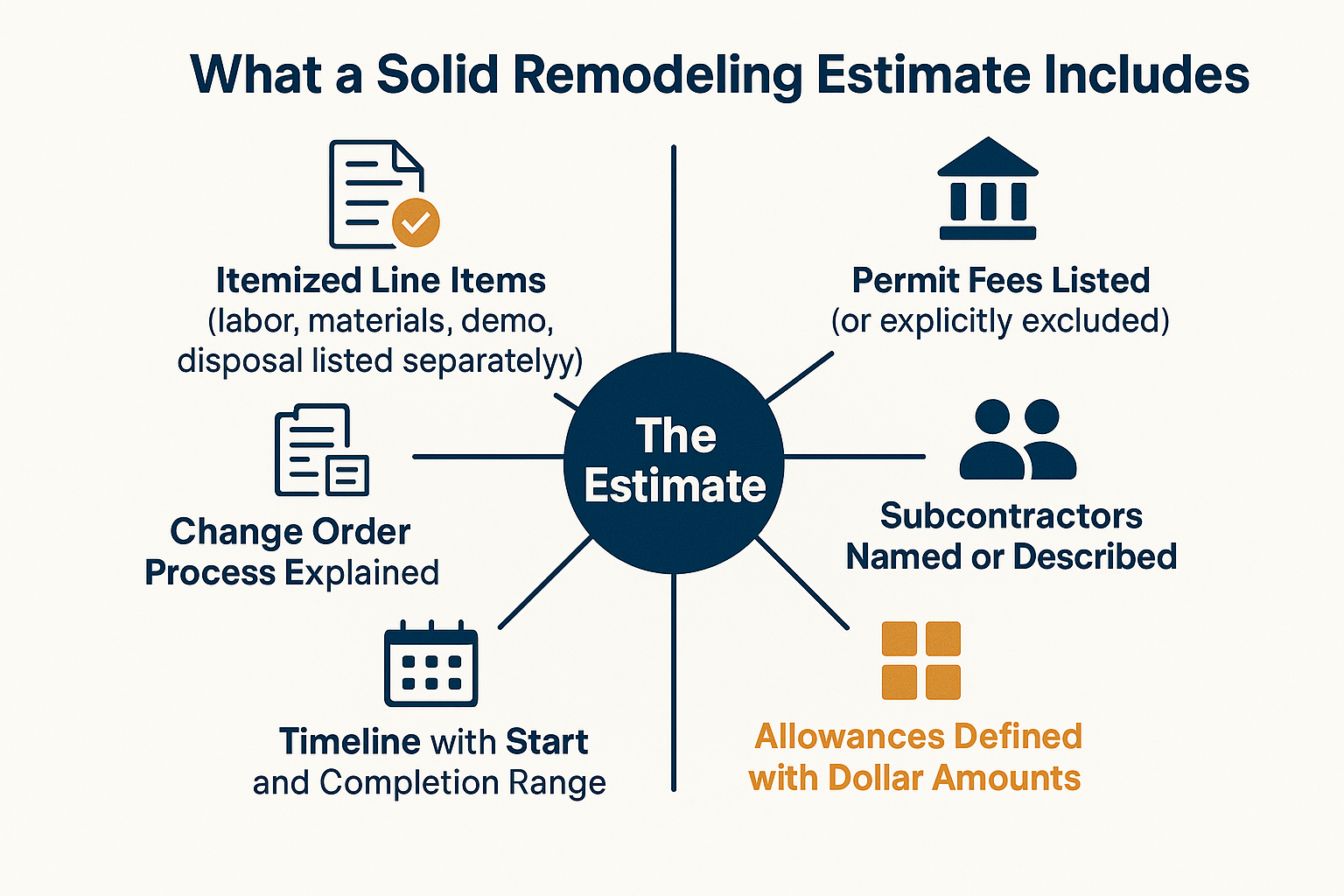
- Permits and fees — In Monterey County, permit costs vary by jurisdiction and project type. A kitchen remodel in Salinas can run $800–$2,500 in permit fees alone depending on the scope. If the estimate doesn’t list permits as a line item, ask whether they’re included or billed as a pass-through.
- Demo and disposal — Tearing out cabinets, tile, or a tub costs money and time. Some contractors bundle this into labor; others quote it separately. If it’s not listed, assume it’s not included.
- Subcontractor work — Plumbers and electricians are almost always subcontractors. The estimate should name them or at least describe the scope they’ll cover. An estimate that says only “electrical work” with a number attached tells you nothing about what work is actually planned.
- Allowances — This is where budgets quietly expand. An allowance is a placeholder — “tile allowance: $4/sq ft” means if you pick a $9 tile, the difference comes back to you. Know your allowances before you sign.
- Change order terms — How does pricing change if something unexpected comes up? A transparent contractor spells this out in the estimate or contract. Understanding your California home improvement contract before you sign is just as important as reading the estimate itself.
If any of these are missing or vague, that’s a conversation to have before the project starts — not after demo day.

What Vague Language in an Estimate Actually Costs You
Words like “as needed,” “allowance,” “to be determined,” and “misc labor” are legal contract language that shifts financial risk from the contractor to you. Every one of those phrases is a potential budget surprise waiting to happen.
Take a bathroom remodel in a 1960s Seaside home. The estimate says “plumbing updates as needed.” Once demo opens the wall, the crew finds galvanized pipe that has to be replaced before the inspector will sign off. That’s not a surprise to an experienced contractor — it’s predictable in that era of home. But “as needed” language means the price to fix it wasn’t in the number you agreed to.
A contractor who has done this work in Monterey County knows what to expect in different housing vintages. That knowledge should show up in the estimate — either as a specific line item, or as a documented contingency (usually 10–15% of total project cost in a remodel with unknown conditions). If neither appears, the estimate is probably optimistic on purpose.
The value engineering conversation is also worth understanding before you sign — it’s a legitimate way to reduce cost without reducing scope, but only if it’s discussed openly and written into the document.
Vague estimates aren’t always dishonest — sometimes they reflect a contractor who genuinely doesn’t know what they’ll find. But vague estimates signed by an uninformed homeowner are almost always expensive.
What a Solid Remodeling Estimate Includes
Use this as a quick reference when reviewing any estimate — whether for a kitchen, bathroom, or larger renovation project.
Estimate Red Flags vs. What Good Language Looks Like
Use this comparison when you’re sitting down with two or three bids — the language on the left should make you ask questions before you sign.
| Red Flag Language | What It Actually Means | What Good Language Looks Like |
|---|---|---|
| “Plumbing as needed” | Cost unknown until demo — you carry the risk | “Replace supply lines to fixtures: $1,200–$1,800” |
| “Misc labor” | Placeholder with no defined scope | “Tile installation, 80 sq ft, includes backer board: $1,440” |
| “Allowance: TBD” | Price will be set later, possibly after you’ve committed | “Cabinet allowance: $8,500 — upgrades billed at cost” |
| “Permit fees not included” | Unknown cost added to your total after signing | “Permit fees estimated at $1,200 — billed as pass-through with receipts” |
| “Work completed in approximately 4–6 weeks” | No start date, no milestone structure | “Demo week of [date], rough inspections by [date], completion by [date]” |
How to Compare Two Estimates Side by Side
When you have estimates from two different contractors, resist the instinct to go straight to the total. Instead, match the scopes line by line.
Start with what each estimate includes for demo and disposal, permit coordination, and subcontractor work. Those three categories alone can account for a $6,000–$12,000 difference on a mid-range kitchen remodel in the Salinas area — not because one contractor is cheaper, but because they’re quoting different things.
Also look at what each estimate leaves out. Some contractors exclude:
- Fixture and appliance delivery fees
- Temporary protection for flooring and adjacent rooms during construction
- Final cleaning after project completion
- Any work required by the building inspector that wasn’t anticipated
None of those are major surprises on their own, but together they add up. A contractor who buries them or simply doesn’t mention them isn’t being dishonest — but you’re the one who’ll get the invoice when the project wraps.
For bathroom projects specifically, questions about scope can be more complicated than they first appear. If you’re not sure whether your project counts as a simple update or a full renovation, the breakdown in when a bathroom update becomes a full renovation is worth reading before you make any decisions. The answer changes what permits are required and how the estimate should be structured.
The Timeline Section — and Why Most Homeowners Skip It
Most homeowners focus entirely on the cost section and skim the timeline. That’s a mistake that shows up around week three of a five-week project.
A well-written estimate or contract should include a project start date, major milestones (demo, rough inspections, finish work), and an anticipated completion range. It should also address what happens if the contractor falls behind — not because every contractor will, but because knowing the answer before you sign tells you a lot about how seriously they take scheduling.
In Monterey County, permit inspection timelines through the county building department can add days to certain phases of a project. A contractor who knows this builds it into the schedule. One who doesn’t is handing you a timeline that looks great on paper and falls apart in the field.
This matters even more for kitchens and bathrooms, where you’re likely living without full use of that room during construction. Bathroom renovation timelines in Salinas tend to surprise homeowners who weren’t told upfront what inspection sequencing actually looks like.
Frequently Asked Questions About Reading Remodeling Estimates
Is it okay to ask a contractor to explain every line item?
Yes — and a contractor who gets defensive about that is a contractor worth skipping. Any reputable contractor should be able to walk you through what’s in the estimate, why it’s priced the way it is, and what assumptions they made. If they can’t explain it clearly, they either don’t know their own scope or they’re hoping you won’t ask.
What’s a reasonable contingency to expect on a kitchen or bathroom remodel?
Most experienced contractors build in a 10–15% contingency on projects involving older homes where conditions inside the walls are unknown. On a $40,000 bathroom remodel, that’s $4,000–$6,000 held in reserve. If a contractor quotes you a number with zero contingency on a 1970s Monterey home, that’s either overconfidence or a low number designed to win the bid.
Do permit fees always show up in the estimate?
Not always — and that’s a problem. In Monterey County, permit fees are real costs that vary by jurisdiction and project type. Ask every contractor directly: are permits included in this number, and who pulls them? The contractor should pull permits, not the homeowner. If they’re asking you to pull your own permits, that’s a significant red flag.
What should the payment schedule look like?
Under California law, a contractor cannot require more than 10% of the project total or $1,000 (whichever is less) as a down payment on a home improvement project. After that, payments should be tied to milestones — not arbitrary dates. A payment schedule that front-loads most of the money before work is completed puts you in a weak position if something goes wrong. California home improvement contracts have specific requirements worth knowing before you write any check.
How do I know if an estimate is too low?
Compare it against at least two others and look at what’s missing, not just the total. A kitchen remodel in the Salinas area that comes in at $22,000 when the other two bids are $41,000 and $47,000 isn’t a bargain — it’s a scope mismatch or a set of missing line items. Ask the low bidder specifically: what does your number not include?
Have an Estimate You Want a Second Opinion On?
Aldridge Construction works with homeowners across Monterey County, Santa Cruz County, and the broader Central Coast who want a straight answer before they commit to a contractor. Brian Aldridge reviews project scope and estimates honestly — not to undercut competitors, but because informed homeowners make better clients. Reach the team directly at 831-682-9788 or through the contact page at aldridgeconstruction.biz.