
Direct Answer: A remodel that holds starts with proper permits, correct sequencing, and materials suited to the local climate. One that fails usually skips at least one of those three.
Most homeowners in Salinas and across Monterey County don’t find out their remodel had problems until years later — a tile that pops loose, a bathroom floor that flexes underfoot, a kitchen cabinet run that slowly pulls from the wall. By then, the contractor is long gone and the repair cost falls on you.
This isn’t about bad luck. It’s almost always about decisions made early in the project — sometimes by the contractor, sometimes by the homeowner trying to save money, often both. Understanding which decisions actually determine long-term quality is the most useful thing you can do before signing any contract.
This article focuses on the two areas where remodels most commonly fail: substrate and waterproofing work in bathrooms, and sequencing decisions in kitchens. These are the places where shortcuts are easiest to take and hardest to see until the damage is done.
Why Bathrooms Fail First — and What That Actually Looks Like
Bathrooms are the most failure-prone room in any home renovation. The reason isn’t the tile or the fixtures — it’s everything underneath them.
In Monterey County’s coastal climate, humidity swings are real year-round. A bathroom that isn’t waterproofed correctly behind the tile doesn’t just get wet — it stays wet, and that moisture works into the wall framing, the subfloor, and eventually the structure of the room itself. By the time you see a grout crack or a soft spot underfoot, there’s typically $3,000 to $8,000 worth of hidden damage already waiting.
The things that actually matter in a bathroom remodel:
- Backer material — standard drywall behind tile is wrong. Cement board or an approved waterproof panel system is the minimum for any wet area.
- Waterproofing membrane — this goes over the backer, under the tile. Skipping it to save $300–$600 in labor is one of the most expensive shortcuts a contractor can take.
- Mud bed or uncoupling membrane under floor tile — a floor tile set directly on plywood will crack. A mortar bed or an uncoupling membrane like Schluter DITRA gives the tile somewhere to move.
- Linear drain slope — shower floors need to drain correctly. Off by even a quarter inch over four feet and water pools at the wall, not the drain.
If you’re trying to figure out whether your planned bathroom project is a true renovation or just a surface update, when does a bathroom update actually become a full renovation walks through the line in plain terms.

Kitchen Remodels: Where Sequencing Errors Show Up Later
Kitchen failures are less about water and more about order of operations. When work gets done in the wrong sequence — or when trades don’t coordinate properly — problems get built in and covered up before anyone notices.
The most common sequencing issue in Central Coast kitchen remodels is electrical work done after cabinet layout is finalized. This creates situations where a new island has no circuit for outlets, a range hood gets vented wrong because the cabinet was already hung, or a homeowner who wants induction cooking discovers mid-project that the existing 200-amp panel is already maxed out and needs an upgrade that runs $2,500–$4,500 before a single cabinet goes in.
Other sequencing decisions that separate lasting work from short-term work:
- Rough-in inspection before drywall — any electrical, plumbing, or gas line work needs to be inspected before it’s covered. Skipping this step to move faster creates unpermitted work inside the walls.
- Cabinet leveling and shimming — cabinets installed on an unlevel floor will rack over time. The remedy is shimming at install, not hoping the floor is flat.
- Countertop template after cabinet install — templating a stone countertop before cabinets are fully set and secured produces a slab that doesn’t fit right when the cabinets shift even slightly.
- Appliance rough-in dimensions confirmed before drywall close — a refrigerator or range that’s even two inches wider than planned can make the last six months of planning useless.
For a broader look at what kitchen remodeling actually costs and what drives those numbers locally, kitchen remodeling in Salinas during the stay-put housing market has current figures.
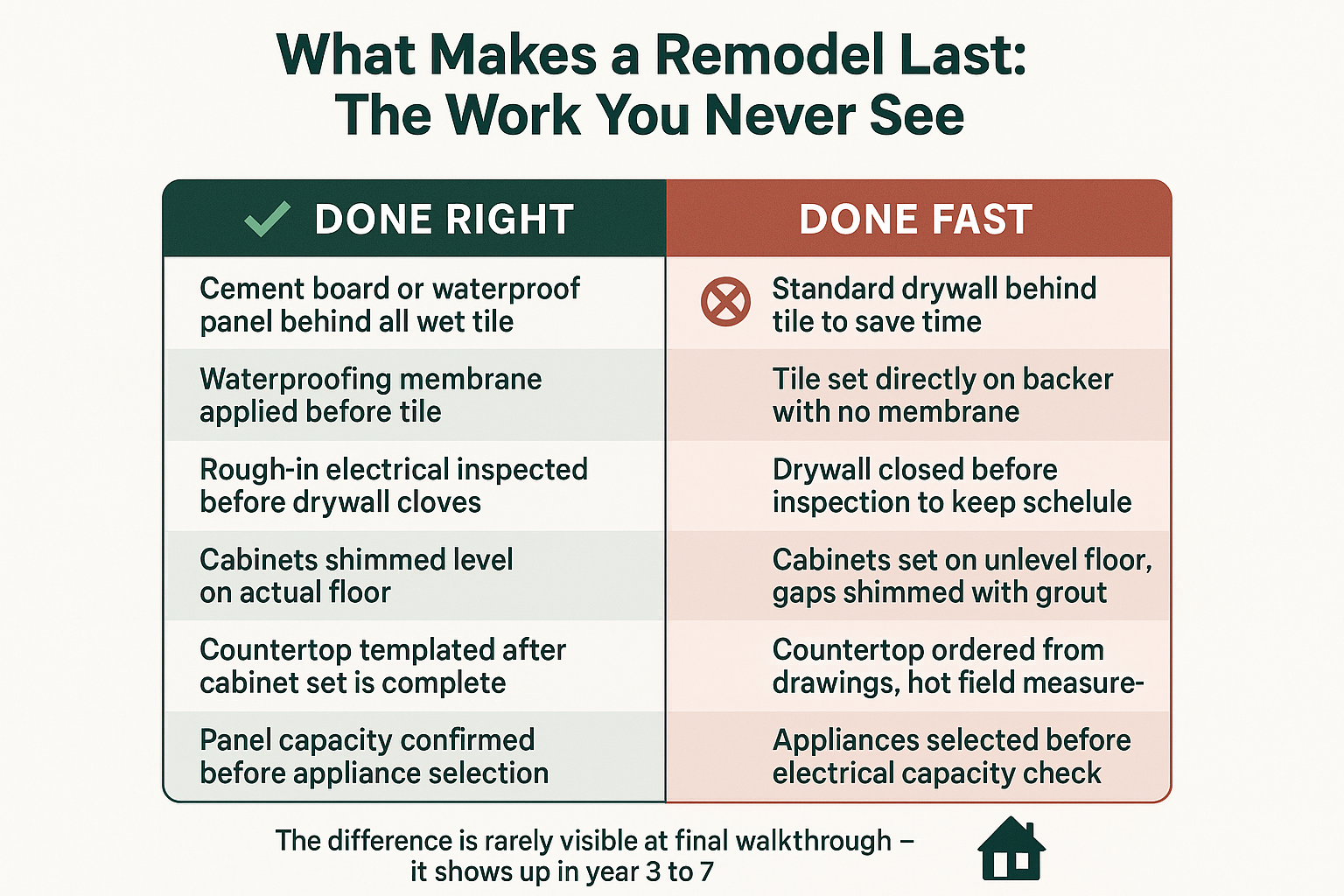
The Two-Phase Quality Check Most Homeowners Never See
This breakdown shows the behind-the-walls work that determines whether a remodel holds up for 20 years or starts showing problems in five.
Permits Aren’t Just Red Tape — They’re Your Quality Backstop
One of the most consistent factors separating remodels that hold from ones that don’t is whether the work was permitted and inspected. This is especially relevant in Monterey County, where the City of Salinas Building Division, Monterey County Planning, and in some cases the Coastal Commission all have jurisdiction depending on where the project sits.
A permit isn’t just paperwork. It means a third-party inspector — someone who doesn’t work for your contractor — looks at the framing, the rough electrical, the plumbing, and the waterproofing before any of it gets covered up. That’s the only real quality check that doesn’t rely entirely on trusting whoever you hired.
Unpermitted work also creates real financial problems. When you sell a home in Monterey County, unpermitted improvements can delay escrow, require retroactive permits, or get flagged by a buyer’s inspector as a defect. A bathroom addition done without permits in Salinas can cost $5,000 to $12,000 to remediate — sometimes more if walls have to come back open.
If you’re unsure which projects actually require a permit in your area, do you really need a permit for that remodel lays out the most common situations clearly.
Common Remodel Shortcuts and What They Cost to Fix Later
These are repair costs homeowners in Monterey County typically face when earlier work wasn’t done correctly. Ranges reflect local contractor rates as of 2025–2026.
| Shortcut Taken | What Fails | Typical Repair Cost |
|---|---|---|
| Drywall used behind shower tile | Water intrusion into framing, mold, subfloor rot | $4,500 – $11,000 |
| No waterproofing membrane in wet area | Grout cracking, tile debonding, subfloor damage | $2,800 – $7,500 |
| Tile set on plywood floor without uncoupling | Cracked tiles, hollow spots, lippage across floor | $1,500 – $4,000 |
| Cabinets set on unlevel substrate | Doors that rack open, drawer misalignment, joint gaps | $800 – $2,500 |
| Electrical added without permit or inspection | Failed home sale inspection, retroactive permit costs | $3,000 – $10,000+ |
| Countertop templated from drawings, not field | Slab doesn’t fit, gaps at wall, full retemplating required | $600 – $2,200 |
What to Look For When Reading a Bid — Before You Commit
Most homeowners in Salinas and Santa Cruz County get multiple bids on a remodel. The problem is that two bids at different prices often don’t include the same work — and the items most commonly left out of a lower bid are exactly the substrate and waterproofing steps that determine long-term quality.
A bid that skips the waterproofing membrane line item isn’t saving you money. It’s passing the future repair cost back to you and making it invisible until the damage is done.
When reviewing any kitchen or bathroom bid, look for:
- Waterproofing system specified by name — Schluter Kerdi, RedGard, Wedi, or similar. “Waterproofed as needed” is not a spec.
- Backer material called out — cement board, HardieBacker, or equivalent. If it just says “tile prep” you don’t know what you’re getting.
- Permit line item — if permits aren’t listed, either the contractor plans to skip them or they’re planning to add the cost later as a change order.
- Electrical panel review noted for kitchen remodels — especially if you’re adding induction cooking or a new appliance circuit.
For a full breakdown of how to read what a bid actually says versus what it implies, how to read a home remodeling estimate before you sign anything is the most practical resource available.
Frequently Asked Questions About What Makes a Remodel Last
How do I know if the contractor I’m hiring actually does the waterproofing correctly?
Ask them to specify the waterproofing system by product name before you sign anything. A contractor who knows what they’re doing will say something like “Schluter Kerdi membrane” or “RedGard applied in two coats.” If the answer is vague — “we waterproof everything” — that’s a red flag. You can also ask to see photos from a past bathroom project showing the membrane applied before tile went up. Most experienced contractors have these.
Does every bathroom remodel in Salinas require a permit?
It depends on scope. Replacing fixtures in place — a toilet swap, a new vanity in the same location — typically doesn’t. Moving plumbing, adding electrical circuits, or changing the shower footprint almost always does. Permit requirements vary by jurisdiction, so verify directly with the City of Salinas Building Division or your local agency before assuming either way.
My bid came in $8,000 lower than the others. Should I be suspicious?
A significant price gap almost always means something is missing. The most common omissions in low bids are the waterproofing membrane, permit fees, and proper substrate materials. Compare the bids line by line, not just the totals. If the lower bid doesn’t specify the same materials and inspection steps, you’re not comparing the same project — you’re comparing different outcomes.
Can unpermitted bathroom work affect my home’s value in Monterey County?
Yes, and it often does. Unpermitted work that affects square footage, plumbing, or electrical is a required disclosure in California real estate transactions. Buyers and their inspectors look for it, and lenders sometimes require remediation before closing. In a market where Monterey County median sale prices sit around $838,000, unpermitted work can cost you far more in negotiated price reduction than the permit would have cost upfront.
What’s the most important question to ask a contractor before hiring them?
Ask: “Walk me through what happens after demo, before tile or cabinets go in.” A contractor who knows their trade will describe the substrate prep, inspections, and waterproofing steps in sequence without hesitating. One who glosses over it or pivots to finishes is telling you something.
Have Questions About a Remodel Project in Monterey County?
Aldridge Construction works with homeowners across Salinas, Monterey, Santa Cruz County, and the surrounding Central Coast — and Brian Aldridge is available to walk through project scope, permit requirements, and what the work actually involves before any commitment is made. If you have a kitchen or bathroom remodel on the horizon and want a straight conversation about how it should be done, reach out at 831-682-9788 or through the contact page at aldridgeconstruction.biz.