
Direct Answer: Three years of ADU work in Monterey County taught us that utility coordination — not construction — drives most schedule delays, and coastal projects require a separate permit layer most homeowners never hear about upfront.
My first ADU bids looked different than the ones I write today. Not because the work changed — the framing, the electrical, the finish carpentry are all the same trades they’ve always been. What changed is that the variables became clearer after doing enough projects to recognize the patterns.
This isn’t a guide. It’s a practitioner’s account of what three years of ADU construction across Monterey County actually revealed — about pricing, permitting, utility timelines, and the specific complications that come with building near the coast. If you’re a homeowner starting to plan an ADU in Salinas, Seaside, Gonzales, Carmel, or anywhere else in the county, the things below are what I wish more people understood before the first site visit.
Some of this you’ll find in general ADU articles. Most of it you won’t — because it only comes from doing the work.
Why ADU Bids Vary So Much — And What Actually Drives the Range
One of the most common questions we get from homeowners — and the form submissions bear this out — is some version of: What does an ADU cost? One caller asked whether he could build one for around $40,000. That’s a real question, and it deserves a straight answer.
For a detached ADU in Monterey County, a realistic starting point in today’s market is somewhere around $350 per square foot for the construction itself. That’s not a ceiling — it’s a floor for a detached build with standard finishes and a reasonably cooperative site. Many projects land higher, and the factors that push the number up are predictable once you’ve seen enough of them:
- Site conditions — slope, soil type, existing drainage, setback from the main house
- Utility work — whether a new electrical service, sewer lateral extension, or separate meter is required
- Finish level — cabinet grade, countertop material, flooring, fixture package
- Structural complexity — flat sites with clean utility access build differently than hillside lots
- Permit fees and plan check costs — these vary by jurisdiction and add up
A 450 sq ft detached unit on a flat Salinas lot with standard finishes builds differently than a 1,200 sq ft three-bedroom on a Santa Cruz westside property with a sloped yard and an existing shed to demo. Both are ADUs. The bids will not look alike.
For a deeper breakdown of how costs stack up across Monterey, Santa Cruz, and San Benito counties, this cost breakdown covers the major line items in plain language. The main takeaway: a contractor who’s built multiple ADUs in your area can tell you which variables apply to your specific site — and that specificity is what separates a useful estimate from a number pulled from thin air.
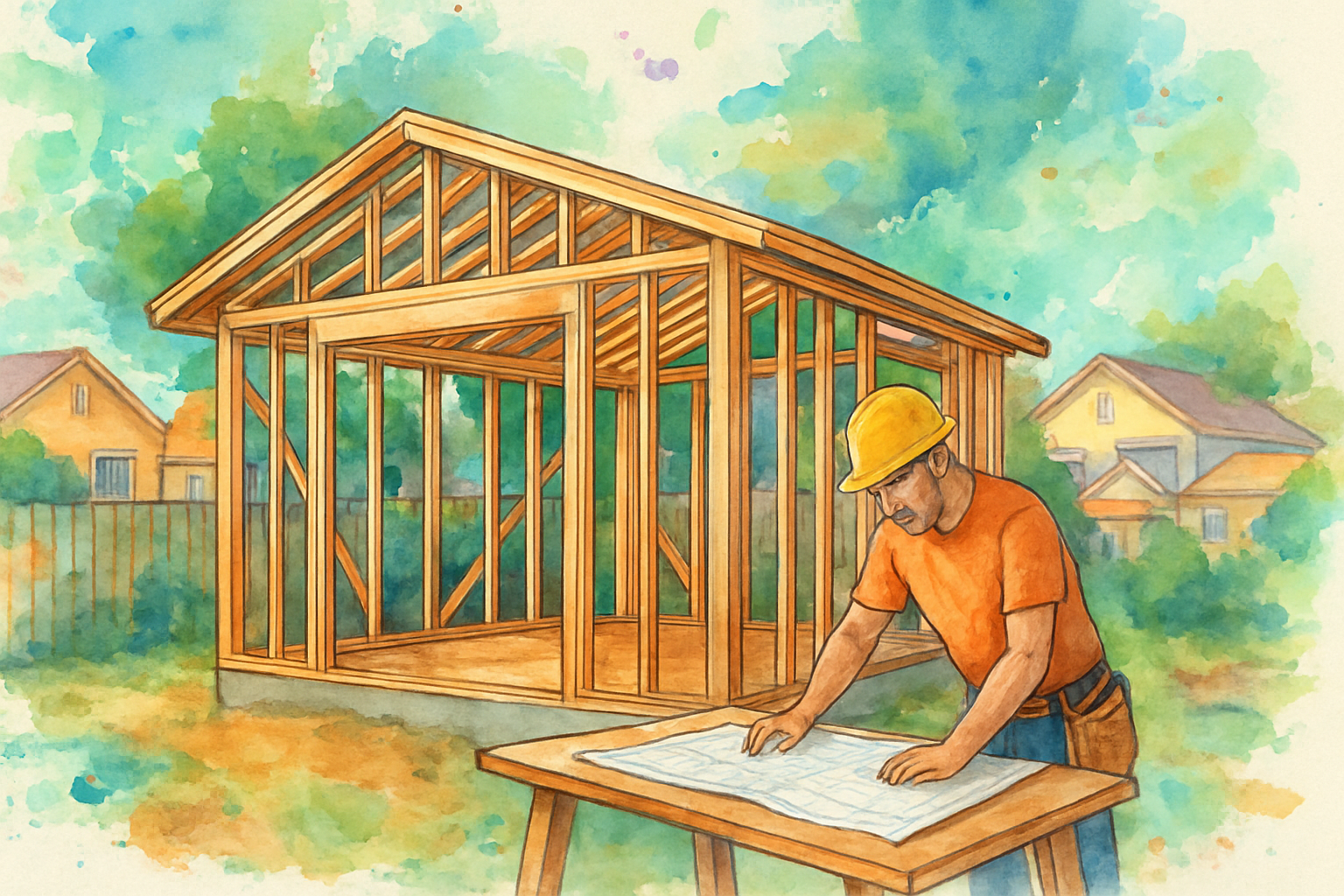
Utility Coordination Is the Schedule — Not the Construction
This is the piece most homeowners never hear before they sign a contract, and it’s the one that causes the most frustration after the fact.
One of our garage conversion clients left a review that said the project took a little longer than expected — but was clear that the delay came from PG&E’s scheduling and availability, not from anything on the construction side. That’s an honest description of what happens on a lot of ADU projects, and it’s worth explaining why.
When an ADU requires a new electrical service, a separate utility meter, or an upgraded panel to handle the added load, the contractor’s crew doesn’t control the timeline for those installations. PG&E does. The same applies to:
- New meter installations — PG&E schedules these on their calendar, not yours
- Service upgrades — if the main house panel needs to be upgraded to support the ADU, that involves both the contractor and the utility
- Sewer lateral extensions — in some jurisdictions, this requires a separate inspection sequence through Monterey County Environmental Health
- Gas service — less common for ADUs but applicable in some configurations
On most ADU builds, the physical construction — framing, roofing, drywall, finish work — is not the critical path. The critical path is utility coordination. A good contractor maps this out before breaking ground and builds the schedule around it.
When you’re navigating ADU construction in Salinas, asking your contractor how they sequence utility work relative to construction milestones is one of the most useful questions you can ask. The answer will tell you a lot about how many ADUs they’ve actually built.
The ADU Critical Path: What Actually Controls Your Timeline
Most homeowners expect construction to drive the schedule. In reality, three external coordination steps often determine when a project finishes.

Coastal ADUs Are a Different Conversation Entirely
A few years back, we worked on an ADU project in the Carmel area — a property that sat within Monterey County’s Coastal Zone. The homeowner had done their research, had a clear picture of what they wanted to build, and had a realistic budget. What they hadn’t accounted for was the additional permitting layer that applies to any development within the Coastal Zone.
In addition to the standard county process — planning review, building permits, Environmental Health if a new septic or sewer connection is involved — Coastal Zone projects require a Coastal Administrative Permit (CAP). That permit goes through Monterey County’s Resource Management Agency and involves its own review timeline, its own submittal requirements, and in some cases, its own conditions.
For homeowners in Carmel, Pacific Grove, the Monterey Peninsula coast, and parts of Seaside and Sand City near the shoreline, this isn’t a minor footnote. It affects:
- Overall permit timeline — plan check windows are longer when a CAP is in the sequence
- Design constraints — coastal development policies may limit height, setbacks, or visibility from public areas
- Budget — additional professional drawings, engineering, and agency fees apply
The good news is that California has been pushing to speed up coastal ADU approvals. Recent changes to coastal ADU permit timelines through AB 462 have reduced some of the friction, but the Coastal Zone still requires more lead time and more careful sequencing than an inland project in Salinas or Gonzales.
If your property is near the coast and you’re not sure whether it falls within the Coastal Zone, that’s the first question to answer — before you spend money on design or drawings.
Coastal vs. Inland ADU Projects: Key Differences in Monterey County
The differences between a Coastal Zone ADU and a standard inland project show up at every stage — permitting, timeline, and budget. Here’s how they compare at a high level.
| Factor | Inland (Salinas, Gonzales, Hollister area) | Coastal Zone (Carmel, Pacific Grove, Peninsula) |
|---|---|---|
| Permit pathway | County Planning + Building | County Planning + Building + Coastal Administrative Permit (CAP) |
| Plan check timeline | Typically 4–10 weeks depending on jurisdiction | Longer — CAP adds review time; vary by project complexity |
| Design constraints | Standard zoning setbacks and height limits | Additional coastal development policies may apply |
| Who reviews | Monterey County or city building dept. | Resource Management Agency (RMA) coastal division involved |
| Budget impact | Standard permit fees and engineering | Additional submittal fees, potential additional conditions |
| Pre-approved plans usable? | Yes, where available | May require modification to meet coastal conditions |
Pre-Approved ADU Plan Sets: A Planning Tool Most Homeowners Skip
Several jurisdictions in our service area offer pre-approved ADU plan sets — designs that have already cleared the architectural review process, which can shorten plan check timelines and reduce design costs. Most homeowners starting an ADU project don’t know this option exists until someone mentions it.
Here’s what pre-approved plans actually do: because the plans have already been reviewed for code compliance by the local agency, the building department can focus their review on site-specific items — foundation conditions, utility connections, setbacks — rather than re-reviewing the full architectural package. That can meaningfully reduce plan check time.
In our service area, jurisdictions that have offered pre-approved ADU plan programs include:
- Santa Cruz County — has offered pre-approved plan sets through their planning department; the submission referenced a Santa Cruz County 1,200 sq ft plan set specifically
- Monterey County — has had pre-approved plans available through the Resource Management Agency for standard ADU configurations
- City of Hollister / San Benito County area — worth checking with the local building department, as availability has expanded statewide under recent ADU legislation
Pre-approved plans are not a fit for every project. If your site has unusual conditions, you want a custom layout, or your property is in the Coastal Zone, a standard plan set may need modification — which can reduce the time savings. But for a homeowner in Salinas or Gonzales with a standard backyard lot who wants a straightforward one- or two-bedroom unit, they’re worth asking about before you commission custom drawings.
A contractor with experience in ADU construction in Salinas and the surrounding county will know which programs are currently active and whether your site is a good candidate. Check with your local planning department for the most current availability, since these programs can change.
Frequently Asked Questions About ADU Projects in Monterey County
How long does it actually take to build an ADU in Monterey County from start to finish?
A realistic range for most detached ADU projects in Monterey County is 12 to 18 months from initial planning through final inspection — and that includes permitting, utility coordination, and construction. Projects in the Coastal Zone often run longer. The single biggest variable outside a contractor’s control is how quickly PG&E can schedule service work and meter installation. That’s not an excuse — it’s just the reality of how utility timelines interact with construction schedules on most ADU builds.
Can I build an ADU if my property is in the Coastal Zone near Carmel or Pacific Grove?
Yes, but the process is more involved. You’ll need a Coastal Administrative Permit in addition to standard county permits, which adds review time and potentially design conditions. Recent legislation has shortened some of those timelines, but coastal projects still require more lead time than inland builds. The first step is confirming whether your parcel actually falls within the Coastal Zone boundary — your contractor or the county’s RMA can help with that.
Why are ADU bids so different from one contractor to the next?
A few reasons. First, not every contractor scopes the same things — one bid might include permit fees, utility coordination, and landscaping restoration while another doesn’t. Second, site conditions vary enormously, and a contractor who hasn’t walked your property is guessing at some line items. Third, experience matters: a contractor who’s built a dozen ADUs in Monterey County has a much tighter handle on what things actually cost locally than one doing their second or third project. Reading an estimate carefully before you sign is worth the time.
Do I need a separate meter for my ADU?
Not always — but it depends on local agency requirements and whether the ADU is intended as a rental. Monterey County and most cities allow ADUs to share utilities with the main dwelling, but a separate meter may be required or preferred if the unit will be rented independently. This is one of the utility coordination questions to resolve early, because the answer affects both your PG&E application and your project budget.
Can I use pre-approved ADU plans to speed up permitting?
In many cases, yes. Several jurisdictions in the area — including Santa Cruz County and Monterey County — have offered pre-approved ADU plan sets that can reduce plan check time. They work best on standard sites with straightforward utility connections. Coastal Zone projects, unusual lot conditions, or custom layouts may still require a full custom drawing set. Ask your local planning department whether a pre-approved program is currently active before paying for custom drawings.
Ready to Talk Through Your ADU Project?
The contractors who give the most accurate estimates are the ones who’ve already solved the problems you haven’t run into yet — permit sequencing, utility scheduling, coastal agency requirements, site conditions that only show up once you’re standing on the property. If you’re planning an ADU anywhere in Monterey County, Santa Cruz County, San Benito County, or south Santa Clara County, Brian Aldridge is available for a free consultation to talk through what your specific project actually involves. Reach the team at 831-682-9788 or through the contact page at aldridgeconstruction.biz.