
Direct Answer: A reliable contractor gives you a detailed estimate, communicates throughout the job, pulls permits without being asked, manages their subs, and stands behind their work after the crew leaves.
If you’ve ever gotten three quotes for the same project and felt more confused afterward than before, you’re not alone. Homeowners across Salinas and Monterey County describe getting bids that swing by tens of thousands of dollars for identical scopes of work. That range doesn’t just represent different pricing strategies, it often signals very different levels of experience, honesty, and process.
This article is specifically about evaluating whether a contractor is trustworthy and competent, not just licensed. We already have a separate post on how to verify a contractor’s license before signing, that’s step one. This goes further, into the behavioral signals that actually predict whether a project will go well.
These five things aren’t hypothetical. They’re what separates the calls we get from happy customers from the calls we get from homeowners who hired someone else and are now dealing with the fallout.
1. How They Handle the Initial Estimate
The estimate isn’t just a number, it’s a window into how a contractor thinks and communicates. A detailed, line-item estimate separates materials from labor, identifies what’s included and what’s not, and notes the conditions that would trigger a change order. A single-number bid tells you almost nothing.
I’ve seen homeowners in Salinas accept a vague low bid, convinced they were saving money, only to watch that number climb once the work started and the contractor started adding charges for things a careful estimate would have flagged upfront. The low number isn’t conservative, it’s incomplete.
When you’re comparing estimates, look for:
- A clear materials breakdown with specific items, not just “kitchen materials”
- Labor costs listed separately from materials
- An explicit list of what is not included in the scope
- A description of what would constitute a change order and how those are priced
If a contractor can’t or won’t show you that level of detail, ask why. A good contractor has nothing to hide in their numbers. For more on reading estimates carefully, how to read a home remodeling estimate walks through the specifics.
2. How They Communicate During the Job, Not Just Before It
Most contractors are responsive before they sign a contract. The real test is what happens once your money is in and the crew is on-site.
Before you sign anything, ask directly: Who is my point of contact during construction? How often will I get updates? What happens if something unexpected comes up mid-project? How a contractor answers those three questions tells you more than their portfolio.
One of the most consistent things customers say about good contractor experiences is that they felt informed the whole way through, not surprised. One reviewer put it plainly: the team “would inform me on any issue along the way and keep to the schedule.” That’s not a given. It’s a standard worth asking for explicitly.
A contractor who goes quiet after demo starts, or who you have to chase for a status update, is already showing you how they’ll handle bigger problems if they arise.
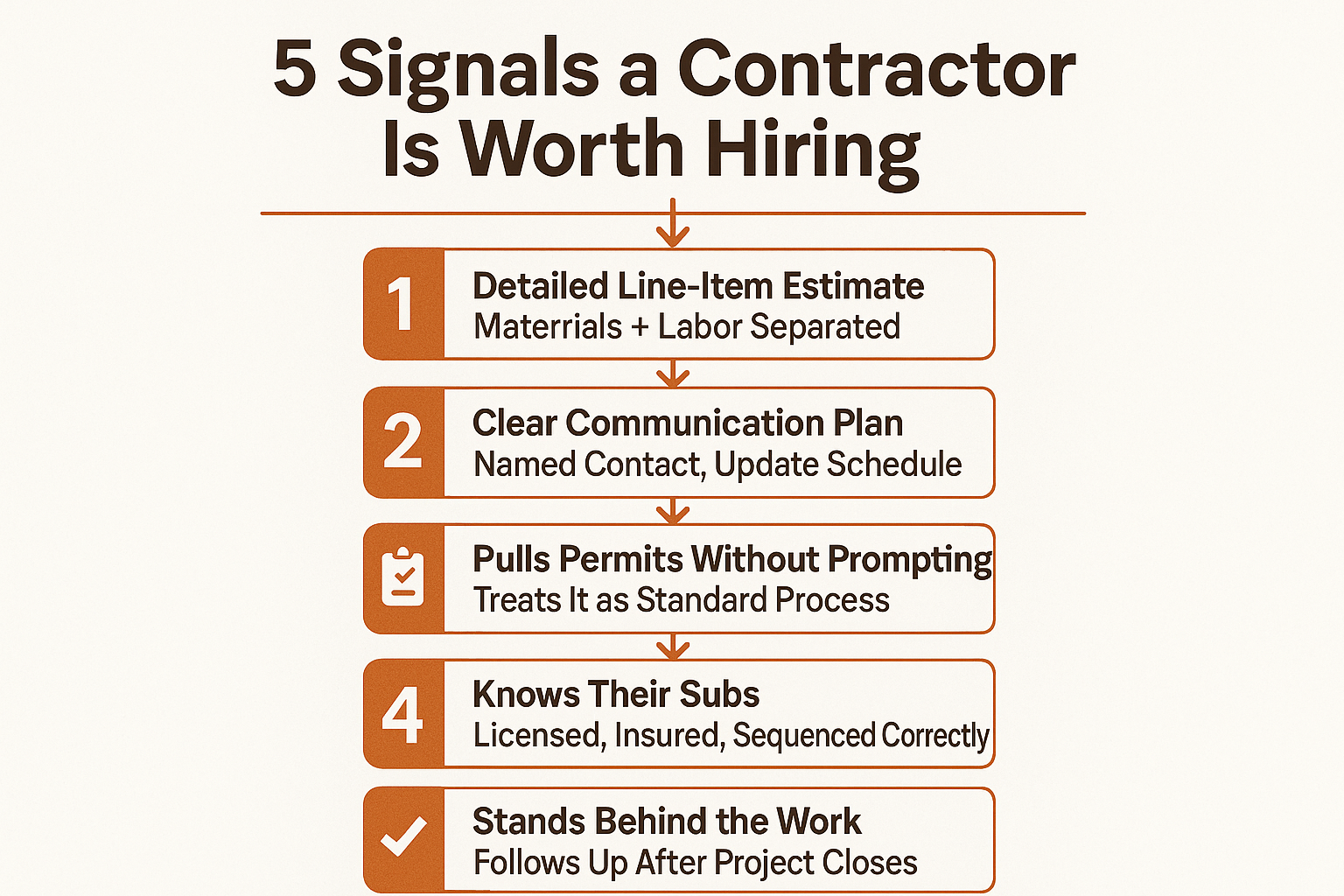
5 Signals a Contractor Is Worth Hiring
This infographic summarizes the five behavioral signals covered in this article, useful for comparing contractors side by side before you sign.

3. Whether They Pull Permits Without You Having to Ask
A contractor who suggests skipping permits to save time or money isn’t doing you a favor. They’re handing you the legal and financial risk.
In Monterey County and the City of Salinas, unpermitted work creates real problems: disclosure obligations when you sell, potential insurance complications if something fails, and personal liability if the work causes injury or property damage. The California Contractors State License Board is direct about this, homeowners who allow unpermitted work can be held responsible for the full cost of corrections.
A contractor who is genuinely experienced with local permit processes treats the permit as a standard part of the job. They know the Salinas Building Division, they understand when Monterey County’s environmental health or coastal zone rules apply, and they’ve done this before. They don’t present the permit as an obstacle, they build it into the timeline from day one.
This is especially true for kitchens, bathrooms, and ADUs, where electrical, plumbing, and structural changes always require permits. If a contractor implies otherwise, that’s your cue to keep looking. Our post on your remodel permit and what changed under the new code covers how 2025-2026 code changes affect permit requirements specifically.
4. How They Manage Subcontractors and Specialty Trades
A general contractor on a kitchen or bathroom project isn’t doing every piece of work themselves. They’re coordinating electricians, plumbers, tile setters, and cabinet installers. A disorganized GC means these trades show up out of sequence, which causes delays, rework, and cost overruns that nobody planned for.
Before signing, ask:
- Who does the specialty work, is it in-house or subcontracted?
- Are those subcontractors licensed and insured in California?
- Who is on-site when they’re working, and does the GC or a foreman supervise?
This matters more than most homeowners realize. A single plumber who shows up before the walls are ready, or an electrician who can’t access the panel because another trade is mid-demo, can add days to a timeline and create friction that ends up in your lap.
We cover this dynamic in detail in what one contractor handling everything actually changes, it’s worth reading if you’re comparing a general contractor to hiring trades separately.
5. What They Do After the Job Is Done
The last signal is the one most homeowners don’t think to ask about until they need it: what happens after the crew leaves?
Every project has a punch list, small items identified at the final walkthrough that need to be addressed before the job is truly complete. A reliable contractor shows up for that walkthrough, documents what’s outstanding, and closes those items without being chased. A risky one considers the job done once the last invoice is paid.
Beyond the punch list, callbacks happen. Tile grout cracks. A cabinet door needs adjustment. Something wasn’t quite right that didn’t show up until you lived with it for two weeks. A contractor who stands behind their work takes those calls seriously and responds promptly. That responsiveness, or the lack of it, is often what homeowners remember most.
Ask a prospective contractor directly: how do you handle callbacks? Do you have a warranty on your work? Get the answer in writing.
Quick Reference: Reliable vs. Risky Contractor Behaviors
Use this as a side-by-side reference when you’re evaluating bids or interviewing contractors before a kitchen, bathroom, ADU, or home addition project.
| Signal | Reliable Contractor | Risky Contractor |
|---|---|---|
| Estimate format | Line-item detail, materials and labor separated, change order triggers noted | Single number, vague scope, nothing in writing |
| Communication during the job | Named contact, scheduled updates, clear protocol for surprises | Responsive before signing, hard to reach after |
| Permits | Pulls them as standard practice, knows local agencies | Suggests skipping them to save time or money |
| Subcontractor management | Knows who’s doing what, verifies licenses and insurance, supervises on-site | Vague about who shows up and when |
| Post-project follow-up | Completes punch list, responds to callbacks, warranty documented | Considers the job done at final invoice |
Frequently Asked Questions About Hiring a Contractor in Salinas
Is a low bid always a red flag?
Not automatically, but it warrants scrutiny. Ask what’s included and what isn’t. A low bid that excludes permit fees, demolition, or certain materials looks cheap on paper but won’t stay that way. The number matters less than what’s behind it.
How do I know if a contractor’s subcontractors are actually licensed?
You can check any California contractor’s license through the CSLB license lookup tool at cslb.ca.gov. Ask for the name and license number of any subcontractor doing electrical, plumbing, or specialty trade work on your project, a trustworthy GC will have that information ready.
What permits are typically required for a kitchen or bathroom remodel in Salinas?
Any work touching electrical panels, plumbing lines, or structural walls generally requires a building permit in Salinas and throughout Monterey County. Cosmetic updates, like painting or replacing fixtures without moving plumbing, often don’t. Permit requirements vary by scope and jurisdiction, so verify with the City of Salinas Building Division or your contractor for your specific project. Our post on bathroom remodel scope creep explains how small jobs sometimes cross into permit territory without homeowners expecting it.
How do I know if a contractor will actually follow through after the job is done?
Ask for references from completed projects, specifically from homeowners who had a callback or a punch-list item after the fact. How a contractor handled that situation tells you more than a five-star review about the finished product. Also ask directly: do you offer a written warranty on your work, and what does it cover?
What’s the difference between this article and the one about verifying a contractor’s license?
License verification is a baseline check, it tells you the contractor is legally allowed to operate. This article is about what happens beyond that: whether the contractor is organized, honest, communicative, and accountable throughout the project and after it. Both matter, and one doesn’t replace the other.
Want to Talk Through a Project With Someone Who’s Done This Before?
If you’re in Salinas, Seaside, Monterey, or anywhere else in Monterey County and you’re trying to make sense of competing bids or figure out whether a contractor is the right fit, Brian Aldridge is available for a straightforward conversation, no pressure, no pitch. You can reach the team directly at 831-682-9788 or through the contact page at aldridgeconstruction.biz.