
Direct Answer: As of January 1, 2026, AB 1154 removes the owner-occupancy requirement for a JADU that has its own private bathroom. If the JADU shares a bathroom, the owner must still live on-site.
Most homeowners I talk to in Monterey County already know what a JADU is. It is the small unit carved out of the walls of an existing single-family home, usually a converted bedroom, capped around 500 square feet, with its own entrance and a small kitchen.
What a lot of people do not know is that the rules changed this year. AB 1154 took effect January 1, 2026, and it rewrote the owner-occupancy math that used to make JADUs a poor fit for rental income.
The short version is that one design decision, whether the unit gets its own bathroom, now determines whether you can rent out your whole property and live somewhere else. I want to walk through what that actually means before you decide what to build.
What AB 1154 actually changed about JADU owner occupancy in California
Under the old rules, creating a JADU came with a string attached. The property owner had to live on-site, either in the main house or in the junior unit itself. That killed the idea for anyone who wanted to move away and rent both spaces.
AB 1154 made that requirement conditional instead of automatic. Here is how it breaks down:
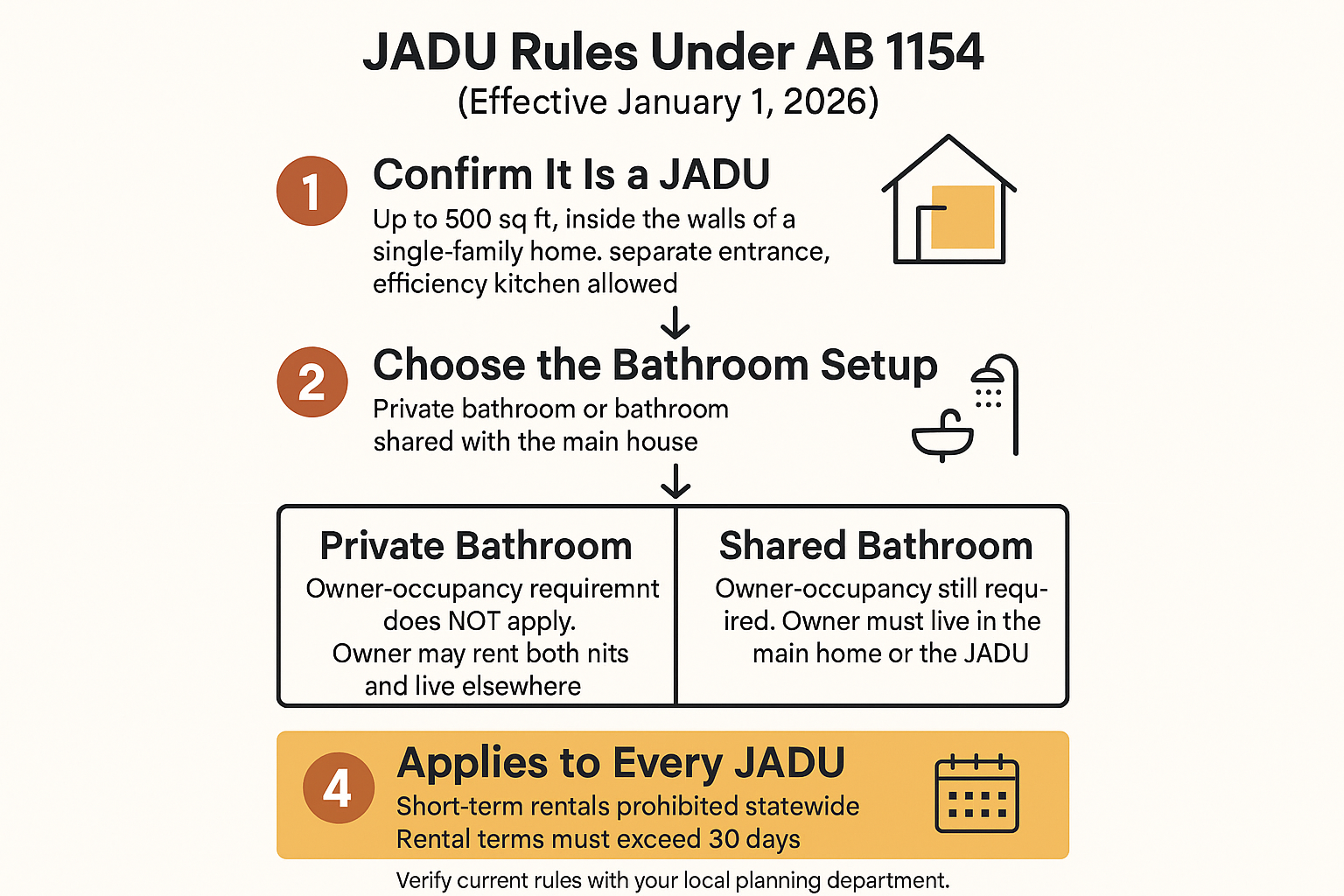
- JADU with its own private bathroom: the owner-occupancy requirement no longer applies. You can rent both the primary home and the JADU while living elsewhere.
- JADU that shares a bathroom with the main house: owner-occupancy is still required, same as before.
- Everything else about JADUs stays put: the size cap, the efficiency kitchen allowance, and the requirement that the unit sit within the walls of a single-family home.
The state’s Accessory Dwelling Unit resources from the California Department of Housing and Community Development are worth bookmarking, since HCD updates its handbook as new laws take effect.
One caution I give every homeowner: cities and counties can layer their own rules on top of state law. Verify current requirements with your local building or planning department before you finalize plans, whether that is Salinas, Monterey County, or the City of Santa Cruz.
Why the bathroom is now a financial decision, not a design preference
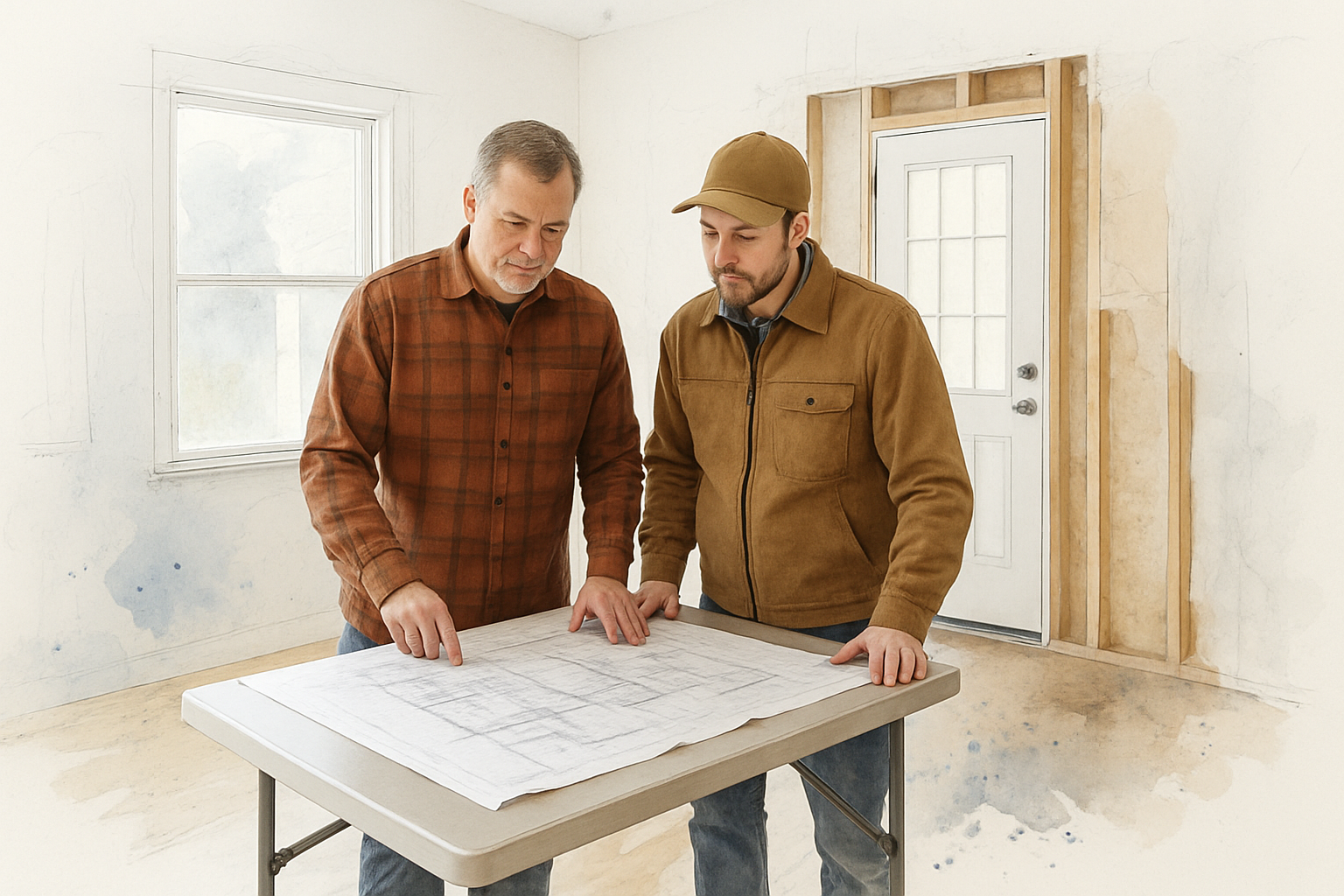
I had a form come in from a Carmel Valley homeowner that lines up almost perfectly with this change. They had a space attached to the house that a previous owner built without a permit, and they wanted to legalize it so they could rent it out.
Under the old rules, that plan got complicated fast. Legalizing the space as a JADU would have locked the owner into living on the property.
Under AB 1154, the math is different. If that legalized space gets its own private bath, the owner can rent the unit and the main house without living on-site.
So when I sit down with a homeowner now, the bathroom question is not about tile or fixtures. It is about what you want the property to do for you in five or ten years:
- Planning to move and rent both units? The private bathroom is not optional.
- Planning to stay and house a family member? A shared bath can work and usually costs less.
- Not sure yet? Build the private bath. Reversing that decision later means opening walls and pulling a new permit.
Adding a bathroom means new drain lines, venting, waterproofing, and an electrical load review. Costs vary a lot by house age and where the existing plumbing runs, so treat any number you see online as a starting point and get a scoped estimate on your actual property.
The AB 1154 Decision, Start to Finish
This is the sequence I walk homeowners through when they are weighing a junior unit against a standard ADU in 2026.
The short-term rental ban applies to every JADU, no exceptions
There is a second half to AB 1154 that catches people off guard, especially here on the coast. The law adds a statewide prohibition on short-term rentals for all JADUs.
It does not matter whether the unit has a private bath. It does not matter whether you live on-site. JADUs must be rented for terms longer than 30 days.
I bring this up because Monterey County gets a steady stream of homeowners who assume a junior unit could work as a vacation rental. Between Carmel, Pacific Grove, and the Highway 68 corridor, that assumption is common and it is now wrong at the state level.
What a JADU with a private bath can do:
- Generate long-term rental income with no owner-occupancy requirement
- House a tenant on a standard lease of a month or longer
- Let you keep the property as an income asset after you move
What it cannot do is get listed on a short-term rental platform. And local ordinances in places like Salinas, Seaside, and Carmel Valley may add restrictions on top of the state rule, so check with your local planning department before you build a business case around any rental number.
JADU vs. Standard ADU Under 2026 Rules
Standard ADUs lost their owner-occupancy requirement a year earlier, under AB 976 effective January 1, 2025. Here is how the two unit types compare now.
| Rule | JADU (2026) | Standard ADU (2026) |
|---|---|---|
| Maximum size | Around 500 sq ft | Up to about 1,200 sq ft depending on type and lot |
| Where it can go | Within the walls of a single-family home | Detached, attached, or a garage conversion |
| Owner occupancy | Not required if the unit has a private bathroom; still required if the bathroom is shared | Not required (removed under AB 976, effective Jan 1, 2025) |
| Kitchen | Efficiency kitchen allowed | Full kitchen typically required |
| Short-term rental | Prohibited statewide; terms must exceed 30 days | Local ordinances govern; many jurisdictions restrict it |
| Typical build scope | Interior conversion with a new entrance and often a new bath | New construction or full conversion with separate utilities |
What this means if you are still deciding between the two
For a Salinas homeowner, both unit types now offer real rental flexibility. The difference is that a JADU carries a bathroom-based condition that a standard ADU simply does not have.
I usually frame the choice this way:
- A JADU is the lower-cost path when you already have a bedroom with an exterior wall and plumbing nearby. Less new construction, fewer utility headaches.
- A standard ADU gives you more square footage and fewer strings, including no short-term rental ban at the state level, but it costs considerably more to build.
- Both require permits, and permit timelines have their own moving parts. Our post on the ADU permit clock under SB 543 covers how the review windows work now.
If you are still weighing the basics of size and layout, our earlier breakdown of JADUs versus standard ADUs walks through the structural side of the decision.
And if your property sits in the Coastal Zone, that adds its own review layer. We covered that in the coastal ADU guidance for Monterey and Santa Cruz post.
Rules also shift by jurisdiction. Hollister handles ADU review differently than Salinas does, which we outlined in our San Benito County ADU rules piece. Gonzales, Marina, and Gilroy each have their own local ordinance language worth reading before you commit to plans.
Frequently Asked Questions About JADU Owner Occupancy in California
If I already have a JADU with a shared bathroom, can I add a private bath later and stop living on-site?
In most cases yes, but it is a permitted job, not a weekend project. You are adding drain and vent lines, waterproofing, and often an electrical change, and the finished unit has to be inspected. Talk to your local building department first, because they will tell you exactly what documentation they want to see before they consider the occupancy condition satisfied.
Does AB 1154 change anything for standard ADUs?
No. Standard ADUs already had their owner-occupancy requirement removed under AB 976, effective January 1, 2025. AB 1154 extends similar flexibility to junior units, but only when the JADU has its own private bathroom.
Can I rent my JADU on a short-term platform if I live on the property?
No. The statewide short-term rental prohibition applies to every JADU, regardless of bathroom setup or whether the owner lives on-site. Rental terms have to run longer than 30 days.
What if the space I want to convert was built without a permit?
That comes up more often than people expect, especially with homes that changed hands a few times. Legalizing unpermitted space usually means opening up sections of wall so an inspector can verify framing, electrical, and plumbing. It is doable, but the scope depends entirely on what the previous work looks like behind the drywall.
How long does a JADU conversion usually take?
The construction itself is often shorter than a detached ADU because you are working inside existing walls. Permitting and utility coordination are what stretch the calendar. One Monterey County homeowner told us their project ran past the estimate purely because of PG&E scheduling, which is a common reality here and worth building into your timeline.
Thinking through a junior unit on your property?
If you are weighing a JADU against a standard ADU somewhere in Monterey County, the bathroom question is worth settling early, before plans get drawn. Our team works on projects across Salinas, Seaside, Carmel, Santa Cruz County, and south county, and we are glad to walk a property and talk through what the 2026 rules mean for your specific lot. You can reach us at 831-682-9788 or through the contact page at aldridgeconstruction.biz whenever you are ready to have that conversation.