
Direct Answer: SB 543 gives California cities and counties 15 business days to decide if an ADU application is complete. Miss that deadline, and the application is deemed complete automatically.
The single most common worry I hear from homeowners planning a backyard unit is not cost. It is time. People have heard the stories about an ADU application sitting at a counter for months with no answer and no explanation.
That frustration was real, and it had a cause. Before 2026, a local agency could call an application “incomplete” with no hard deadline attached to that decision.
SB 543 took effect January 1, 2026, and it puts a clock on that step. Below I break down what actually changed, what did not, and how it plays out for a project in Salinas, Seaside, Gonzales, or anywhere else in Monterey County.
The 15 business day completeness clock is the real change
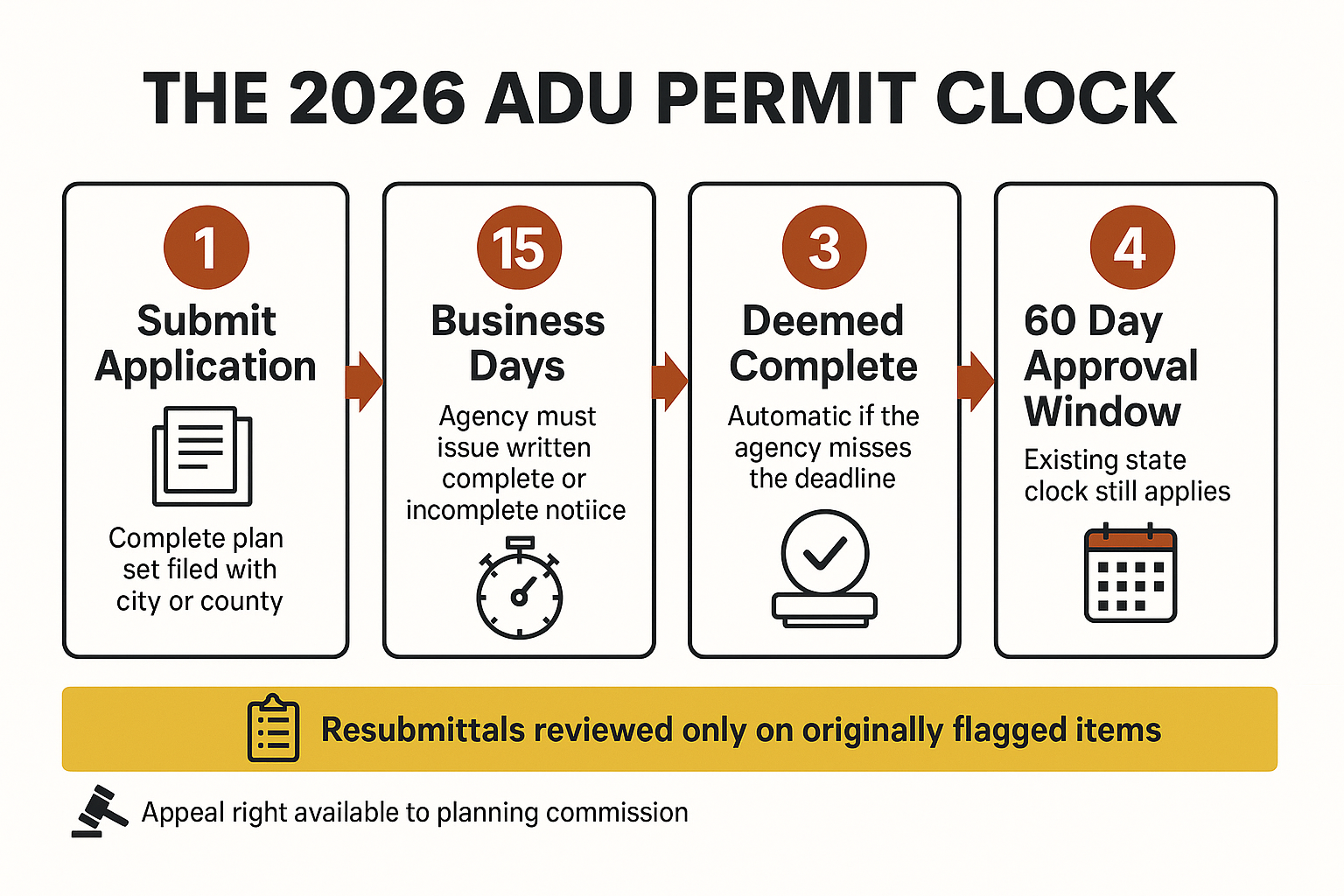
Here is the part that matters most. Once you submit an ADU application, the local agency now has 15 business days to decide whether your package is complete and to send you written notice either way.
If they miss that window, the application is deemed complete by operation of law. Nobody has to sign off on it for that to happen. The clock runs out and the file moves forward.
That is a meaningful shift, because the completeness review used to be the black hole of the process. I have watched projects lose six to ten weeks there, not building anything, just waiting for someone to say yes or no.
A few things worth understanding about how this works in practice:
- Business days, not calendar days. County holidays and weekends do not count against the agency.
- The clock starts at submittal, so an incomplete package still burns your own calendar before it is ever filed.
- Written notice is required, which gives you a dated paper trail instead of a phone call you cannot prove happened.
- Local implementation varies, so verify current procedure with your city or county building department before you plan around it.
The California Department of Housing and Community Development publishes updated ADU guidance for homeowners and agencies, and it is worth a read if you like knowing the rules yourself. You can find it through HCD’s accessory dwelling unit resources.

The resubmission rule ends the moving target problem
The second change is smaller in the text and bigger in real life. When an agency does flag your application as incomplete, SB 543 requires a specific written list of what is missing and how to fix it.
Then comes the important part. On resubmission, the agency can only review the items it originally flagged. It cannot introduce brand new objections after the fact.
Anyone who has been through a multi-round correction cycle knows why that matters. The old pattern went like this:
- Round one flags three items, you correct them.
- Round two flags four different items nobody mentioned before.
- Round three flags a detail on a sheet that was never questioned.
- Four months are gone and no permit has been issued.
That pattern is now off the table for ADU applications. It also changes how we prepare a submittal on our end, because a clean, code-ready package is worth more than it used to be.
I will be straight with you about the flip side. If a package goes in thin, missing structural details, missing Title 24 documentation, missing septic or utility information, it will still cycle through corrections. The new rule adds accountability on both sides of the counter, not just the agency’s.
Before and after SB 543, side by side
This is the practical difference for a Monterey County homeowner filing an ADU application.
| Stage | Before January 1, 2026 | Starting January 1, 2026 |
|---|---|---|
| Completeness review | No fixed deadline for the agency to respond | 15 business days, written notice required |
| Missed deadline | Application simply waits | Application deemed complete automatically |
| Incomplete notice | Could be general or vague | Must list specific items and how to correct them |
| Resubmittal review | New objections could be added each round | Review limited to originally flagged items |
| Disputing a decision | No formal statutory path | Right to appeal to the planning commission or governing body |
| Approval clock once complete | 60 days under prior law | Still 60 days, unchanged |
How the ADU permit clock runs now
Here is the sequence from submittal to approval under the 2026 rules.
The 800 square foot rule now measures interior space only
This one flies under the radar, and it changes real design decisions. SB 543 clarifies that the 800 square foot size limit for state-exempt detached ADUs is measured by interior livable space only.
Exterior walls and stair structures are excluded from that calculation. Some local departments had been counting the total footprint, which quietly shrank the usable room inside.
In plain terms, a unit designed around 800 square feet of interior space can now carry a bit more building mass than some local interpretations allowed. On a tight lot, that difference is the gap between a workable layout and a compromise.
Where this shows up most in our work:
- Narrow Salinas and Seaside lots where setbacks already squeeze the buildable area
- Two story designs where stair structure used to eat into the countable square footage
- Thicker wall assemblies for insulation and sound performance, which no longer cost you interior room
If you are still deciding how big to build, size drives cost more than almost any other single choice. Our guide on sizing an ADU as a Salinas homeowner walks through the tradeoffs, and what an ADU actually costs in Monterey County in 2026 covers the money side. Costs vary a lot by site, but many Monterey County projects land in a broad range that a real site visit narrows fast. We have had homeowners ask if a full ADU can be done for around $40,000, and the honest answer is that a permitted, code-compliant unit on the Central Coast sits well above that.
You now have an appeal right, and when it is worth using
SB 543 also gives ADU applicants a formal right to appeal an incompleteness determination to the local planning commission or governing body. That right did not exist in statute before.
I want to be careful here. Filing an appeal is not a normal step, and I would not want a homeowner to read this and go looking for a fight with their building department.
An appeal makes sense in a narrow set of situations:
- The incomplete notice lists items that are not actually required by code or local ordinance
- The agency adds new objections on a resubmittal that were never flagged the first time
- The notice is vague enough that you cannot tell what to correct
Most of the time, a phone call with the plan checker solves it faster than a hearing. But the existence of an appeal path changes the tone of the conversation, and that alone is useful.
One more honest note about timelines. Permits are only one clock. A homeowner who hired us for a garage conversion put it plainly in a review: the project took a little longer than expected, and it was due to PG&E’s scheduling and availability. Utility coordination, environmental health signoff, and inspection scheduling all run on their own calendars, and SB 543 does not touch any of them.
Frequently Asked Questions About the SB 543 ADU Permit Timeline
Does SB 543 mean my ADU gets approved in 15 days?
No. The 15 business day clock only covers whether your application is complete, not whether it is approved. Once it is deemed complete, the existing 60 day state approval window starts. SB 543 shortens the uncertain waiting period at the front, it does not shorten the review itself.
What happens if my city misses the 15 day deadline?
The application is deemed complete by operation of law. You do not need approval from the agency for that to take effect, though you should keep your submittal receipt and any written correspondence to document the date.
Does this apply to garage conversions too?
Garage conversion ADUs go through the same permit process, so the completeness clock applies. The design questions are different though. Whether a conversion or a detached unit fits your property depends on lot size, existing structure condition, and parking. We covered that comparison separately.
I am in the Coastal Zone. Do the same rules apply?
Coastal Zone properties in Monterey County carry an extra layer, since a coastal development permit can be part of the sequence. State ADU timelines still apply to the ADU application itself, but coastal review has its own path. Verify current requirements with the county, because these details change.
Should I wait for my jurisdiction to post pre-approved ADU plans?
As of January 2026, jurisdictions are required to maintain pre-approved ADU plans online. They can save design time and cost, but they do not fit every lot. If your site has slope, setback pressure, or septic constraints, a custom plan often moves faster than trying to force a standard one to fit.
Thinking through an ADU on your Monterey County property?
The new completeness clock rewards a submittal that is right the first time, which starts with an honest look at your lot, your utilities, and your budget. If you want to talk through what that would look like on your property in Salinas, Seaside, Gonzales, or anywhere across Monterey County, the team is reachable at 831-682-9788 or through the contact page at aldridgeconstruction.biz. No pressure either way, and questions are free.