
Direct Answer: Most coastal bathroom moisture problems are not cleaning problems. They are air movement problems, and the failure is usually a crushed, uninsulated, or wrongly terminated exhaust duct rather than the fan itself.
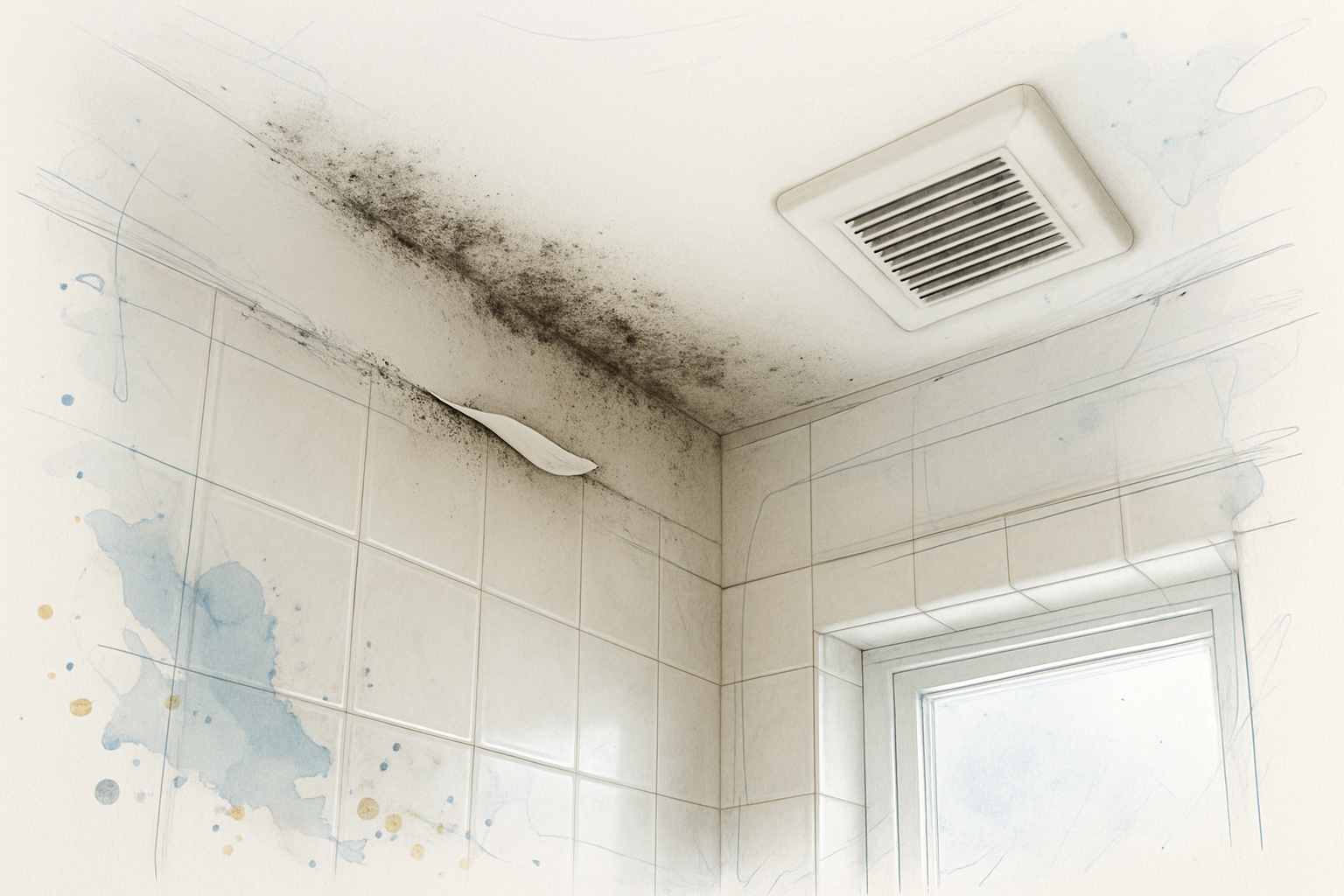
You scrub the black speckling off the ceiling above the shower. Six weeks later it is back, in the same corner, in the same shape.
Maybe the paint is peeling off the wall in sheets instead of flaking. Maybe the mirror is still fogged twenty minutes after anybody showered, or the drywall near the tub feels soft when you press a thumb into it.
I get called about this constantly in Monterey County, and almost every homeowner describes it as a mold problem. It is usually an air movement problem, and in coastal homes the fix is rarely the one people expect.
Why Coastal Bathrooms Behave Differently Than Inland Ones
A shower puts the same amount of water into the air whether the house sits in Pacific Grove or in Gonzales. What changes is how fast that moisture leaves.
Fog belt communities sit in high outdoor humidity for a large chunk of the year. In Pacific Grove, Monterey, Seaside, Marina, and along the Santa Cruz coast, the outside air is often already close to saturated, so the moisture you push out of a bathroom has fewer chances to dry out of the structure.
An inland home in Salinas, Gonzales, or Hollister usually gets a real drying window between weather systems. Coastal homes often do not, especially from late fall through spring.
That changes the math in a few ways:
- Surfaces stay cooler, so warm shower air condenses on them faster and for longer
- Wall cavities dry slower, which gives mold time to establish instead of just dying back
- A marginal fan that works fine inland fails here, because it never gets help from dry outside air
- Closed-up winter houses recirculate the same damp air for weeks at a time
So when someone tells me their bathroom has had the same stain for three winters running, I am not thinking about bleach. I am thinking about where that air is actually going.
What California Code Actually Asks of a Bathroom
Most homeowners have never been told any of this, so here it is in plain language.
Mechanical exhaust ventilation is required in a bathroom that has a bathtub, a shower, or a tub and shower combination. That requirement applies whether or not the room has a window that opens. The old idea that a window counts as ventilation has not been true for a long time.
The exhaust also has to terminate directly to the outside. Not into the attic. Not into a soffit cavity. Outside.
Under the state energy standards, the fan and the lighting need to be on separate controls, so the fan is not forced to run only when the light is on.
For capacity, the numbers typically cited for residential bathrooms are around 50 CFM for intermittent operation or roughly 20 CFM running continuously. A city building department handout on 2025 code bathroom remodel requirements lays these same points out clearly if you want to read it yourself.
When the work is permitted, an inspector will look at all of this. And requirements and local amendments vary by jurisdiction, so confirm current rules with your city or county building department before you plan around anything you read online, including this.
The Duct Is the Problem, Not the Fan
This is the part almost nobody writes about, and it is where the repeat failures come from.
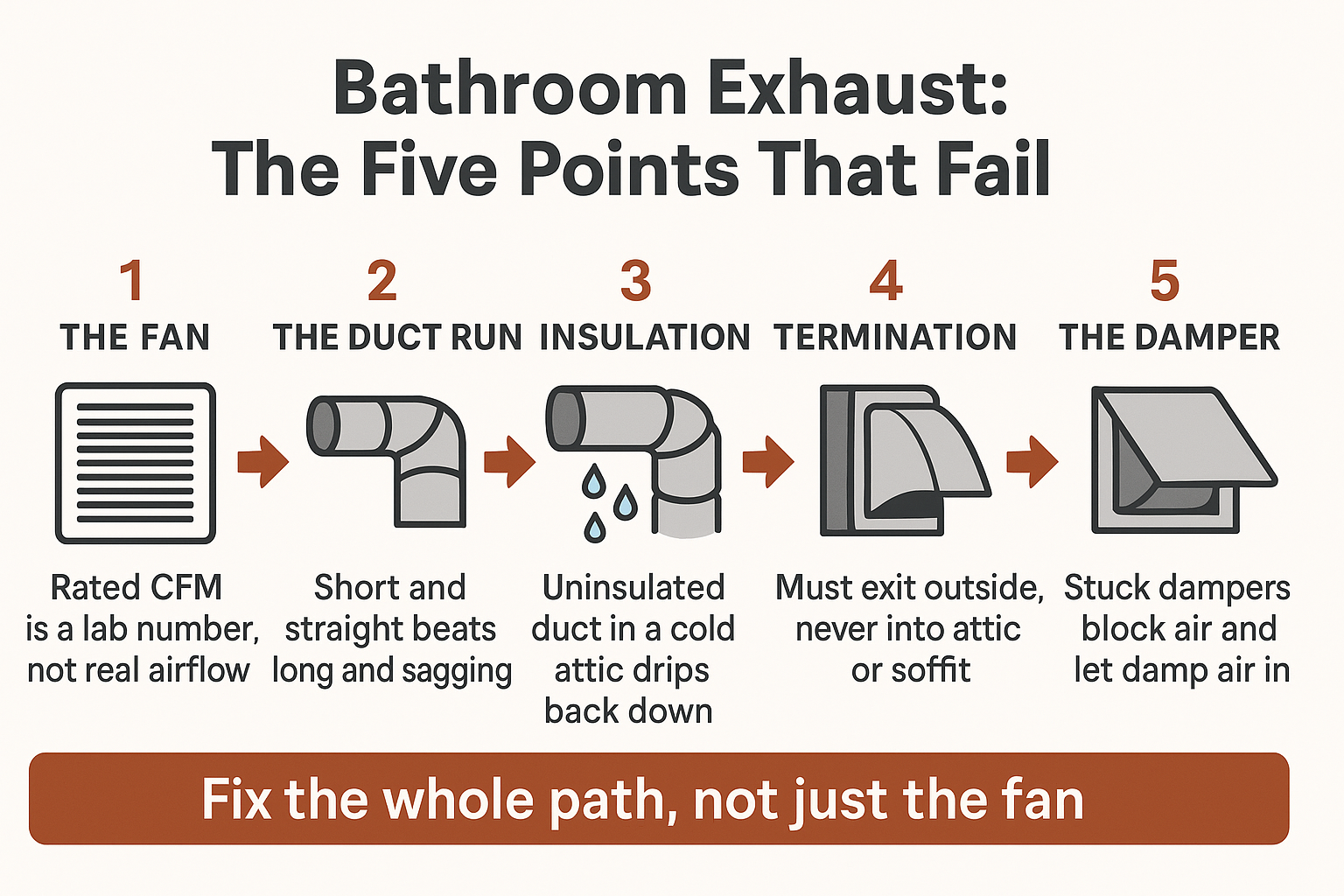
A fan rated at 80 CFM is rated on a test bench with almost no resistance. Run that same fan through fifteen feet of flexible duct with two tight bends and a sag in the middle, and it might move a fraction of that. The label on the box tells you nothing about what is happening in your house.
Here is what I find in older Central Coast bathrooms, over and over:
- Flex duct crushed where it passes a rafter or got stepped on by someone running cable
- A long sagging belly in the duct that collects water and partially blocks airflow
- No exterior termination at all, with the fan dumping straight into the attic, a soffit, or a crawl space
- A wall or roof cap with a stuck backdraft damper, painted shut or gummed with lint
- Uninsulated duct crossing a cold attic, which is its own special problem
That last one causes the call I get most often in winter. On a foggy night, warm wet shower air hits the inside of a cold uninsulated duct and condenses. That water runs back downhill into the fan housing and shows up as a brown ceiling stain that looks exactly like a roof leak.
Homeowners climb on the roof, find nothing wrong, and then buy a bigger fan. Three months later the mold is back, because the new fan is pushing more wet air into the same bad duct.
What a Working Bathroom Exhaust Path Looks Like
This is the sequence I walk through on a site visit when a homeowner describes recurring mold or ceiling stains.
This Winter Is a Bad One to Guess On
NOAA’s Climate Prediction Center has put roughly an 81 percent chance on a very strong El Nino developing across October through December 2026, with high confidence the pattern holds into early spring 2027.
Forecasters are careful about what that means, and so am I. A strong El Nino raises the odds of an unusually wet stretch. It does not guarantee any particular storm or any particular rainfall total.
What it does mean for your bathroom is simple. Wet months are months when the house stays closed up, windows stay shut, and interior humidity has nowhere to go. A marginal fan that limps through August will not keep up in February.
If you are already thinking about the season, our Salinas-area El Nino winter prep guide covers the exterior side of the same problem.
Reading the Stain: Where the Water Is Coming From
Before anyone opens a wall, the pattern of the damage usually tells you which of three problems you have.
| What you see | Most likely source | What that means for the fix |
|---|---|---|
| Speckling high on walls and ceiling, across the whole room, worse right after showers | Ventilation | Air is not leaving the room fast enough. Check the full duct path, not just the fan. |
| Brown ring or stain directly around the fan housing, worse on cold damp nights | Condensation inside the duct | Duct is uninsulated or sloped wrong. Looks like a roof leak but is not. |
| Stain that grows during rain and dries between storms | Exterior envelope | Points to flashing, siding, or a window. Ventilation work will not touch it. |
| Soft drywall or bubbling low on a wall next to the shower pan | Water past the tile assembly | Water is getting behind the tile. This is a waterproofing failure, not an air problem. |
| Mirror still fogged 20+ minutes after a shower | Undersized or blocked exhaust | Classic airflow restriction. Measure actual airflow, not the rating on the fan. |
Why This Gets Decided During a Remodel, Not After
Every January I watch the same thing happen. Regional search interest for bathroom remodeling in the Monterey and Salinas market jumps from a few hundred searches in December to several thousand in January, because families spent the holidays staring at a guest bathroom full of relatives.
That timing matters, because ventilation is close to free to solve while the ceiling and walls are already open. With framing exposed, I can place the fan where the moisture actually is, run rigid duct instead of flex, keep the run short, insulate it, and pick an exterior termination that makes sense for the roof and the wall.
After the tile is set and the drywall is finished, the same work means reopening finished surfaces. Same fix, much bigger bill.
One homeowner who reached out recently described a bathroom that “currently has a small shower, toilet and vanity” and also wanted cabinets added in the adjacent washroom area. That is an extremely common Central Coast setup, and it is a ventilation trap. A tight bathroom and a laundry space sharing damp air and one undersized fan will stay damp no matter how nice the new cabinets are.
On cost, I am not going to throw a number at you, because the drivers vary wildly house to house:
- Distance from the fan to an exterior wall or roof
- Whether there is usable attic access above the bathroom
- How much of the run can be rigid duct instead of flex
- Whether the circuit and switching need updating for separate controls
- Whether the work triggers other code items under the current permit cycle
If you want the bigger picture on what moves the budget, we broke it down in what actually drives bathroom remodel cost and in how the new code affects remodel permits.
Why Nobody Owns This Problem on a Split-Trade Job
Here is the structural reason bathrooms keep failing. The electrician wires the fan. Somebody else runs the duct. The tile setter closes the ceiling. Nobody is responsible for whether the air actually gets outside.
We coordinate those trades under one contract, with Brian Aldridge on the project himself, license 1081584. Bathroom work is one of the highest volume jobs our crew runs, including tub to shower conversions and aging in place changes, so this is a failure mode we look for before anything gets closed up.
One homeowner put it this way after two bathrooms: “The work performed was meticulous, and all aspects of the job were outstanding.” (Fred G.)
If the water is coming from behind the tile rather than from the air, that is a different repair, and why tile jobs fail and what waterproofing involves walks through it.
Frequently Asked Questions About Bathroom Ventilation and Moisture
My bathroom has a window. Do I still need a fan?
Yes. Mechanical exhaust is required in a bathroom with a tub or shower regardless of whether there is an operable window. And on the coast, opening a window in February often brings in air almost as damp as what you are trying to remove.
Will a bigger fan fix my recurring mold?
Usually not on its own. If the duct is crushed, sagging, uninsulated, or dumping into the attic, a stronger fan just pushes more wet air into the same bad path. Fix the whole run or you will be scrubbing the same ceiling next winter.
How do I know if the stain is a roof leak or condensation?
Watch when it grows. A stain that darkens during and after rain points to the roof, flashing, or a window. A stain centered on the fan housing that appears on cold foggy nights with no rain is almost always condensation draining back down the duct.
Does replacing a bathroom fan require a permit?
It depends on the scope and the jurisdiction. A straight like-for-like swap is treated differently than new ducting, a new exterior penetration, or electrical changes. Requirements vary by city and county, so check with your local building department before you start.
Can we stay in the house while this gets handled?
For most bathroom projects, yes. The exception is a single-bathroom home, which needs real planning around the days the room is out of service.
Thinking Through a Damp Bathroom in Monterey County?
If you have a bathroom that never seems to dry out, the useful first step is figuring out which of the three problems you actually have before anyone quotes a fix. Our team works across Monterey, Santa Cruz, San Benito, and Santa Clara Counties and is available for consultations and estimates at 831-682-9788 or through the contact page at aldridgeconstruction.biz.