
Direct Answer: Starting January 1, 2027, AB 956 requires local agencies to ministerially approve up to two detached, new construction ADUs on a lot with an existing or proposed single family home.
A homeowner wrote to me this summer saying her two bedroom, one bath house had gotten too small for her life. A neighbor had an ADU dropped in next door, and she figured she could probably do the same. Her real question was simpler than the project: how much am I even allowed to build?
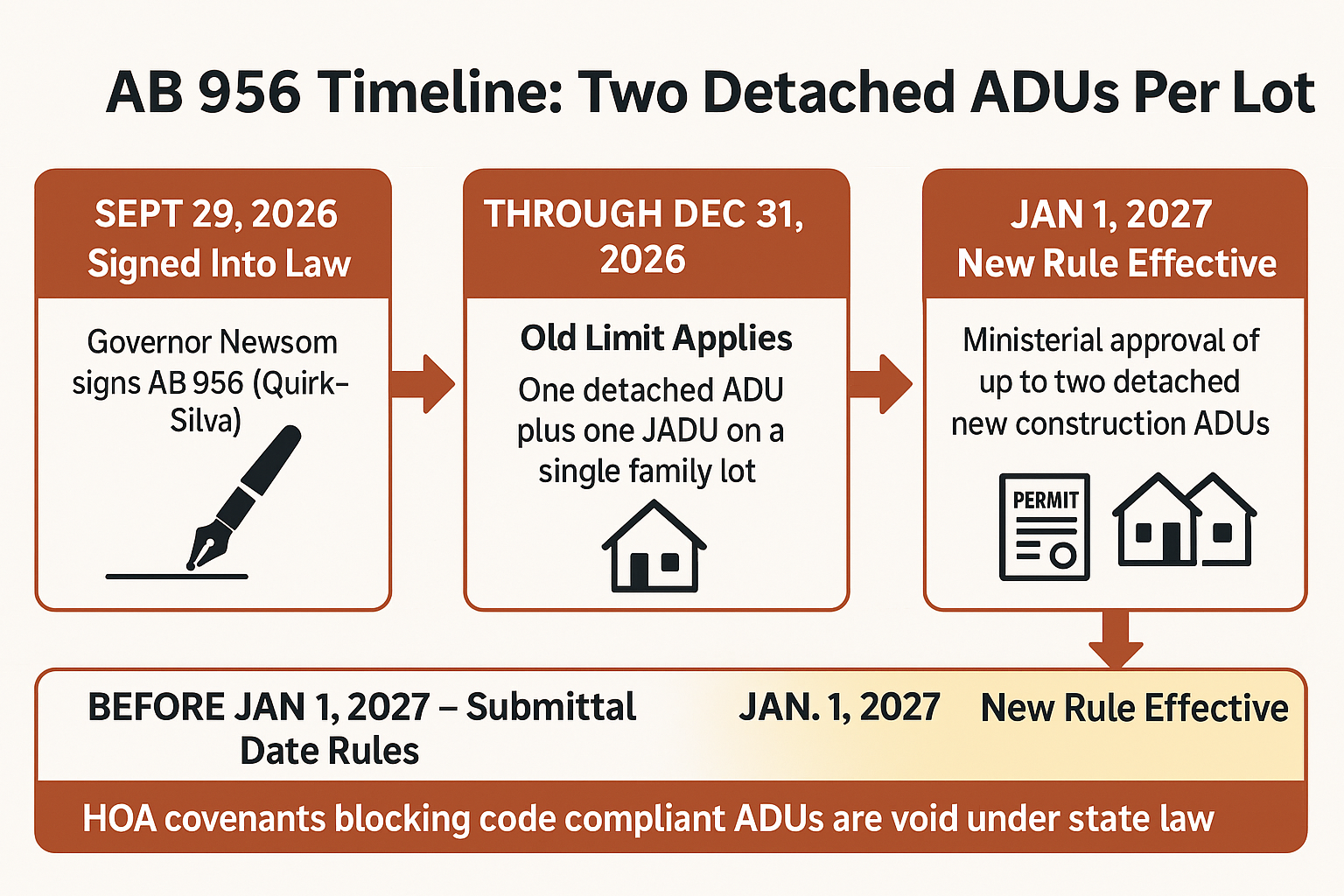
That answer changes on January 1, 2027. Governor Newsom signed AB 956 (Quirk-Silva) on September 29, 2026, and it requires local agencies to ministerially approve up to two detached, new construction ADUs on a lot with an existing or proposed single family home.
For a homeowner in Salinas, Hollister, or Prunedale sitting on a deep lot, that is a real shift in what the backyard can hold. Below is what the law actually says, what it does not fix, and how the submittal date on your permit decides which rule you get judged under.
What AB 956 Changes, In Plain English
Right now, through the end of 2026, the standard setup on a single family lot in Monterey County is one detached ADU plus one junior ADU carved out of the existing house. That is the limit most planning counters are applying today.
Starting January 1, 2027, AB 956 requires cities and counties to approve up to two detached, new construction ADUs on a lot with an existing or proposed single family home. Two key words there:
- Detached. The bill is written around freestanding new construction, not conversions of existing space.
- Ministerial. Ministerial approval means a planner checks your plans against written standards and signs off. No public hearing, no discretionary judgment call, no neighbor appeal process.
The bill also voids HOA covenants that block ADUs that otherwise comply with state law. If you are in a Salinas or Morgan Hill subdivision with CC&Rs that say “no second dwellings,” that language loses its teeth for a code compliant ADU.
You can read the bill history and summary at California YIMBY’s AB 956 page. The Casita Coalition, which tracks ADU legislation statewide, lists it among the 2026 bills signed into law, and notes that ADUs are the fastest growing housing type in California with more than 113,000 permitted since 2017.
The Date on Your Permit Application Decides the Rule
This is the part I want homeowners to hear clearly. Permits submitted before January 1, 2027 are still judged under the old one detached unit limit. The law is not retroactive to applications already in the queue.
So if you are drawing plans right now for a single detached ADU in Salinas and you want the option of a second one later, you have a decision to make:
- Submit now and get moving, knowing the second detached unit is a separate future conversation.
- Design the lot for two now, submit after the first of the year, and take one trip through planning instead of two.
- Phase it, meaning submit a two unit site plan after January 1 but build the second structure later.
There is a second date worth stacking against this one. Permits submitted since January 1, 2026 already fall under the 2025 California Building Standards Code, so energy, electrical, and ventilation requirements have already shifted. If you are weighing timing anyway, read what changed when permits moved to the new code before you lock a submittal date.
Permit requirements vary by jurisdiction. Verify current rules with your city or county planning department before you commit to a calendar.
Your Lot Decides This More Than the Law Does
State law can say two detached units are allowed. Your dirt still has to agree. In four years of ADU work across Monterey, Santa Cruz, San Benito, and Santa Clara Counties, the constraints that kill a second unit are almost never zoning.
Here is what I actually check first on a two unit site plan:
- Setbacks and buildable area. Two detached structures plus required separation eats a backyard faster than most people expect. A 6,000 square foot lot in central Salinas is tight for this. A half acre in Prunedale or outside Hollister is a different conversation.
- Sewer or septic capacity. On a septic lot, Environmental Health is sizing the system for total bedrooms. Two ADUs can push you into a new or expanded system. Here is what Environmental Health looks for on a septic lot.
- Water. On the Monterey Peninsula, the water credit question comes before the building permit, not after. That permit sequence is its own hurdle.
- Electrical service. One 200 amp panel feeding a house and two separate dwellings often does not pencil. Service upgrades and new meters mean PG&E, and PG&E holds up more ADUs than framing does.
- Fire access and defensible space. Rural and hillside parcels in Monterey County carry access width and clearance requirements that a flat city lot does not.
One of our clients had a garage conversion ADU finished in July 2025, and her own review noted the project ran a little long because of PG&E scheduling. That was not framing. That was the utility calendar.
Planning for One Detached ADU vs Two
Building two units is not the same as building one twice. Some costs share, some do not. Every figure below depends on your lot, so treat it as general market context rather than a quote.
| Factor | One Detached ADU | Two Detached ADUs |
|---|---|---|
| Earliest submittal under the new rule | Allowed today | Applications on or after January 1, 2027 |
| Planning review | Ministerial under current state ADU law | Ministerial under AB 956 once effective |
| Site work and trenching | One run from the main service | Often shared trench, shared staging, lower cost per unit |
| Utility connections | Typically one new meter set | Usually two meter sets, often a main panel upgrade |
| Septic or sewer review | Sized for added bedrooms | More likely to trigger system expansion |
| Typical build timeline | Commonly several months once permitted | Longer if built together, shorter per unit than two separate projects |
| Cost pattern | Highest cost per square foot | Second unit usually costs less per square foot than the first |
The AB 956 Timeline At a Glance
Four dates decide which rule applies to your project and what you should be doing between now and then.
What Two Units Realistically Cost on the Central Coast
I will not hand you a number off a blog post. What I can give you is how the math tends to behave.
Detached ADU projects in our market generally land in a wide range depending on size, finish level, site conditions, and how much utility work the lot demands. Costs move a lot. Two identical looking lots two blocks apart in Salinas can differ by tens of thousands of dollars once you dig.
What drives the number on a two unit build:
- Site prep and utilities. The single biggest swing factor, and the one that benefits most from building both units at once.
- Electrical service capacity. A panel and service upgrade is common when you add two dwellings.
- Septic versus sewer. A new leach field is a major line item that a sewer lot never sees.
- Finish level. Standard finishes versus upgraded cabinetry, tile, and appliances.
- Foundation and grading. Sloped lots in Carmel Valley or the Santa Cruz Mountains cost more than flat ground in Gonzales.
If rental income is the point, run the payback honestly. Two long term rentals change the math on a mortgage in a way one does not, but short term rentals carry added local restrictions in many Central Coast jurisdictions.
Before you commit to two detached structures, it is worth confirming that detached is even the right call for your property. Garage conversions and detached ADUs solve different problems, and AB 956 is written around new detached construction.
Frequently Asked Questions About Building Two Detached ADUs
Can I build two detached ADUs and still add a junior ADU inside my house?
AB 956 is written around up to two detached, new construction ADUs on a lot with an existing or proposed single family home. JADU rules sit in a separate part of state law, and how your local agency stacks the two is something to confirm directly with your planning department before you draw anything.
My HOA says no second dwellings. Does that still block me?
Not for an ADU that complies with state law. AB 956 voids HOA covenants that block otherwise legal ADUs. You still have to meet setbacks, height limits, and building code, but the CC&R language alone is not a stop sign.
I’m in the Coastal Zone in Monterey County. Does this apply to me?
State ADU law applies, but the Coastal Act adds a separate layer of review on top of it. Coastal lots in Carmel, Pacific Grove, and unincorporated coastal Monterey County go through an additional permit path, and that timeline is its own planning exercise. Verify current requirements with Monterey County planning for your specific parcel.
Should I wait until January to submit my ADU permit?
It depends on whether you actually want two units. If one detached ADU meets your need, waiting gains you nothing and costs you months. If you have the lot area and the long term plan for two, submitting on or after January 1, 2027 with a two unit site plan means one trip through planning instead of two.
Can I rent out both ADUs?
ADUs can generally be rented long term, and that is the common path for homeowners treating the backyard as income. Short term rentals carry added restrictions that vary a lot between Salinas, Santa Cruz County, and the coastal cities, so check your local ordinance before you build around that assumption.
Thinking about what your lot can actually hold?
If you are weighing whether to submit before the end of 2026 or plan a two unit site plan for after January 1, a walk of the property usually answers more than another hour of research. Aldridge Construction is booking consultations across Monterey, Santa Cruz, San Benito, and Santa Clara Counties, and you can reach the team at 831-682-9788 or through the contact page at aldridgeconstruction.biz.