
Direct Answer: An ADU on a septic system in Monterey County needs environmental health clearance before the building permit. The county checks system capacity, soil, and setbacks, which can mean testing or a larger leach field.
Most ADU calls I take start with the fun part. The homeowner has a floor plan they like, a rough budget in mind, and a spot in the yard already picked out.
Then, about two minutes in, they mention the property is on septic. A homeowner on a ranch outside San Juan Bautista said it as plainly as anyone has: they were interested in a pre-approved plan around 1,190 square feet, and the project would also need septic. That one detail changes the order of everything.
On a sewer lot, wastewater is a line item. On a septic lot, wastewater is the first question, and the answer shapes the size of the unit, where it sits, and how long the permit takes. Here is what environmental health is actually looking at, and why it pays to know before you fall in love with a plan set.
Why an ADU on a Septic System in Monterey County Starts With Wastewater
A steady share of the ADU inquiries we get come from acreage and rural-edge parcels. Ranch land outside San Juan Bautista. Five-acre searches near Hollister. A 1.4-acre lot on the Santa Cruz westside. A half-acre in Salinas someone is looking at for aging parents. Plus Prunedale, Carmel Valley, and King City.
All of those have one thing in common. There is no sewer main to tie into, so the property has to treat and disperse its own wastewater on site.
That splits your project across two different reviews:
- The building department reviews the structure, the framing, the energy code, and the electrical and plumbing work
- The environmental health department reviews whether the land can handle the additional wastewater from a second dwelling
The building side is the part homeowners expect. The wastewater side is the part that decides whether a 1,190 square foot, three-bedroom plan is even realistic on your parcel, or whether a one-bedroom makes far more sense. That is why I push people to settle the septic question before they commit to square footage. Sizing decisions on a septic lot are downstream of the soil, not the other way around.
How a County Decides If Your Existing System Can Carry a Second Home
In plain English, a septic system is sized for an expected daily volume of wastewater. That expected volume, often called design flow, is generally tied to bedroom count rather than square footage.
So picture a system installed in the 1970s for a three-bedroom ranch house. Add a two-bedroom ADU and you are now asking that same tank and leach field to serve five bedrooms it was never designed for.
What happens next depends on three things: what records exist for the original system, what the soil does, and how old the system is. Depending on how those land, an environmental health review can lead to any of the following:
- Soil and percolation testing to measure how fast the ground actually absorbs water
- A capacity evaluation of the existing tank and disposal field
- An expanded or replacement leach field sized for the new total bedroom count
- A reserve area that must stay clear and undeveloped for a future replacement field
- A full new system for the ADU where the existing one cannot be brought up to current standards
That reserve area catches people off guard more than anything else on the list. It is buildable-looking dirt you are not allowed to build on, park on, or pave.
Standards vary by county and by parcel. Confirm the current requirements with your local environmental health office before you spend money on drawings.
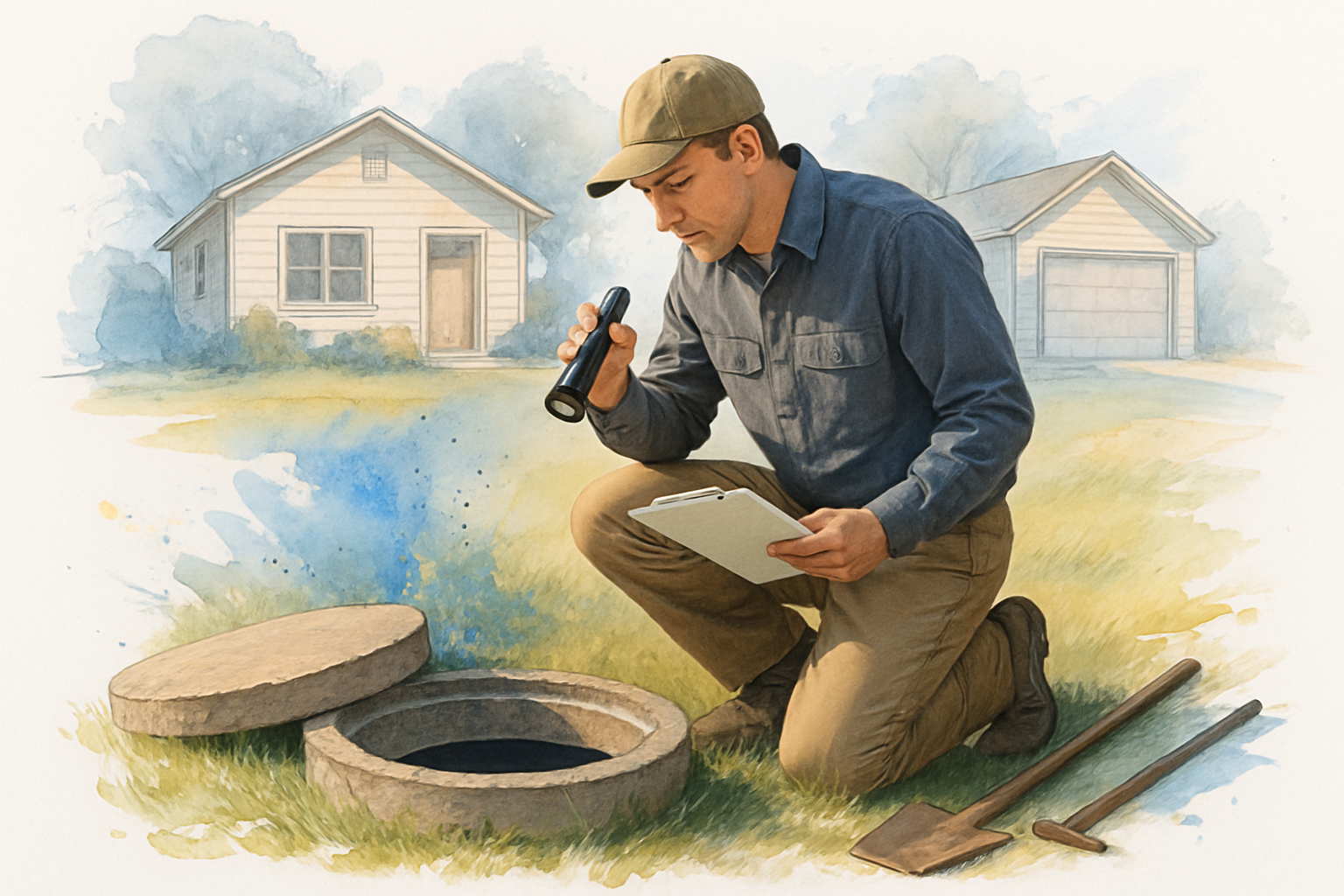
Septic Clearance Is a Separate Review, and It Runs Ahead of Your Building Permit
This is the part most homeowners miss. Septic clearance is not a box the building department checks for you. It is its own agency review with its own submittal packet, its own queue, and its own timeline.
An incomplete wastewater package stalls everything downstream. Your plans can be perfect and your plan check can still sit, because the building department will not issue a permit for a second dwelling with an unresolved disposal question.
Monterey County, San Benito County, and Santa Cruz County each run their own environmental health review with different submittal expectations. Santa Cruz County’s planning department states directly on its ADU basic requirements page that parcels on septic may need system upgrades and that owners should contact Environmental Health. The same ADU plan set can move at noticeably different speeds depending on which side of a county line the parcel sits on. San Benito parcels in particular follow their own path, which I covered in more detail in how ADU rules differ in San Benito County.
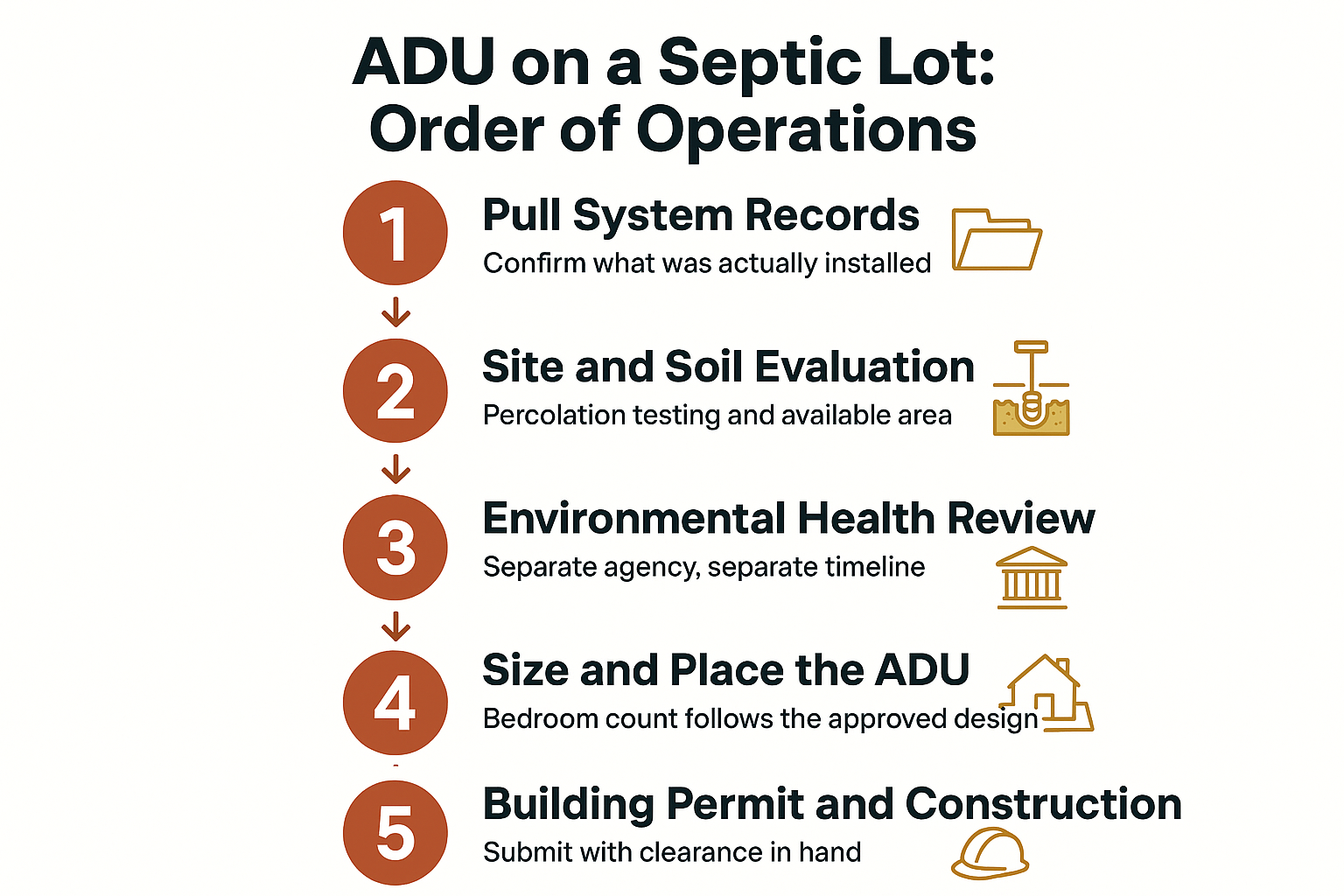
The practical order of operations looks like this:
1. Pull the existing system records from the county and confirm what was actually installed
2. Get the site evaluated and tested for soil, slope, and available disposal area
3. Let the approved wastewater design set the bedroom count and placement
4. Finalize the ADU plans around that design
5. Submit for the building permit with clearance already in hand
Run it in that order and the project moves. Run it backwards and you redraw plans.
The Order of Operations on a Septic Lot
Here is the sequence I walk rural homeowners through, and why each step has to come before the next one.
Septic Constraints Decide Where the Unit Can Actually Sit
This is the decision that surprises people most, and it has nothing to do with the floor plan.
On a septic parcel, the buildable area shrinks fast once you overlay everything that has to be kept clear:
- Setbacks from a private well, which are usually the largest of the bunch
- Setbacks from property lines
- Setbacks from creeks, swales, and drainage courses
- The existing leach field footprint
- The reserve area held for a future replacement field
By the time all of that is drawn on the site plan, the open corner you were eyeing may be the only place the disposal field can go. The spot with the best view is often the worst spot for a drain line.
One homeowner in Santa Cruz County wanted the ADU tucked in the far corner of the lot, away from the house and closer to the road. That is a reasonable request and I understood the thinking. It also means a longer water line, a longer power run, a longer waste line, and sometimes a pump system instead of simple gravity flow, because sewage does not run uphill on its own.
A garage conversion is the other end of the spectrum. The structure sits close to the main house, the plumbing route is short, and the real constraint is capacity rather than distance. If you are weighing those two paths, I broke the tradeoffs down in garage conversions versus detached ADUs.
What Moves the Budget on a Rural Septic Lot
Two ADUs of identical square footage can price out very differently based on what the ground and the existing system dictate. These are the factors I look at first.
| Factor | Why It Matters | What It Can Change |
|---|---|---|
| Soil type and perc results | Slow-draining soil needs more disposal area | Size and cost of the leach field |
| Distance from house to usable field area | Longer runs mean more trenching and pipe | Site work and excavation scope |
| Grade and slope | Waste may need to be pumped uphill | Adds a pump, controls, and power |
| Condition of existing tank and field | Reuse is far less work than replacement | Whole system replacement versus a tie-in |
| Private well testing and capacity | No public water connection to rely on | Water testing, treatment, or well work |
| Reserve area availability | County requires land held in reserve | Where the unit can legally be placed |
Timing: Be Honest About Who Controls the Clock
I will not give anyone a firm permit date on a septic parcel, and you should be skeptical of anyone who does.
Site testing depends on inspector availability, and in some jurisdictions it also depends on soil conditions at the time of testing. Heading into a wet Central Coast winter, saturated ground can push testing out or affect the results you get. If you are already mid-project when the rain starts, our storm checklist for an open remodel or ADU build covers how we protect a site.
The build itself is the predictable part. The agency calendar is not. We have always been straight with homeowners about that, and one client put it well after we finished converting her garage into an ADU: “The project took a little longer than expected, but this was due to PG&E’s scheduling and availability.”
That is the honest framing for septic work too. Utility and agency scheduling drives more delay than framing ever does, and the PG&E connection step is its own separate wait on top of environmental health.
As for cost, I would skip the per-square-foot numbers you find online. They are built on in-town sewer lots. A site-specific evaluation is the only thing that tells you what your parcel actually requires, though the general ranges in what an ADU costs in Monterey County are a fair starting point for the building side of the budget.
Frequently Asked Questions About Building an ADU on Septic
Can I add an ADU if my septic system is already old?
Often yes, but age matters less than capacity and condition. A well-maintained older system with good soil around it may pass a capacity evaluation, while a newer one on tight clay may not. The county will want records and, in most cases, testing before it signs off.
Does the ADU need its own separate septic system?
Not always. Some parcels can tie the ADU into the existing system if the tank and field have room for the added design flow. Others need an expanded field, and some need a fully separate system. That answer comes out of the site evaluation, not the floor plan.
How much does septic work add to an ADU budget?
There is no honest flat number, because soil, slope, and distance drive it. A short tie-in to a healthy existing field is a modest line item. A full replacement system with a pump on a sloped rural parcel is a meaningful share of the project. Get a site-specific evaluation before you set a budget.
Will a smaller ADU make septic approval easier?
Usually, yes. Since design flow is generally tied to bedroom count, a studio or one-bedroom asks less of the system than a two or three-bedroom unit. Plenty of homeowners start out wanting three bedrooms and land on one after seeing what the soil supports.
Do I need to do this before I buy a rural property?
If the ADU is the reason you are buying, absolutely. I have had people call about five-acre parcels near Hollister and 1.4-acre lots on the Santa Cruz westside while still in escrow. Knowing what the wastewater review will require is worth far more before closing than after.
Thinking About an ADU on a Rural Lot?
If your property is on septic, the smartest first move is having the lot looked at before you commit to a floor plan. Aldridge Construction handles planning, environmental health, and building department sequencing on the same project, so homeowners in Monterey, Santa Cruz, San Benito, and Santa Clara Counties are not chasing three agencies on their own. Brian Aldridge is a third-generation contractor holding California license 1081584, and the office can be reached at 831-682-9788 or through the contact page at aldridgeconstruction.biz when you are ready to talk through your parcel.