
Getting a handle on construction permit requirements is the first, and most important, step for any home remodel or new build. While it's easy to see a building permit as just bureaucratic red tape, it serves as your project's official stamp of approval for safety, quality, and legal compliance. It’s the formal process ensuring every part of the work meets established codes, protecting both your investment and your family.
At Aldridge Construction, our deep experience in Monterey, Santa Cruz, San Benito, and Maricopa counties means we manage this entire complex process for our clients. We ensure every detail is handled correctly, giving you peace of mind from day one.
Why Permits Are Your Project's Foundation
Securing the right permit before a single shovel hits the dirt is a non-negotiable step that truly serves as the foundation for a successful project. This official authorization from your local building department is more than just a piece of paper; it’s a critical safeguard.
The permitting process ensures your plans have been reviewed by experts to confirm they meet minimum safety, structural, and environmental standards. This third-party review protects you from construction defects that could compromise your home's integrity. For homeowners in Monterey and Santa Cruz Counties, this includes crucial checks for seismic safety codes. In Maricopa County, it ensures materials like energy-efficient Milgard windows can withstand extreme desert heat.
Protecting Your Investment and Future Value
A properly permitted project is one of the best ways to protect your home's future value. When it comes time to sell, unpermitted work can derail a sale or force you into expensive, after-the-fact repairs. Furthermore, most homeowner's insurance policies will not cover damage or accidents related to unpermitted construction, leaving you dangerously exposed financially.
The High Cost of Skipping Permits
The risks of trying to skip this crucial step are massive and can include:
- Hefty Fines: Municipalities often impose penalties that are double or triple the original permit fee.
- Stop-Work Orders: An inspector can halt your project on the spot, causing major delays and increasing costs.
- Forced Demolition: In a worst-case scenario, you could be ordered to tear down the unpermitted work entirely.
- Future Sales Complications: Lenders and sharp-eyed buyers will flag unpermitted additions, creating huge hurdles during any real estate transaction.
At Aldridge Construction, we manage the entire complex permitting process. If you have questions about your project, Contact Aldridge Construction for expert guidance.
When Do You Need a Building Permit?

One of the first and most critical questions we hear from homeowners is: "Does my project actually need a permit?" While sorting through construction permit requirements can feel like a maze, it usually boils down to one core idea: is the work cosmetic or structural?
As a rule of thumb, any project that alters your home's fundamental systems or its physical footprint will need a permit. This includes work on structural framing, electrical wiring, plumbing lines, or mechanical systems like your HVAC. On the other hand, simple cosmetic updates—like interior painting or swapping a light fixture—typically do not require city involvement.
Projects That Almost Always Require a Permit
Major renovations and new builds are the most obvious candidates for permits. Think of any project that fundamentally changes how your home functions or its physical dimensions.
Common examples include:
- Building a Home Addition: Any time you expand your home’s footprint, a permit is a must.
- Major Kitchen or Bath Remodels: If you're moving walls, relocating plumbing, or reconfiguring electrical outlets, you'll need a permit.
- Constructing an ADU: Building an Accessory Dwelling Unit (ADU) is essentially building a small new home, requiring comprehensive permits.
- Replacing All Windows: In California, this requires a permit to ensure new windows meet Title 24 energy efficiency standards.
- Installing a New Roof: This permit verifies that the structural load and materials like Class A shingles meet current safety codes.
Quick Guide: Permit or No Permit?
To help clarify, we created a simple reference table. Always confirm with your local building department in Monterey, Santa Cruz, San Benito, or Maricopa County, as local rules can vary.
| Project Example | Permit Usually Required? | Why It Matters |
|---|---|---|
| Major Kitchen Remodel (Moving Walls or Plumbing) | Yes | Ensures structural integrity and safe electrical/plumbing work. |
| Building a New Accessory Dwelling Unit (ADU) | Yes | A new dwelling requires full review for zoning, safety, and utilities. |
| Replacing All Windows | Yes | Guarantees proper installation and compliance with energy codes like CA Title 24. |
| Interior Painting or New Flooring | No | These are cosmetic changes that don't impact the home's structure or systems. |
| Building a Deck Over 30 Inches High | Yes | Critical for structural safety, railings, and property line setbacks. |
| Replacing a Bathroom Faucet | No | A minor fixture swap without altering the main plumbing lines. |
Understanding this distinction is fundamental. When you factor in the permit process from the beginning, you can build a more realistic schedule. To see how these steps fit into the bigger picture, check out our guide on the typical home construction timeline.
Your Step-By-Step Permit Application Journey
The journey to get a building permit can feel like navigating a maze blindfolded. With an experienced guide like Aldridge Construction, however, it becomes a clear, predictable path. We don't just fill out forms; we manage a multi-step process designed to take your project from idea to officially approved plans.
Our deep familiarity with the local building departments in Monterey, Santa Cruz, and Maricopa counties pays off. We know the specific online portals, common review sticking points, and how to assemble a submission that answers questions before they are asked, avoiding costly delays.
Stage 1: Creating Professional Plans
The first step is turning your vision into a set of professional drawings that city officials can understand and approve. These aren't just sketches; they are highly detailed architectural and engineering plans that prove your project will be safe, stable, and up to code.
These plans are the universal language between you, your contractor, and the building department. They must show everything from foundation specifics and structural framing to electrical layouts and plumbing schematics. In coastal California, they must also detail requirements like seismic bracing and Title 24 energy efficiency measures.
Stage 2: Compiling the Application Package
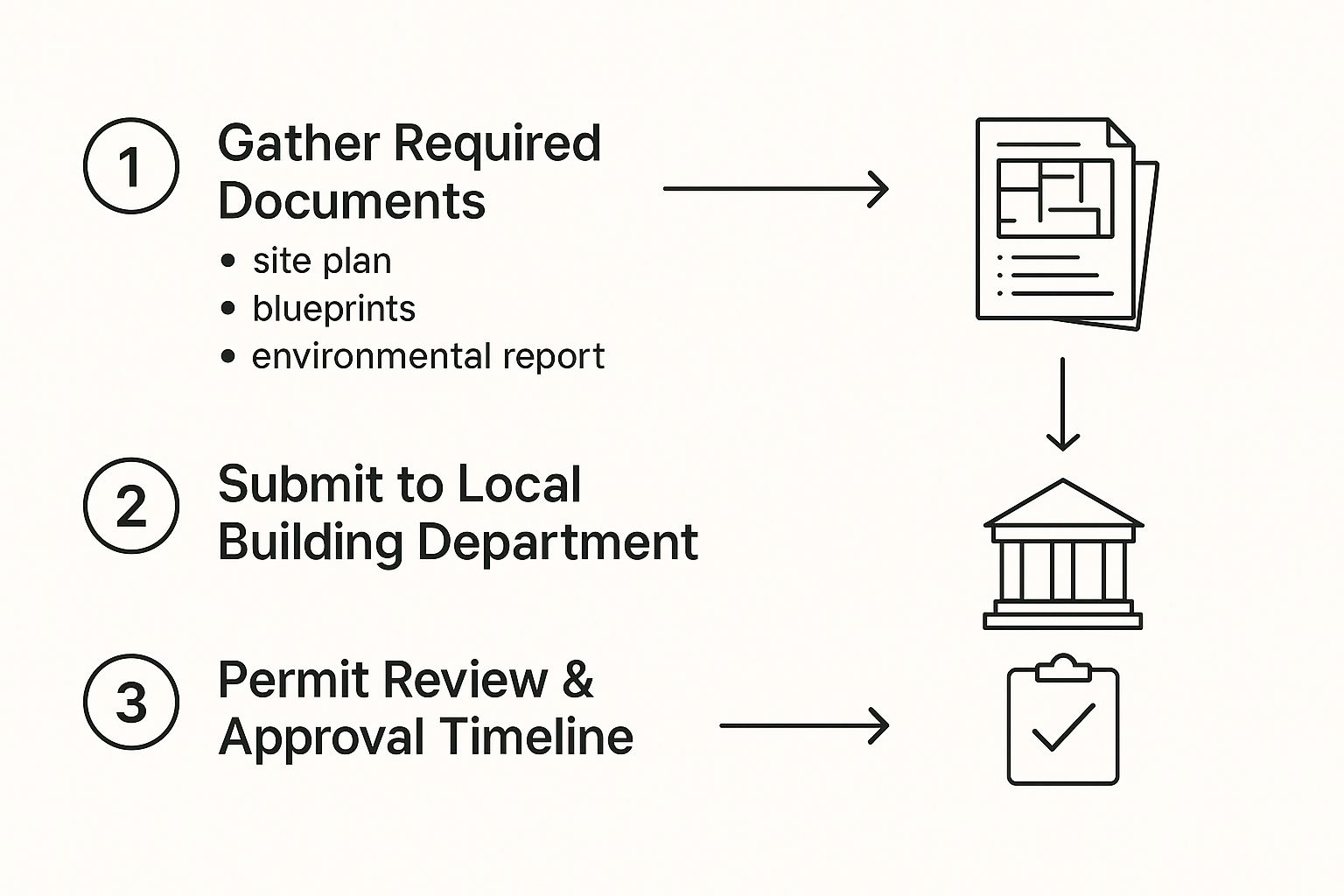
Once the plans are locked in, the next move is to assemble the complete application package. This is much more than just the blueprints. It's a collection of supporting documents that paint a full, clear picture of the project for the review team.
A complete package typically includes:
- The Permit Application Form: The official request with precise details about your project's scope and location.
- A Full Set of Construction Plans: Multiple copies of the architectural and engineering drawings.
- A Detailed Site Plan: A map showing property lines, where the work will happen, and required setbacks.
- Supporting Reports: Depending on the project, this could include soil reports, structural calculations, or energy compliance documentation.
Our detailed guide, the Building a New Home Checklist, can help you understand all the pieces that go into planning a successful build.
Stage 3: Submission and Plan Review
With a complete package in hand, it's time to submit it to the right local department. Cities in Monterey County have different portals and requirements than those in Maricopa County, and this is where local expertise is critical.
After submission, your application enters the plan review phase. City engineers, planners, and building officials scrutinize your documents to ensure they meet every local and state code. It’s common for reviewers to ask for clarifications. An experienced contractor anticipates these questions, drastically cutting down the back-and-forth that can stall a project.
Our team at Aldridge Construction actively manages this entire review process, responding promptly to keep your application moving forward. This hands-on management is a cornerstone of our service, ensuring your project stays on track.
Essential Documents for a Successful Application
Getting a permit approved is about meticulous preparation, not luck. Think of your application as building a case for your project. Every document is evidence that your plans are safe, compliant, and thoughtfully designed. A complete package is the fastest way to get a green light.
This paperwork is so central to the process that permit trends often reflect the health of the economy. For instance, U.S. building permits saw a 3.8% dip in May 2024 to an annual rate of 1.386 million, the lowest since June 2020, showing how factors like mortgage rates influence new construction. [U.S. Census Bureau, 2024]
At Aldridge Construction, we treat the application like the foundation of the project itself, building a bulletproof package that meets the strict construction permit requirements of your specific city or county.
The Anatomy of a Permit Application
While the specifics may vary between Monterey, Santa Cruz, and Maricopa counties, the core documents are remarkably similar.
Key documents almost always include:
- Construction Plans (Blueprints): The heart of your application. These are detailed architectural and engineering drawings that map out exactly what you plan to build, from foundation footings to roof trusses.
- Site Plan: A bird's-eye map of your property showing property lines, existing buildings, and precisely where the new work will sit, including setbacks.
- Structural Engineering Calculations: If your project involves structural changes—like removing a load-bearing wall—a licensed engineer must provide the math that proves the design is strong and stable.
Region-Specific Documentation
Your specific location often adds another layer of requirements. In California, for instance, you will likely need to submit a Title 24 Energy Compliance Report. This document proves that your project's design—from windows to insulation—meets the state's rigorous energy efficiency standards.
If your property is on a hillside, a Geotechnical or Soils Report might be mandatory to ensure the foundation is designed for the specific ground conditions. Aldridge Construction has deep roots in both Central California and Arizona, so we know exactly what is needed for any major residential construction project.
How Local Rules Shape Your Project in CA and AZ
A permit application is a hyper-local story told through blueprints and reports, written in the specific dialect of your city or county. Understanding these local nuances is what separates a smooth project from one bogged down in bureaucratic delays. This is where our on-the-ground experience in both California and Arizona is critical.
Navigating the construction permit requirements for a remodel in coastal Monterey is a world away from planning a new build in the deserts of Maricopa County. These local drivers are even seen globally—recent data from the European Union shows permit applications in some countries jumping over 25% while others fell, all due to local conditions.
California Coast Permitting: Monterey and Santa Cruz Counties
On California's Central Coast, we constantly navigate unique regulatory hurdles tied to the region's environment and housing needs.
Key local factors include:
- Coastal Commission Approvals: If your project is near the shoreline, you also need approval from the California Coastal Commission, which has its own stringent requirements.
- Wildfire Safety Standards: For homes in Wildland-Urban Interface (WUI) zones, applications must include a wildfire hardening plan, specifying materials like fire-resistant James Hardie siding and Class A roofing.
- Strict ADU Laws: While California encourages ADUs, each city puts its own spin on the rules. We are experts at designing ADUs that meet local requirements for setbacks, size, and utility connections.
Arizona Desert Permitting: Maricopa County
In Maricopa County, Arizona, the desert environment dictates the rules. The focus shifts from seismic safety to intense sun, extreme heat, and water conservation.
For projects in the Phoenix metro area, our permitting strategy centers on:
- Desert-Adapted Materials: Plans must specify materials that withstand punishing sun, like durable stucco finishes, cool-roofing systems, and energy-efficient Milgard windows with proper SHGC ratings.
- Swimming Pool and Spa Codes: A pool permit process focuses entirely on safety, with strict rules for fencing, gate latches, and drain covers.
- Water-Efficient Landscaping: Many municipalities require or encourage xeriscaping and low-water-use irrigation systems to combat drought.
Whether planning an expansion in Salinas or a backyard oasis in Scottsdale, our team manages the specific construction permit requirements for your location. This is especially vital for complex projects like home additions.
Start Your Project with Confidence

Untangling construction permit requirements can feel overwhelming, but it is an absolutely critical step. The smoothest path forward is working with an experienced, local contractor who already knows the ins and outs of your county's specific rules.
Your Partner in Compliance and Quality
Think of this partnership as your greatest asset. A seasoned expert takes the mystery out of the process, handling the paperwork, talking to city officials, and steering you clear of common pitfalls that sink timelines and blow up budgets.
Choosing the right partner makes all the difference. When you team up with skilled home improvement contractors, you get the peace of mind that your project not only meets every legal standard but is also built to the highest possible quality.
Take the Next Step with Aldridge Construction
If you're ready to transform your home in Monterey, Santa Cruz, San Benito, or Maricopa County, Aldridge Construction is ready to help. We will guide you through the specific permit requirements for your vision and build your project on a solid foundation of compliance and quality.
Contact us today to start planning your project with total confidence.
Frequently Asked Questions About Construction Permits
1. How long does it take to get a construction permit?
The timeline varies significantly by location and project complexity. A simple permit in Monterey or Santa Cruz County might take 4-8 weeks, while a new home or major addition in Maricopa County could take several months. The key factor is submitting a complete and accurate application, which is a core part of the service Aldridge Construction provides.
2. What are the risks of working without a permit?
Skipping a required permit is a high-risk gamble. Potential consequences include stop-work orders, significant fines (often double the permit fee), and even orders to demolish the unpermitted work. It also creates major liability and can make it nearly impossible to sell your home in the future.
3. How much does a building permit cost?
Permit fees are typically based on the total value of your construction project. For smaller jobs, fees might be a few hundred dollars. For a major addition or a new custom home, they can run into several thousand. We always include a detailed estimate for permit fees in our project proposals so there are no surprises.
4. Can a homeowner apply for their own permit?
While technically possible for homeowners to act as an "owner-builder," we strongly advise against it. The process requires highly detailed architectural plans and a deep understanding of complex building codes. A small mistake can cause major delays. Hiring a professional contractor like Aldridge Construction ensures it’s done right the first time.
5. Do building permits expire?
Yes, they do. Most permits expire if work doesn't begin within a specific period (usually 180 days) or if the project is inactive for that same amount of time. If your project faces delays, it's often possible to apply for an extension to keep your permit active.