
For homeowners weighing whether to remodel vs. move in 2025, the decision boils down to one critical factor: your mortgage rate. Remodeling lets you keep your current low rate while tailoring your home to your exact needs. Moving offers a clean slate but almost certainly means trading up to a much higher interest rate.
The right path depends on whether you value financial certainty and customization over a brand-new location and layout.
The 2025 Homeowner's Dilemma: Remodel or Relocate?
Here in Monterey, Santa Cruz, and Maricopa Counties, the "remodel or move" question has never been more pressing. Just a few years ago, it was common for growing families to simply sell and buy a bigger place. Today, rising mortgage rates are reshaping homeowner behavior.
The thought of giving up a comfortable 2-3% mortgage for a new one hovering around 7% is a massive financial pill to swallow. This new economic reality is fundamentally changing how people think about their homes. Instead of calling the movers, more homeowners are calling contractors.
The Rise of Renovating Over Relocating
A major trend is taking shape across the country. More than half of U.S. homeowners plan a renovation within the next year, with data showing 55% prefer renovating over moving. That’s a clear sign that homeowners see the wisdom in upgrading what they have instead of braving a tough buyer’s market.
In today’s high-interest environment, homeowners are choosing to stay put rather than trade up. You can read more about what is driving this remodeling surge and why it's a smart financial decision for many.
Renovations offer a personalized solution without the stress of moving. A renovation lets you:
- Create dedicated spaces like a functional home office for hybrid work.
- Modernize outdated kitchens and bathrooms with updated finishes like durable quartz countertops.
- Expand your living area with a thoughtful home addition or a versatile Accessory Dwelling Unit (ADU).
Quick Comparison: Remodeling vs. Moving At a Glance
Before diving deep, it helps to see the trade-offs side-by-side. This table gives a quick, high-level look at the key factors you should be thinking about.
| Factor | Remodeling | Moving |
|---|---|---|
| Financial Impact | Keep your current mortgage; pay for project costs. | Incurs transaction fees and a new, likely higher, mortgage rate. |
| Customization | Full control to design spaces exactly to your taste. | Limited to available homes on the market. |
| Disruption | Temporary construction noise and inconvenience at home. | The stress of packing, selling, buying, and settling into a new area. |
| Location | Stay in the neighborhood and community you already know. | Opportunity for a new location, schools, and commute. |
| Emotional Toll | Can be stressful living through construction. | Emotionally taxing to leave a home with memories. |
At the end of the day, there's no single right answer. As local experts, Aldridge Construction helps homeowners in Monterey, Santa Cruz, and Maricopa counties work through this decision, ensuring the path they choose adds lasting value.
A Practical Financial Breakdown
When it comes down to it, the remodeling vs. moving debate is almost always about the numbers. A new house has a clear price tag, but the real cost of getting into it goes far beyond that number. Let's get into the real-world finances of each path.
When you remodel, your biggest expenses are tied directly to the project itself. Moving is different. A huge chunk of your money goes to transactional fees that add zero long-term value to your new home.
The Real Cost of Remodeling
A renovation is a direct investment in your property, turning cash into tangible home equity. In our local markets in California and Arizona, the cost of popular projects varies depending on the scope and the finishes you choose.
Here’s a look at some typical project costs:
- Kitchen Remodel: A mid-range kitchen update—think quartz countertops, new cabinetry, and energy-efficient appliances—will likely land somewhere between $40,000 and $90,000+.
- Bathroom Renovation: Transforming a primary bathroom with a modern walk-in shower and new vanity usually falls in the $25,000 to $60,000 range.
- Home Addition: Expanding your home's footprint is a larger investment. A new primary suite or family room addition can run from $150,000 to $300,000+. For a clearer picture, our home addition costs calculator can give you a solid preliminary estimate.
A critical piece of any renovation budget is the contingency fund. At Aldridge Construction, we advise clients to set aside an extra 10-15% of the total project cost to cover any unknowns found once walls are opened.
Uncovering the Hidden Costs of Moving
A new home’s sticker price is just the starting line. The process of selling your current place and buying a new one is loaded with expenses.
- Realtor Commissions: Sellers typically pay 5-6% of the home's sale price to the real estate agents. For an $800,000 home, that’s $40,000 to $48,000.
- Closing Costs: Buyers have their own stack of fees, from loan origination and appraisals to title insurance. These usually add up to another 2-5% of the purchase price.
- The Mortgage Rate Shock: For 2025, this is the biggest financial hurdle. Swapping a low 3% mortgage for a new 7% loan can spike your monthly payment by hundreds, if not thousands, of dollars.
- Moving and Setup: Don't forget to factor in the cost of movers, new furniture, utility hookups, and immediate repairs.
How 2025 Homeowner Priorities Are Shifting
The financial math is clearly pushing more homeowners toward renovation. Recent data shows a strong preference for staying put and upgrading. Today’s homeowners want functional spaces that support hybrid work, multigenerational living, and sustainable lifestyles.
For anyone leaning toward remodeling, tax incentives can sweeten the deal. There are major home energy and solar tax credits set to expire in 2025. Upgrading to energy-efficient Milgard windows or installing solar panels not only lowers your tax bill but also cuts down your monthly utility costs.
Aldridge Construction helps homeowners in Monterey and Santa Cruz Counties make the most of their renovation budget, ensuring your investment enhances your home’s comfort, function, and long-term value.
Comparing Long-Term Value and ROI
 home renovation.” />
When you're weighing remodeling against moving, it’s smart to think about long-term value. A renovation is a direct investment in your current property. Moving, on the other hand, means trading one asset for another, and you often lose value to transactional costs.
The real question is: where do you want to build your wealth? Remodeling gives you the power to strategically increase your home’s worth without leaving the community you love.
The Financial Power of a Smart Renovation
Not all home projects are created equal when it comes to ROI. Certain upgrades are known for boosting a home’s market value, making them shrewd financial moves for homeowners in Monterey, Santa Cruz, and Maricopa Counties.
Data from Remodeling Magazine's annual Cost vs. Value report consistently shows that kitchen and bathroom remodels are top performers. Adding a midrange bathroom remodel can recoup 66.7% of its cost, according to Remodeling Magazine’s 2024 Cost vs. Value Report. In California, another high-value project is adding an Accessory Dwelling Unit (ADU).
Projected ROI for Popular Remodeling Projects in California
To give you a clearer picture, here is some data based on regional averages. Keep in mind that these numbers can shift based on your location and material choices.
| Project Type | Average Cost (Mid-Range) | Average Resale Value Recouped |
|---|---|---|
| Minor Kitchen Remodel | $31,000 | 98.5% |
| Bathroom Remodel | $29,500 | 93.2% |
| Bathroom Addition | $68,000 | 86.4% |
| Window Replacement (Vinyl) | $24,000 | 85.7% |
| ADU / In-Law Suite Addition | $160,000 | 80-90% (or higher with rental income) |
| Major Kitchen Remodel | $85,000 | 75.3% |
These figures show that even major projects can provide a strong financial return.
Maximizing Your Home's Value in Santa Cruz and Monterey
Aldridge Construction specializes in tailored renovations that add lasting value. We guide homeowners toward projects that deliver immediate lifestyle improvements and future financial gains.
Here are a few high-ROI projects we frequently build for our clients:
- Bathroom Additions: Adding a new bathroom is a game-changer for a home’s functionality, especially for growing families.
- ADU Construction: In a high-demand area like Santa Cruz, a permitted ADU is a powerful asset for generating rental income or creating a space for multigenerational living.
- Kitchen Remodels: An updated kitchen remains a top selling point. Think quartz countertops, a smart layout, and modern, energy-efficient appliances.
- Exterior Improvements: Never underestimate curb appeal. New siding, energy-efficient windows, or a thoughtfully designed entryway provide an immediate boost to both appearance and value.
To get a deeper dive, check out our guide on calculating your home renovation return on investment.
The Financial Risks of Moving in a Peak Market
Moving can lead to appreciation, but it also carries significant risks, especially when the market is at its peak. If you buy when prices are high, you could see limited equity growth in the short term.
When you move, a huge chunk of your money—up to 6% for realtor fees and another 2-5% for closing costs—is spent on the transaction itself. That's money that vanishes without adding a single dollar of value to your new property. In contrast, every dollar you put into a well-planned remodel is a direct investment in your home.
The Impact on Your Daily Life

This decision goes way beyond the numbers. Remodeling versus moving isn't just about finances; it's about your daily routine, your stress levels, and your family's overall well-being.
Both paths bring their own brand of chaos. One involves living through a controlled, temporary mess inside your home. The other means uprooting your entire life and starting over.
The Reality of Living Through a Renovation
Living in a construction zone demands patience. You'll be dealing with noise, dust, and the temporary loss of a key space, like your kitchen. A major remodel is loud and messy, and managing that daily reality is a huge part of the experience.
But here’s the upside: it's temporary. In Monterey or Santa Cruz County, the timeline really depends on the scope:
- Bathroom Remodel: You're looking at 4-8 weeks of work.
- Kitchen Remodel: This is a bigger deal, usually taking 3-5 months.
- Major Home Addition: For a project that expands your home’s footprint, you should plan on 6 months or more.
The disruption from a remodel is contained and finite. A clear plan allows you to seal off work areas and set up temporary living spaces to keep some sense of normalcy. At Aldridge Construction, our project management system is built to minimize that chaos.
The Emotional and Practical Toll of Moving
Moving swaps construction dust for a whole different set of stressors. The process kicks off with house hunting in a competitive market, which can be draining.
Once you find a new home, the marathon begins. You’re packing up everything you own, coordinating movers, and managing a mountain of paperwork. For anyone leaning toward a move, this ultimate 2025 long-distance moving checklist can help break the process into manageable steps. Don't forget the emotional weight of uprooting your family.
Finding a Path That Fits Your Family
This choice is about your family's unique tolerance for different kinds of upheaval. If you love your neighborhood and your home just needs a few key changes, renovating is almost always the better choice.
This is particularly true for homeowners planning to age in place. The right updates can create a safe, comfortable environment for the long haul. We have extensive experience with home modifications for seniors that focus on enhancing independence right at home.
On the other hand, if the core issues are your home’s location or a fundamentally flawed layout, moving might be the only way to get what you truly need.
Navigating Local Permits and Regulations
Choosing between remodeling and moving is also about navigating local rules. Whether you're in Santa Cruz County, Monterey County, or Maricopa County, understanding local permits and regulations is a non-negotiable step.
Remodeling throws you directly into the world of local building departments. Moving requires you to become a detective, uncovering a new property's compliance history.
The Remodeling Path: Permits and Codes
When you decide to remodel, you’re stepping into the realm of building permits. Simple cosmetic updates like painting typically don't need one. But the moment you touch a home’s structure, plumbing, or electrical systems, a permit is required.
In communities across our service areas, the permitting process exists for safety.
- Structural Changes: Any work involving moving walls, changing the roofline, or altering window openings will require a permit.
- Accessory Dwelling Units (ADUs): Building an ADU has specific local and state rules, especially in California.
- Electrical and Plumbing Work: Upgrading an electrical panel or rerouting plumbing lines must be inspected.
In California, projects must also meet Title 24 energy standards. These codes dictate requirements for insulation and window efficiency. Aldridge Construction manages the entire process to ensure your project is fully compliant. You can learn more about local construction permit requirements on our blog.
The Moving Path: Due Diligence is Key
If you opt to move, your regulatory homework shifts. You’re inheriting a property’s complete history, including any unpermitted work.
Your due diligence should focus on a few key areas:
- Thorough Home Inspections: A qualified inspector can spot signs of non-compliant work.
- Reviewing Property Records: Check the property's permit history with the local building department.
- Understanding Zoning and HOAs: Know the local zoning laws and any Homeowners Association (HOA) rules before you buy.
Skipping this research can turn your dream home into a regulatory nightmare.
How to Make Your Final Decision
After you’ve crunched the numbers and considered the lifestyle impacts, the last step is to make a clear choice. This is about your long-term happiness, daily comfort, and the connection you have to your home and community.
To cut through the noise, it helps to ask yourself some direct questions.
An Actionable Checklist for Your Family
Use these questions as a guide. Talk them over with your family and be honest with your answers.
- Financial Reality: Can we absorb the hidden costs of moving, like a higher mortgage payment? Or does our budget better support a renovation where we keep our current rate?
- Space Needs: Can a well-planned home addition solve our space problem? Or are the core issues, like a tiny yard, impossible to fix with a remodel?
- Customization vs. Compromise: Is it important for our home to be designed exactly for us? Or are we willing to live with the compromises of an existing house?
- Community and Location: Do we love our neighbors and schools in Monterey or Santa Cruz? Or is a new location a primary goal?
- Disruption Tolerance: Can our family handle living through construction? Or would the stress of packing and uprooting our lives be a bigger challenge?
This decision tree offers a simple visual to help you think through the process.
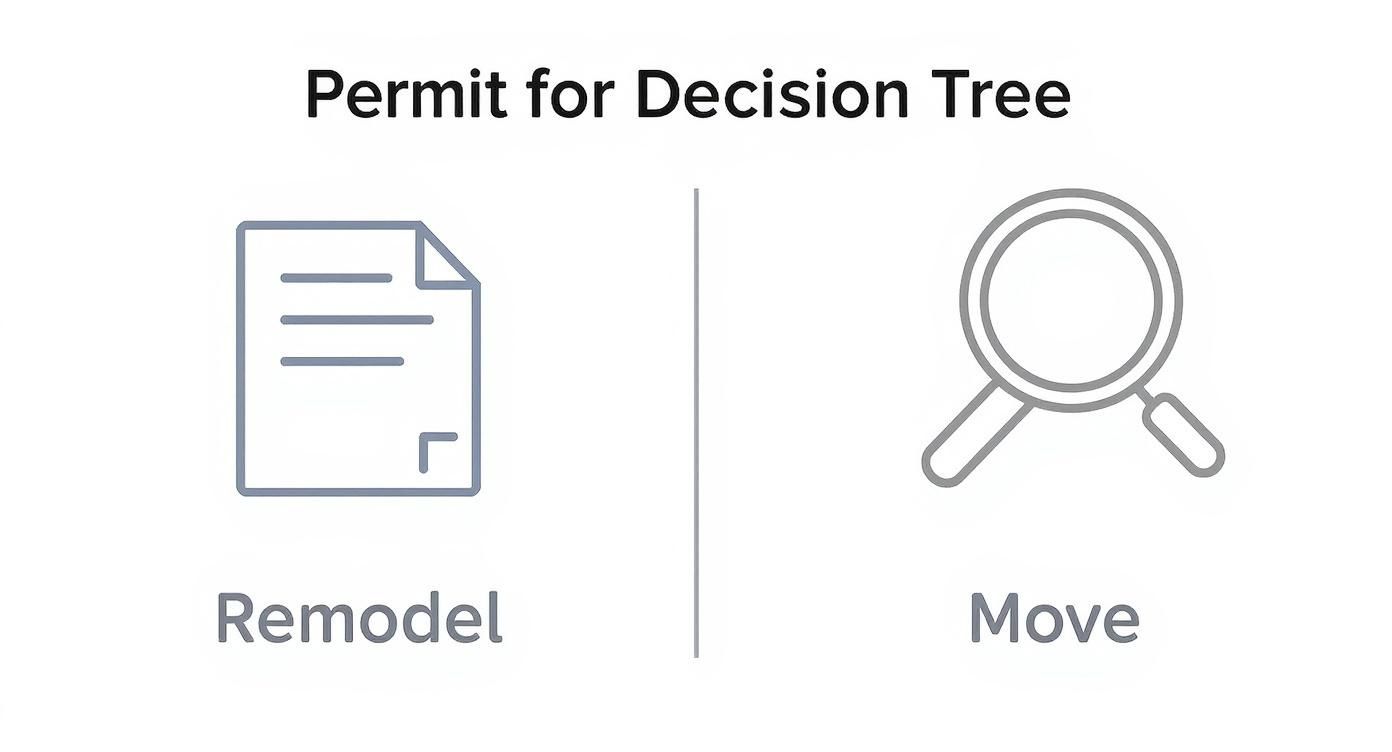
Answering these questions honestly almost always reveals a clear winner. If you lean toward improving the home you're in, the next crucial step is finding the right partner. Our guide on how to find a good contractor provides key insights for making a confident choice.
Frequently Asked Questions About Remodeling vs. Moving
Is it cheaper to remodel or move in 2025?
For most homeowners, remodeling is more cost-effective right now. Moving comes with transaction costs—realtor commissions, closing costs—and the near certainty of a much higher mortgage rate. A renovation lets you keep your current, likely lower, mortgage rate.
How long does a typical home remodel take?
The timeline depends on the project. A bathroom remodel might take 4–8 weeks, while a full kitchen renovation could take 3–5 months. A major home addition often takes 6 months or longer. Aldridge Construction provides a detailed project schedule from the start.
Which renovations add the most value to a home?
Kitchen and bathroom remodels consistently offer a high return on investment. In California, building an Accessory Dwelling Unit (ADU) is also a fantastic way to boost property value. Exterior upgrades like new siding or energy-efficient windows also add significant value.
Can I live in my house during a major renovation?
It depends on the scale of the work. If the project is contained to one or two rooms, you can absolutely stay. For a whole-house remodel affecting essential spaces like your kitchen, temporary housing is often the best call for your family's comfort and safety.
What is the first step if I decide to remodel?
Start by defining your goals and setting a realistic budget. Pinpoint what isn't working in your current space and what your dream outcome looks like. Then, talk to a reputable design-build contractor like Aldridge Construction to help you build a solid plan.
If you're in Monterey, Santa Cruz, or nearby counties and are considering staying in your home but need more from it, Aldridge Construction can help you make the most of your space. Reach out to explore your renovation options today.