
Direct Answer: Check their CSLB license at cslb.ca.gov, ask for certificates of insurance, and review the written contract for a detailed scope and payment schedule before signing anything.
I talk to homeowners across Monterey County almost every week who have already had a bad experience with a contractor. The stories follow the same pattern: the work started, the problems started, and then the contractor stopped answering the phone. It happens here, in Salinas, in Seaside, in Hollister, in Santa Cruz, more often than it should.
When I look at search data for our area, ‘contractors in Salinas CA’ gets hundreds of searches every month. But most of those people aren’t actually looking for a list of names. They’re asking a harder question: how do I know if any of these people are legitimate? That’s the question I want to answer here.
This isn’t about scaring you. Most contractors doing work in Monterey County are honest people trying to run a good business. But the ones who aren’t follow predictable patterns, and those patterns are entirely checkable before you hand over a dollar.
Start With the CSLB License Check, It Takes Two Minutes
The California Contractors State License Board (CSLB) maintains a free public lookup at cslb.ca.gov. Any homeowner can use it, and it should be the first thing you do before any conversation gets serious.
Here’s what to look for when you pull up a contractor’s record:
- License status, it should say ‘Active.’ Expired or suspended licenses are a hard stop.
- License classification, for most residential renovation and ADU work in Salinas, you want a B-General Building contractor license. Specialty trades like electrical or plumbing carry their own classifications (C-10, C-36), and subcontractors working under a general contractor will often hold those. But whoever is running your project and pulling permits should hold a B license.
- Expiration date, a license that expires next month is worth asking about.
- Complaints and disciplinary actions, this is the part most people skip. The CSLB record will show any formal complaints filed against the license. A single old complaint isn’t automatically disqualifying, but a pattern is.
I’ve had homeowners come to us after working with someone who turned out to have a license that lapsed two years earlier. The work failed inspection, the permits couldn’t be closed, and sorting it out cost more than the original job. Two minutes on cslb.ca.gov would have caught it.
If a contractor hesitates to give you their license number, that tells you something too.

Insurance Is Separate From Licensing, and Just as Important
A valid CSLB license does not mean a contractor is insured. These are two completely separate things, and both matter.
There are two types of coverage you should ask about:
- General liability insurance, this covers property damage and third-party injuries. If a crew member accidentally damages your neighbor’s fence or a pipe gets hit during demo, general liability is what pays for it.
- Workers’ compensation insurance, this covers crew members who get injured on your job site. And this one is where homeowners often get surprised.
If a worker is injured on your property and the contractor does not carry workers’ comp, your homeowner’s insurance policy may be the one on the hook. That’s not a hypothetical, it’s a real exposure.
Ask for certificates of insurance, not just a verbal assurance. A legitimate contractor will have these ready. The certificate should list your property address as the project location. If someone says they’re insured but can’t produce a certificate within a day or two, treat that the same way you’d treat a lapsed license.
For a deeper look at what California requires contractors to carry and why it matters for your specific project, How to Actually Verify a Contractor’s License Before Signing breaks this down further.
The Pre-Hire Checklist: What to Verify Before You Sign
This checklist covers the four things every Salinas-area homeowner should confirm before signing a contractor agreement.
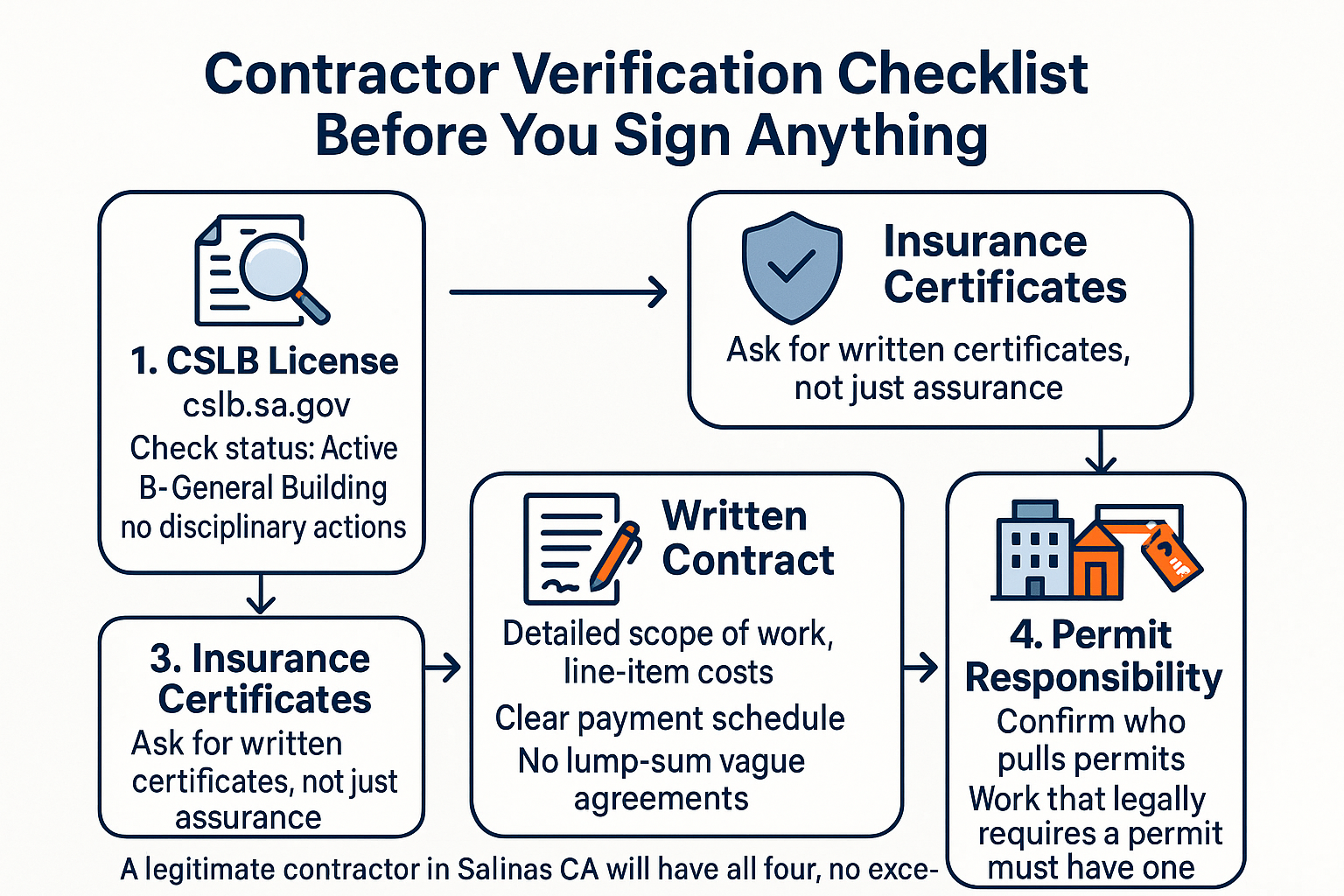
The Contract and Payment Schedule Tell You a Lot
A contractor’s license and insurance are table stakes. The contract is where you see how they actually operate.
California law requires home improvement contracts over $500 to be in writing. But the legal requirement is a floor, not a standard. What you want to see:
- A detailed written scope of work, not ‘kitchen remodel’ but a description that specifies what’s being demolished, what’s being replaced, what materials are being used, and what the finished state looks like.
- A line-item or broken-out cost structure, you should be able to see where the money goes. Lump-sum bids make it impossible to evaluate what you’re actually paying for or to compare bids fairly.
- A payment schedule tied to milestones, deposits are normal, but California law limits the initial deposit on most home improvement jobs. Be cautious of any contractor asking for more than 10% or $1,000 (whichever is less) upfront before work begins. Legitimate contractors don’t need to front-load cash.
- A clear permit plan, for most kitchen remodels, bathroom renovations, ADU builds, and additions in Salinas and Monterey County, permits are required. The contract should say who is pulling them.
If a contractor tells you permits aren’t needed for work that clearly requires them, that’s a red flag. Unpermitted work can block a future sale, void your homeowner’s insurance, or require costly tear-out and redo. What Separates a Renovation That Goes Smoothly From One That Doesn’t goes deeper on how permit handling affects the outcome of a project.
For a detailed walkthrough of what to look for line by line, How to Read a Home Remodeling Estimate Before You Sign Anything is worth reading before you compare bids.
Common Red Flags vs. What Legitimate Contractors Do
Here’s a quick reference for the warning signs that show up most often in bad contractor experiences on the Central Coast, alongside what you should expect from a contractor who runs a real business.
| Red Flag | What It Looks Like | What to Expect Instead |
|---|---|---|
| No written contract | Handshake deal or vague email summary | Signed contract with detailed scope before any work starts |
| Front-loaded payment | Asking for 40-50% deposit before any materials are ordered | Deposit at or near the CA legal limit; payments tied to milestones |
| No permits pulled | ‘We don’t need a permit for this’ on work that clearly requires one | Contractor pulls permits as part of the project; inspections are scheduled |
| Unlicensed or lapsed license | Can’t provide a CSLB license number, or number comes back inactive | Active B-General Building license, verifiable at cslb.ca.gov |
| No insurance certificates | ‘We’re covered’ with no paperwork to back it up | Written certificates of general liability and workers’ comp, naming your property |
| Unavailability after problems arise | Phone goes to voicemail after the deposit clears | Owner or project manager accessible throughout the job |
What Owner-Operated Actually Means in Practice
One thing I hear from homeowners who’ve had bad experiences is that they never actually spoke to the person in charge after the first sales meeting. A salesperson closed the deal, handed off to a project manager, who handed off to a crew, and nobody with real decision-making authority was reachable when something went wrong.
Owner-operated contracting is different in one specific way: the person who made you the promise is the person responsible for delivering it. There’s no layer of insulation between the commitment and the outcome.
Reviews for the work we do at Aldridge Construction consistently mention things like “stays in communication and explains everything” and “knowledge unparalleled”, not because we have a better communication system, but because Brian is personally accountable for every project we take on. That accountability changes how decisions get made on the job site.
When you’re evaluating any contractor, ask directly: who will be my point of contact during the project, and how do I reach them when something comes up? The answer tells you a lot. A contractor who can’t give you a direct answer to that question before you sign is probably not going to be easier to reach after.
For ADU projects specifically, where the permit process alone can involve Monterey County planning, environmental health, the building department, and utility coordination with PG&E, having someone who understands all those moving parts and stays engaged matters more than almost anything else. One of our ADU customers noted that a utility scheduling delay from PG&E pushed the project timeline, but throughout it she said the team was responsive and the worksite stayed clean and organized the whole time. That’s what a well-run project looks like even when things outside anyone’s control cause delays.
If you’re starting to think through an ADU build, Three Years of ADU Projects in Monterey County: What We Learned covers what we’ve seen go right and wrong across dozens of projects in this specific market.
Frequently Asked Questions About Hiring a Contractor in Salinas
How do I look up a contractor’s license in California?
Go to cslb.ca.gov and use the public license lookup. Enter the contractor’s name or license number. You’ll see whether the license is active, what classification it carries, when it expires, and whether any complaints have been filed. It takes about two minutes.
What license classification should a general contractor in Salinas have?
For most residential renovation work, kitchens, bathrooms, ADUs, additions, garage conversions, you want a B-General Building contractor license. Subcontractors doing electrical or plumbing will carry C-10 or C-36 licenses respectively, but the general contractor overseeing the project and pulling permits should hold a B license.
Is it legal for a contractor to ask for a large deposit upfront?
California law limits the initial deposit on most home improvement contracts to 10% of the total price or $1,000, whichever is less. There are exceptions for special-order materials, but a contractor asking for 30-50% before work starts is outside the norm and worth pushing back on. Payments should be tied to project milestones, materials delivered, framing complete, rough inspections passed, not front-loaded.
What happens if a contractor skips permits on my project?
Unpermitted work creates real problems down the road. It can surface during a home sale (buyers and their agents check permit history), it may void coverage under your homeowner’s insurance policy if something fails, and it can require expensive tear-out and redo to bring the work up to code after the fact. In Monterey County, the building department can also require full demolition of unpermitted work in some cases. You Bought a House With an Unpermitted Unit, Now What? covers what legalization looks like if you’re already in that situation.
Why do bids for the same project vary so much?
A few reasons. Some contractors price low to win the job and make it up in change orders later. Others carry proper insurance and licensing overhead that cheaper bids skip entirely. Material specs matter too, a bid using builder-grade materials and a bid using mid-grade or better will look very different on paper for what sounds like the same job. When bids are miles apart, ask each contractor to walk you through their scope in detail. The differences usually become clear quickly. How to Read a Home Remodeling Estimate Before You Sign Anything walks through what to look for line by line.
Do I need permits for a kitchen or bathroom remodel in Salinas?
For most kitchen and bathroom remodels that involve moving walls, changing electrical, updating plumbing, or adding ventilation, yes, permits are required. Cosmetic updates like painting or replacing a faucet typically don’t trigger permit requirements, but anything structural or mechanical usually does. Requirements vary by jurisdiction and scope, so verify with your local building department or ask your contractor directly. As of January 1, 2026, remodel projects are also subject to the 2025 California Building Standards Code, which brought changes worth knowing about.
Ready to Talk Through Your Project With Someone Who’ll Give You a Straight Answer?
If you’re weighing a kitchen remodel, bathroom renovation, ADU build, or home addition in Salinas or anywhere else in Monterey County, the team at Aldridge Construction is available to walk through your project, answer questions about the permit process, and give you an honest picture of what the work actually involves. You can reach Brian directly at 831-682-9788 or through the contact page at aldridgeconstruction.biz.