
Direct Answer: Structural and rough-in work comes first, finishes come last. If you are living in the house the whole time, sequencing protects both your daily life and the work already done.
A lot of homeowners in Monterey County come to us with a list, not a single project. A kitchen, a bathroom, maybe new flooring throughout, and an ADU in the backyard. They know what they want. What they haven’t worked out is what order to do it in, and that question matters more than most people expect.
Sequencing a multi-scope renovation while you are still living in the house is a real logistical problem. Get it wrong and a crew’s equipment damages the floors you just paid to install. Get it right and the project flows, inspections don’t pile up on each other, and you always have at least one functional bathroom.
I’ve worked through this problem with enough Salinas and Santa Cruz homeowners to have a clear point of view on it. This article is not about which projects are worth doing, that’s a different conversation. It’s about the order, and the logic behind it.
Start With Whatever Opens the Walls
The foundational rule is simple: anything that opens walls goes first, anything that covers them goes last. That’s not a scheduling preference, it’s how construction actually works.
If your kitchen remodel requires an electrical panel upgrade for induction cooking, that panel work needs to happen before cabinets go in. If your bathroom addition requires plumbing rough-in that ties into a wall shared with the kitchen, you want those walls open and that rough-in done before anyone starts hanging tile in either room.
This is the part homeowners most often underestimate. They’ll plan a kitchen remodel and a bathroom addition as two separate projects with two separate timelines, then discover midway through that one trade’s work affects the other. The cost of replanning in the middle is real, in both money and time.
The same logic applies at a bigger scale. If you’re planning an ADU in your backyard and interior floor work in the main house, the ADU foundation and framing should happen before you touch the flooring inside. Not because of cost savings, but because heavy equipment moving across your property, crews tracking through, and material deliveries through the side yard will damage new finished floors. I’ve seen it happen. It’s an avoidable problem if you plan the order right.
For a useful reference on how the whole project process connects, what one contractor handling everything actually changes explains why a single GC managing all the trades is the practical way to keep this sequencing from falling apart.
How Permit Sequencing Adds a Layer Most Homeowners Don’t See Coming
In Monterey County, different scopes of work often require separate permits, and those permits are issued and inspected on different timelines. A project that combines a structural addition, plumbing changes, and an electrical upgrade may involve three separate permit tracks running at the same time.
The problem isn’t that permits are hard to get. The problem is that inspections have to happen in a specific order, and one inspection that isn’t scheduled or passed will hold up the next phase of work. If a framing inspection is delayed because a correction is needed, the plumber can’t close that wall. And if the plumber can’t close the wall, the tile work doesn’t start.
I coordinate this sequencing as a standard part of the job. A homeowner managing subcontractors independently is almost certain to hit at least one avoidable bottleneck here, because the inspection calendar isn’t something most people have experience reading.
For ADU projects specifically, Monterey County often involves multiple agencies, planning, environmental health, and building, before a permit is even issued. What an ADU actually costs in Monterey County in 2026 gets into how this process affects the overall project timeline and budget. It’s worth reading before you set your expectations on a start date.
The Renovation Sequencing Order
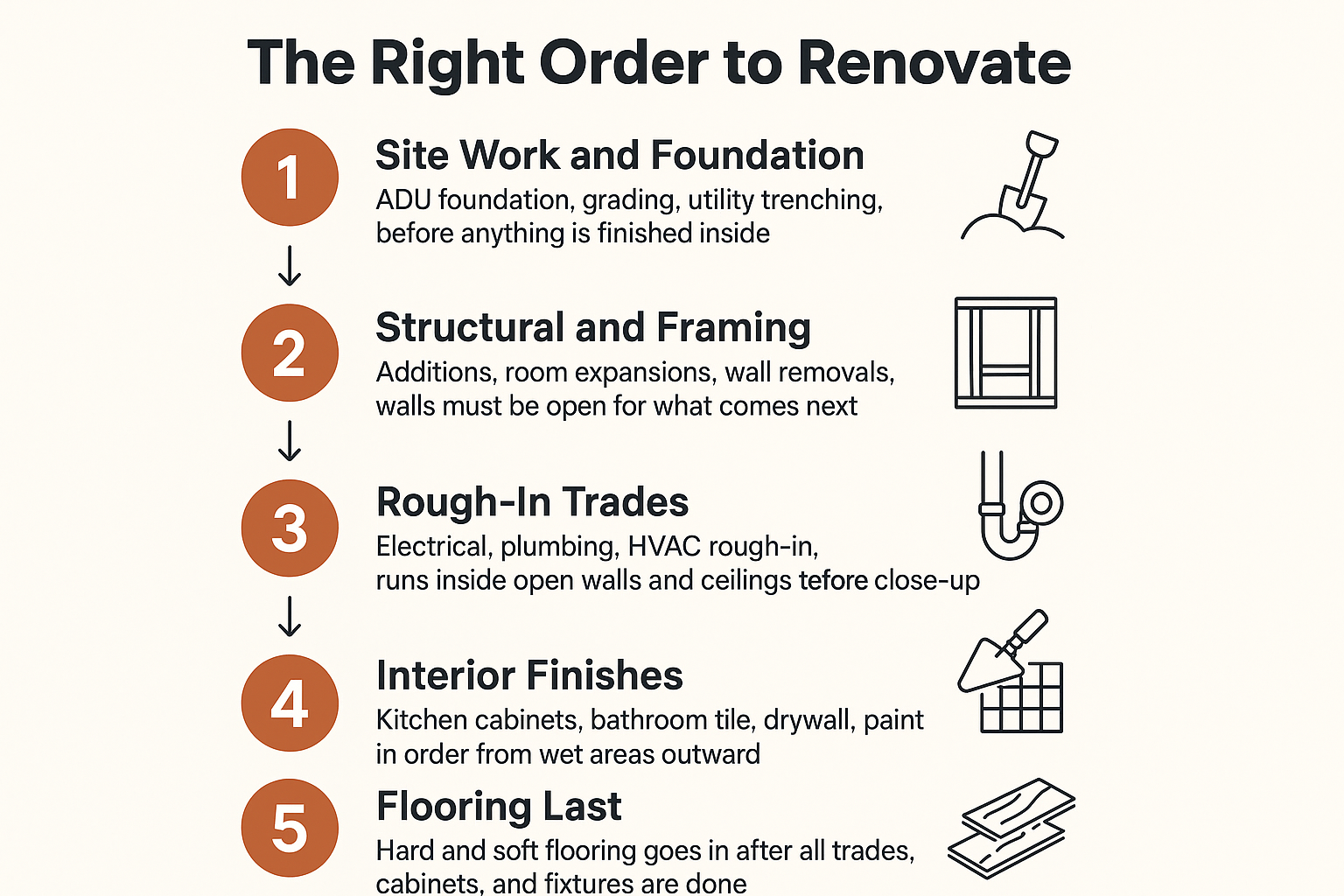
This flow shows the general order of operations for a multi-scope renovation where structural work, interior remodeling, and finish work all need to happen on the same property.
Living in the House While It’s Under Construction
Living through an active renovation is the norm on the Central Coast, most homeowners aren’t leaving for a hotel while their kitchen gets redone. But the sequencing of your projects has a direct impact on how livable your house is during each phase.
The most important thing I tell homeowners planning both a kitchen remodel and a bathroom remodel in the same season: make sure you always have at least one functional bathroom and some way to prepare food. That sounds obvious. But it’s easy to schedule yourself into a corner if you haven’t mapped out which rooms will be offline and for how long.
Here’s what I usually recommend for phasing interior projects when someone is staying put:
- Tackle one wet area at a time. Kitchen and bathroom demolition happening simultaneously is the fastest route to a genuinely difficult daily situation. Stage them back-to-back, not side by side.
- Sequence the bathroom with the lesser-used one first. If you have a hall bath and a master bath, finishing the hall bath first gives you a functioning space while the master is under construction.
- Plan flooring as the last interior phase. New flooring goes in after cabinets are set, fixtures are installed, and painting is done. Installing it earlier just puts it at risk from the remaining work.
- Set up a temporary kitchen space before demo starts. A countertop, a microwave, and a coffee maker in the dining room goes a long way over a four-to-eight-week remodel timeline.
One customer reviewed their multi-room project and noted that the team was “experienced, courteous, and respectful of our home, which was especially important since we lived in it during the renovations.” That’s the standard the work should be held to, livability isn’t sacrificed just because construction is happening.
How to actually get through a kitchen remodel without losing your mind goes deeper on the daily-life side of managing an active kitchen remodel.
The Seasonal Window and Why It Changes the Order
Salinas is dry from roughly late May through early October. That stretch is the optimal window for outdoor and exterior work, ADU site prep, foundation pours, exterior framing, utility trenching. Once the rains come back in November, exterior work slows down and scheduling gets harder.
A homeowner who starts planning in July with a realistic goal of completing the outdoor and structural phases before November is working with the weather. One who plans to break ground on an ADU in October is likely to face delays that push the whole project into the following spring.
The practical implication for sequencing: if you have both exterior and interior work planned, push the exterior phases first into the summer window. Interior work, kitchen remodeling, bathroom remodeling, flooring, finish carpentry, can run any time of year. It doesn’t need the dry season the way foundation work and framing do.
This also means your planning timeline should start earlier than you think. According to California’s Department of Housing and Community Development, ADU permits and approvals involve multiple steps. Factoring in design, permit submission, review, and approval before a single shovel goes in the ground means a homeowner targeting a summer exterior construction window should be in conversations with a contractor by late winter or early spring at the latest.
For projects involving ADUs specifically, what Salinas homeowners need to know before sizing an ADU covers the planning-phase decisions that affect what you can build and when.
Renovation Phase Timing: What Can Run Year-Round vs. What Needs Dry Season
This table shows which project phases are tied to seasonal conditions and which can be scheduled any time, useful for building a realistic multi-phase plan in Monterey County.
| Project Phase | Best Window in Salinas Area | Can It Run in Wet Season? |
|---|---|---|
| ADU site prep and foundation | May through October | No, soil and pour conditions matter |
| Exterior framing and roofing | June through September | With caution, risk of weather delays |
| Utility trenching and hookups | May through October | Generally no, open trenching in rain causes problems |
| Kitchen remodel (interior) | Year-round | Yes, fully interior scope |
| Bathroom remodel (interior) | Year-round | Yes, fully interior scope |
| Flooring installation | Year-round | Yes, but watch humidity for hardwood |
| Interior electrical and plumbing | Year-round | Yes, not weather-dependent |
What a Multi-Scope Project Actually Looks Like to Manage
I’ve seen form submissions from homeowners describing scopes that include a kitchen remodel, bathroom addition, flooring replacement, and a backyard ADU on the same property. One described needing to remodel the main house and garage alongside building an ADU. These are not simple single-trade projects, they are sequencing problems, and they need to be planned that way from day one.
The homeowner who tries to manage each contractor independently almost always runs into the same set of problems:
- One trade’s schedule doesn’t account for what the next trade needs
- Inspections create bottlenecks no one anticipated
- Materials get delivered into spaces that aren’t ready for them
- Finish work gets damaged by later rough-in work
A general contractor who handles all the trades under one contract solves this not because of some special authority, but because one person is responsible for the whole schedule. When a plumbing inspection slips, the GC adjusts the tile schedule. When a material delivery is delayed, the cabinet installation gets moved rather than left idle.
For readers thinking through what this coordination actually involves, what separates a renovation that goes smoothly from one that doesn’t is worth reading before you finalize your plan.
Frequently Asked Questions About Renovation Sequencing
Can we do the kitchen and one bathroom at the same time?
You can, but it takes careful planning. If you’re doing both, make sure at least one bathroom stays fully functional throughout. The bigger risk is that two major wet-area projects running simultaneously means more trades on site at once, which strains scheduling and inspection timelines. If your budget allows for running them in parallel with a GC managing the coordination, it can work. If you’re trying to manage it yourself, I’d stage them back-to-back.
Why does flooring have to go in last?
Because everything that comes before it creates risk for the floor. Cabinets being set, fixtures going in, paint being sprayed or rolled, heavy tool bags being moved through the house, all of it can scratch, dent, or stain new flooring. Installing it last means it only gets walked on when the work is done, not during it.
How far in advance do we need to plan a multi-scope project in Monterey County?
For a project that includes an ADU alongside interior work, plan on starting conversations with a contractor at least four to six months before you want construction to begin. Between design, permit submission, agency review, and approval, particularly in Monterey County where multiple agencies may be involved, the pre-construction phase takes time. Interior-only projects like a kitchen or bathroom remodel typically have a shorter lead time, but they still benefit from early planning.
What if we want to start the ADU but can’t afford to do the interior renovations yet?
That’s actually a reasonable sequencing choice. Building the ADU first, particularly during the dry summer window, keeps the heavier exterior work out of the main house’s disruption zone. Interior remodeling can be scheduled later without losing anything, in fact, if the ADU starts generating rental income first, some homeowners use that toward financing the interior work.
Does the order of projects change if we’re in the Coastal Zone?
Yes, it can. Properties in Monterey County’s Coastal Zone face additional permitting steps, coastal development permits, sometimes environmental health review, that don’t apply to standard inland parcels. This can extend the pre-construction phase significantly. If your property falls in the Coastal Zone, sequencing the permit applications needs to happen earlier, and you should build more buffer into your project timeline.
Planning a Multi-Phase Project in Monterey County?
If you’re looking at a combination of interior remodeling and an ADU, or just trying to figure out which project should happen first, a conversation early in the process saves real headaches later. The team at Aldridge Construction works through multi-scope sequencing regularly across Salinas, Santa Cruz, Hollister, and surrounding communities. You can reach us at 831-682-9788 or through the contact page at aldridgeconstruction.biz.