
Direct Answer: No. The CalHFA $40,000 ADU grant has been fully allocated since December 2023, with no new round announced. It also never paid for construction, only pre-development costs like design and permits.
The number $40,000 lands in my inbox two completely different ways, and the people sending it are asking two completely different questions.
One homeowner here in Salinas wrote in asking, more or less, whether they could build an ADU for around forty grand. That is a budget question. Other folks write in because they read about the state’s $40,000 ADU grant and assume the money is sitting there with their name on it.
Both deserve a straight answer, and almost nobody publishing on this topic gives one. So here is the current grant status, what that money actually covered, and what an ADU in Monterey County really runs when you add up the real parts.
What the $40,000 California ADU Grant Actually Paid For
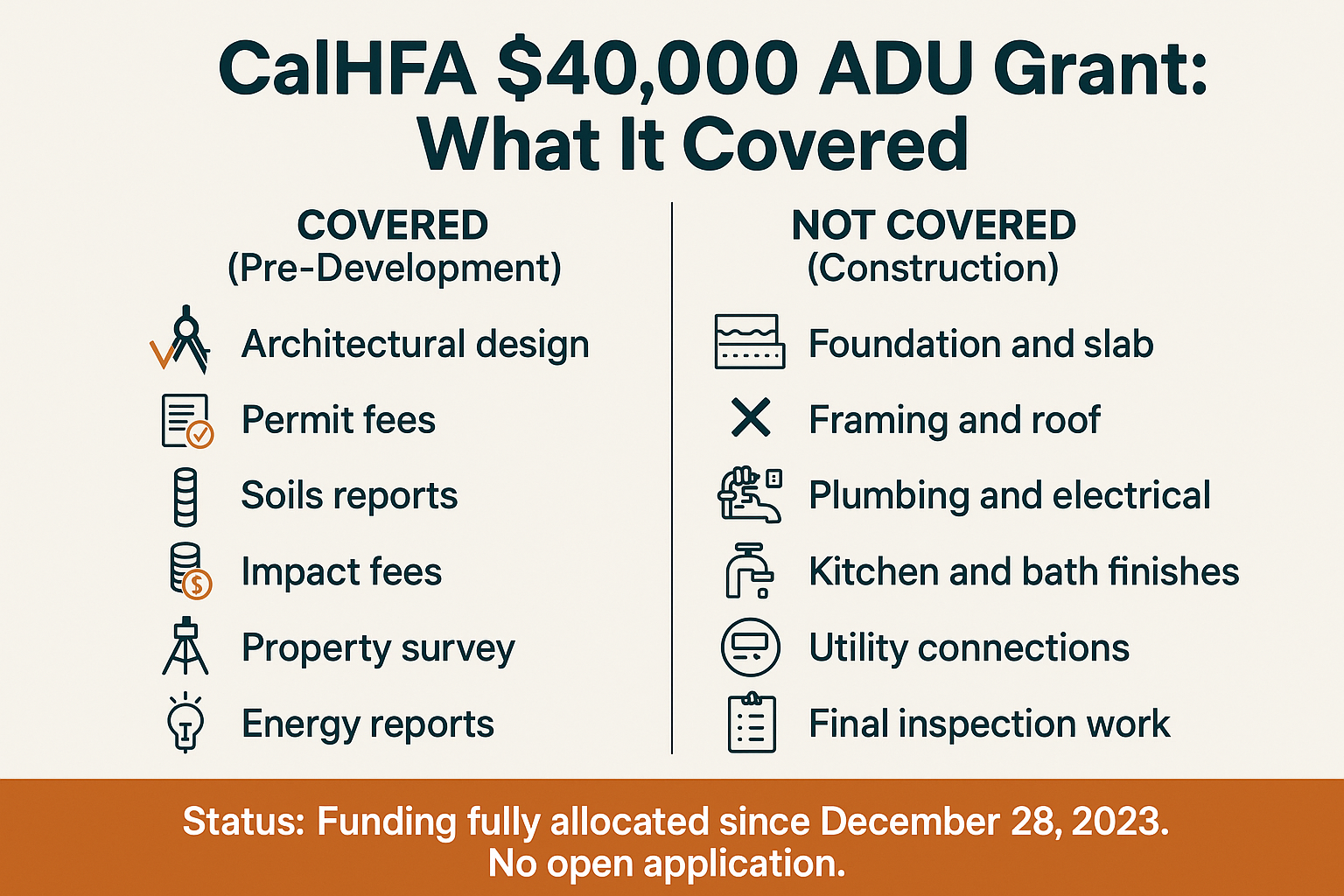
The program people are thinking of is the CalHFA ADU Grant Program. It reimbursed eligible homeowners up to $40,000, but only for pre-development and non-recurring closing costs.
That covered things like:
- Architectural design and drawings
- Permit fees
- Soils reports
- Impact fees
- Property surveys
- Energy reports
Notice what is missing. It never paid for construction. Not framing, not plumbing, not cabinets, not the final inspection. It was money for the paperwork stage, which is exactly the stage most homeowners underestimate.
As for whether you can still apply: the official CalHFA ADU Grant Program page has carried the same notice since December 28, 2023 stating that the latest round of ADU funding was fully allocated. As of mid-2026, there is no open application and no announced new round.
CalHFA has also warned that anyone telling you they can still secure this grant for you may be running a scam. I would take that warning seriously. If a builder, lender, or online ad promises you grant money, close the tab and check the state page yourself.
Could a New Round Open Up Later?
Maybe. Grant funding rides on state budget cycles, so a future round is possible. But nothing has been announced, and I am not going to guess at it.
Here is my honest advice for anyone planning a 2027 project: do not build $40,000 of imaginary money into your math. If a round opens and you qualify, great, that is a bonus. If you planned around it and it never comes, you are $40,000 short before you pour a foundation.
Two things worth doing instead:
- Check the CalHFA page yourself before you believe any contractor, lender, or ad that says otherwise.
- Ask your own city or county about local permit fee reductions, deferrals, or pilot programs.
That second one matters more than people expect. Fee relief is not uniform across Monterey, Santa Cruz, San Benito, and Santa Clara Counties. What Salinas does is not what Hollister does, and the Peninsula cities each run their own show. One phone call to your permit counter is worth more than an hour of reading blog posts, including this one.
Now the Other Question: Can You Build an ADU for $40,000?
I want to answer this kindly, because the homeowner who asked it was not being unreasonable. They just had not seen the parts list.
A new detached ADU is a small house. It has its own foundation, framing, roof, insulation, drywall, plumbing, electrical, kitchen, bathroom, utility connections, and its own round of inspections. On the Central Coast, general market context puts that kind of build well into six figures rather than five.
A garage conversion usually lands lower, and the reason is simple. The slab, the walls, and the roof already exist, so you are paying to upgrade and finish rather than to build from nothing.
That is exactly why so many inquiries I get start with an existing 400 to 500 square foot detached garage in Salinas, Seaside, or Marina. It is the most common starting point around here.
The things that actually move your number up or down:
- Detached new build versus conversion of existing space
- Distance from the main house to the panel, sewer, and water line
- Whether your electrical panel has capacity or needs an upgrade
- Slope, soil, and access for equipment
- Finish level, which is the one part you fully control
If you want the longer breakdown, I wrote about what an ADU actually costs in Monterey County and about how garage conversions compare to detached builds. But no article replaces someone standing on your lot.
What the Grant Covered, and What It Never Did
This is the split that trips up most homeowners who call about the grant. The money was aimed at the front end of a project, not the build.
The Soft Costs Nobody Budgets For
The grant pointed straight at soft costs for a reason. That is where homeowners get blindsided.
Before anyone frames a single wall, you are paying for drawings, a site plan, plan check, and permit fees. On rural parcels you may add a soils report or septic design. Then comes utility coordination, which has its own calendar.
And on the Monterey Peninsula, there is a water permit that has to be in hand before a building permit can issue. I have covered how that water permit works separately, because it surprises people every single time.
Here is the part that makes flat-rate estimates useless. A ranch property outside San Juan Bautista adding a septic system and a Salinas backyard tying into city sewer are not carrying the same pre-construction bill. Same square footage, very different front end.
Utilities deserve their own mention. One homeowner I worked with had a garage conversion run longer than planned, and she said plainly in her review that the delay came down to PG&E’s scheduling and availability, not the crew. That is normal here. The PG&E step holds up more ADUs than framing does.
One way to trim design cost is a pre-approved plan program, where some jurisdictions keep stock ADU plans already vetted. They help, but only if the plan actually fits your lot. I broke down pre-approved plans versus custom drawings if you are weighing that choice.
Pre-Construction Cost Drivers, Side by Side
Two properties can be the same size and still carry very different paperwork bills. This is what changes the front-end number.
| Pre-construction item | What it is | What pushes it higher |
|---|---|---|
| Design and drawings | Architectural plans and site plan for submittal | Custom design, tight lots, two-story or attached units |
| Plan check and permit fees | Agency review and issuance costs | Jurisdiction, valuation of the project, impact fees |
| Soils and site reports | Geotech or soils work where required | Slope, fill soil, rural parcels, expansive soils |
| Septic or sewer | Wastewater connection or system design | Septic design and environmental health review outside city limits |
| Water permit | Required on the Monterey Peninsula before a building permit | Added fixture units, water credit availability |
| Utility coordination | New meter, panel capacity, service upgrade | Utility scheduling, long trench runs, panel upgrades |
How People Around Here Are Actually Paying for It
I am a contractor, not a lender, so take this as what I see in the field rather than financial advice.
Home equity is the most common lever. One homeowner in Santa Cruz planning a phased renovation plus an ADU told me straight out they were funding it with a HELOC.
Others use construction loans that release money in draws as work gets completed and inspected. And plenty of people simply phase the work, splitting it across two budget years so the spending does not land all at once.
The useful thing a builder brings to a financing conversation is not money. It is an accurate scope, so the loan amount matches the actual project instead of a rough guess that leaves you short in month four.
That also applies if you are dealing with existing space that was never permitted. Legalizing an unpermitted unit is its own budget category, and I wrote about what happens when you buy a house with an unpermitted unit.
The Cheapest Bid Is Rarely the Cheapest Project
Money and craftsmanship are the same conversation. A low number from an unreliable builder is the most expensive outcome available, because you pay twice and wait longer.
Aldridge Construction holds California license #1081584, and Brian is a third-generation contractor. We take on the work that catalog ADU builders tend to turn down:
- Garage conversions on older detached structures
- Attached units on tight lots where a stock plan will not fit
- Bringing existing unpermitted space up to code
One homeowner put it about as plainly as anyone could in a review: “it was nice to see somebody get the job done efficiently and not empty my bank account.”
That is the balance worth aiming for. Not the lowest bid, and not a blank check. A real number, built on a real walkthrough of your lot.
Frequently Asked Questions About the $40,000 California ADU Grant
Is the $40,000 ADU grant coming back in 2027?
Nobody can honestly tell you yes. Grant funding depends on state budget cycles, so a new round is possible, but none has been announced. Check the CalHFA page yourself before you plan around it.
A contractor told me he can still get me the grant. Is that real?
CalHFA has warned that anyone claiming they can still secure the grant may be running a scam. The program page has said funding was fully allocated since December 28, 2023. Verify it directly on the state site, not through whoever is pitching you.
Could I have used the grant to pay for the actual construction?
No. It reimbursed pre-development and non-recurring closing costs only, things like design, permits, surveys, soils reports, impact fees, and energy reports. Construction was always on the homeowner.
Is a garage conversion really cheaper than building a detached ADU?
Usually, yes. You already have the slab, walls, and roof, so you are upgrading and finishing instead of building from scratch. That said, an old garage can hide bad footings, low ceilings, or a panel with no room left, and those findings change the number. It is one of the reasons I want to see the building before I quote it.
What should I have ready before asking a contractor for a real estimate?
Your parcel number, a rough idea of size and bedroom count, whether you are on city sewer or septic, and where your electrical panel sits. That is enough to have a grounded first conversation.
Getting a real number for your own lot
Grant money may or may not return, but your lot, your sewer line, and your panel are knowable today. Our team walks properties across Monterey, Santa Cruz, and San Benito Counties, and we are happy to talk through what your site actually requires before you commit to anything. You can reach us at 831-682-9788 or through the contact page at aldridgeconstruction.biz.