
Direct Answer: SB 1117 would charge ADU impact fees only on interior livable space above 750 square feet, for the first two ADUs on a lot. If signed, it takes effect January 1, 2027.
Almost every ADU conversation I have in Salinas starts with size. How big can I build, and what does each extra foot cost me? For years, 750 square feet has been the line where the permit bill jumps.
That line may be about to move. A bill sitting on the Governor’s desk right now would change how impact fees get calculated on ADUs, and for a homeowner planning a two-bedroom unit, the difference can run into thousands of dollars.
Below I’ll walk through what SB 1117 would actually do, the dates that matter, what it could mean on a real Monterey County lot, and whether it makes sense to slow your project down and wait.
What SB 1117 would change about California ADU impact fees above 750 square feet
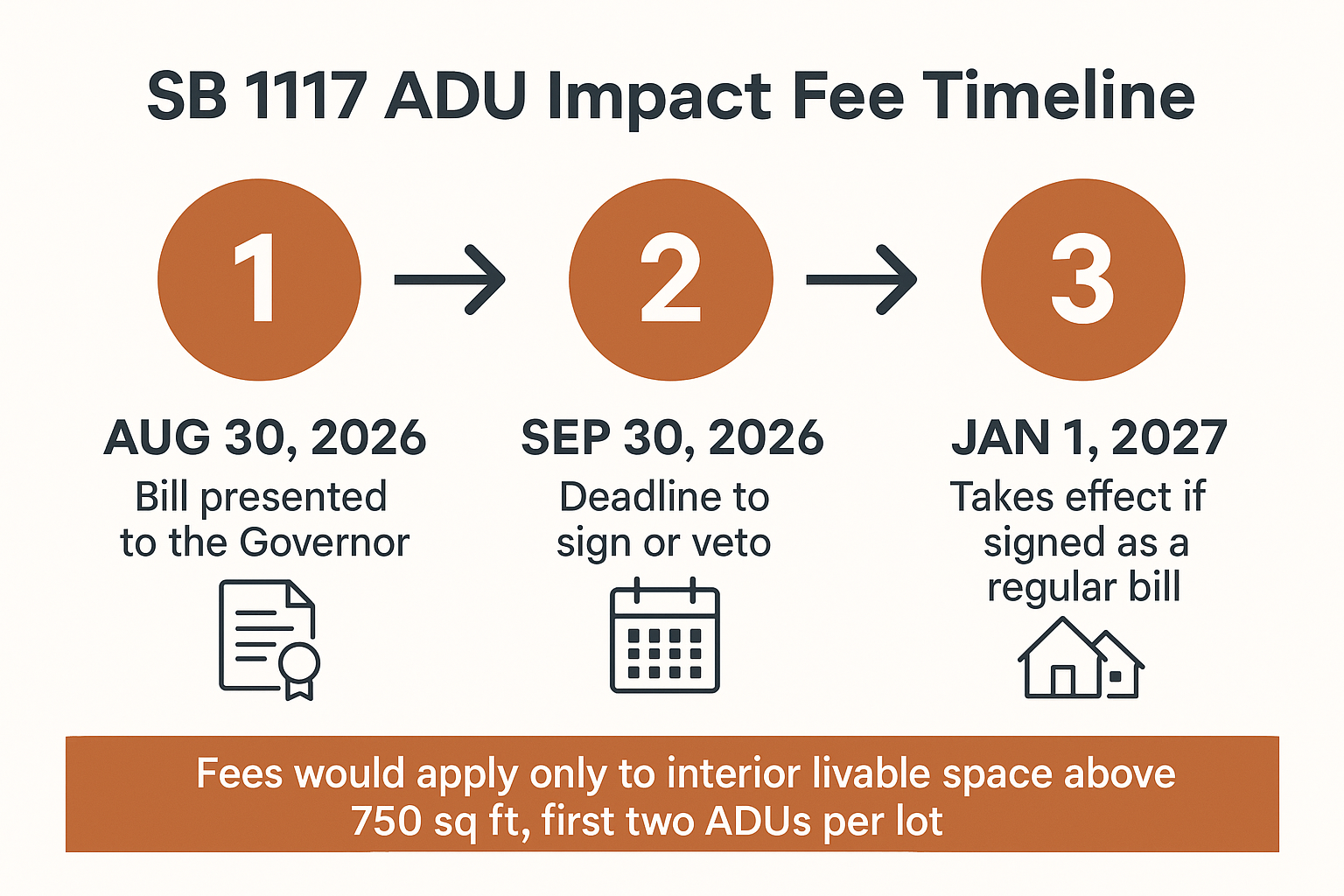
Here is the short version. SB 1117 (Cervantes) passed the Legislature and was presented to Governor Newsom on August 30, 2026. He has until September 30, 2026 to sign or veto it. If he signs it as a regular bill, it takes effect January 1, 2027.
What the bill does: it would require local agencies, special districts, and water corporations to charge impact fees on the first two ADUs on a lot only for interior livable space above 750 square feet.
Today the rule works differently. Existing law bars any impact fee on an ADU with 750 square feet of interior livable space or less, and requires fees on an ADU over that size to be charged proportionately. Once you cross the line, the whole unit is in play, not just the part above it.
So the change is from an all-or-nothing threshold to a marginal one. You can read the bill text and status directly at California Legislative Information. Residential Contractor magazine covered the vote in August 2026, and LeSar Development Consultants tracked it as part of the package sent to the Governor on September 2, 2026.
Until it is signed, it is a bill, not law. I tell homeowners to plan around what is on the books today and treat this as a possible improvement.

What the math looks like on a Salinas lot
Take a 900 square foot two-bedroom ADU, which is close to what a lot of the families who contact me are actually after. One homeowner recently described wanting a real second unit for family, not a studio.
Under today’s rules, that 900 square feet is over the threshold, so impact fees apply to the unit. Under SB 1117, fees would be assessed on 150 square feet instead of all 900.
What that saves depends entirely on your jurisdiction, because impact fees are set locally and stack up from several agencies:
- School district fees, charged per square foot of new living space
- Water and sewer capacity or connection charges from the district serving your parcel
- Park, traffic, and general facilities fees where the city or county adopts them
- Special district fees that vary parcel by parcel
I am not going to hand you a flat number, because I have seen the same size ADU carry very different fee totals a few miles apart in Monterey County. But when you are talking about dropping the assessed area by roughly 80 percent, the swing on a larger unit can easily reach the thousands.
If you want a fuller picture of where the money actually goes on one of these projects, I broke that down in what an ADU actually costs in Monterey County in 2026.
How ADU size affects impact fees, now and under SB 1117
This is a simplified side by side. Actual fee schedules vary by city, county, school district, and water provider, so verify your numbers with the agency that will issue your permit.
| ADU interior livable space | Under current law | Under SB 1117 if signed |
|---|---|---|
| 500 sq ft | No impact fees | No impact fees |
| 750 sq ft | No impact fees | No impact fees |
| 900 sq ft | Fees charged proportionately on the unit | Fees charged on 150 sq ft |
| 1,000 sq ft | Fees charged proportionately on the unit | Fees charged on 250 sq ft |
| Third unit on the same lot | Not covered by the 750 sq ft exemption | Not covered by the first two ADU rule |
The dates that decide this
Three dates control whether this affects your project. Here is the sequence in order.
Should you wait until 2027 to pull permits?
This is the question I expect to hear all fall, so let me give you my honest read.
In most jurisdictions, impact fees are calculated and collected when the building permit is issued, not when you submit plans. Confirm that with your permit counter, because the practice is not identical everywhere in Monterey, Santa Cruz, San Benito, and Santa Clara Counties.
If that holds for your agency, waiting is really a question of timing your issuance date, not your start date. Design and permitting on a Central Coast ADU regularly runs several months once you account for planning review, environmental health if you are on septic, and utility coordination. A project starting drawings this fall may not reach permit issuance until 2027 anyway.
When waiting is worth pricing out:
- Your planned unit is meaningfully larger than 750 square feet
- Your local fee schedule is on the heavy side
- You are early in design and have no hard move-in deadline
When I would not wait:
- Your unit is at or under 750 square feet, since it is already exempt
- You are housing a family member on a set timeline
- Your plans are already through review and ready to issue
There is a cost to waiting too. Labor and material pricing does not stand still, the 2025 California Building Standards Code took effect January 1, 2026, and code cycles keep moving. Sitting on a project for a fee break you might not get is a real risk while the bill is still unsigned.
If size is what you are wrestling with, sizing an ADU is worth reading before you lock a footprint.
What this bill does not touch
Impact fees are one line on the permit bill. SB 1117 does not change the parts of an ADU project that most often cause delay around here.
Still in play regardless of what the Governor does:
- Setbacks, height limits, and zoning on your specific parcel
- Coastal Zone permits in Monterey and Santa Cruz County coastal areas
- Environmental Health review if your lot is on septic
- Water permits, which on the Monterey Peninsula come before a building permit
- PG&E service and meter coordination, which delays more builds than framing does
One homeowner who hired us for a garage conversion said it plainly in a review: the project ran a little long, and the reason was utility scheduling, not the crew. That is the normal shape of an ADU schedule on the Central Coast.
Two pieces worth reading if those apply to you: the water permit that comes before a building permit in Monterey and Carmel and the PG&E step that holds up more ADUs than framing does.
Frequently Asked Questions About the 750 Square Foot ADU Impact Fee Rule
Is SB 1117 law right now?
No. It passed the Legislature and was presented to the Governor on August 30, 2026. He has until September 30, 2026 to sign or veto it. If signed as a regular bill, it would take effect January 1, 2027.
Does this apply to every ADU on my property?
The bill covers the first two ADUs on a lot. A third unit would not fall under that provision.
My ADU is 700 square feet. Does anything change for me?
Not really. Existing law already prohibits impact fees on an ADU with 750 square feet of interior livable space or less, so you are exempt either way.
Would this lower my property taxes too?
No. Impact fees and property taxes are separate. Adding an ADU triggers a reassessment of the new construction value, which is a different calculation handled by the county assessor.
How do I find out what my impact fees would actually be?
Call the building or planning department for the city or county where your parcel sits, and ask for the current fee schedule for a new ADU at your square footage. Ask your water and sewer providers separately, since those charges often come from a district rather than the city. Fee schedules change, so get the current one in writing.
Thinking through the timing on an ADU?
If you are weighing a unit over 750 square feet in Salinas, Monterey, Santa Cruz, or Hollister, it is worth mapping your permit issuance date against what the Governor decides by September 30. Brian and the team at Aldridge Construction are available to walk your property, look at your parcel’s constraints, and talk through what the schedule realistically looks like. You can reach us at 831-682-9788 or through the contact page at aldridgeconstruction.biz.