
Building an Accessory Dwelling Unit (ADU) is a smart investment. However, stories about unexpected project delays are common. To avoid ADU delays, you need to understand the realistic, step-by-step timeline. A typical project in Monterey or Santa Cruz County takes between 9 to 12 months from the first sketch to the final sign-off.
The most unpredictable stage is almost always getting the permits. With ADU permits up 20x in California, knowing the schedule is key for homeowners balancing rental goals, family needs, or elder care.
Mapping Your Realistic ADU Project Timeline
Homeowners across California want to know how long their ADU project will actually take. Vague national estimates don't work here. They often create unrealistic expectations and lead to frustration when local Monterey Bay realities set in.
An ADU isn't a simple remodel—it's a small new home build. It involves multiple phases, several city departments, and potential hurdles that can pop up along the way. Many online guides oversimplify this, focusing only on the construction phase and ignoring local permitting or site-specific issues.
A well-managed project breaks down into four stages: design, permitting, construction, and final inspections. A local expert who knows how to anticipate challenges in places like Santa Cruz or San Benito County is essential.
ADU Project Timeline at a Glance
Here is a high-level look at the four main phases of an ADU project. This table shows typical timelines and common reasons for delays.
| Project Phase | Typical Duration | Common Delay Factors |
|---|---|---|
| Design & Engineering | 4 – 7 weeks | Homeowner indecision, complex design changes, slow turnaround from engineers. |
| Permitting | 8 weeks – 6 months | City/county backlogs, incomplete applications, requests for plan corrections. |
| Construction | 4 – 6 months | Bad weather, material shortages, subcontractor scheduling conflicts, failed inspections. |
| Final Inspection & Sign-Off | 1 – 3 weeks | Final inspector availability, last-minute correction requests ("punch list" items). |
The permitting phase has the widest time range. It's the "wait-and-see" part of the process that requires patience and perfectly prepared plans.
This infographic shows the typical flow of an ADU project, from design and permitting to the final construction phase.
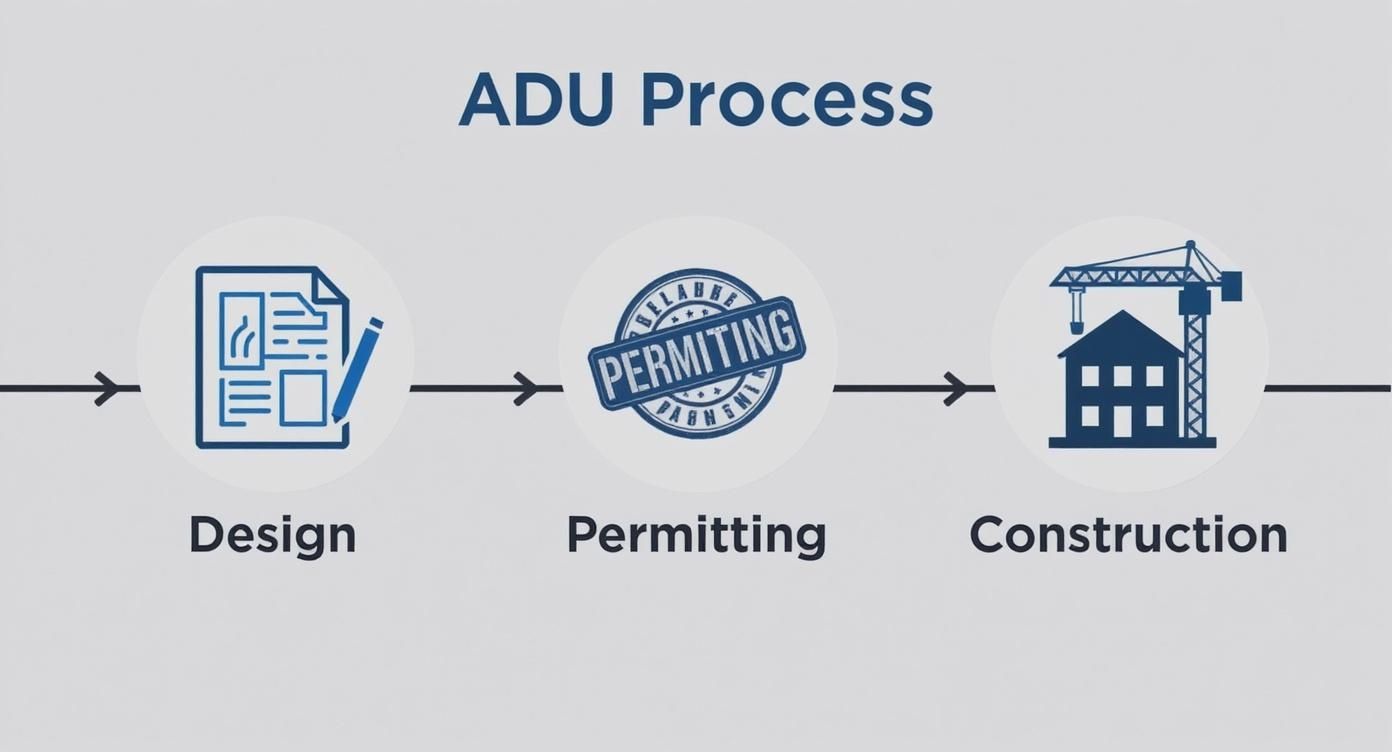
Permitting is the critical bridge between your dream design and the actual build. It's also where the most significant delays can happen.
One of the first steps is assessing the buildability of your land. This helps you spot roadblocks—like tricky utility hookups or a steep slope—before they derail your timeline and budget.
For a broader look at construction schedules, check out our guide to the general home construction timeline.
Laying the Groundwork with Planning and Design
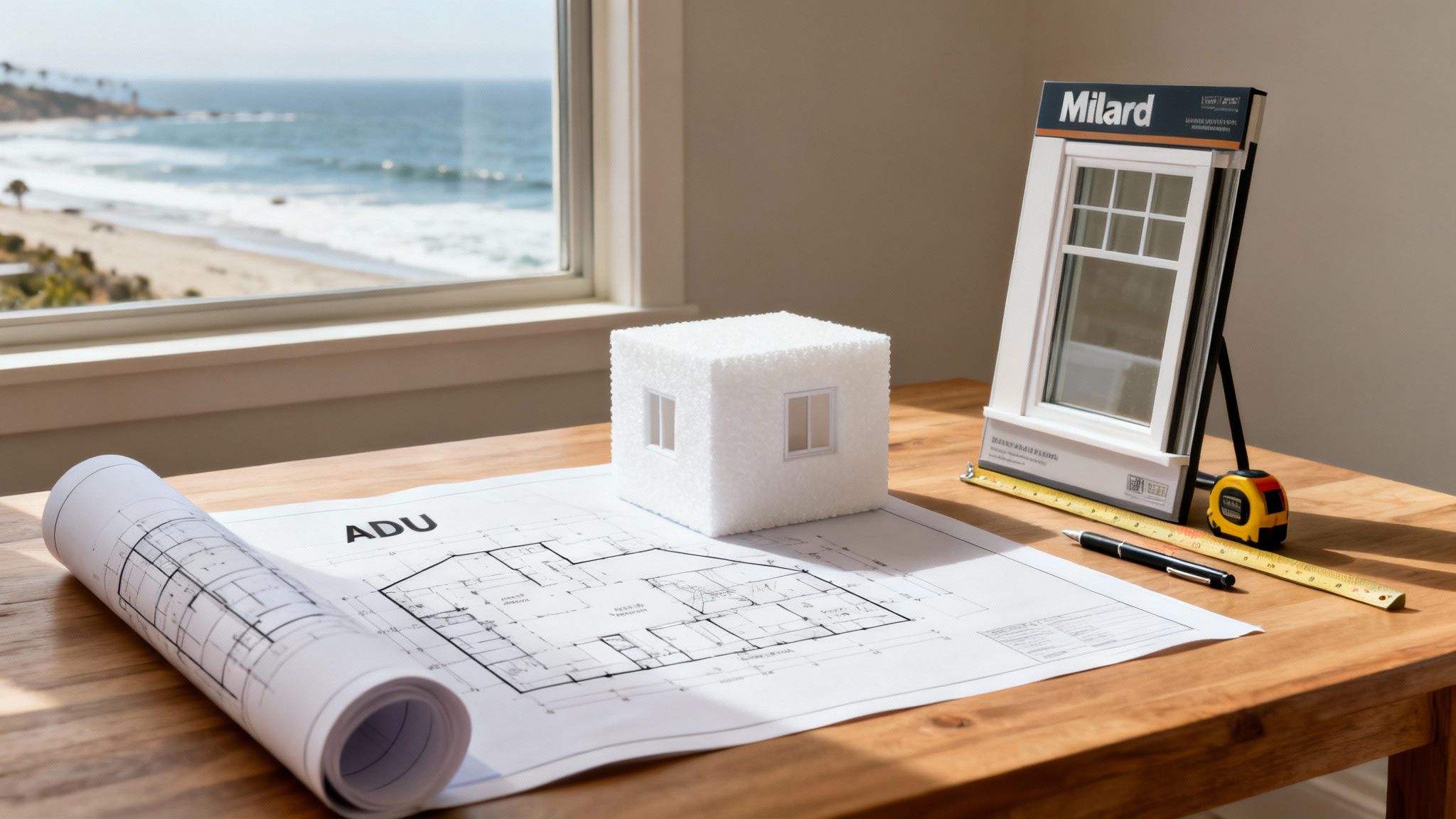
This is where your vision becomes real. The decisions you make now will either set your project up for success or cause major headaches. A great ADU project starts with a solid plan.
Everything decided here—from layout to materials—directly impacts your budget and timeline.
To truly avoid ADU delays, we start every project with a detailed site evaluation. This is a professional deep dive into your property's conditions in Monterey, Santa Cruz, or San Benito County. We look at everything: soil quality, access for construction vehicles, and utility locations.
Figuring out where sewer, water, and electrical lines are early on prevents expensive surprises later.
Confirming Your Property Is ADU Eligible
Before you get attached to a design, a feasibility study is a must. This confirms your property is eligible for an ADU under local zoning laws. Every city, from Salinas to Santa Cruz, has its own rules for setbacks, lot coverage, and unit size.
A quick feasibility check ensures your vision lines up with what the city will allow.
Pre-Approved Plans vs. Custom Designs
One of the biggest choices is between a pre-approved ADU plan and a custom design. Each path affects your timeline differently.
-
Pre-Approved Plans: Jurisdictions like Monterey County offer pre-approved ADU plans. Since the city has already signed off on the design, this can shorten the plan review process. It's a great option for a faster, more predictable path to your permit. Aldridge Construction has experience working with these plans to streamline projects.
-
Custom Designs: A custom ADU offers total creative freedom. You can match your main home's architecture or design a space for specific family needs. This means a longer design phase and a more thorough review by the city.
The right choice comes down to your priorities. If speed is the goal, a pre-approved plan is best. If your unique vision is non-negotiable, custom is the way to go—but you must build extra time into the schedule.
Finalizing Your Budget and Design
The final step is locking in a realistic budget and a design that works for you. This is when we select materials, balancing quality and cost. We help clients choose everything from durable Quartz countertops to energy-efficient Milgard windows.
The design must also comply with California's Title 24 energy requirements. It is critical to finalize these details before submitting plans. Changing your mind after plans are with the city is a guaranteed way to add weeks or months to your timeline.
For inspiration, you can explore ADU design ideas to see what’s possible.
Navigating the Permitting Maze
Once your design is finalized, your project enters the permitting process. This is often the most unpredictable stage. Your plans go to the city or county for review.
A small mistake here can lead to big delays. Understanding this phase shows why a complete, professional submission is your best tool to avoid ADU delays.
Who Reviews Your ADU Plans
Getting a permit isn't a single-stop process. Your plans will go through several city departments. A delay in any one department can put your project on hold.
In places like Salinas or Santa Cruz, your plans will be reviewed by:
- The Planning Department: They confirm your ADU design complies with local zoning rules like setbacks, height, and lot coverage.
- The Building Department: This team focuses on safety. They ensure your plans meet the California Building Code and Title 24 energy standards.
- Public Works or Engineering: This department checks drainage, sewer connections, and any impact on public sidewalks or streets.
A professional submission package provides clear information for all three departments.
The Plan Check and Correction Cycle
After you submit, your project enters the plan check phase. A city plan reviewer will look for any issues. It is rare for a custom ADU plan to be approved on the first submission.
Often, the city returns plans with a list of corrections. This is where delays happen. An incomplete response can send your plans to the back of the queue, adding weeks or months to your wait.
Our experience with local planning offices in Monterey Bay means we understand what they look for. We know how to interpret their comments and make the right revisions, which reduces back-and-forth cycles.
While state law aims for a 60-day review period, local factors can extend this. Local knowledge is crucial.
Why Relationships and Reputation Matter
Working with a builder who has relationships with local planning officials is a big advantage. When plan checkers are familiar with a contractor's quality work, it can build trust and help move projects along.
This doesn't mean skipping steps. It means having a direct line of communication to quickly clarify an issue. A phone call from a trusted local builder can often solve a problem that might otherwise take weeks.
For a deeper dive into the rules, you can review the essential California ADU requirements.
Bringing Your ADU to Life During Construction
With approved permits in hand, the most exciting part begins. This is where plans become a physical structure. The construction phase is all about expert execution and smart project management.
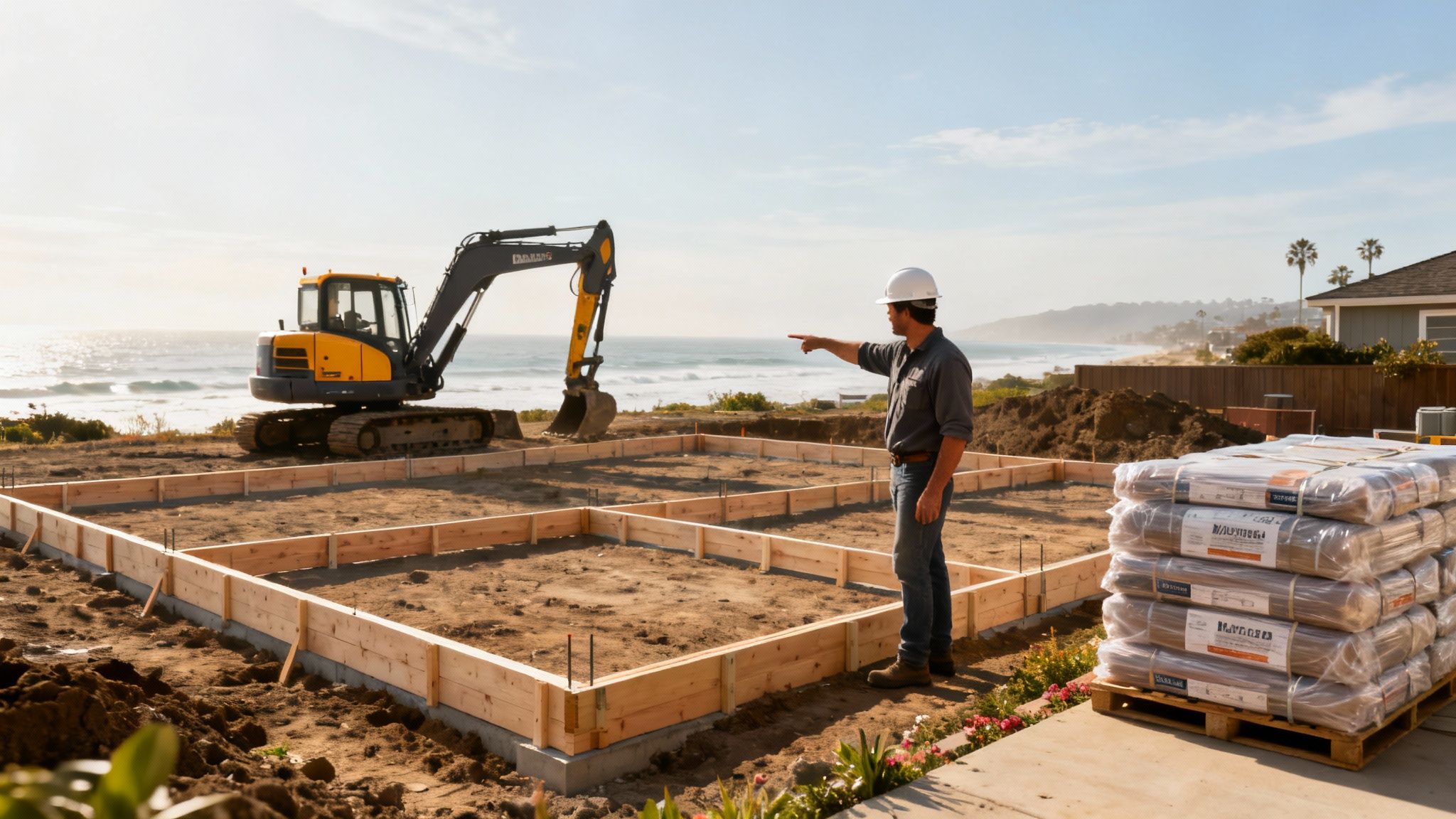
A well-run construction site follows a specific sequence. It's a complex dance of site preparation, skilled trades, material deliveries, and city inspections.
Knowing the steps and potential hurdles is the best way to ensure a smooth build.
Breaking Ground and Building the Shell
The first work you'll see is site preparation. This involves clearing the area and grading the land. For homeowners in the Monterey Bay area, we schedule this work to avoid the rainy season, which can cause long delays.
Next, we pour the concrete foundation. This is the first of many crucial inspections. A city inspector must verify the footing and steel reinforcement before any concrete is poured.
After the foundation cures, the framing goes up quickly. The walls and roof of your ADU take shape in a matter of days. We then install the roofing and wrap the exterior to protect the structure.
Installing the Core Systems
With the structure in place, we focus on the systems that turn a shell into a home. This involves specialized subcontractors for mechanical, electrical, and plumbing (MEP).
- Plumbing: We run all water supply and drain lines through the walls and floors.
- Electrical: Electricians run wiring for every outlet, switch, and light.
- Mechanical (HVAC): The heating, ventilation, and air conditioning systems are installed.
These three systems are installed at the same time and require careful coordination. After this "rough-in" stage, another round of city inspections is needed. You can't put up drywall until every trade gets a green light.
The Critical Role of Proactive Management
Efficient project management separates a smooth timeline from a frustrating one. At Aldridge Construction, we order long-lead items like windows and custom cabinetry months in advance to avoid supply chain disruptions. We also rely on trusted subcontractors in the Salinas and Monterey areas.
Clear and consistent communication is key. We keep you informed at every milestone and maintain a professional relationship with city inspectors. This helps resolve issues quickly.
For anyone planning a project, getting familiar with ADU construction in Salinas and Monterey is vital.
Common Construction Delays and How to Mitigate Them
Even with the best plans, issues can pop up. Here are common delays and the strategies we use to keep your project on schedule.
| Potential Delay | Impact on Timeline | Our Mitigation Strategy |
|---|---|---|
| Material Shortages | 2-8 weeks | We order long-lead items like windows and appliances during the permitting phase so they arrive on time. |
| Weather Events (e.g., Rain) | 1-3 weeks per event | We schedule exterior work like grading around seasonal weather patterns in Monterey Bay and Maricopa County. |
| Failed Inspections | 1-2 weeks per failure | Our knowledge of local codes minimizes failures. If corrections are needed, we address them immediately. |
| Subcontractor Scheduling | 1-4 weeks | We maintain a roster of trusted local subcontractors and schedule their work far in advance. |
By anticipating these challenges, we deliver your ADU with fewer surprises.
Wrapping Up: Final Inspections and Project Handover
You've made it to the home stretch. The construction is done, and your new ADU is starting to feel real. But before you get the keys, there are a few final steps: inspections and the project handover.
This is where every detail gets a final check to ensure your ADU is safe and ready to enjoy.
The Final City Inspection
The last major hurdle is the final building inspection. An inspector from your local city will do a top-to-bottom review. Their job is to make sure everything matches the approved plans and meets all building codes.
The inspector has a long checklist. They look at everything to guarantee safety and quality.
- Electrical Systems: They test every GFI outlet, check smoke detectors, and confirm wiring is up to code.
- Plumbing Fixtures: All sinks, toilets, and showers are checked for proper installation and leaks.
- Structural and Safety: The inspector verifies that railings, stairs, and windows meet safety standards.
Passing this inspection is required to legally occupy your ADU. A failure means more work and delays.
Coordinating Final Utility Hookups
You also need the final green light from the utility companies. The new gas, electric, and water meters need to be activated. This step can cause delays if it isn't scheduled in advance.
Utility providers run on their own schedules. We coordinate these appointments proactively so there's no dead time between passing your inspection and getting the lights on.
At Aldridge Construction, we handle this entire sign-off process for you. We schedule the final inspection and work with utility companies for a seamless transition.
The Final Walkthrough and Punch List
Once all inspections are passed, we do one last walkthrough of the ADU with you. This is our chance to create a "punch list"—a list of any small adjustments that need to be addressed.
It could be a tiny paint scuff or a cabinet door that doesn't close right. This process ensures you are 100% satisfied with our work.
We take that list and get every item fixed promptly. This ensures your ADU project ends on a high note.
Your Partner in Building an ADU on Time
Building an ADU is a big project. The company you choose to guide you makes all the difference. To avoid ADU delays, you need proactive planning and local expertise. A successful project depends on understanding every phase, from navigating coastal building challenges in Santa Cruz to knowing codes in Monterey County.
Choosing the right firm is the most critical decision you'll make. A good partner has a proven track record in your area and can see problems coming. For a detailed guide, Aldridge Construction explains how to find a good contractor.
Your builder should be your project advocate. Their local knowledge is the secret to a smoother, faster build.
To make sure your project stays on track, it’s important to team up with seasoned professionals. It’s worth reading tips on choosing a reliable construction partner so you feel confident in your choice.
Ready to start planning an ADU in Monterey, Santa Cruz, or a nearby community? Talk to a builder who gets the local process from day one.
Common Questions We Hear About ADU Timelines
Homeowners planning an ADU often have the same questions. Here are some straight answers based on our experience building in Monterey, Santa Cruz, and Maricopa counties.
Can I Really Get My ADU Permit in 60 Days?
While California law gives cities a 60-day window to review ADU applications, that clock only starts after your plans are accepted as complete. In reality, the entire journey from first submission to final permit is closer to 3 to 6 months.
Most initial submissions are sent back with requests for corrections. Each round of back-and-forth can add weeks to your timeline. The best way to stay on track is to work with an experienced local builder who knows what the city wants to see.
How Much Faster Is a Pre-Approved or Prefabricated ADU?
A pre-approved plan can give you a head start. Because the core design is already approved by local officials, you can save several weeks on the permitting phase.
A prefabricated ADU speeds up the on-site construction phase. A build that might take six months can be done in two or three. But you still have to go through the full permitting process for the foundation and utility hookups, which takes time.
What Is the Single Biggest Cause of ADU Delays?
The most common and frustrating delays almost always happen during the permitting phase. This is the one stage where you rely on outside parties and are subject to their backlogs and interpretation of building codes.
The number one cause is an incomplete or inaccurate set of plans. Simple mistakes can set off a chain reaction of corrections, adding months to your wait. A close second is an unexpected issue during construction, like poor soil conditions.
How Does Financing Affect My ADU Project Timeline?
Getting your financing lined up should be one of the very first things you do. If you wait until your design is finished, the project will stop right when it should be moving forward. Lenders won't release funds for a construction loan without finalized plans and a signed contract.
Putting off financing can add a 1 to 2 month delay. To avoid ADU delays, we always tell clients to get pre-approved for their loan at the very start of the process.
Do I Need a Separate Address for My ADU?
Yes, in most areas, including Monterey County and Maricopa County, a new ADU must have its own separate address. This is critical for emergency services to find the right unit. It is also needed for mail and separate utility accounts. Your builder should handle the address application as part of the permitting process.
Ready to build your ADU without the guesswork? The team at Aldridge Construction has the local expertise to guide your project smoothly from concept to completion. Contact us today to map out your realistic project timeline and avoid costly delays. Learn more at https://aldridgeconstruction.biz.