
Building an Accessory Dwelling Unit (ADU) is a great way to add space and value to your property. But for many homeowners in areas like Monterey, CA, or Maricopa County, AZ, the biggest question is how to get started. Choosing the right process can make all the difference.
This is where custom ADU design-build services come in. This approach combines the design, permits, and construction into one simple process. It helps you avoid common headaches like delays and surprise costs.
Why Choose Design-Build for Your Custom ADU?
When you decide to build an ADU, you have two main options. The old way is to hire an architect for the plans, then find a separate contractor to build it. This can lead to communication problems and budget issues.
There’s a better way. The design-build model brings everyone together under one roof. Your designers, project managers, and builders work as a single team. This means one company is responsible for your whole project. Your team works together from day one to create a plan that fits your budget.
The Power of a Unified Team
With a design-build firm, the same team that draws your plans also builds them. This simple change helps avoid many common construction problems.
- Clear Budget: Your team can price out materials and labor during the design phase. This gives you a realistic budget much earlier.
- Faster Timeline: Design and construction can overlap. We can start site prep while finalizing permits, saving you weeks or months.
- No Finger-Pointing: You have one contact for every question. No more chasing down different people for answers.
This team-based approach is why we use this process at Aldridge Construction. It works better for homeowners. You can learn more about our integrated design and build services for projects in Monterey, Santa Cruz, and Maricopa Counties.
To help you see the difference, here’s a quick comparison.
Design-Build vs. Traditional Construction for Your ADU
See how the design-build model compares to hiring separate teams for your ADU project.
| Factor | Custom ADU Design-Build (One Team) | Traditional Method (Separate Teams) |
|---|---|---|
| Responsibility | Single point of contact and accountability | Multiple contacts; potential for blame-shifting |
| Budgeting | Real-time cost feedback during design | Design is completed before pricing, risking costly revisions |
| Timeline | Overlapping phases can speed up the project | Sequential process; can lead to longer timelines |
| Collaboration | Designers and builders work together from the start | Communication gaps between architect and contractor are common |
| Risk | The firm owns the risk for the entire project | Homeowner manages risk between two separate contracts |
The design-build method gives you a smoother, more predictable experience.
Meeting Modern Housing Needs
The demand for ADUs is growing fast. People need them for aging parents, rental income, or a home office. In fact, the North American ADU market was valued at $1.6 billion in 2024 and is expected to nearly double by 2035 [Source: Global Market Insights, 2024]. This growth is driven by housing needs in California and Arizona.
A big advantage of design-build is its use of modern tools. For example, leveraging BIM modeling to preempt construction risks lets the team create a digital model of your ADU first. This helps us find and fix problems before construction begins, saving you time and money.
Mapping Out Your ADU Design-Build Journey
Seeing your ADU idea become a real home is exciting. The design-build journey is a clear path with distinct steps. This roadmap keeps everyone on the same page.
At Aldridge Construction, our custom adu design-build services are all about working together. We are with you at every step, making sure your vision and budget are the focus. Let's walk through what you can expect.
Phase 1: Initial Discovery and Site Evaluation
Every great ADU starts with good information. This first phase is about understanding what you want and what is possible on your property.
We start with a detailed conversation to learn your goals. Are you building a rental unit in Salinas? A guest house for family in Maricopa County? Knowing your "why" helps us create the perfect design.
Next, our team does a full site evaluation. We check:
- Local Rules: We research rules in places like Monterey or San Benito Counties for setbacks and height limits.
- Utility Access: We locate existing sewer, water, and electrical lines to plan for efficient hookups.
- Land Conditions: We look at the slope and soil, which can affect your foundation design and costs.
This early work makes sure your project is possible before you spend money on design.
Phase 2: Custom Design and Clear Budgeting
Now we start the creative part. This is where your ideas become a real blueprint.
Our design team works with you to create a custom floor plan and exterior look. We focus on making spaces that are both beautiful and useful. For ideas, homeowners often look at different ADU design ideas to see what styles they like.
Here’s the key difference with design-build: as we design, we also build the budget. Every choice is tied to a real cost. We help you pick materials that fit your budget, offering specific options like:
- Durable quartz countertops for a modern kitchen.
- Energy-efficient Milgard windows to meet California’s Title 24 energy codes.
- Tough luxury vinyl plank flooring that is great for a rental unit.
Key Takeaway: In a design-build process, the budget is part of the design conversation from day one. This gives you cost certainty and stops you from falling in love with a design you can't afford.
This process makes the design-build model a faster, simpler, and more certain path to your finished ADU.
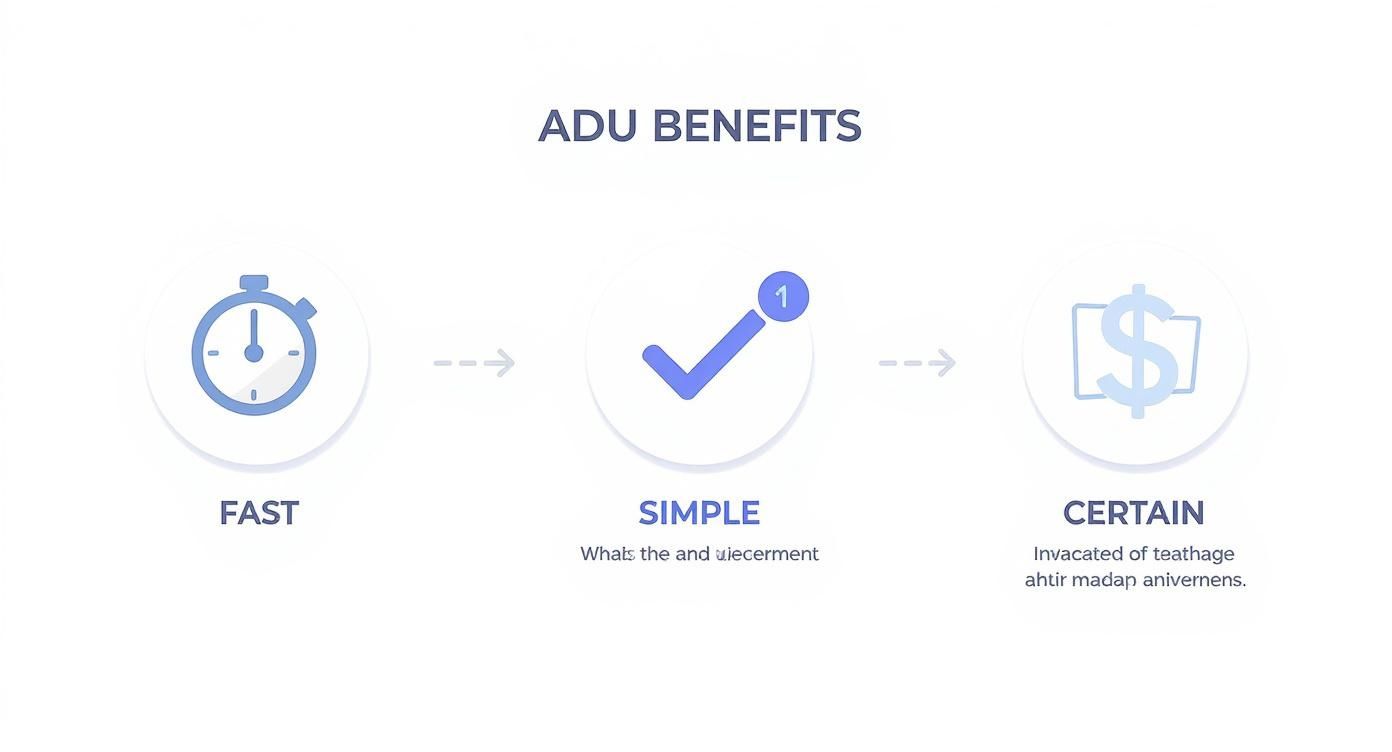
As the infographic shows, bringing every step together makes the journey less stressful for you.
Phase 3: Navigating the Permitting Maze
Once the design and budget are approved, the next step is getting building permits. This can be the most confusing part of a project.
The good news? With a design-build partner, you don't have to do it alone. Our team handles the entire permitting process for you. We have experience working with local building departments in Monterey County, Santa Cruz County, and Maricopa County.
We prepare and submit all the required paperwork, including:
- Complete architectural plans.
- Structural engineering calculations.
- Title 24 energy reports (for California).
- Other documents your city or county might need.
Our knowledge of local rules helps us avoid delays and keep your project on track.
Phase 4: Construction and Consistent Communication
With permits approved, it’s time to start building! Our skilled crew manages every part of the construction, from the foundation to the final light fixture.
Clear communication is our top priority. You’ll have a project manager who gives you regular updates. We believe an informed client is a happy client, so you’ll always know what’s happening.
The build usually follows these key stages:
- Site Prep and Foundation: We clear the land and pour the concrete foundation.
- Framing and Rough-Ins: The structure goes up, and we install plumbing, electrical, and HVAC systems.
- Exterior and Interior Finishes: We install windows, siding, roofing, drywall, flooring, and cabinets.
- Final Touches and Walkthrough: We handle painting and fixtures, then walk through the finished space with you to make sure everything is perfect.
The custom adu design-build services journey is designed to be a smooth and organized experience.
What to Expect with ADU Costs and Financial Payback
When homeowners think about a custom ADU, they always ask about the cost. It’s important to understand the initial investment and the long-term financial benefits.
The final price of an ADU can vary. It depends on the size, type, and finishes you choose.
For example, a new detached ADU in your backyard will cost more than converting a garage. A garage conversion uses an existing structure, which can save money. However, it will still need major upgrades to meet current building codes.
Key Factors That Shape Your ADU Budget
A few key things will drive the total cost of your project.
- Site Prep: Is your lot in Monterey flat, or does it need a lot of grading? The condition of your property plays a big role in the cost.
- Size and Layout: A larger, more complex floor plan costs more than a simple studio layout.
- Level of Finishes: High-end materials like quartz countertops and custom cabinets will increase the budget compared to standard options.
- Utility Connections: The distance from your ADU to the main house's utility lines affects the cost.
For a deeper look at the numbers in our area, check out our guide on the cost to build an ADU.
The Powerful Return on Your Investment
While the upfront cost is important, the financial benefits of an ADU make it a smart investment.
The most obvious benefit is monthly rental income. In markets like Santa Cruz County or Maricopa County, an ADU can generate significant cash flow. That money can help pay your mortgage or provide extra income.
Real-World Scenario: A homeowner in Salinas builds a one-bedroom ADU. By renting it out, they can create a new income stream of over $2,000 per month. This can be a game-changer for their finances.
Boosting Property Value and Creating Flexibility
An ADU also adds real value to your property. It increases your home's living space and adds a legal rental unit, which is attractive to future buyers. This makes your property more valuable in the real estate markets of California and Arizona.
As you plan your project, it's worth exploring all the available construction financing options to find the right one for you.
An ADU also provides personal flexibility. It can be a home for aging parents, a space for adult children, or a private guest suite. This can save your family money on rent or senior care costs.
Navigating Local ADU Rules in California and Arizona
While state laws have made it easier to build ADUs, you still need to follow local rules. Every city and county has its own regulations. A local expert is essential for success.
At Aldridge Construction, we know the local codes in Central California and Arizona. Our experience in Monterey, Santa Cruz, San Benito, and Maricopa counties helps us avoid problems. We design ADUs that follow the rules from the start.
California's Pro-ADU Laws
In recent years, California has passed laws to make it easier to build housing. These state laws set a baseline that all local governments must follow.
For example, cities can no longer use minimum lot size rules to stop projects. They also can't require extra parking if your ADU is near public transit. The state also requires cities to approve or deny an ADU permit within 60 days.
While these laws help, you still need to follow local rules for things like design style. For an overview, it’s worth reading the official California ADU requirements.
Local Nuances in Monterey and Santa Cruz Counties
Even with state laws, the rules in Salinas can be different from the rules in Santa Cruz.
Expert Insight: The biggest mistake homeowners make is assuming state law covers everything. Local governments can still have "objective design standards." This means they can have rules about your siding material or roof style.
Here are a few examples of local rules we handle:
- Setbacks and Height Limits: One town in Monterey County might require a 5-foot side setback, while a nearby town is fine with 4 feet.
- Architectural Overlays: If you live in a historic district, there may be specific design rules for your ADU.
- Fire Safety Regulations: In areas like the Santa Cruz Mountains, you'll need to use fire-resistant materials like non-combustible siding and dual-pane tempered glass windows.
Understanding the Rules in Maricopa County, Arizona
For our clients in Arizona, the rules are different but just as important. Maricopa County and cities like Scottsdale have their own zoning codes.
Unlike California, Arizona's rules are decided at the city and county level. Our team in Maricopa County knows these codes well. We help homeowners with things like:
- Zoning Designations: Your property's zoning will determine the size and type of ADU you can build.
- Permitting Processes: Each city has its own steps for submitting plans and getting permits.
- Utility and Impact Fees: Some cities charge fees to connect your ADU to public utilities.
Trying to figure this all out on your own is tough. A design-build partner brings the experience needed to navigate these rules.
Finding the Right Design-Build Partner
Choosing a partner for your ADU project is the most important decision you’ll make. The right partner will be your guide. The wrong one can lead to stress and costly mistakes.
The global ADU market was valued at $5.2 billion in 2023 and is expected to grow to nearly $14.9 billion by 2032 [Source: Precedence Research, 2023]. This growth means more contractors are entering the field. It's crucial to find a team that provides proven, quality custom adu design-build services.
Vetting Your Potential Builder
To find a team you can trust, you need to do more than just get a price quote. Think of it as a job interview. A good contractor will welcome your questions.
Start with the basics. Any firm you consider must have a state contractor's license and full insurance. If a contractor won't provide these documents, walk away. This is a big red flag.
Key Questions for Any ADU Builder
Use this checklist during your first talks to get a feel for a potential partner.
- Licensing and Insurance: "Can you provide a copy of your contractor's license and insurance?"
- Local ADU Experience: "How many ADUs have you built in Monterey, Santa Cruz, or Maricopa County?"
- Project Portfolio: "Can I see photos of ADUs you've completed that are similar to my idea?"
- Client References: "Could you connect me with a few recent ADU clients?"
- Communication Process: "Who will be my main contact, and how often will I get updates?"
- Handling Changes: "What is your process for managing changes during construction?"
These questions will give you real insight into how a company works. For more tips, check out our guide on how to find a good contractor.
The Importance of Seeing Their Work
Photos are a good start, but seeing a contractor's work in person is better. A confident builder will gladly provide references.
Expert Tip: When you talk to a reference, ask specific questions. Instead of just asking, "Were you happy?" ask, "How did the team handle unexpected problems?" and "Did the final cost match the budget?"
Taking the time to vet your partner will set your project up for success.
Ready to Start Your Custom ADU Journey?
Building a custom ADU is a smart investment. It’s about creating new possibilities for your family and your finances. The key to a great result is choosing the right process.
The design-build model delivers clarity and confidence. It brings every part of the project under one team. This leads to a simpler and faster experience.
The Bottom Line: The design-build approach turns a complex project into a clear journey. It ensures your ADU gets finished on time, on budget, and just the way you imagined it.
If you’re a homeowner in Monterey, Santa Cruz, San Benito, or Maricopa counties, Aldridge Construction is here to help.
Contact our team today for a personalized consultation and let's start turning your vision into a reality.
Common Questions About Building a Custom ADU
Here are answers to some common questions we hear from homeowners in California and Arizona.
1. How long does a custom ADU project usually take?
You should plan for about 9 to 12 months from the first design meeting to getting the keys. The timeline can change based on your design's complexity and how busy the local permit office is. A rough breakdown is:
- Design & Planning: 2–3 months
- Permitting: 2–4 months
- Construction: 5–6 months
A design-build team helps keep everything moving forward without delays.
2. Can I completely customize my ADU design?
Yes, absolutely. That is the main benefit of a custom design-build process. You are not limited to pre-designed templates. You decide on everything, from the layout and window placement to the kitchen cabinets and bathroom tiles. Our job is to help you create a vision that is beautiful, practical, and within your budget.
3. What is the very first step to get started?
The first step is a consultation and site evaluation. We will talk about your goals, budget, and vision. Then, we will visit your property in Monterey, Santa Cruz, or Maricopa County to check for feasibility, zoning rules, and utility access. This step ensures your project starts on solid ground.
4. How does financing for an ADU work?
Homeowners have several good options for financing an ADU. The best one depends on your finances and home equity. The most common options are:
- Home Equity Line of Credit (HELOC): A flexible line of credit you can use as costs arise.
- Cash-Out Refinance: You refinance your mortgage for a larger amount and use the extra cash for the ADU.
- Construction Loan: A short-term loan for building projects, where money is released in stages.
5. Does my ADU have to match my main house?
Not always. This often depends on local rules. Some cities or HOAs have design standards that may require the ADU's style and materials to match the main home. However, in many areas, you have creative freedom. You can choose a design that blends in or one that stands out.
Ready to add a valuable new space to your property? The expert team at Aldridge Construction is here to guide you through every step of the ADU design-build process, from the first sketch to the final walkthrough.
Contact us today for a personalized consultation and let's bring your vision to life.