
An effective construction contract negotiation is the single most important step you can take to protect your project, your budget, and your sanity. This process turns a standard agreement into a detailed roadmap for success. When done right, both you and your builder share the exact same vision, from materials to milestones.
Think of it as your first and best defense against common construction nightmares like shocking cost overruns and infuriating delays. It's the foundation for a smooth project in Monterey, Santa Cruz, or Maricopa County.
Why Your Construction Contract Is Your Project's Foundation
Before negotiating a single term, you must appreciate the contract's fundamental power. It's far more than a legal formality; it's the architectural blueprint for how the project gets done and your strongest shield if a dispute arises.
A thoughtfully negotiated agreement separates a smooth, collaborative build from a stressful, conflict-ridden headache. This document is where every verbal promise gets put down in black and white, becoming a firm commitment. It’s how Aldridge Construction gets on the exact same page with you about what will be built, how it gets done, and when it will be finished.
The True Goal of Negotiation
Negotiation isn't a high-stakes confrontation where one person "wins." It’s a collaborative effort to hammer out a fair, balanced, and crystal-clear agreement that works for everyone.
The main goals are straightforward:
- Define the Scope: We get specific on every detail, from the brand of Milgard windows for your new build in Monterey County to the exact type of tile grout for a bathroom remodel in Maricopa County, AZ.
- Establish a Timeline: This means setting firm start and completion dates. We also map out key milestones along the way that trigger payments.
- Prevent Budget Overruns: We create a clear payment schedule and, crucially, a defined process for handling any changes that come up, known as "change orders."
- Mitigate Risks: What happens if material prices suddenly spike? A good negotiation addresses these potential issues before they happen.
A well-crafted contract isn't just a reactive document for when things go wrong; it's a proactive tool for success. It anticipates bumps in the road and lays out an agreed-upon solution in writing.
Understanding these fundamentals is vital, especially when factoring in the maze of local building codes. Navigating specific regulations in places like Santa Cruz or San Benito counties demands a contract that reflects those precise rules, such as California's Title 24 energy standards.
For a closer look at that complexity, check our guide on local construction permit requirements. Ultimately, mastering construction contract negotiation ensures your project kicks off on a solid foundation of mutual understanding and trust.
How to Prepare for a Successful Negotiation
Any seasoned contractor will tell you: a successful negotiation is won long before you sit down at the table. This prep work phase builds the foundation for a fair and clear project. Walking into these discussions unprepared is a surefire way to end up with confusion, delays, and unexpected costs.
Your homework starts with serious research. Meticulously vetting any contractor is the first, non-negotiable step. Go beyond a website visit: verify their state license, confirm they have adequate liability and workers' compensation insurance, and call their recent references. Our guide on how to find a good contractor is an excellent starting point.
Get Hyper-Detailed With Your Project Scope
Ambiguity is the single biggest enemy of a fair contract. A vague project scope leaves too much room for interpretation, which almost always leads to change orders and surprise costs for "extras" you assumed were included. The goal is to eliminate as many assumptions as possible.
A truly solid scope of work gets specific.
- Materials and Brands: Don't just write "hardwood floors." Specify "7-inch wide plank European Oak from Brand X in the 'Natural' finish."
- Model Numbers: For every appliance, like a Bosch 800 Series dishwasher, or a Kohler faucet, list the exact model number. This prevents swaps to lower-quality alternatives.
- Finishes: Detail everything. Specify paint colors and sheen levels for every room, the style of cabinet hardware, and even the mitered edge profile for your quartz countertops.
This level of detail ensures that when you get bids, every contractor is pricing the exact same project. It’s the only way to get a true apples-to-apples comparison.
Arm Yourself with Documents and Set a Realistic Budget
Once you have that detailed scope, gather at least three competitive bids from qualified contractors. The point isn’t just to find the lowest price—it’s to establish a realistic market rate for the work in Monterey, Santa Cruz, or Maricopa County. Comparing detailed bids is incredibly revealing; you’ll often spot things one contractor included that another missed, giving you powerful talking points.
When it comes to your budget, think beyond just the project total. A smart, realistic budget always includes a contingency fund of 10–20%. According to the National Association of the Remodeling Industry (NARI), this is standard practice for handling the inevitable, unforeseeable issues that pop up during construction.
The path from initial idea to a signed contract can feel complex, but it boils down to a few key phases. This graphic breaks down the typical flow of a negotiation.
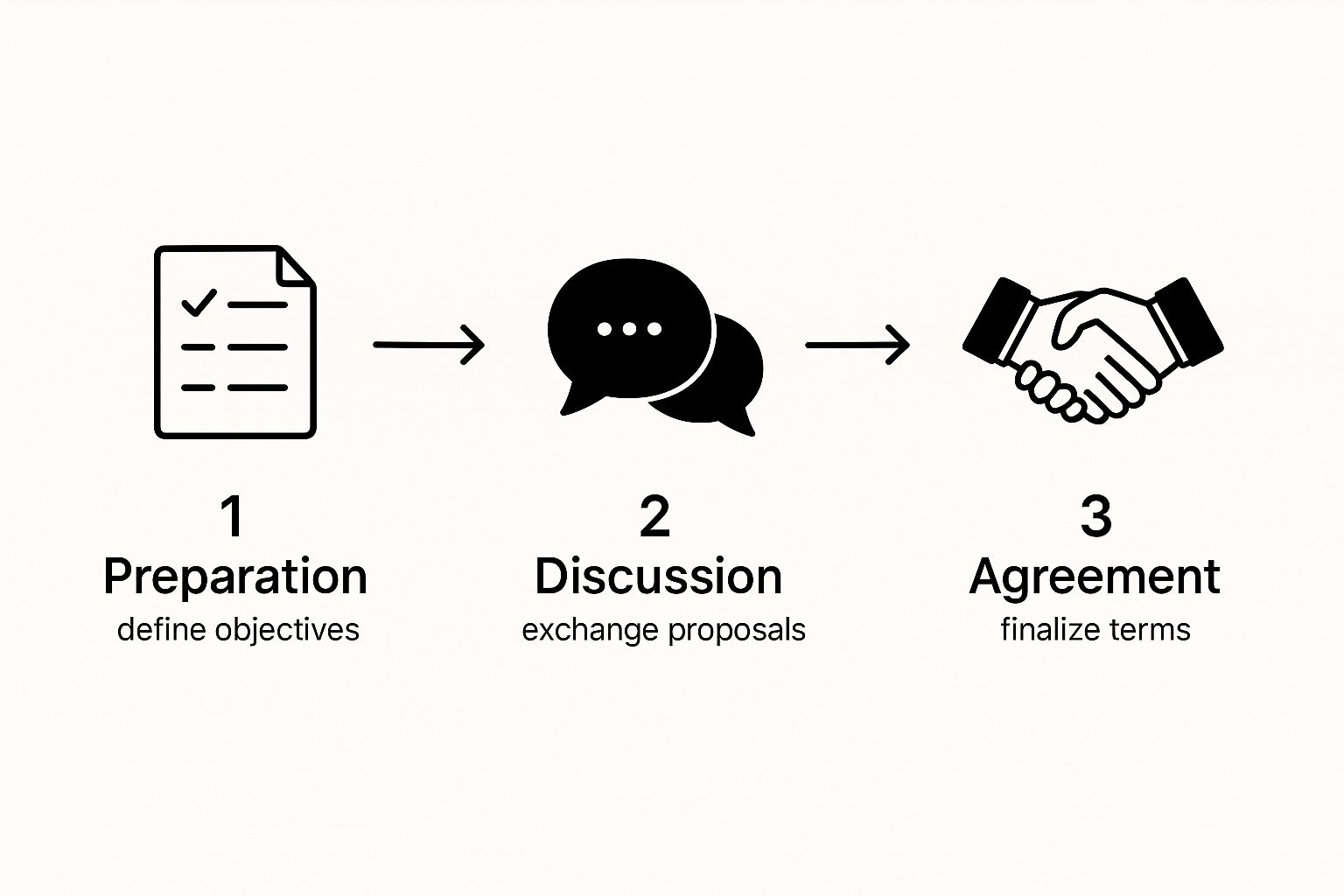
As you can see, a rock-solid agreement is the direct result of thorough preparation. When you arm yourself with a detailed scope, multiple bids, and a well-planned budget, you become an informed partner in the process.
Your Pre-Negotiation Checklist
Use this checklist to ensure you have all the necessary information and documentation before starting contract negotiations with your contractor.
| Checklist Item | Why It's Critical for Negotiation | Actionable Tip |
|---|---|---|
| Detailed Scope of Work | Prevents ambiguity and ensures all parties are bidding on the exact same project. This is your primary negotiation tool. | List specific brands, model numbers (e.g., Milgard Trinsic windows), and finishes. Leave nothing to interpretation. |
| At Least Three Bids | Establishes a fair market price and provides leverage. It highlights discrepancies between contractor proposals. | Ensure each bid is based on your exact scope of work for an accurate comparison. |
| Verified Contractor Credentials | Confirms the contractor is legitimate, licensed, and insured, protecting you from liability and poor workmanship. | Check their license status online with the state board and ask for a current Certificate of Insurance. |
| Realistic Budget with Contingency | Gives you clear financial boundaries and prepares you for unexpected costs that inevitably arise during construction. | Set aside 10–20% of your total project cost in a separate contingency fund. Don’t touch it unless it's a true surprise. |
| List of Questions & Priorities | Helps you stay focused during the negotiation, ensuring you address your most important concerns and get clarity on key terms. | Write down your top 3 "must-haves" and "deal-breakers" before the meeting. |
This upfront work pays off. It transforms the negotiation from a potentially confrontational event into a collaborative discussion, setting the stage for a smooth and successful project.
Decoding Key Contract Clauses and Terms
Let’s be honest: the fine print in a construction contract is where most people’s eyes glaze over. But this is where the success of your project is truly forged. This part of the construction contract negotiation can feel overwhelming, but getting comfortable with these key clauses is the best way to protect your investment.
Think of the contract as the official rulebook for the entire job. Let's break down the most critical clauses you'll run into for your home remodel in Monterey County or new build in Maricopa County.
The Scope of Work Clause
This is, without a doubt, the most important section of your entire contract. A vague “Scope of Work” is a recipe for disaster and the number one cause of surprise charges. It needs to be painfully detailed.
For instance, a scope for a kitchen remodel shouldn't just say "install new cabinets and countertops." A proper scope will get specific:
- Cabinets: Brand, style, and material (e.g., "Shaker-style maple cabinets from Wellborn Forest"), right down to the model numbers for hardware.
- Countertops: Material, thickness, and edge detail (e.g., "3cm Calacatta Laza quartz countertops with a mitered edge").
- Tasks: It must explicitly list every step, including demolition, all plumbing and electrical rough-ins, installation, finishing, and even daily site cleanup.
Without this level of detail, a contractor can legally argue that hauling away old appliances is an "extra." Getting this right is so fundamental that we suggest using a detailed checklist, much like our new home building checklist.
Payment Schedule and Change Orders
A fair payment schedule protects your cash flow and keeps the builder motivated. Never agree to a payment schedule based on arbitrary dates. Instead, insist on tying payments to the completion of specific, verifiable project milestones.
Key Takeaway: A typical milestone-based schedule might look like this: a small down payment, a second payment after the foundation passes inspection, another after framing and roofing are complete, and so on. The final, largest payment is held until the project passes final inspection and a punch list is completed to your satisfaction.
The Change Order clause is your defense against scope creep. It defines the formal process for making any changes to the original plan. It must require that all changes are documented in writing, signed by both you and the contractor, and clearly state the new cost and any impact on the schedule. This prevents casual conversations from turning into major disputes.
Recent supply chain disruptions have also impacted how contracts are written. The landscape now often includes more flexible terms to manage risks like material delays or price spikes. You can read more about these evolving contractual strategies and how they protect both homeowners and builders.
Navigating Price and Cost Escalation Clauses

The financial discussion is the heart of any construction contract negotiation, moving your project from paper to dollars and cents. Start by digging into the contractor's detailed cost breakdown. A true professional will have no problem explaining their numbers for labor, materials, and their overhead and profit markup.
This transparency is key to making sure you’re paying a fair price for the quality you expect, whether it's a small update or a major home renovation and remodeling project.
Dealing with Cost Escalation
Right now, the cost escalation clause is a critical part of any contract. In today's volatile market, builders need protection from sudden spikes in material costs. However, an unchecked escalation clause can turn your fixed-price contract into a blank check.
Your goal is to negotiate fair and balanced limits so neither you nor your builder carries all the risk.
- Set a Cap: Agree on a maximum percentage increase for the entire project. For instance, agree to cover material price hikes up to 5% of the total contract price, with the contractor absorbing anything beyond that.
- Require Proof: This is non-negotiable. The clause must state that the contractor has to show you supplier invoices as hard proof of a price increase before they can pass that cost along.
- Share the Risk: A 50/50 split is another fair approach. If lumber prices suddenly jump by $5,000, you agree to cover $2,500 of it, and the contractor absorbs the other $2,500.
This is about finding a reasonable middle ground. You’re creating a financial safety net that protects both parties from market shocks, which helps build a true partnership.
This isn't just a local issue. In 2024, global construction cost inflation jumped by 4.15%, fueled by labor shortages and supply chain snags. This reality makes these negotiations more important than ever. You can explore more on global construction cost trends to get a better sense of these market forces.
Fixed-Price vs. Cost-Plus Contracts
It's also crucial to understand the type of contract you're signing. For most residential projects in Santa Cruz or San Benito counties, a fixed-price contract is standard. You and the contractor agree on one set price for a detailed scope, which gives you excellent budget certainty.
The alternative is a cost-plus contract, where you pay for the actual costs of labor and materials, plus a pre-negotiated fee for the contractor’s profit. This model offers more flexibility but comes with far less budget predictability. The right choice depends on how well-defined your project is and your comfort level with financial risk.
Securing Timelines and Managing Delays
Your project's timeline is every bit as critical as its budget. A successful construction contract negotiation must lock in a realistic, clearly defined schedule. This goes beyond a start and end date. A solid contract will detail key milestones and establish rules for what happens when delays pop up.
What happens if the project falls behind? The answer depends on why it's behind, and your contract must spell out the difference. A delay from a contractor's poor planning is different from an uncontrollable delay, like permitting backlogs in Monterey County or a freak storm.
Defining Realistic Completion Dates
The first step is setting a firm completion date that’s ambitious but achievable. This means having an honest chat with your contractor about potential hurdles from the start. A huge part of that conversation must be about the local labor market, which impacts project duration.
Labor shortages are a massive factor in construction. In North America alone, it's estimated there's a need for an additional 500,000 skilled workers just to meet current demand [Associated Builders and Contractors, 2024]. This strain can lead to delays. You can review this global construction report to see how these trends are shaping project negotiations.
Your contract should absolutely hold the contractor responsible for securing and managing their labor force effectively. This is a reasonable expectation and a key point to stand firm on during negotiations.
Structuring Penalties and Incentives
To give your contract real teeth, include consequences for unexcused delays. This isn't about being punitive—it's about creating powerful motivation for the contractor to keep your project on track. We do this with a "liquidated damages" clause.
This clause sets a specific daily fee the contractor pays for every day the project runs past the agreed-upon completion date if the delay is their fault. For example, a contract might state a $200 per day penalty.
When negotiating this clause, focus on these key things:
- A Fair Amount: The fee should be a reasonable estimate of the actual costs you’d face from a delay, like extra rent or storage fees.
- Clear Exceptions: The contract must be crystal clear about what counts as an excusable delay. This usually includes changes you requested, severe weather, or documented supply chain issues.
- A Bonus for Early Completion: To balance things out, consider offering an incentive. A bonus for finishing ahead of schedule can foster a much more collaborative atmosphere.
Understanding how these pieces fit together is essential. To see how a well-managed project flows, look at our overview of a typical home construction timeline. A well-negotiated schedule clause protects your investment and ensures everyone is working toward the same finish line.
Finalizing Your Agreement and Taking the Next Steps

You’ve made it through the toughest parts of the construction contract negotiation. This last stage is about making sure everything is formalized before building begins. Before you pick up a pen, it’s time for one last, careful review.
This is your final chance to confirm that every verbal agreement made it into the written document. Pull out your notes and check the specifics. Are the Milgard window models you wanted explicitly listed? Are the daily site cleanup procedures included? Any ambiguity now is a potential dispute later.
The Last-Look Checklist Before You Sign
For a large project, like a custom home in Monterey County or a major remodel in Maricopa County, AZ, bringing in a qualified construction attorney for a final review is money well spent. Their expertise is in spotting tricky clauses or hidden risks that could cost you a fortune down the road. It’s a small price for serious peace of mind.
Before you sign on the dotted line, run through this final checklist:
- Verify Insurance Certificates: Get a copy of the contractor's general liability and workers' compensation insurance certificates. Confirm the coverage is active and the policy limits are high enough for your project.
- Confirm Lien Waiver Process: The contract must clearly spell out how you'll get lien waivers from the general contractor and their subs at every payment milestone.
- Review All Exhibits: Double-check every attached document, including architectural plans, the detailed scope of work, and material selection sheets. Make sure they are the correct versions and officially referenced in the contract.
Once the ink is dry, that contract becomes the law of the land for your project. This final review isn't a formality; it's the last line of defense for your investment and sets the foundation for trust from day one.
What Happens After the Contract Is Signed
Signing the contract officially kicks the project into gear, turning all negotiated terms into a binding plan. From here, the contractor will usually start the permitting process, order long-lead-time materials, and line up subcontractors.
At Aldridge Construction, this is when we shift from planning to execution. We’ll establish a communication schedule and introduce you to your dedicated project manager. Our focus is on a smooth handoff, starting your project on a solid foundation of mutual understanding.
Frequently Asked Questions About Construction Contracts
1. Should I just sign the contractor's standard contract?
No. A contractor's standard agreement is written to protect them, not you. It's your responsibility as a homeowner to read every word, ask questions, and negotiate changes to create a balanced agreement that protects your investment in your Monterey, Santa Cruz, or Maricopa County home.
2. What is the biggest mistake homeowners make in negotiations?
The most common and costly mistake is not defining the 'Scope of Work' in obsessive detail. Homeowners often assume certain tasks (like site cleanup or hauling away old appliances) or materials are included, only to get hit with expensive change orders later. If it isn't written down, it doesn't exist.
3. Do I really need a lawyer to review my construction contract?
For any project larger than a simple repair—like a major remodel, addition, or new build—hiring an attorney who specializes in construction law is one of the smartest investments you can make. Their fee is minor compared to the potential cost of a major contract dispute.
4. What is a 'mechanic's lien' and how can I protect myself?
A mechanic's lien is a legal claim filed against your property by a subcontractor or supplier who didn't get paid by your general contractor. To protect yourself, insist on a 'lien waiver' clause. This requires the general contractor and their subs to sign a document at each payment milestone proving they've been paid and waiving their right to file a lien.
5. How do I handle a disagreement after the contract is signed?
Your contract must include a 'Dispute Resolution' clause. This section acts as a roadmap for what to do when you disagree. The process typically starts with direct negotiation, then moves to mediation with a neutral third party, using a lawsuit only as a last resort. Following these steps can save significant time, money, and stress.
Ready to start your project with a team that believes a strong, transparent contract is the foundation of a great partnership? The experts at Aldridge Construction are here to guide you through every step, ensuring your contract is as solid as our craftsmanship. Contact us today for a transparent consultation.