
Direct Answer: Rain is usually treated as an excusable delay, meaning the schedule moves but the contract price does not. Delays a homeowner causes, like late selections or mid-build changes, can move both.
You sign a contract in October. Framing starts, the walls go up, and then a week of storms rolls through the Salinas Valley and the site goes quiet. Now you are staring at a muddy lot wondering two things: is this going to cost me more, and is the crew coming back?
I get that call every winter. And the fear underneath it is almost never about the rain itself. It is about whether a slipping schedule means a slipping price, and whether anyone is going to keep you in the loop while nothing visible is happening.
So here is the plain version. In a construction contract, delay time and delay money are two separate things. Most homeowners assume they move together, and that assumption is what turns a normal two-week weather pause into a panic.
Winter Construction Delays and Who Pays: The Two Categories That Matter
Almost every delay on a residential job falls into one of two buckets, and the bucket decides who absorbs what.
Excusable delay. Weather, a county inspector backlog, a utility scheduling window. Nobody on the job caused it and nobody could have prevented it. The standard treatment is that the calendar moves but the contract price does not. You get more days, not a bigger invoice.
Homeowner-caused delay. Picking tile six weeks after the deadline in the schedule, changing the shower layout during framing, or holding a decision while the crew stands idle. These can move both the schedule and the cost, because a change order or a stalled crew has a real dollar figure attached.
California home improvement contracts are required to include approximate start and completion dates, along with a description of the work and the payment schedule. The Contractors State License Board publishes what belongs in that document, and it is worth reading before you sign anything.
But the dates alone tell you very little. The question I would ask any contractor bidding a winter job is this: how many weather days are already built into this schedule, and who decides that a day counts as one?
A contractor who has run jobs through a Central Coast winter will have a number and a method. One who says “we’ll play it by ear” is handing you a hopeful schedule, not a real one.
What the Forecast Actually Says About This Winter on the Central Coast
Forecasters have put roughly an 81 percent chance on a very strong El Niño developing across October through December 2026, with a very high likelihood the pattern holds into early spring 2027. Sea surface temperature readings in August were already running well above average.
Here is the honest caveat that climate scientists make themselves. A strong El Niño raises the odds of unusually wet conditions and individual heavy rain events in California. It does not tell anyone whether a specific winter brings a major flood event to Salinas, Hollister, or the San Lorenzo Valley.
So the takeaway for a homeowner planning a build is not to predict the winter. It is to schedule around the possibility.
That means front-loading the work that cannot happen in the wet and pushing the work that can happen indoors into January and February. I walk through the property-side version of that in what homeowners should do now to prepare for a wet winter.
What Actually Stops in the Rain, and What Keeps Moving
This is the part where a homeowner has real influence, because the sequence you agree to in October decides how much of December is productive.
Weather-gated work that stops:
- Excavation and trenching
- Footings and concrete pours
- Framing before the roof is dried in
- Roof and window openings left exposed
- Exterior stucco, siding, and paint
Work that generally keeps moving once the structure is dried in:
- Interior demolition
- Rough plumbing and electrical
- Insulation and drywall
- Tile and waterproofing
- Cabinet and fixture installation
One local wrinkle matters more than people expect. The heavier clay soils across much of the Salinas Valley hold water, so a saturated trench can hold up a foundation inspection for days after the rain stops. The sun comes out, the driveway dries, and the trench is still soup.
That is why I tell homeowners to ask one question about sequencing: which milestone does this project need to reach before Thanksgiving? For most additions and ADUs, the answer is a dried-in shell. Hit that, and the wet months get spent working inside. Miss it, and you are waiting on weather windows until March.
If your project is already open when a storm lands, the storm checklist for an open remodel or ADU build covers what to protect and in what order.
Who Absorbs the Time and Who Absorbs the Cost
Here is how the common winter delays usually break down on a residential contract. Specific terms vary by contract, so read yours.
| Cause of delay | Schedule impact | Cost impact |
|---|---|---|
| Multi-day storm, saturated site | Extended | Typically none to the homeowner |
| Utility connection scheduling | Extended, sometimes weeks | Typically none, but utility fees are separate |
| County inspection backlog | Extended | Typically none |
| Late homeowner selections | Extended | Can increase, depending on contract terms |
| Change order during framing | Extended | Increases by the change order amount |
| Material soaked in storage on site | Varies | Depends on who was responsible for protection |
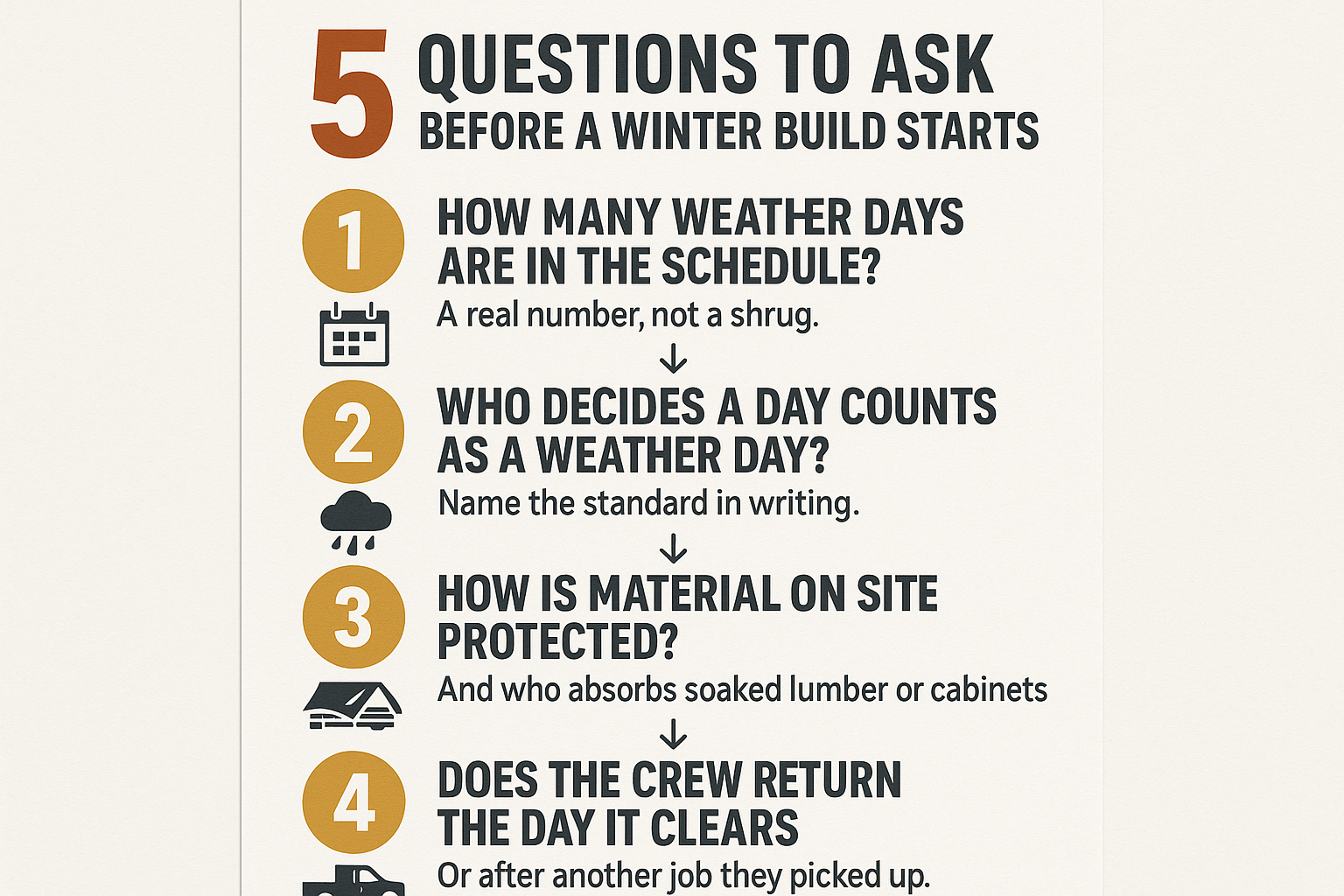
Five Questions to Ask Every Bidder About a Winter Start
Homeowners in this market compare bids carefully, and these five questions separate a contractor who has run winter jobs from one who has not.
Why I Push Back on the Questions a Bidder Waves Off
Bid comparison anxiety is real in Monterey and Santa Cruz Counties. When homes trade in the high six figures and up, a $40,000 spread between two bids feels like a trap, and the winter schedule is where a lot of that spread quietly lives.
So I would press on three things specifically.
Material protection. Where does the lumber sit, what covers it, and who eats the loss if a cabinet package gets soaked in a garage that is not dried in yet? A contractor who has done this has a storage plan before you ask.
Return timing. Does the crew come back the day conditions clear, or after they finish the other job they picked up during the pause? This is the honest version of the ghosting fear, and it deserves a direct answer.
Documentation. Photo updates, written progress notes, a delay logged with a date and a reason. That paperwork is what keeps a two-week pause from turning into an argument in February.
A bidder with a specific answer to each has run winter work before. One who brushes the question off has not, and you will find out in December.
On ADUs Here, the Bigger Schedule Risk Usually Is Not Rain
I want to be straight about this, because it surprises people. On garage conversions and detached ADUs in Monterey County, utility scheduling causes more schedule slip than weather does.
A meter set, a panel upgrade, a service drop. Those dates belong to the utility, not to the crew, and they can sit for weeks regardless of the forecast. A Salinas homeowner whose garage we converted into an ADU described it plainly in her review:
“The project took a little longer than expected, but this was due to PG&E’s scheduling and availability.” – Blanca B.
She still rated the job five stars. That gap right there is the whole point of this article: a delay you understand is manageable, and a delay nobody explains to you feels like abandonment.
Layer in the other agency timelines and the picture gets clearer. Septic review, water credit, planning, and building all move on their own clocks. Two that catch people off guard locally are the water permit that comes before a building permit on the Peninsula and what Environmental Health looks for on a septic lot. Neither one cares whether it is raining.
Frequently Asked Questions About Winter Construction Delays
If rain adds three weeks to my job, can the contractor charge me more?
Generally no. Weather is normally handled as an excusable delay, which extends the completion date without changing the contract price. Read your contract’s delay language, though, because terms vary and some contracts address extended general conditions.
Should I just wait until spring to start?
Not necessarily. Design and permitting run fine in the rain, and in Monterey County those steps often take longer than the build itself. Starting the paperwork in the fall so construction begins with a clear runway is usually smarter than sitting idle until April.
What happens if a storm damages work that is already finished?
Depends on the cause and on whose responsibility the protection was. That is exactly why the material protection and site-protection questions belong in the conversation before you sign, not after the first atmospheric river.
Can I stay in my house while a winter remodel is going on?
For most kitchen and bathroom projects, yes, and most of our clients do. Winter makes dust containment and temporary weather protection more important, so ask how the work area will be sealed off and how the exterior openings get covered overnight.
How do I know a contractor will actually come back after a long rain pause?
Look at how they communicate before there is a problem. Quick callbacks, updates that arrive before you ask, and delays logged in writing are the signals that hold up in January.
Thinking through a winter build timeline?
Whether a rainy-season delay feels manageable or alarming almost always comes down to accountability: who calls you first, how fast you get a callback, and whether anyone disappears mid-project. Brian Aldridge is a third-generation contractor who runs jobs under one license and one point of contact, so schedule questions do not get bounced between a sales rep and a crew. If you are mapping out a fall or winter start anywhere in Monterey, Santa Cruz, San Benito, or Santa Clara County, the team at Aldridge Construction is available to talk it through at 831-682-9788 or through the contact page at aldridgeconstruction.biz.