
When you receive a quote for a home renovation, you're looking at far more than just the price of lumber and paint. A professional contractor's bid is a complete financial blueprint. It accounts for everything from the skilled craftspeople on site and high-quality materials to the insurance, project management, and fair margin needed to run a sustainable business.
Understanding this breakdown is the key to seeing the real value behind the numbers. This guide helps homeowners in Monterey, Santa Cruz, San Benito, and Maricopa counties understand exactly what's inside a professional construction quote.
The Real Story Behind Your Contractor's Quote
Breaking down contractor pricing reveals why a detailed, comprehensive bid from a trusted builder like Aldridge Construction is a mark of true professionalism. It’s a carefully balanced recipe of direct project costs, the indirect expenses of running a legitimate business, and the profit necessary for a company to stand behind its work.
For homeowners, a thorough quote isn’t an inflated price—it's an investment in a successful, protected, and guaranteed project.
This image gives you a clear visual of how a total project cost is typically divided.
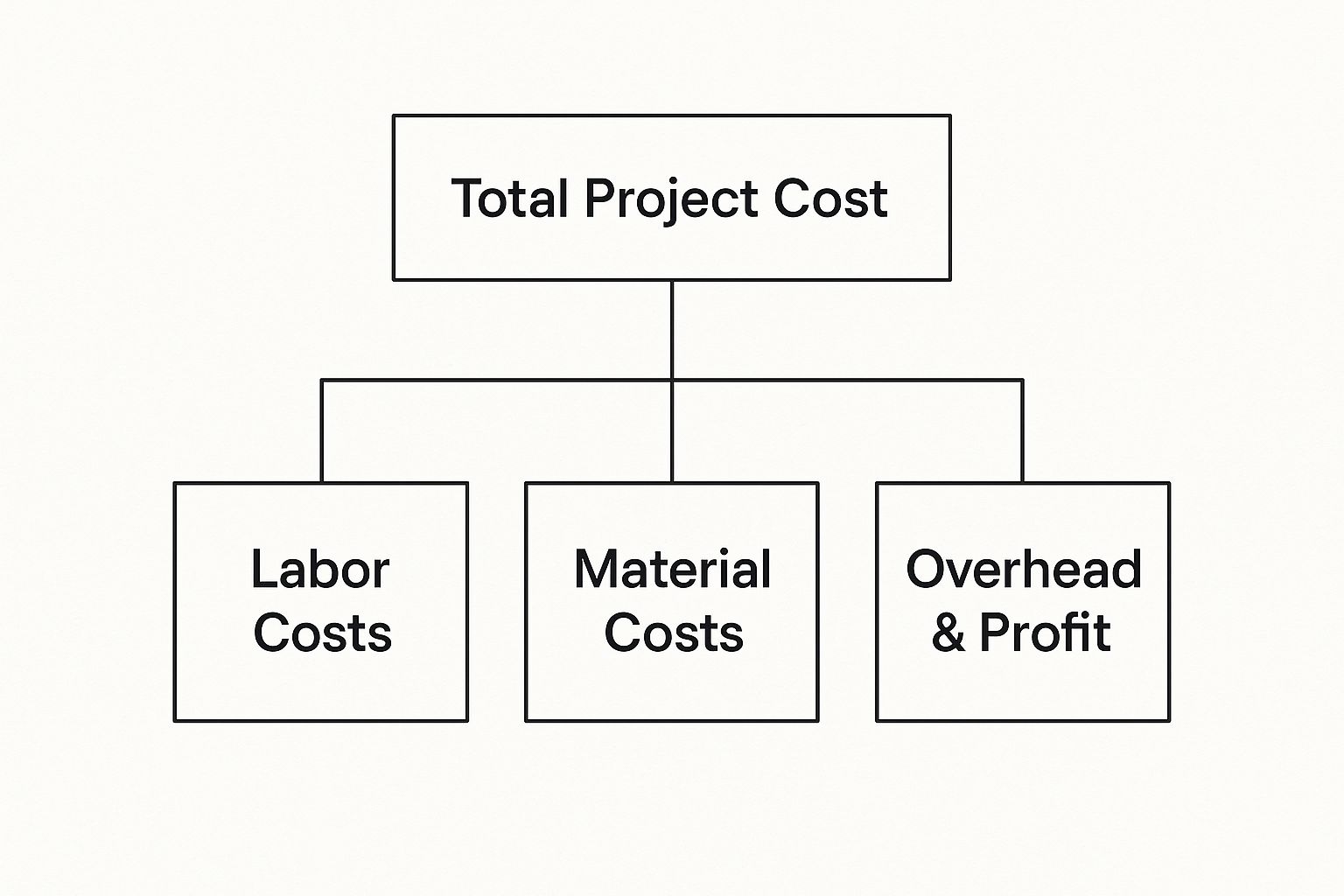
As you can see, the tangible items—the materials you can touch and the crew’s hands-on work—are only part of the final number. A significant portion of the cost covers the essential, behind-the-scenes business functions that ensure your project runs smoothly and is legally and financially sound.
What Goes Into a Professional Bid?
A legitimate contractor’s bid is designed to eliminate surprises and protect both you and the construction team. The price tag reflects not just the visible work but also the intensive, behind-the-scenes management required to execute a project flawlessly.
Here's a quick look at the core components you'll always find in a professional quote.
Quick Look at Contractor Pricing Components
This table summarizes the main elements that make up a contractor's total project price, giving you a clearer picture of where your money goes.
| Cost Category | What It Covers | Typical Percentage of Total Cost |
|---|---|---|
| Direct Costs | Materials (lumber, fixtures, etc.) and labor (wages for carpenters, plumbers, etc.) | 60% – 70% |
| Overhead | Business expenses like insurance, vehicle maintenance, office rent, and software | 15% – 25% |
| Profit Margin | The contractor's fee for managing risk, expertise, and providing a warranty | 10% – 20% |
Let's break these down a bit further.
- Direct Costs: These are the most straightforward parts of your bill. They cover the physical materials needed for your project, like quartz countertops, and the wages for the skilled labor required to install them.
- Indirect Costs (Overhead): Think of this as the cost of doing business professionally. It’s all the expenses required to run a licensed, insured construction company, including vehicle maintenance, workers' compensation, and project management software.
- Profit Margin: This isn't just extra money. It's the contractor's compensation for taking on the project's financial risk, managing complex logistics, and—most importantly—providing a warranty for the finished work.
Once you have a clear picture of what goes into your contractor's quote, you might also want to explore financing options for construction projects to help budget for your dream home.
Understanding Your Project's Direct Costs
When you look at a contractor's estimate, the first things that usually jump out are the direct costs. These are the tangible, hands-on parts of your renovation—the skilled people physically building your project and the actual materials used to bring your vision to life.
Think of them as the core ingredients in your project's recipe. But just like in cooking, there's more to these line items than meets the eye. Getting a feel for what’s really inside these categories is the key to understanding the true value of a professional quote.

The True Cost of Skilled Labor
The "labor" line on a bid from a reputable contractor like Aldridge Construction covers way more than just the crew's take-home pay. It’s a comprehensive figure that includes crucial financial responsibilities, often bundled together as the labor burden.
This "burden" ensures every single person working on your property is a legitimate, protected employee. Key pieces of the labor burden include:
- Wages: Competitive pay to attract and retain specialized tradespeople like carpenters, electricians, and plumbers.
- Payroll Taxes: Mandatory contributions to Social Security and Medicare.
- Workers' Compensation: This is crucial. It's insurance that protects both the workers and you from liability if someone gets hurt on your property.
- Unemployment Insurance: State and federal taxes that provide a safety net for workers.
Without these things properly accounted for, you, the homeowner, could be on the hook financially for any accidents. A professional quote bakes these necessities in, guaranteeing a safe, legal, and fully protected job site.
More Than Just Materials
The "materials" category is about making strategic choices that directly affect your project's durability, safety, and ability to pass inspection. For homeowners in Monterey County, CA, or Maricopa County, AZ, this means picking materials that can handle local environmental conditions.
For example, a home in a high-risk California fire zone might legally require a fire-resistant metal roof. Down in Arizona, choosing energy-efficient Milgard windows isn't just a nice-to-have—it’s a practical necessity for surviving the summer heat and meeting local energy codes.
Market volatility and supply chain headaches can throw a wrench in both labor and material costs. A professional contractor is constantly managing these swings, using their industry connections to find materials efficiently and schedule tradespeople in a way that keeps your project moving forward without blowing the budget.
The last five years have driven this point home. Industry data shows that from late 2019 to late 2024, construction labor costs surged by an incredible 150%, blowing past material price hikes. This mix of labor inflation and material price swings creates a tricky environment that contractors navigate daily.
To see how these costs apply in a real-world scenario, check out resources that offer a complete cost breakdown for remodeling a shower. You can also start mapping out potential expenses with our home addition costs calculator.
The Hidden Costs of Professionalism and Protection
Ever wonder what really separates a professional, licensed contractor from a "guy with a truck"? The answer is the invisible but critical costs of running a legitimate business.
We call this business overhead. These are the essential expenses required to operate a reliable and legally compliant construction company, whether in Santa Cruz, CA, or Maricopa County, AZ. When you see these costs in a quote, you're investing in the peace of mind that comes from knowing your contractor runs a sustainable business that will still be around to honor its commitments long after the paint dries.

What Overhead Actually Covers
Overhead isn't just one single line item. It's the foundational structure supporting your entire project—the behind-the-scenes work ensuring everything is handled correctly, legally, and safely.
Here’s a quick look at what’s included:
- Insurance Coverage: This includes General Liability to cover accidental property damage and Workers' Compensation to protect the crew (and you) if someone gets injured.
- Licensing and Bonds: Staying properly licensed in counties like San Benito and Monterey costs money, involving fees and continuing education to meet professional standards.
- Vehicle and Equipment Costs: This covers fuel, insurance, maintenance, and replacement for work trucks and specialized tools.
- Office and Technology Expenses: A pro contractor invests in project management software, accounting systems, and other tools that keep the business running smoothly.
It's also crucial to know that not all insurance is the same. While General Liability is standard, many contractors also need to understand things like professional liability insurance for contractors, which covers a different set of risks.
Reframing the Concept of Profit
The word "profit" can sometimes make homeowners nervous, but in reality, a contractor's profit is their fair compensation for taking on immense responsibility and risk.
A contractor’s profit isn't just a paycheck. It is the reward for managing immense complexity, assuming all financial risk for the project's execution, and providing a warranty that guarantees the quality of the work.
Without a reasonable profit margin, a construction business simply can't survive. That profit ensures the company stays stable enough to stand behind its work for years to come—something especially important for complex jobs. You can dive deeper into this topic in our complete 2024 ADU budget guide.
How Pros Plan for Project Unknowns
A professional construction quote does more than just list the work you can see—it’s carefully designed to anticipate and manage the inevitable curveballs that every project throws. Experienced contractors use a few key tools to shield your project from delays and budget overruns.
When you break down a contractor's pricing, you realize a huge chunk of the value is in this proactive planning. It’s how a builder like Aldridge Construction turns a potentially chaotic process into a controlled, predictable experience.

Navigating Permits and Regulations
Getting the right permits is a non-negotiable first step for most renovation projects. In places like Monterey County, CA, or Maricopa County, AZ, this means submitting detailed plans, coordinating with officials, and scheduling multiple inspections.
All the administrative legwork is built into a contractor’s fee. This covers the expertise needed to manage paperwork, answer an inspector's technical questions, and ensure every phase meets strict local codes, like California’s Title 24 energy standards. This expert management keeps you from facing costly fines or a work stoppage.
Using Allowances for Flexible Choices
A professional quote will almost always include allowances, which are budget placeholders for items you haven't picked out yet. Think of them as pre-approved spending limits for finishes that come down to personal taste, such as:
- Kitchen countertops
- Bathroom tile
- Light fixtures
- Plumbing faucets
Allowances give you the freedom to choose materials that fit your style and budget without derailing the project cost. If you pick a less expensive item, the difference is credited back to you. If you opt for something more high-end, you just pay the difference.
The Critical Role of a Contingency Fund
One of the most misunderstood parts of any bid is the contingency fund. It is often mistaken as extra padding or profit for the contractor, but it's the exact opposite.
A contingency fund is your project’s dedicated safety net. It is a portion of the budget, typically 10-20%, set aside to cover unforeseen problems discovered after the work begins.
This fund is there to deal with issues that are literally impossible to predict. We're talking about finding dry rot hidden behind a wall, uncovering outdated electrical wiring, or dealing with hidden structural problems. It ensures that surprises don't spiral into a financial crisis.
Asking a potential builder about their approach to contingencies is one of the 8 crucial questions to ask general contractors before hiring.
Why the Cheapest Bid Is Often the Most Expensive
Getting an unusually low bid on a construction project might feel like a huge win. But in our experience, that's almost always the biggest red flag you'll see. When you're trying to understand contractor pricing, a quote that seems too good to be true usually is.
The construction world is incredibly competitive, and intense price competition can lead to "ridiculously low bids." That "unbelievable deal" often comes with steep hidden costs, like using cheaper materials, hiring less-skilled workers, or skipping crucial steps like pulling permits.
Unpacking the Risks of a Lowball Offer
A drastically low price is a dead giveaway that essential costs are missing. Any professional, sustainable construction business has unavoidable overhead expenses—insurance, proper licensing, and quality tools. If a bid doesn't account for these, the contractor is likely operating without them, putting all the financial and legal risk on you.
This is why learning how to find a good contractor means looking beyond the bottom line. It's also worth noting that the global construction market faces a skilled labor shortage, which naturally drives up wages for experienced tradespeople. To offer a dirt-cheap price, some contractors rely on less experienced crews, which can tank project quality. This report on global construction trends shows the bigger picture.
Professional Bid vs. Low Bid: A Comparison
Understanding the real differences behind the numbers is crucial. A professional bid from Aldridge Construction is an investment in certainty, quality, and peace of mind. A low bid, on the other hand, is often a gamble with your home's future.
| Feature | Professional Bid (Aldridge Construction) | Typical Low Bid |
|---|---|---|
| Insurance | Fully insured (Liability & Workers' Comp) to protect you. | Often uninsured or underinsured, putting you at risk. |
| Permits | All necessary permits are pulled and managed correctly. | May skip permits to cut costs, risking fines and stop-work orders. |
| Materials | Uses high-quality, specified materials with warranties. | Uses cheaper, unspecified, or lower-grade materials. |
| Labor | Employs experienced, skilled, and vetted tradespeople. | Relies on unskilled or inexperienced labor to reduce wages. |
| Contract | Provides a detailed, clear contract and scope of work. | Uses a vague or verbal agreement with no clear scope. |
| Warranty | Stands behind the work with a comprehensive warranty. | Offers no warranty, leaving you to pay for any future repairs. |
True value is measured by long-term quality and durability, not just the initial number on a piece of paper. The most expensive project is almost always the one you have to pay for twice.
Frequently Asked Questions About Contractor Pricing
Navigating bids and estimates can be overwhelming. Asking the right questions is the key to understanding what you're really paying for. Here, we tackle common questions homeowners in Monterey, Santa Cruz, and Maricopa counties have when breaking down contractor pricing.
1. Why do contractor quotes for the same project vary so much?
Quotes vary because contractors operate differently. A higher, detailed bid from Aldridge Construction usually accounts for crucial elements that low-cost operators skip, such as comprehensive insurance, high-quality materials with warranties, skilled labor, and legitimate business overhead. A higher quote reflects a commitment to quality, safety, and long-term value.
2. How do change orders affect the total project cost?
A change order is a formal, written amendment to your original construction contract. It becomes necessary when you alter the scope of work, choose different materials, or when an unforeseen issue is uncovered. Any approved change order will adjust the final project price and potentially the completion schedule. It’s crucial that every change is documented and signed to avoid misunderstandings.
3. What should I look for in a detailed contractor bid?
A professional, transparent bid is your best tool for a successful project. It should be a clear, comprehensive document that includes a detailed scope of work, an itemized cost breakdown, specific allowances for selections like tile or fixtures, a clear payment schedule, a proposed project timeline, and proof of the contractor’s license and insurance. A great bid leaves no room for guesswork.
4. Is the contractor's profit margin negotiable?
While some negotiation is normal when finalizing a contract, aggressively trying to slash a contractor's profit margin can backfire. Profit covers the immense risk the contractor assumes, compensates them for their expertise, and allows them to stand behind their work with a warranty. A contractor working on a razor-thin margin may be forced to cut corners on materials or labor, which is a risk you don't want to take. Our homeowner's guide to construction contract negotiation offers more insight.
5. What are some major challenges contractors face that impact pricing?
Contractors deal with several pain points that influence their pricing and business model. These include managing unrealistic client expectations and persistent price negotiations, dealing with "scope creep" where a project expands beyond the original agreement, and navigating intense price competition that can lead to razor-thin profit margins. These challenges highlight why a structured, professional approach is vital for a project's success.
Ready to get a clear, transparent quote for your next project? The team at Aldridge Construction is here to provide a detailed bid that breaks down every cost, ensuring you know exactly what you’re paying for. Contact us today for a professional consultation in Monterey, Santa Cruz, San Benito, or Maricopa County.