
Direct Answer: The electric service application is separate from your building permit. File it once plans are approved and an address is assigned, because energization is scheduled by the utility, not your contractor.
An ADU budget usually covers the parts a homeowner can picture. Framing, windows, drywall, tile, and the inspections along the way.
What almost nobody plans for is the stretch of calendar that belongs to the electric utility. I have seen projects in Salinas, Seaside, and out toward Prunedale sit at 95 percent complete waiting on a meter set. The crew is finished, the site is clean, and the power is still off.
So this is the utility side of an ADU in plain language. What the electric service application actually is, when to file it, how the meter decision moves both cost and timeline, and what the state changed in 2024.
Every ADU Has Two Clocks, and You Only Control One
The first clock is the build. That one runs on my schedule, the subcontractors, material lead times, and the local inspector. When it slips, it is usually something I can explain and something I can push on.
The second clock is the utility. A new or upgraded electric service is its own application with its own queue, and it moves at the pace of utility engineering and crew availability. No contractor sets those dates.
One homeowner said it better than I can in a review after a garage conversion in Salinas: “The project took a little longer than expected, but this was due to PG&E’s scheduling and availability.” (Blanca B.)
That project was not slow because of the crew. It was finished and waiting. And this is the single most common reason a Monterey County ADU misses its original completion date.
So when you compare bids and someone hands you a tidy month count with no mention of the utility, ask where that step sits in their schedule. A contractor who has built here knows the answer.
What the PG&E Side of an ADU Actually Looks Like
This is the part no local contractor content explains, so here it is start to finish. The service application is separate from your city or county building permit, and filing one does not start the other.
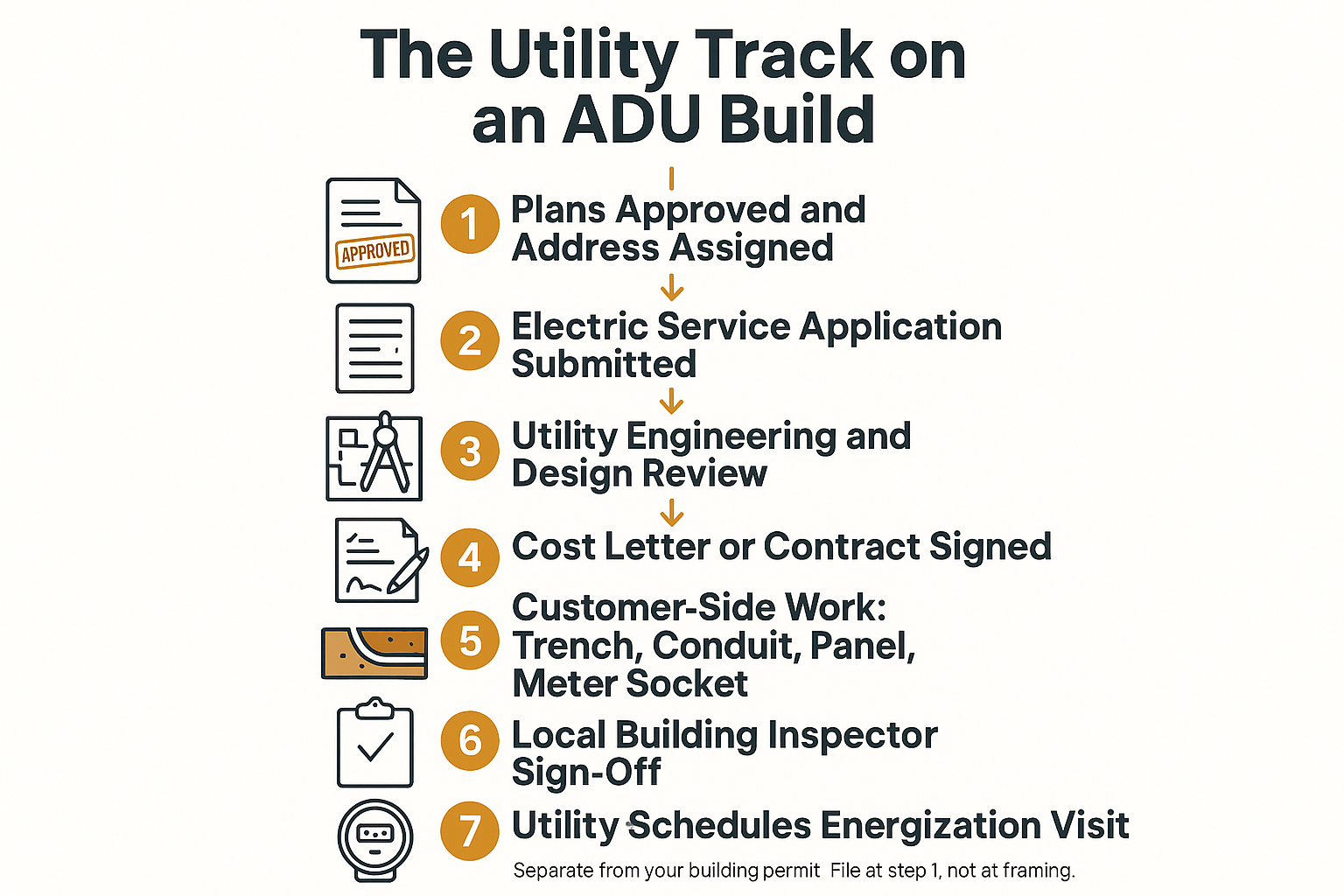
The general path looks like this:
- You submit a service application describing the new or upgraded service
- Utility engineering reviews the site and designs the connection
- You receive a cost letter or contract to sign and pay
- Customer-side work gets built, meaning trenching, conduit, panel, and meter socket
- The local building inspector signs off on the electrical work
- The utility schedules an energization visit to set the meter and turn it on
The practical trigger point is usually plan approval plus an address assignment for the new unit. That is when you have the numbers the utility needs.
Submitting then, instead of waiting until framing is up, is the biggest schedule lever a homeowner has on an ADU. It costs nothing and it can save weeks or months.
The path also depends on what you are building. A detached backyard unit, a garage conversion in Seaside or Marina, and an attached addition in south Salinas can each follow a different service route.
The Meter Question: Separate Service, Submeter, or Shared
This question drives both cost and timeline, so it belongs in the first conversation, not month four.
California law limits what a local agency can require of an ADU when it comes to separate utility connections. But the utility still sets its own technical service requirements, and those are a different rulebook. Homeowners should confirm both with their jurisdiction and with the utility rather than assuming one answer covers the other.
In practice there are three real options:
- A separate metered service for the ADU, with its own account and its own bill
- A submeter behind the existing meter, where the main account pays and usage gets tracked privately
- Shared service with the main house, where the ADU simply draws off the existing panel
How you plan to use the unit usually decides it. A homeowner building for aging parents on a half acre in Salinas often does not care about billing separation at all.
Someone renting a 450 square foot studio in Watsonville cares a lot. Clean separation keeps the tenant relationship simple and keeps you out of the business of splitting a bill every month.
Comparing the Three Meter Paths
Here is how the three options tend to play out on real Monterey County and Santa Cruz County projects. Specifics vary by site, so treat this as orientation rather than a rule.
| Option | What it involves | Fits best when |
|---|---|---|
| Separate metered service | New service application, its own panel and meter, often trenching and utility-side work | The ADU will be rented long term and you want billing fully separate |
| Submeter behind existing meter | Private metering equipment, no second utility account, usage tracked by the owner | You want usage visibility without a second service, and existing capacity allows it |
| Shared service with main house | ADU fed from the existing panel, subject to load capacity | Family use, multigenerational housing, or a small unit on a home with capacity to spare |
The Utility Track, Step by Step
This is the sequence the utility side follows on a typical ADU, and where the waiting usually happens.
Older Salinas Homes and the Load Problem Nobody Priced In
A lot of housing stock in Salinas, Gonzales, and Prunedale was built decades ago on modest main service. That was plenty for the original house.
Then you add a full second dwelling with heat pump space conditioning, a heat pump water heater, and induction cooking, and the whole property can land past what the existing panel and service drop can carry.
That turns into a load calculation, which is the math that tells you whether your service holds. Sometimes it points to a service upgrade. Sometimes it points to utility-side work like a new transformer or a longer trench, and that is where the timeline really stretches.
Cost is site specific, and I will not pretend otherwise. The factors that move the number most are:
- Distance from the nearest transformer
- Overhead versus underground service
- Trench length and what the trench has to cross, like driveway or hardscape
- Engineering and design fees on the utility side
- Whether a second service is involved instead of a shared one
Only a site-specific review gives a real figure. If you are still building a rough budget, our breakdown of what an ADU actually costs in Monterey County gives you the wider picture, but the utility line item is the one that varies most from lot to lot.
What Changed in 2024: The State Put Targets on the Utility
This part is genuinely useful and almost nobody in this market talks about it.
Under the state legislation known as the Powering Up Californians Act, the California Public Utilities Commission adopted a decision in September 2024 that set average and maximum target timelines for the energization steps the large electric utilities control. It also added reporting requirements and a process for customers to report energization delays. The CPUC published a plain summary in its energization fact sheet.
Let me be honest about what that does and does not mean. Targets are not guarantees. Utility workload, crew availability, and any upstream capacity upgrades still drive the real-world date on your lot.
What it does mean is that the process now has published expectations and a complaint path. That is worth knowing before a project stalls, not after.
Running the Tracks in Parallel Is the Whole Job
One Salinas homeowner planning a 1,200 square foot unit told us they needed someone “handling all the pre construction permits and everything else associated with it.” That is really a request for someone to run several tracks at the same time.
On a typical ADU here, the parallel tracks look like this:
- Local plan review with the city or county building and planning departments
- Utility service application filed as soon as plans and address are set
- Environmental health and water review on rural parcels, which matters on lots near San Juan Bautista or Hollister
When those run one after another, you add months for no good reason. When they run side by side, the utility queue overlaps with construction instead of sitting on the end of it.
Requirements vary by jurisdiction and by utility, and the specifics change. Verify current requirements with your local agency before anyone counts on a date. If you are in San Benito County, the rules differ from Salinas in ways that affect this sequencing directly, and permit clocks themselves have shifted under recent state law.
The reason I lean on coordination rather than craftsmanship claims is simple. At Aldridge Construction we run the agency sequencing and the utility paperwork on the same schedule as the build, and homeowners hear about issues as they come up rather than after the fact. On ADU work, where one step sits outside anyone’s direct control, honest updates are the only thing that keeps expectations real.
Frequently Asked Questions About ADU Utility Connections
When should I submit the electric service application for my ADU?
As soon as your plans are approved and the new unit has an address assignment. Waiting until framing is the most common and most expensive scheduling mistake I see on Central Coast ADU projects.
Does my ADU have to have its own meter?
Not automatically. California law limits what a local agency can require of an ADU regarding separate utility connections, but the utility still applies its own technical service requirements. Confirm both with your jurisdiction and with the utility before you design around one answer.
Why does the meter get set so late in the project?
Energization is normally scheduled after the local building inspector signs off on the electrical work. So the customer-side install has to be complete and cleared before the utility can put the unit on a route, which is why a finished ADU can still sit dark for a stretch.
What if my existing panel is too small for a second dwelling?
That is common on older Salinas and Gonzales homes. It starts with a load calculation. Depending on the result you may need a panel or service upgrade, and in some cases utility-side work like a transformer or added trenching, which is the piece that adds the most time.
Can I do anything if the utility connection drags on?
Since the September 2024 CPUC decision, there are published target timelines for the large electric utilities and a process for customers to report energization delays. It is not a guarantee of a date, but it gives you documented expectations and somewhere to raise the issue.
Does a garage conversion avoid all of this?
Sometimes it simplifies it, because the structure and some existing service may already be there. But it depends on the panel capacity, the planned appliances, and whether you want separate metering, so a conversion is not an automatic shortcut on the utility side.
Thinking through the utility side of an ADU?
If you are mapping out an ADU anywhere in Monterey County, Santa Cruz County, San Benito County, or south Santa Clara County, the utility track is worth sorting out early rather than late. Aldridge Construction is available to walk a property, look at existing service, and talk through how the agency and utility steps would sequence on your lot. Reach out at 831-682-9788 or through the contact page at aldridgeconstruction.biz when the timing suits you.