
Ever wondered who turns a blueprint into a beautiful, finished space? That’s the job of the general contractor (GC). If your home remodel were a movie, the GC would be the director—they manage the entire production from start to finish, making sure your vision becomes a reality. This guide explains what a general contractor does and why hiring one is critical for your next major project.
The Single Most Important Role on Your Project

A general contractor is the central hub for any significant construction or remodeling project. They are the professional responsible for the day-to-day oversight of the worksite, managing all vendors and trades, and keeping communication flowing.
This leadership role is fundamental to the construction industry. With U.S. construction spending now surpassing $2.1 trillion annually [U.S. Census Bureau, 2024], the need for skilled project management has never been greater. GCs are at the heart of this, overseeing risk, ensuring quality, and handling all legal and compliance hurdles.
Your Project’s Conductor
A GC is like the conductor of an orchestra. Each musician—the plumber, the electrician, the painter—is a specialist. Without a conductor, you just get noise. The conductor makes sure everyone follows the same sheet music and plays in harmony to create a beautiful symphony.
A great GC coordinates every specialist, whether it's plumbers in Monterey County or electricians in Maricopa County, making sure they all work together seamlessly. That coordination is what turns the potential chaos of a remodel into a streamlined, predictable process.
The Scope of Responsibility
The GC's job starts long before the first hammer swings and doesn't end until the final walkthrough. Their main purpose is to be your single point of contact and accountability for the project's success.
To give you a clearer picture, here’s a breakdown of what a general contractor handles:
- Project Planning and Scheduling: Creating a master timeline that dictates who works when, preventing delays and on-site conflicts.
- Budget Management: Tracking all expenses against the budget, from materials like energy-efficient Milgard windows to subcontractor payments.
- Permitting and Inspections: Navigating the complex permitting processes specific to regions like Santa Cruz County, ensuring all work meets local codes like California's Title 24.
- Hiring and Managing Subcontractors: Vetting and hiring qualified, licensed, and insured tradespeople for every part of the job.
- Quality Control and Safety: Ensuring all work meets high standards of craftsmanship and that the job site remains safe for everyone.
- Client Communication: Acting as the single point of contact, providing regular updates and answering questions.
By managing these critical elements, a general contractor protects your investment, saves you from costly mistakes, and ensures the finished project meets your expectations.
What Does a General Contractor Actually Do?

We know a general contractor is the "big picture" person, but their real value shines through in the day-to-day details. It's one thing to have a grand vision; it's another to handle the thousands of tiny tasks that make it happen. Let's look at the specific jobs that turn a set of blueprints into a finished home.
Master Project Scheduling
Without a master schedule, a construction site descends into chaos. Your general contractor builds and enforces this critical timeline, preventing subcontractors from tripping over each other and making sure every task happens in the right order.
The foundation has to be poured before the framers show up, and the drywall needs to be installed before the painters arrive. This careful sequencing prevents costly delays and is a foundational part of the entire custom home building process.
Diligent Budget Management
This is one of the most important roles a GC plays. They are your financial steward, responsible for tracking every dollar spent on the project. From labor hours to lumber deliveries, they ensure everything aligns with the agreed-upon budget.
A professional contractor provides transparent financial updates, so you always know where your investment is going. This accountability prevents surprise costs and helps you make informed decisions about any potential changes along the way.
Subcontractor Vetting and Management
Not all tradespeople are created equal. A huge—and hugely important—part of your GC’s job is to find, vet, and manage a team of highly qualified subcontractors. Any experienced contractor has a deep network of trusted pros they've relied on for years.
They ensure that every plumber, electrician, and roofer who sets foot on your property is:
- Fully Licensed: With credentials verified through state boards like the CSLB in California or the AZ ROC in Arizona.
- Properly Insured: Carrying both liability and workers' compensation insurance to shield you from risk.
- Proven and Reliable: With a track record of delivering high-quality work and acting professionally on site.
Material Procurement and Quality Control
Getting the right materials is about more than looks; it's about durability and compliance. Your GC manages the entire procurement process, from ordering framing lumber to helping you select finishes like quartz countertops. They know which materials stand up to the salty air in Santa Cruz and which are best for the desert sun of Maricopa County.
More importantly, they are your eyes on the job site, providing constant quality control. They inspect work at every stage, catching small mistakes before they become major problems. This hands-on supervision guarantees the final product reflects true craftsmanship.
Comparing Your Remodel Options
When it's time for a major home project, you have three main paths: hire a general contractor, manage subcontractors yourself, or take a full DIY approach. Knowing the pros and cons of each is critical before you start knocking down walls.
Hiring a general contractor provides a single, expert point person accountable for the entire project. They handle the scheduling, permits, liability, and quality control. Managing it yourself means you're on the hook for every detail—a role that can quickly become a full-time job packed with financial and legal risks.
The True Cost of DIY vs. Professional Management
The DIY route often looks cheapest on paper but can lead to expensive mistakes, failed inspections, and frustrating delays. Without professional experience, it’s incredibly easy to underestimate the complexity of a major renovation, like a kitchen remodel in Monterey County.
The image below breaks down the typical outcomes of a DIY remodel versus one managed by a general contractor.
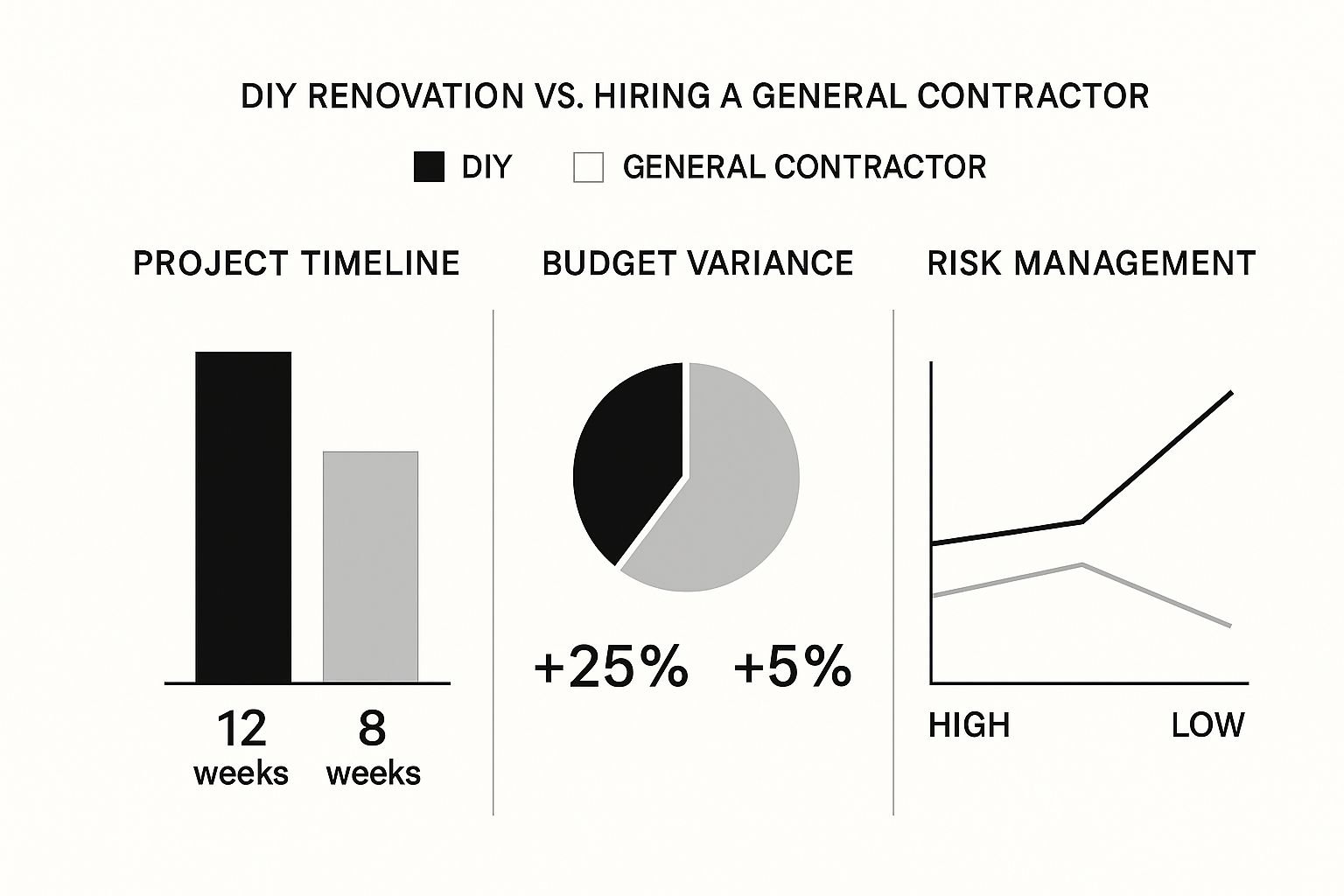
As you can see, a general contractor’s expertise translates into shorter timelines, tighter budget control, and significantly less risk. This is why hiring a professional is often the smarter, more cost-effective choice.
Project Management Options Compared
| Factor | General Contractor | Hiring Subcontractors | DIY Approach |
|---|---|---|---|
| Responsibility | The GC is the single point of accountability for the entire project. | You are responsible for hiring, scheduling, and managing every subcontractor. | You are responsible for all labor, materials, and project management. |
| Cost | Higher upfront cost, but often lower total cost due to efficiency and fewer errors. | Potentially lower cost, but with high risk of budget overruns from mistakes. | Lowest initial cost, but highest risk of expensive errors and rework. |
| Risk & Liability | GC assumes liability for work quality, safety, and insurance. | You assume all liability for permits, insurance, and subcontractor work. | You assume 100% of the risk and liability for the entire project. |
| Time & Stress | Minimal stress for you; the GC handles the day-to-day chaos. | Becomes a full-time job; you handle all coordination and problem-solving. | Extremely high stress; every problem and delay falls on your shoulders. |
This table shows a clear trade-off: taking on more personal responsibility may seem to save money upfront, but it dramatically increases your risk and time commitment.
A Real-World Kitchen Remodel Scenario
Let's walk through a kitchen remodel. If you hire a GC, they’ll map out a detailed plan, coordinating the plumber, electrician, cabinet installer, and countertop fabricator. The GC manages material deliveries, handles permit inspections, and solves problems—like finding unexpected rot—before they derail the project.
Now, imagine managing this yourself. You’d have to find and vet each trade, juggle their schedules, and hope the electrician doesn't arrive before the new drywall is up. If a delivery is delayed, it's on you to reschedule everyone—a frustrating domino effect that can blow up your budget. Whether you are planning a renovation or addition, an expert coordinator is invaluable.
How General Contractor Fees Work

Understanding how a general contractor gets paid is key to a strong, trusting relationship. A GC’s fee covers their expertise, insurance, project management, and the guarantee of a professionally run job. At Aldridge Construction, our bids for projects in San Benito or Santa Cruz counties are detailed and transparent.
You'll generally encounter two primary payment models. The right one depends on your project's scope, budget flexibility, and comfort with risk.
The Fixed-Price Model
A fixed-price (or lump-sum) contract is one total price for the entire project, covering all labor, materials, and management fees. This model offers predictability and simplicity, making it a popular choice for well-defined projects.
- Pros: You know the total cost before work begins, making budgeting simple. The risk of cost overruns falls on the contractor.
- Cons: Any mid-project changes will require a formal (and often costly) change order. The initial bid may be slightly higher to cover the contractor’s risk.
The Cost-Plus Model
In a cost-plus model, you pay for the actual costs of labor and materials, plus a set percentage or fixed fee for the contractor’s overhead and profit. This fee typically ranges from 10% to 20% of the total project cost [NAHB].
This structure is common for complex projects where the final scope is hard to define upfront. It offers excellent transparency, as the contractor shares all receipts and invoices, and allows more flexibility as the project progresses. To get a preliminary idea of these expenses, our home addition costs calculator can provide a helpful starting point. The main drawback is that your final budget isn't locked in, requiring close collaboration to manage spending.
How to Hire the Right General Contractor
Picking the right general contractor is the most important decision you'll make. This isn't just about hiring a builder; you’re choosing a partner and an advocate you'll trust to turn a financial investment into your dream space. A methodical approach is key.
Verify Their Credentials and Insurance
First, make sure they're legitimate. This is your frontline defense against fraud and liability. For work in California, look up their license and insurance on the Contractors State License Board (CSLB) website. For Arizona, use the Arizona Registrar of Contractors (AZ ROC) search tool. Never work with someone who can’t show proof of an active license, general liability insurance, and workers' comp.
A contractor’s license proves they've met state requirements for experience and knowledge. Their insurance protects you and your property if an accident happens on site.
Review Past Work and Speak with References
Once you know they're legit, see if they're any good. A reputable contractor will be eager to show you their portfolio. Ask about the challenges of specific jobs and how they handled them.
Even more telling are conversations with past clients. Ask for at least three recent references, and actually call them. Key questions to ask are:
- Did the project stick to the schedule and budget?
- How was communication from start to finish?
- Were you happy with the quality of the work?
- Would you hire them again?
This is where you get the real story. For more guidance, check out our guide on how to find a good contractor.
Get Detailed, Itemized Bids
After narrowing your list to two or three contenders, ask for detailed, itemized bids. A vague, one-line price is a massive red flag. Insist on a quote that breaks down labor, materials, permits, and the contractor's fee.
This lets you compare apples to apples and ensures everyone is quoting the same scope of work. Be wary of the lowest bid; it can scream inexperience or low-grade materials. This diligence is especially important, as 70% of construction firms report labor shortages [Associated General Contractors of America, 2023], which can strain timelines. A seasoned GC is better equipped to navigate these hurdles.
Frequently Asked Questions About General Contractors
1. When do I absolutely need to hire a general contractor?
You should hire a GC for any project involving multiple specialized trades (e.g., plumbing, electrical, framing) or one that requires building permits. A GC is essential for successfully managing kitchens, bathrooms, home additions, or whole-home remodels in regions like Monterey or Maricopa County.
2. Can a general contractor help with design and permits?
Yes. While not a substitute for an architect on a large custom home, experienced GCs provide valuable design insights on what's practical and cost-effective. Crucially, they are experts at navigating the local permitting process in areas like Santa Cruz County, ensuring all paperwork is filed correctly to avoid costly delays.
3. What should be included in a contract with a GC?
A solid contract is your project's roadmap. It should clearly spell out the detailed scope of work, total price and payment schedule, an estimated timeline, material specifications and allowances, proof of insurance, and a formal change order process. For more tips, review our list of essential questions to ask general contractors before signing.
4. How does a professional GC handle unexpected problems?
A professional GC expects the unexpected. When a problem arises—like finding hidden termites or foundation issues—they first assess the situation, then clearly communicate your options. Any changes to scope or budget are formally documented through a "change order," ensuring transparency and keeping the project moving forward.
5. What is the difference between a GC and a design-build firm?
A general contractor is typically hired after you have complete design plans to execute the construction. A design-build firm, like Aldridge Construction, handles everything under one roof—from initial architectural design to final construction. This integrated approach creates a single point of responsibility, often leading to a more collaborative process and a faster timeline.
Ready to turn your vision into a reality with a team you can trust? The experts at Aldridge Construction are here to manage every detail of your project in Monterey, Santa Cruz, San Benito, and Maricopa Counties. Contact us today for a professional consultation.