
It’s a homeowner's worst nightmare. Your renovation project starts off strong, but then the calls go unanswered, work stops, and your contractor is gone. You're left with a half-finished job and a growing sense of panic.
If your renovation is stuck in limbo, you’re not imagining things. Homeowners often feel stranded when contractors lose interest or stop showing up. If this is happening to you, take a deep breath. You're not alone, and there is a clear path forward.
The first thing you must do is stop all future payments and start documenting everything. This isn't the time for angry texts. It's time to build a solid, factual record of the situation. This paper trail is your most powerful tool.
What to Do When Your Contractor Vanishes
It feels personal when a contractor ghosts you. However, many homeowners report their projects dragging on for months with no clear updates. Some contractors even disappear before final completion, leaving trim, finishes, or permits unresolved.
According to ConstructConnect's Project Stress Index, private construction project abandonments recently shot up by a shocking 92.2% year-over-year. This data shows that some contractors are more likely to walk away from residential remodels when unexpected costs hit. This leaves homeowners like you to deal with the fallout.
So, what are your immediate, practical first steps?

Take Control with Immediate Documentation
Before you do anything else, create a clear, factual record of where the project stands. This is not about emotion; it's about building a case. Think of yourself as an investigator gathering evidence.
This documentation will be the foundation for resolving the issue. It is useful whether you file a formal complaint or hire a new team to finish the job.
Your first moves should be methodical:
- Secure Your Property: First, make sure your home is safe. Lock all doors and windows. Cover any unfinished areas to protect them from weather or unauthorized access.
- Photograph and Video Everything: Pull out your phone and start recording. Take clear, timestamped photos and videos of all incomplete work from every angle. Get close-ups of poor work, exposed wiring, and uninstalled fixtures.
- Gather All Your Paperwork: Collect every document related to the project. This means your signed contract, all change orders, and proof of payments. Also include every email and text message you've exchanged.
Organize all of this into one folder, either physical or digital. A detailed record is crucial if you need to take legal action. It also gives you an accurate punch list of what's left, which is essential when hiring a new contractor. For a good baseline, you can review this construction quality control checklist.
Immediate Action Checklist When Your Contractor Goes MIA
The first 48 hours after you realize your contractor has abandoned the job are critical. Use this checklist to cover all your bases immediately.
| Action Item | Why It's Important | How to Do It |
|---|---|---|
| Halt All Payments | This is your most important leverage. It prevents you from losing more money on a job that isn't progressing. | Immediately contact your bank to stop any pending checks or electronic transfers. Do not make any more payments. |
| Document the Site | Creates a timestamped record of the project's status the moment work stopped. This is crucial evidence. | Use your phone to take dated photos and videos of the entire work area. Capture both wide shots and close-ups of incomplete work. |
| Gather All Contracts & Comms | Organizes all project-related documents into a single, easy-to-access file for reference. | Create a folder and collect your signed contract, change orders, invoices, proof of payment, and all email/text correspondence. |
| Send Formal Written Notice | Establishes a professional paper trail and officially puts the contractor on notice that you are aware of the abandonment. | Draft a simple, unemotional email or certified letter requesting a status update and a plan to complete the work by a specific date. |
Taking these steps will shift you from a position of stress to one of control. This preparation is key to navigating the next phases of resolving the issue.
Creating a Formal Paper Trail
When your project hits a wall, it’s easy to send frustrated texts. But to protect yourself, you need to switch to a formal, documented approach. This is where you create a paper trail.
This step shows your contractor you’re serious about getting the issue resolved. Moving from conversation to documentation is often enough to get a contractor’s attention. It creates a clear record of your attempts to see the job through.
Start with a Professional Inquiry Email
Your first formal move should be a calm, clear email. This isn’t the time to list grievances. It’s a simple request for information and a plan.
Your email needs to clearly outline a few key things:
- A Simple Subject Line: Use something direct, like "Inquiry Regarding Project at [Your Address]."
- Reference Your Agreement: Briefly mention the contract you both signed and the work you agreed on.
- State the Facts: List the specific tasks that are incomplete. Use your photos to be precise (e.g., "The master bathroom tile remains ungrouted," or "The kitchen backsplash has not been installed.").
- Request a Plan: Politely ask for a date they plan to return and a timeline for finishing the remaining work.
This email is your first piece of formal evidence. It proves you made a reasonable attempt to communicate professionally.
Escalate to a Formal Demand Letter
If your email gets no response, your next step is a formal demand letter sent via certified mail. Certified mail gives you a receipt proving the contractor received your letter. This is vital if you deal with licensing boards or courts.
A demand letter is a pre-legal document. It formally states the contract has been breached. It gives the contractor one last chance to fix the situation.
This letter needs to be more direct. Include all the same factual points but add a firm deadline. State that you expect work to resume within 7 to 10 business days. You must also state the consequences if they fail to comply. Let them know you will file a complaint with the California Contractors State License Board (CSLB). Our guide on construction contract negotiation explains what makes a contract strong.
Escalating Your Claim Through Official Channels
When your emails and letters go unanswered, the contractor probably isn't cooperating. But you still have options. California has official channels to protect homeowners and hold contractors accountable.
At this point, you can use state-level resources built for these situations. By filing a formal complaint, you bring in a neutral third party with authority to investigate and mediate. Often, this is enough to get things moving again.
This flowchart shows the communication steps you should have already taken. Having this paper trail is crucial.
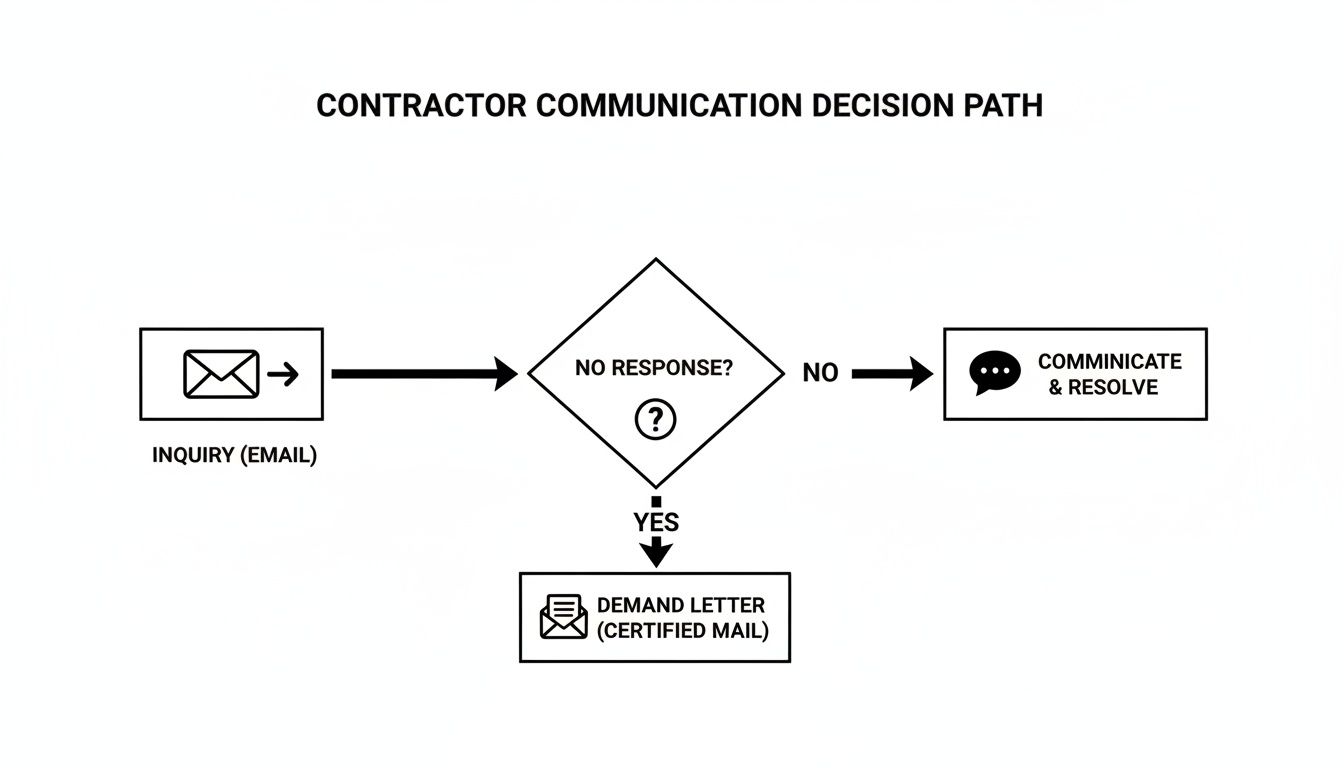
This visual breaks down the logical flow from a simple email to a formal demand letter. This is the proof you'll need for official channels to work for you.
Filing a Complaint with the CSLB
In California, your strongest ally is the Contractors State License Board (CSLB). This is the government agency that licenses and regulates contractors. They take complaints about abandoned projects very seriously.
The CSLB has a straightforward process. You can file a complaint online, and you have up to four years from the date of the problem to do so. They may assign a mediator to help you and the contractor reach an agreement.
The CSLB handles over 3,000 complaints a year for unfinished work. Its mediation services resolve about 60% of these cases without court. In fact, 80% of contractors respond within 30 days once the CSLB gets involved. You can discover more insights about contractor project abandonments on ConstructionDive.com.
Making a Claim Against the Contractor’s License Bond
Every licensed contractor in California must carry a license bond. This is financial security to protect consumers like you. If your contractor fails to finish the job, you can file a claim against this bond to recover financial losses.
This bond is not the same as liability insurance, which covers property damage or injuries. The license bond is there to compensate you for the financial harm caused by your contractor.
To make a claim, you'll need to:
- Find the Contractor’s Bonding Company: Look this up on the CSLB website using the contractor's license number.
- Submit Your Documentation: The bonding company will need proof. Your organized file of photos, contracts, and emails is critical here.
- Follow Their Process: The bonding company will investigate. If they find your claim is valid, they can pay out up to the full bond amount.
For homeowners in Monterey, Santa Cruz, or San Benito County, using these official channels can be a turning point. If you need a reliable team to see an abandoned project through, contact Aldridge Construction. We believe in finishing what we start.
Understanding Your Legal Options and Liens
When a contractor walks off the job, the legal side can feel overwhelming. But knowing your rights is the best way to protect your property and investment. If letters haven't worked, it’s time to look at your legal options.
This does not mean you are headed for a long court battle. Often, showing the contractor you know your rights is enough to get them back to the table. In California, you can challenge an improper lien and use small claims court.
The Truth About Mechanic's Liens
A mechanic's lien is a legal claim a contractor can place on your property if they haven't been paid. It can stop you from selling or refinancing your home.
Here’s the frustrating part: a contractor might file a lien even if they abandoned the project. They may claim you owe them for completed work. This shifts the burden to you to prove they broke the contract.
If this happens, don't panic. Homeowners in Monterey, Santa Cruz, or San Benito County can challenge an invalid lien in court. Your documentation proves the project was unfinished and the lien has no merit.
Using Small Claims Court to Your Advantage
You have a powerful tool on your side: small claims court. The system helps people resolve financial disputes without hiring expensive attorneys. It’s a direct way to sue for money you paid for work that was done poorly or never completed.
The process is straightforward. You file paperwork and have the contractor served. Then you present your case to a judge. Your organized folder with your contract, photos, and communication log will be your best friend in court.
In California, small claims court handles disputes up to $12,500. It has a success rate of around 70% in contractor cases. To protect your investment, you can also file a mechanics lien within 90 days of the last work performed, as you can learn more about abandoned construction projects and your rights.
The best way to deal with legal headaches is to avoid them. Taking time to vet professionals is critical, which we cover in our guide on how to hire the best licensed contractors for home renovations in Salinas.
Hiring a New Contractor to Finish the Job

After you cut ties with the first contractor, the goal is to get your project finished. This means bringing in a reliable team to pick up the pieces. But hiring a replacement is not simple. You must be strategic to protect yourself.
Your most critical task is getting detailed bids. These bids should separate the cost of completing the original work from any new work. This paperwork is essential if you pursue a claim against the original contractor.
Your Vetting Checklist for a Replacement Contractor
Bringing a new contractor into a half-finished project demands extra scrutiny. You need someone skilled, organized, and trustworthy. Do not rush this part.
Use this checklist to make a solid choice:
- Verify Their License: Go to the California Contractors State License Board (CSLB) website and check their license. Make sure it's active and in good standing.
- Confirm Insurance Coverage: Ask to see proof of general liability insurance and workers' compensation. This protects you from accidents or property damage.
- Check Local References: Don't just scan online reviews. Ask for references from recent jobs in Monterey, Santa Cruz, or San Benito County and call them. Ask about communication and if they stuck to the schedule.
A trustworthy contractor will welcome these questions. Their transparency is a great indicator of professionalism.
For homeowners on the Central Coast, a builder with a strong local reputation is key. Aldridge Construction has the systems to see a project through to a proper finish. Our guide on how to find a good contractor offers more tips for making a confident choice.
How to Avoid Contractor Problems From the Start
The best way to handle a contractor who won't finish a job is to never hire them in the first place. A few proactive steps during hiring can save you from months of stress and wasted money. The most important thing is to vet your contractor before you sign anything.
People often assume a good start means a good finish. But without a defined close-out plan, final details can stall. A solid contractor will offer a written project schedule, clear milestones, and no final payment until all work is done.
To make sure your project stays on track, insist on these non-negotiables:
- Milestone-Based Payments: Your contract should tie payments to completed stages of work (e.g., foundation, framing, drywall). Never pay large sums upfront.
- A Detailed Written Schedule: Ask for a project timeline with specific dates for key phases. This document holds everyone accountable.
- Regular Communication: Set up a regular check-in schedule. Vague answers like "we'll get to it soon" are not acceptable.
Your final payment is your biggest leverage. A reputable contractor will never pressure you for that final check until every item on your punch list is complete. To learn more, read our guide on the top questions to ask general contractors.
At Aldridge Construction, we avoid these delays. We use milestone-based schedules with built-in checklists. We ensure final payment only happens after full completion. This structure keeps everyone accountable and gives clients peace of mind.
Frequently Asked Questions
When your renovation grinds to a halt, you likely have questions. It’s a stressful situation. Here are answers to common questions from homeowners dealing with an unfinished job.
What should I do if my contractor won't finish the job?
First, stop all payments immediately. Then, document the state of the project with photos and videos. Gather all contracts and communications. Send a formal, written request to your contractor for a plan to complete the work.
How do I legally fire a contractor for non-performance?
Send a formal termination letter via certified mail. The letter should clearly state the contract breaches (like abandonment or failure to meet deadlines). It should also give them a final, short deadline to resolve the issues before termination is final.
Can I sue a contractor for not finishing a job?
Yes. You can take your contractor to small claims court to recover money you paid for work that was not completed. In California, you can sue for up to $12,500 in small claims court without needing a lawyer.
How do I file a complaint against a contractor in California?
You can file a complaint with the Contractors State License Board (CSLB) online. The CSLB investigates complaints of project abandonment, poor workmanship, and other violations of contractor law. This is often the most effective first step.
What is a contractor's license bond and how can it help me?
A license bond is a type of surety bond required for all licensed California contractors. It provides a source of funds to compensate homeowners for financial losses if a contractor fails to complete a job or violates license laws. You can file a claim against this bond.
If you're renovating in Monterey, Santa Cruz, or San Benito County and want the job done right and finished on time, Aldridge Construction has the systems and local reputation to back it up. Contact us today for a no-pressure consultation.