
The first thing to do when your remodel is way behind schedule is to take a deep breath. Before sending an angry text, step back from the frustration and start documenting everything. Your goal is to gather the facts, review your contract, and schedule a real meeting to get things back on track. The key is to shift from being frustrated to finding a solution.
Why Remodel Delays Are So Common

It’s a story we hear often from homeowners in Monterey, Santa Cruz, and San Benito Counties. The excitement of demo day is gone. Now, weeks have turned into months, the completion date has passed, and you’re living in a construction zone, wondering what should i do if my remodel is way behind schedule?
This problem often starts before the first hammer swings. Many homeowners focus only on the price and forget to ask how a contractor manages timelines or communicates progress. A common misstep is making large final payments too early. This leaves you with no leverage if the contractor disappears near the end of the job.
You Are Not Alone
If you're stuck in this situation, you’re not alone. Nearly half of all homeowners face serious delays during renovations. Online forums are full of complaints about contractors who lose momentum after the bulk of the job is done.
While some delays are normal, a professional contractor's response makes all the difference. At Aldridge Construction, our projects are built on clear communication and realistic schedules. We use a milestone-based process and a detailed home remodel checklist to ensure every detail is covered. We don't consider a project done until you are 100% satisfied.
Gather Your Facts And Review Your Contract
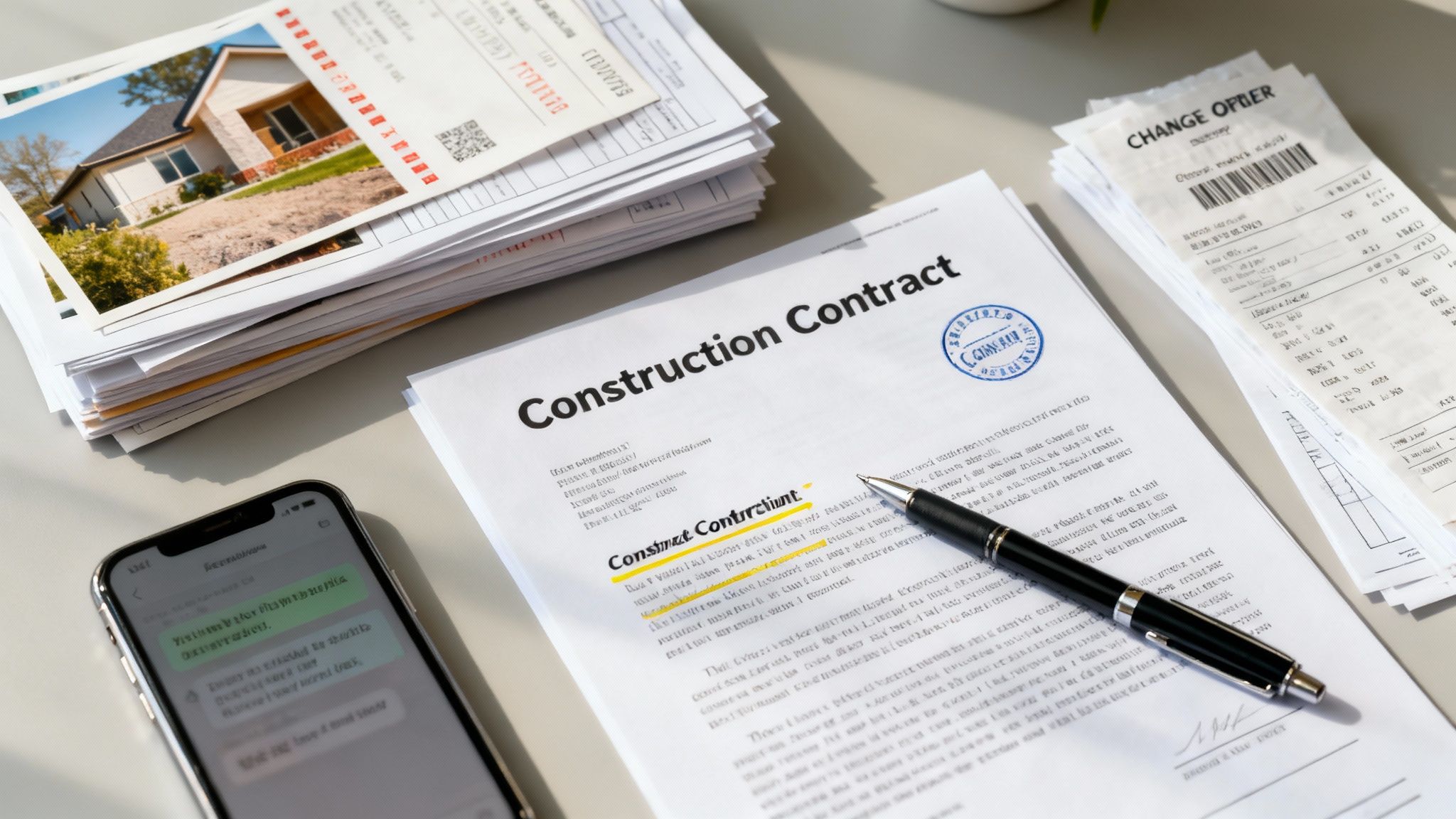
Before you talk to your contractor about the lagging project, you need to get organized. It’s normal to be frustrated, but productive talks are based on facts, not feelings. Your first move is to gather every piece of information you have.
This isn’t about building a case for a lawsuit yet. It's about having a clear and strong position for your discussion.
Create Your Project Audit File
The goal here is to put everything related to your project in one place. This can be a physical binder or a folder on your computer. This file will be your single source of truth when you're trying to figure out what you should do if your remodel is way behind schedule.
Your audit file should have these key sections:
- Photo and Video Evidence: Start taking timestamped pictures and videos today. Document the current state of the project, focusing on unfinished work and any areas of concern.
- Communication Log: Gather every text message, email, and voicemail you've exchanged with your contractor. For verbal conversations, write down the date and a summary of what was discussed.
- Financial Records: Collect all invoices, proofs of payment, and receipts. Most importantly, find any signed change orders that altered the original plan or price.
Key Takeaway: A complete and organized project file is essential. This documentation is your protection. It provides the hard evidence you need to enforce your contract.
Dive Deep Into Your Contract
With your documents organized, it’s time to read your construction contract carefully. This legal document is the rulebook for your project. Don't just skim it. Look for specific clauses that apply to your situation. For a better sense of what should be in there, it’s worth learning the basics of construction contract negotiation.
Focus on these key sections:
- Project Timeline or Completion Date: Is there a specific end date? Are there clauses that define what happens in case of a delay?
- Payment Schedule: Look at how payments are tied to project milestones. Have you paid for work that isn't finished yet? This section is your leverage.
- Dispute Resolution: This clause explains the steps you agreed to take if there is a problem. It might require mediation before you can take legal action.
- Scope of Work: This is a detailed list of what the contractor promised to do. Compare this list to the actual state of your project to identify what’s missing.
Time To Talk: Initiating A Constructive Dialogue
You've done your homework and have everything organized. Now it's time to move from frustration to action. The goal of this next conversation is not to assign blame. It's to walk away with a clear, actionable plan to finish your remodel.
You need to approach this like a business meeting, not a fight.
Request a formal, in-person meeting at the job site. This is important. Trying to solve this over the phone or through text messages won't work. Being on-site allows you to point to unfinished work and avoid misunderstandings. Understanding strategic communication in construction can be a game-changer here.
Setting The Agenda For Your Recovery Meeting
When you sit down, that file you prepared is your best friend. Your goal is simple: leave the meeting with clear reasons for the delay and a new, realistic schedule.
How your contractor handles this conversation says a lot. A good contractor will be willing to have this tough discussion. This is a key trait we highlight in our guide on how to find a good contractor.
Come prepared with a clear agenda. This isn't just a casual chat; it's a project recovery session.
Here's a structured agenda you can use to guide the conversation.
Your Project Recovery Meeting Agenda
| Agenda Item | Objective | Key Question to Ask |
|---|---|---|
| Review Current Status | Agree on what is complete and what is not. | "Can we walk through the project and agree on the status of each major task, like plumbing and drywall?" |
| Identify Specific Delays | Get detailed reasons, not vague excuses. | "What specific issues—materials, subcontractors, inspections—have caused the schedule to slip?" |
| Create a New Timeline | Get a written, revised schedule with firm dates. | "What is your proposed, realistic completion date, and what are the specific milestone dates?" |
| Confirm Dedicated Resources | Ensure your project will be a priority. | "How many workers will be on my job each day? Can we get that commitment in writing?" |
| Discuss Payment Schedule | Link remaining payments to completed milestones. | "Can we agree to tie the next payment to the completion of [specific milestone] and the final payment to the punch list?" |
Walking through these points keeps the meeting focused on solutions. It moves the conversation away from emotion and toward a clear path forward.
Tying Payments To Progress Is Your Strongest Move
One of the most powerful tools you have is the milestone-based payment schedule. It protects you and gives the contractor a big reason to finish the work. You only pay for work that has been completed and verified.
If your original contract wasn't structured this way, now is the time to propose it as part of the recovery plan.
Make it clear that the final payment will only be released after the final punch-list walkthrough is 100% complete and you have signed off. This is the best way to ensure those small finishing touches get done.
At Aldridge Construction, we know trust is built on communication. For our clients in Santa Cruz, Monterey, and San Benito Counties, we establish a clear, milestone-based schedule from day one. We believe in facing delays head-on with transparent updates, not disappearing after demo day.
What To Do When Communication Fails
The calls are going to voicemail and the new schedule is collecting dust. When talking it out has clearly failed, it’s time to change your strategy. You have to move from friendly check-ins to formal, written communication.
This isn’t about being aggressive. It’s about creating a legal paper trail that protects your investment and puts your expectations on the record.
The next step is sending a formal Demand Letter or a Notice to Perform. These are official documents that show you are serious about enforcing your contract. This letter must be sent via certified mail to create a legal record that it was delivered.
Crafting a Formal Notice
Your demand letter needs to be professional and stick to the facts. Don't let emotion take over.
It must clearly state three things:
- The Breach: Detail how the contractor has failed to meet the contract terms. For example, "failed to follow the revised project schedule dated [Date], resulting in a 45-day delay."
- A Cure Period: Give them a reasonable deadline to get back on site and fix the issues. A window of 10 to 14 days is standard.
- The Consequences: State that if they fail to perform by the deadline, you will consider them in breach of contract and will pursue other options.
This process can feel scary, but it's a necessary step when things go wrong.
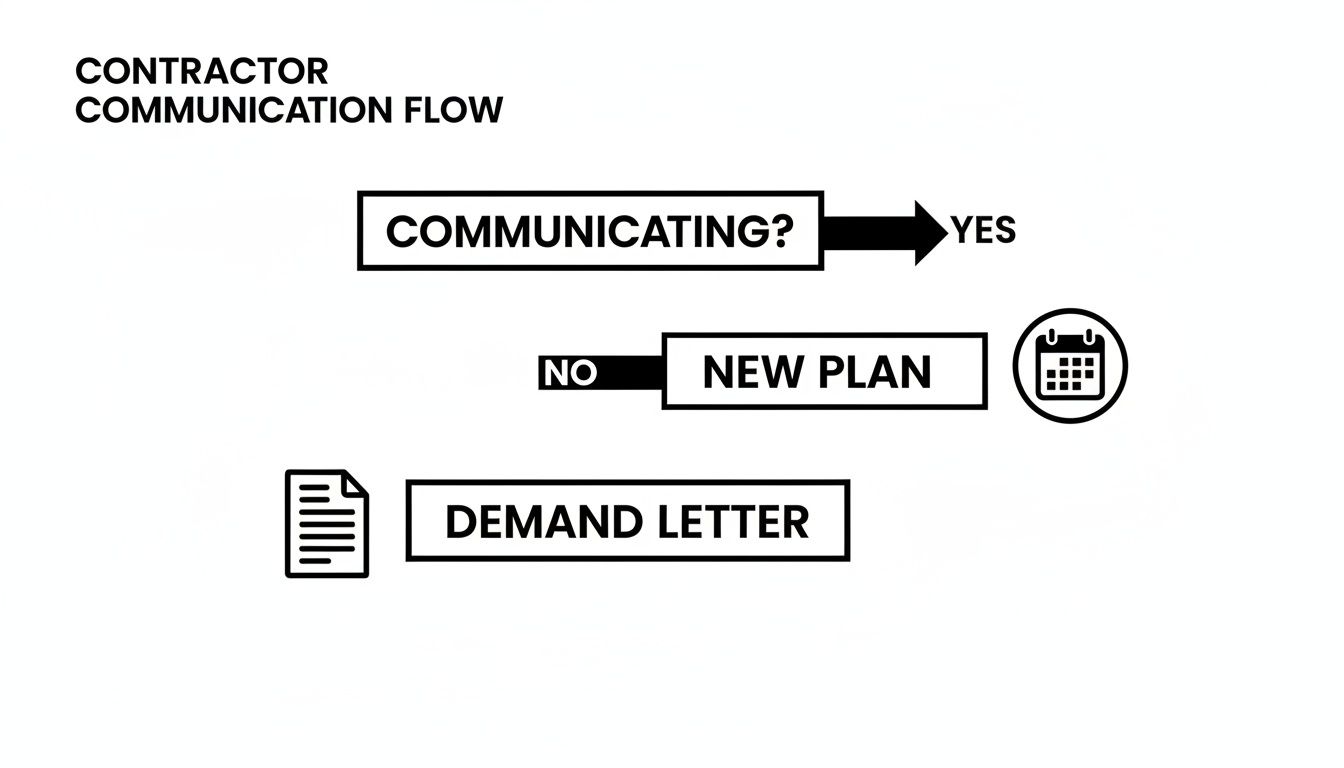
As you can see, a lack of communication should trigger a more formal response. It’s the best way to protect yourself.
Escalating to Official Channels
If your demand letter is ignored, your next moves are more serious. You are now seeking resolution through official channels. Homeowners in California have several powerful options.
Important Note: At this point, we strongly recommend consulting with an attorney who specializes in construction law. Their guidance will be valuable for your specific situation.
Here are the logical next steps:
- Filing a CSLB Complaint: The California Contractors State License Board (CSLB) investigates complaints against licensed contractors. This can trigger an official investigation and action against the contractor's license.
- Engaging a Mediator: Many contracts require mediation to resolve disputes. A neutral third party helps you and the contractor negotiate a solution, which is often faster and cheaper than a lawsuit.
- Filing a Claim Against the Contractor's Bond: Licensed California contractors must have a surety bond. If a contractor's actions caused you financial harm, you may be able to file a claim against this bond to recover losses.
If you're stuck with a stalled project and a ghosting contractor in Santa Cruz, Monterey, or San Benito County, contact our team. We can offer a professional consultation on how to get your remodel finished right.
How To Prevent Delays On Your Next Remodel
The best way to handle a major project delay is to make sure it never happens again. After the stress of a stalled remodel, you have learned some valuable lessons. Use that experience to be more selective with your next project.
Most homeowners get caught up in pretty portfolios and low quotes. But a gallery of finished kitchens in Santa Cruz doesn't tell you how a contractor handles problems. The secret to a smooth remodel is found in a builder's process, not just their finished product.
Vetting for Process, Not Just Price
When you interview contractors for your next remodel, change your focus. Stop looking at what they've built and start digging into how they build it. A low bid is tempting, but it often comes with poor project management—which leads to delays.
Ask detailed questions that show how they run their business:
- Project Management Plan: Ask to see an example of their project management documents. Do they use specific software like Buildertrend? How do they track milestones?
- Communication Cadence: Pin them down on specifics. How often will you get updates? Who is your main contact? At Aldridge Construction, we provide regular, scheduled updates so you are never left in the dark.
- Reference Checks: When you call references, ask specific questions. "How was the communication?" and "Did the project finish on schedule? If not, how did they manage the delays?"
To truly protect your next project, it's important to understand what makes an effective construction schedule. A contractor who can explain their scheduling method is one who takes your timeline seriously.
Bulletproof Your Contract
Think of your contract as your insurance policy. Make sure it has clear clauses that protect you from stalled work.
The most important part is tying payments to progress. Insist on milestone-based payments, which means you only release funds for a phase of the project after it is 100% completed and inspected.
The real game-changer is a final completion holdback clause. This states that the final payment (usually 10-15% of the total) will not be paid until every item on the final punch list is finished to your satisfaction. This is a powerful motivator for any contractor to finish strong.
If you’re planning a project in Monterey, Santa Cruz, or San Benito County and want a partner who prioritizes a transparent, well-managed process, we should talk. A clear plan is the foundation of every successful remodel. Our guide on how to estimate renovation costs can help you get started on solid ground.
FAQs: Common Questions About Remodel Delays
Even with good planning, a project delay brings up a lot of questions. Here are answers to questions we hear most from homeowners in Monterey, Santa Cruz, and San Benito Counties.
Can I fire my contractor for being too slow?
Firing a contractor should be your last resort. First, check your contract for the termination clause. This section explains the conditions for ending the contract.
If you fire them without a good reason, you could be in breach of contract. A smarter first move is to send a formal "Notice to Perform." This gives them one last chance to get back on schedule.
Should I stop paying if the project is delayed?
You have to handle payments carefully. Never stop paying for work that has already been completed to your satisfaction. This would put you in breach of contract.
However, you should absolutely refuse to pay for future milestones until the work for those stages is done. Your power comes from tying payments directly to finished work. This is why a milestone-based payment schedule is so important.
What is a punch list and why is it important?
A punch list is a final to-do list created at the end of a project. It includes all the small items that need to be fixed before the job is 100% complete.
This could be a paint touch-up, a loose cabinet handle, or a missing light switch cover. Your contract must state that the final payment is not due until every item on the punch list is done. This protects you from a contractor who tries to disappear when the job is "mostly done."
How do I know if a delay is reasonable or a red flag?
Telling the difference between a normal delay and a big problem comes down to communication.
- Reasonable Delays: These are usually caused by things outside the contractor's control. Examples include a week of heavy rain on the Central Coast, backordered Quartz countertops, or a surprise permit issue. A good contractor tells you about these things immediately.
- Red Flags: These are signs of poor management. If your contractor stops returning calls, the crew doesn't show up for days, or you get vague excuses—those are major red flags.
What if another contractor abandoned my project?
It is very stressful when a contractor walks off the job. First, secure the job site to prevent more damage. Then, follow the proper steps to document everything and formally end your original contract.
At Aldridge Construction, we have helped dozens of homeowners in Santa Cruz, Monterey, and San Benito Counties complete renovations that others abandoned. Our team can assess a half-finished project, find what was done wrong, and create a realistic plan to finish it. We can help you finally get the beautiful space you paid for by creating a clear home construction timeline.
If your remodel in Monterey, Santa Cruz, or San Benito County is stalled, you don’t have to figure it out alone. The team at Aldridge Construction specializes in transparent project management and has rescued projects for homeowners just like you.
Contact us today for a no-pressure consultation to discuss how we can get your home finished right.